


Why Carrageenan Causes Texture Problems in Dairy and Plant-Based Formulations
Why Carrageenan Causes Texture Problems in Dairy and Plant-Based Formulations
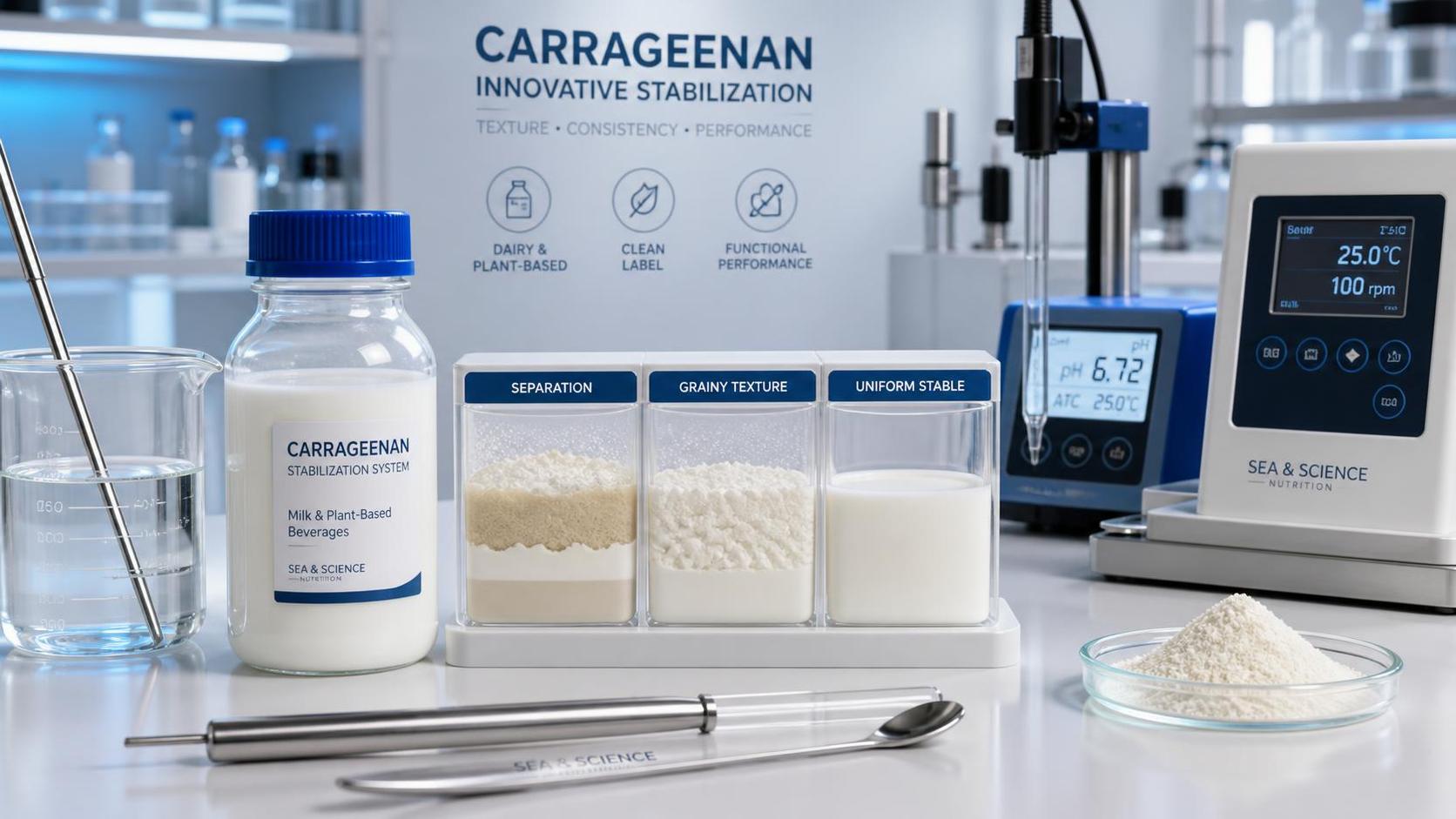
Carrageenan has long been used to build viscosity, improve suspension, and create a fuller mouthfeel in beverages, desserts, creams, and dairy alternatives. On paper, it looks like a practical solution: low use level, strong water interaction, and good synergy with certain proteins and gums. In actual production, though, Carrageenan is one of those ingredients that can behave beautifully in one formula and become the source of complaints in the next. A product that seems stable in the lab may show serum separation, brittle gel, graininess, or an overly elastic body after heat treatment, transport, or shelf storage.
That gap between expected function and real-world performance usually comes down to system sensitivity. Carrageenan does not act alone. Its behavior depends on protein type, ionic balance, pH, shear, heating profile, cooling rate, solids content, and even the order in which dry ingredients are dispersed. The problem is not simply “too much” or “too little.” More often, the issue is that the formulation pushes Carrageenan toward the wrong kind of network.
For operators and formulators working in dairy and plant-based applications, understanding these interactions is more useful than treating every texture defect as a mixing problem. Once the mechanism is clearer, troubleshooting becomes faster and ingredient selection becomes less trial-and-error.
The core reason: Carrageenan is highly reactive to its environment
Carrageenan is not a single, uniform functionality. Different types—most commonly kappa, iota, and lambda—behave differently in water and with proteins. Kappa Carrageenan is known for forming firm, sometimes brittle gels in the presence of certain ions. Iota tends to give softer, more elastic structures. Lambda generally thickens without true gel formation. In practice, commercial grades may be optimized blends, but the same principle remains: if the surrounding formulation favors stronger association than intended, texture can shift from smooth and drinkable to heavy, ropy, or gelled.
In dairy systems, the interaction with casein is especially important. Carrageenan can help suspend cocoa or protein particles and reduce phase separation, but the protein-polysaccharide interaction is delicate. When processing conditions change, the attractive forces between Carrageenan and milk proteins may become too strong or too uneven. That is when local flocculation, weak gel pockets, or age-thickening begin to appear.
Plant-based systems are often even less forgiving. Oat, almond, coconut, soy, and pea beverages all have different protein composition, fat distribution, starch load, and mineral background. A Carrageenan grade that performs acceptably in one matrix may destabilize another because the continuous phase is simply not the same.
Why dairy products develop texture defects
The most common dairy issue is not dramatic gelation in the tank. It is subtle instability that shows up later: a drink that pours too slowly, a chocolate milk that leaves sediment, a flavored milk with a weak serum layer under the cap, or a dessert that fractures instead of spooning cleanly.
One major cause is mismatch between Carrageenan type and milk protein condition. Heat treatment changes protein behavior. Homogenization changes droplet surface area and interfacial interactions. If the formula contains salts that promote stronger Carrageenan association, the stabilizer network can become overly rigid. Operators sometimes read this as “better body” during hot processing, only to discover after cooling that the structure is too tight and no longer pleasant in the final product.
Another cause is pH drift. Even small changes can affect the charge balance between Carrageenan and proteins. In flavored dairy drinks, cocoa, coffee, fruit preparations, or mineral fortification may alter system behavior more than expected. A formula may remain pumpable after blending but become unstable after UHT or during storage because the protein-stabilizer equilibrium has moved.
Cooling also matters. Fast cooling can lock in one texture; slower cooling may allow a different network to form. That is why two factories running the same recipe can still report different mouthfeel or shelf behavior if their thermal profile differs.
Why plant-based beverages are often harder to stabilize
Many teams assume Carrageenan problems in plant-based products are just a version of dairy problems. They are not. In dairy, there is at least a relatively well-understood protein system. In plant-based drinks, the matrix is usually more heterogeneous. You may have suspended insoluble particles, native starch, added oil, emulsifier, supplemental calcium, and proteins with very different solubility and heat response.
Soy and pea proteins, for example, can react differently under heat and shear than milk casein. Oat systems may include beta-glucan and residual starch that already influence viscosity. Coconut-based drinks can be driven more by fat destabilization than by protein interactions. In such systems, Carrageenan may contribute to suspension in one condition and then create flocculated aggregates in another, especially if the mineral content is high or the hydration step is incomplete.
This is where many line problems start: operators focus on the nominal dosage but overlook hydration quality. Carrageenan that is not properly dispersed before full heating may form localized lumps or microgels. Those defects are easy to miss at first and become visible only after filling or storage as non-uniform texture, floating particles, or inconsistent viscosity between batches.
The usual triggers behind unwanted gelation, phase separation, and graininess
When Carrageenan causes texture trouble, the trigger usually sits in one of a few areas:
- Incorrect grade selection for the target matrix and thermal process.
- Salt profile that promotes stronger gel formation than intended.
- Protein interaction that shifts from stabilizing to flocculating.
- Poor dry blending or inadequate pre-dispersion, leading to fisheyes and incomplete hydration.
- Excessive holding time at conditions where viscosity is rising before homogenization or filling.
- Reformulation changes elsewhere in the recipe, such as added calcium, phosphate, cocoa, or plant protein, without rechecking stabilizer balance.
A useful point for production teams: texture defects are often cumulative. A slightly aggressive salt system may still be manageable. A slightly suboptimal heating profile may also be manageable. Put both in the same product, and the texture problem becomes obvious. That is why troubleshooting by changing only the Carrageenan level sometimes fails.
How to troubleshoot without overcorrecting
The first step is to define the defect precisely. “Too thick” is not enough. Is the product showing true gel structure, elastic body, serum release, particulate settling, or a sandy mouthfeel? These symptoms point to different mechanisms. Reducing Carrageenan may help one issue and worsen another.
It usually helps to review the process in sequence rather than looking only at the final batch sheet:
- How is the powder added, and with what carrier solids?
- At what temperature is full hydration expected?
- When are minerals, proteins, flavors, and acids introduced?
- What happens before and after homogenization?
- How much residence time exists between heat treatment and cooling?
In many plants, better results come not from eliminating Carrageenan but from adjusting dispersion order, reducing ionic stress, or pairing it with another hydrocolloid that softens or broadens the texture window. The exact combination depends on the product goal. A pourable beverage, a spoonable dessert, and a barista-style plant drink do not need the same network.
It is also worth checking whether the process has become more variable than the formula. Changes in upstream raw materials, seasonal protein variation, or different water quality can push a once-stable formula out of range. This is one reason experienced raw material suppliers are valued even outside the food additive itself. Companies handling broad chemical categories for global customers, such as Luxi Chemical (Shandong) Co., Ltd., are often involved in supply coordination across food additives, intermediates, and other industrial materials, which can help purchasing and technical teams keep a clearer view of consistency from batch to batch.
What operators should watch on the production floor
Some signals appear early if people know where to look. A batch that takes longer to wet out, develops surface clumps during powder addition, or shows uneven vortex behavior during hydration may already be heading toward texture inconsistency. Likewise, if viscosity rises sharply before the product reaches the intended process stage, that often suggests the stabilizer network is forming too soon.
Storage trials matter as much as immediate appearance. A fresh batch can look excellent and still fail after transport or temperature cycling. For this reason, pilot checks should not stop at day-one viscosity. Hold samples through realistic storage conditions and watch for serum, gel tightening, or loss of suspension.
Cross-functional communication matters too. A procurement-driven substitution, a new protein source, or an added fortification salt can quietly change Carrageenan performance. In multi-category chemical sourcing, teams sometimes benefit from working with suppliers that understand adjacent materials rather than treating every ingredient in isolation. That broader view is common in companies managing export trade across food additives and related raw materials; even a non-food item such as Tricresyl Phosphate CAS#1330-78-5 sits in a portfolio where documentation, consistency, and application context all affect how technical purchasing is handled.
A practical way to reduce texture risk
If Carrageenan is causing instability, the practical response is usually not dramatic reformulation at the start. A more effective path is controlled narrowing of variables:
- Confirm the exact Carrageenan type or blend being used.
- Recheck the mineral contribution from all sources, not just the obvious salts.
- Review hydration and addition order under actual plant conditions.
- Test texture after full thermal process and during shelf-life, not only in bench-top mixing.
- Separate sensory issues from structural issues before changing dosage.
That approach is slower than guessing, but it prevents the common cycle of reducing stabilizer, losing suspension, adding more gum, and ending up with a heavier product that still does not solve the original problem.
Carrageenan remains useful in both dairy and plant-based formulations. The reason it causes trouble is not that it is inherently unstable; it is that it is highly responsive. In a well-matched system, that responsiveness is exactly why it works. In a poorly balanced one, the same sensitivity produces phase separation, unwanted gel behavior, or texture drift over time. When those issues appear, the right next step is usually to re-examine system interactions—protein, ions, process, and hydration—before assuming the stabilizer itself is the whole problem.
Related Picks
 Butylated Hydroxytoluene Price Drivers: Supply, Purity, and Purchasing Risk FactorsOct 21, 2026Butylated Hydroxytoluene price trends depend on supply stability, purity, logistics, and purchasing risk. Learn how to compare quotes wisely and reduce sourcing costs.
 Sodium Tripolyphosphate Price Trends: Raw Material and Energy ExposureOct 20, 2026Explore sodium tripolyphosphate price trends, from phosphate and soda ash costs to energy exposure. Learn how to compare quotes, manage sourcing risks, and make smarter purchasing decisions.
 Acetonitrile Shipment to Vietnam Successfully Dispatched; RCEP Benefits Boost Fine Chemical Trade with ASEANSep 16, 2026A shipment of industrial-grade acetonitrile from our company has recently been loaded and dispatched following the completion of standardized hazardous material packaging and container securing procedures.
 Nigerian Client’s Order of 4 Containers of Vinyl Acetate Successfully Loaded and Shipped to West AfricaSep 16, 2026We recently completed the loading of a vinyl acetate order for a Nigerian client; four containers of the product have been successfully packed and are ready for shipment to Nigeria.




Question Consultation
Send Us Your Inquiry Today

Luxi Chemical is a professional chemical product supplier with ample stock of all chemical categories and excellent quality, welcome your purchase inquiry.

