


Why Citric Acid Bulk Orders Require Pre-Shipment Testing — and What Parameters Must Be Verified Before Unloading
2026.09.14
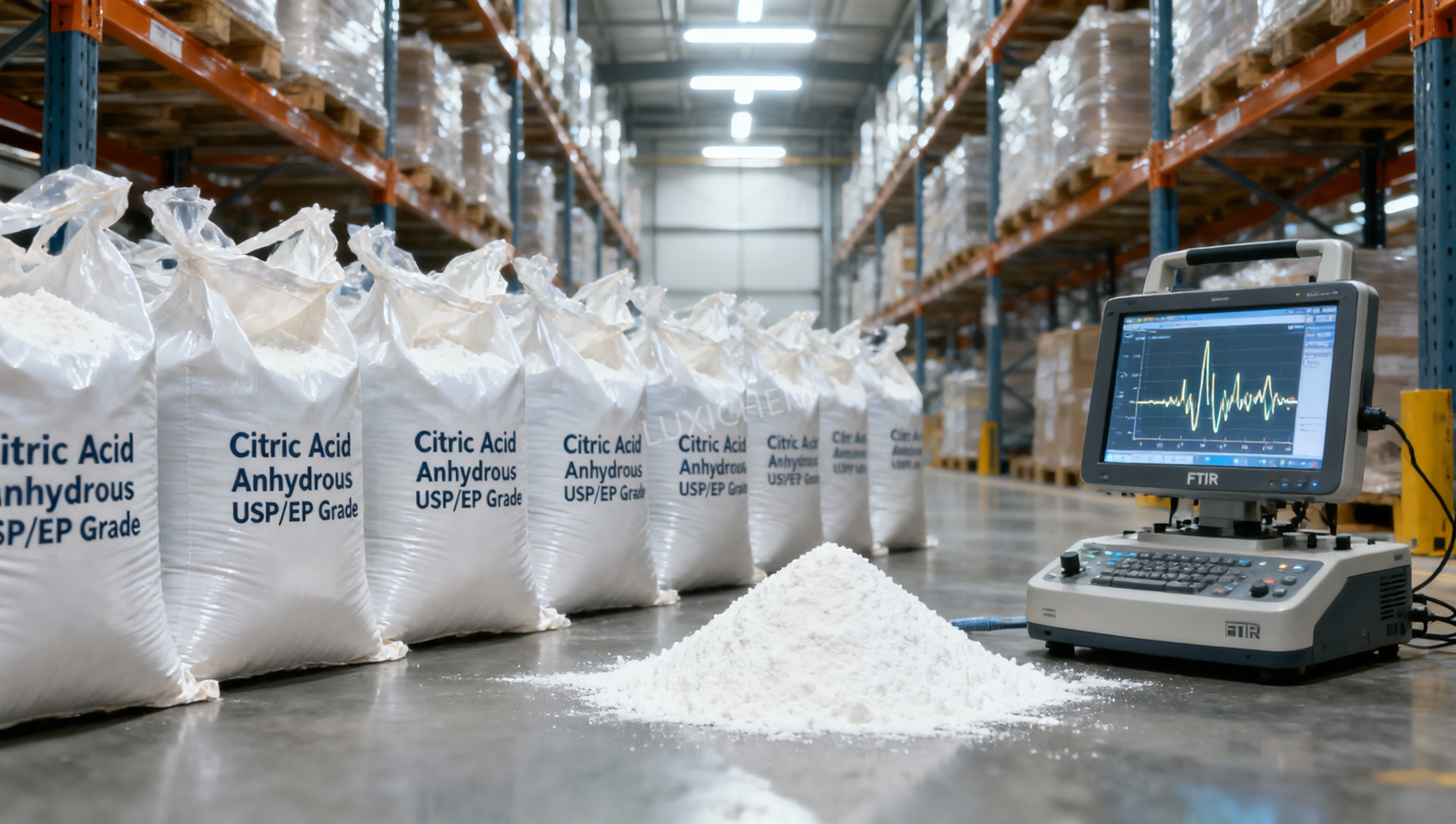
Pre-shipment testing for citric acid bulk shipments is not a procedural formality—it is the last, non-negotiable checkpoint before material enters your production line. For quality control and safety managers, skipping or outsourcing this verification invites tangible risk: compromised batch integrity, regulatory nonconformance, and downstream failures in food, pharmaceutical, or detergent manufacturing where citric acid functions as a chelator, preservative, or pH adjuster. Unlike packaged or lab-scale quantities, bulk citric acid—typically shipped in 1–20 metric ton flexible intermediate bulk containers (FIBCs) or tanker vessels—presents unique exposure pathways: moisture ingress during transit, temperature-induced crystallization, cross-contamination from shared transport infrastructure, and inconsistent homogeneity across large volumes. These conditions mean analytical results from a single sample taken at origin may not reflect the entire lot unless sampling follows statistically valid protocols *and* testing covers parameters with direct functional and compliance implications.
The critical parameters verified before unloading fall into three interdependent categories: identity and purity, safety-critical impurities, and physical stability. First, identity confirmation via infrared spectroscopy (FTIR) or HPLC retention time matching against a certified reference standard eliminates substitution risk—especially relevant given the global availability of lower-grade technical citric acid marketed deceptively as food- or pharma-grade. Purity—measured by titration (USP <21>) or HPLC (FCC VI)—must meet ≥99.5% for food-grade and ≥99.8% for USP/EP-compliant batches. Deviations below these thresholds correlate directly with reduced chelating capacity and increased ash content, affecting clarity in beverage formulations or buffering efficiency in parenteral solutions.
Second, heavy metal limits are non-negotiable. Cadmium, lead, arsenic, and mercury must be quantified using ICP-MS or graphite furnace AAS—not just screened—because their presence is not uniformly distributed in bulk lots. Regulatory thresholds differ by application: FCC allows ≤1 mg/kg total heavy metals for food use, while USP <231> sets stricter individual limits (e.g., Pb ≤ 5 ppm, As ≤ 3 ppm). Crucially, heavy metal contamination often originates not from synthesis but from raw material sourcing (e.g., molasses-derived citric acid from regions with high soil cadmium) or storage in galvanized steel hoppers. Testing must therefore include both composite and stratified samples—top, middle, and bottom layers—to detect segregation, particularly in FIBC-stored powder that can stratify during ocean freight.
Third, microbial load and moisture content govern shelf life and handling safety. Bulk citric acid is hygroscopic; moisture above 1.5% w/w promotes caking, microbial proliferation (especially *Aspergillus* and *Penicillium* spp.), and accelerated degradation of co-formulated actives in final products. Total aerobic count must remain ≤10² CFU/g, and absence of *Salmonella*, *E. coli*, and *Staphylococcus aureus* is mandatory for food and pharmaceutical use. These limits cannot be assumed—even under ISO 22000-certified production—because ambient humidity fluctuations during loading, port storage, or container condensation introduce post-manufacturing risk. A single elevated moisture reading at unloading signals potential microbial growth throughout the lot, requiring quarantine and retesting—not just rejection of the sampled portion.
Fourth, particle size distribution and flowability impact dosing accuracy in continuous manufacturing lines. While not specified in FCC or USP, deviations from typical D90 ≤ 450 µm (for anhydrous grade) cause bridging in pneumatic transfer systems or uneven dispersion in dry-blend detergents. This parameter is routinely verified at Luxi Chemical (Shandong) Co., Ltd. using laser diffraction before dispatch—not because it’s a regulatory requirement, but because it’s a functional failure point observed in real-world processing environments across 60+ countries.
 Finally, specification alignment must be validated against the *exact* standard referenced in the purchase order—not generic “pharma-grade” claims. USP Citric Acid monograph requires assay, specific optical rotation ([α]D²⁵ = +37.5° to +39.5°), and sulfate limit ≤ 0.05%, while EP 10.0 adds additional tests for oxalate and chloride. A batch compliant with FCC may fail USP on optical rotation alone—a detail easily missed without full monograph-level verification. This is why Luxi Chemical conducts pre-shipment testing against all three major pharmacopoeias when requested, with full COA traceability to accredited third-party labs (e.g., SGS, Eurofins) or in-house ISO/IEC 17025-certified facilities.
It’s worth noting that some functional excipients used alongside citric acid—such as Hydroxyethyl Cellulose CAS#9004-62-0 in liquid detergent stabilization—exhibit complementary but distinct stability profiles. While citric acid degrades above 40°C in humid conditions, hydroxyethyl cellulose maintains viscosity across pH 2–12 but hydrolyzes rapidly above 60°C. Their co-use in multi-phase formulations demands coordinated stability testing—not just individual spec checks—because interaction effects (e.g., acid-catalyzed polymer cleavage) aren’t captured in standalone assays.
In practice, the most common unloading failures stem not from out-of-spec results, but from inadequate sampling methodology. Grab samples from a single FIBC valve or surface scoop from a tanker hatch yield false negatives up to 40% of the time for segregated contaminants. Validated methods require rotary sampling probes for powders or automated mid-batch draw valves for liquids, followed by composite blending per ASTM D5365-19. Without this, even rigorous lab testing delivers misleading confidence.
For quality and safety managers, the decision isn’t whether to test—but how comprehensively and at what stage. Pre-shipment verification shifts risk upstream, avoids costly quarantine, prevents production line stoppages, and provides auditable evidence during FDA, EFSA, or BRCGS inspections. It transforms citric acid from a commodity input into a controlled, traceable, functionally assured component—where every parameter verified before unloading directly maps to a failure mode prevented in the final product.
Related Picks
 Butylated Hydroxytoluene Price Drivers: Supply, Purity, and Purchasing Risk FactorsOct 21, 2026Butylated Hydroxytoluene price trends depend on supply stability, purity, logistics, and purchasing risk. Learn how to compare quotes wisely and reduce sourcing costs.
 Sodium Tripolyphosphate Price Trends: Raw Material and Energy ExposureOct 20, 2026Explore sodium tripolyphosphate price trends, from phosphate and soda ash costs to energy exposure. Learn how to compare quotes, manage sourcing risks, and make smarter purchasing decisions.
 Acetonitrile Shipment to Vietnam Successfully Dispatched; RCEP Benefits Boost Fine Chemical Trade with ASEANSep 16, 2026A shipment of industrial-grade acetonitrile from our company has recently been loaded and dispatched following the completion of standardized hazardous material packaging and container securing procedures.
 Nigerian Client’s Order of 4 Containers of Vinyl Acetate Successfully Loaded and Shipped to West AfricaSep 16, 2026We recently completed the loading of a vinyl acetate order for a Nigerian client; four containers of the product have been successfully packed and are ready for shipment to Nigeria.




Question Consultation
Send Us Your Inquiry Today

Luxi Chemical is a professional chemical product supplier with ample stock of all chemical categories and excellent quality, welcome your purchase inquiry.

