


HDPE Suppliers for Municipal Water Tanks: NSF/ANSI 61 Certification Depth, UV Stabilizer Migration Limits, and Long-Term Hydrostatic Strength Data
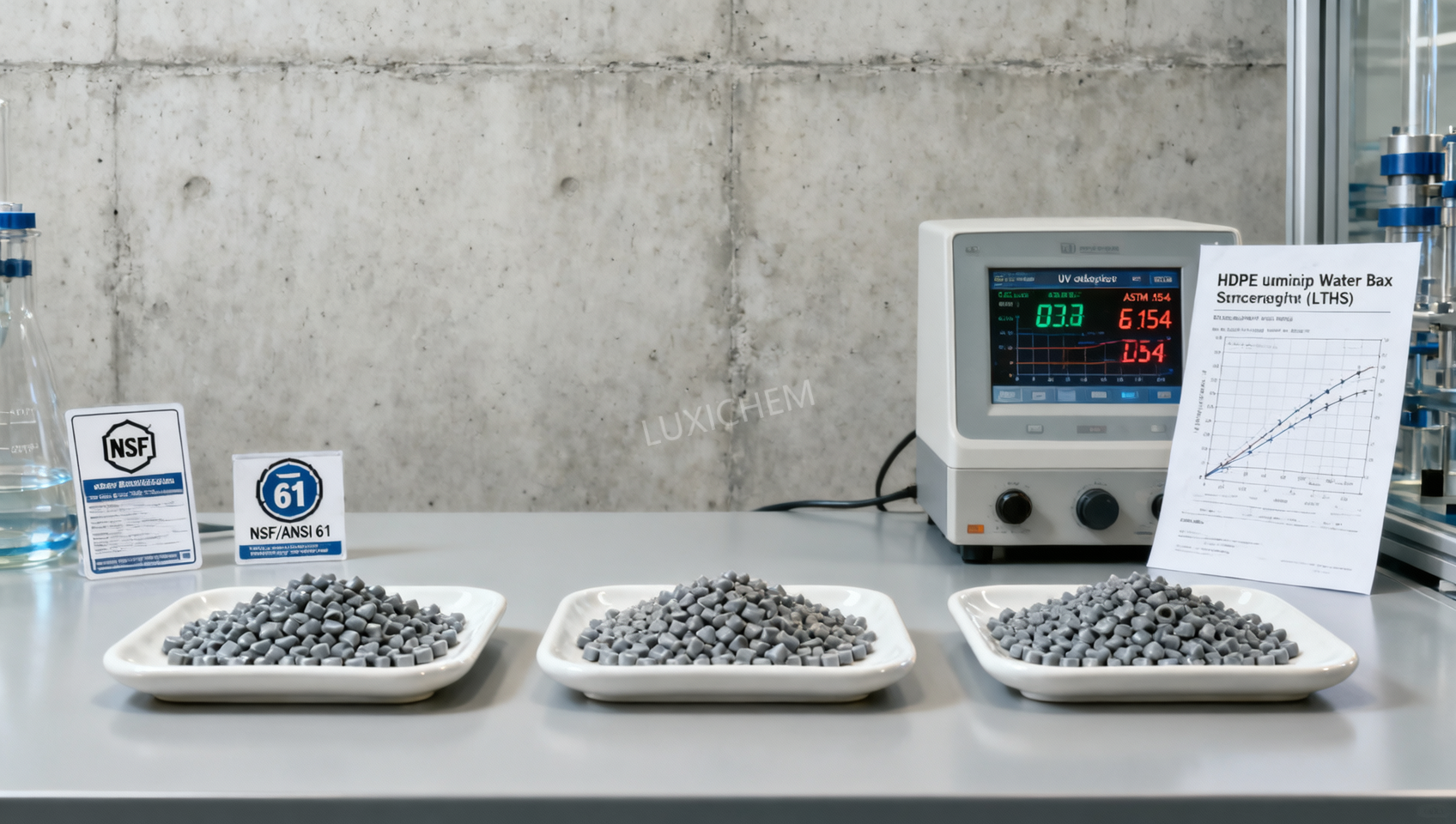
Selecting HDPE suppliers for municipal water tanks is fundamentally a procurement risk mitigation exercise—not merely a sourcing transaction. Cost overruns rarely originate from resin price differentials alone; they stem from field failures tied to insufficient NSF/ANSI 61 certification depth, unverified UV stabilizer migration behavior under long-term exposure, or misinterpretation of long-term hydrostatic strength (LTHS) data in real-world service conditions. Unlike commodity-grade HDPE used in packaging or piping, tank-grade material must withstand decades of cyclic loading, solar irradiance, and continuous contact with potable water at variable temperatures—conditions that expose weaknesses in both formulation and test reporting.
NSF/ANSI 61 certification is often treated as binary: “certified” or “not certified.” But the depth of compliance matters critically. Certification requires extraction testing of leachables—including antimony, lead, cadmium, and organic stabilizers—across multiple exposure scenarios: cold water (23°C), hot water (60°C), and stagnant conditions mimicking low-flow storage. Some suppliers submit only the minimum required extraction profiles, omitting accelerated aging protocols or multi-cycle retesting after UV exposure. That gap becomes visible only after installation, when trace-level migratory antioxidants—such as hindered amine light stabilizers (HALS) or phenolic UV absorbers—leach into water at rates exceeding NSF limits after three to five years of outdoor service. Validated migration limits must therefore be reported not just for virgin resin, but for extruded tank walls aged under ASTM G154 UV-A cycles equivalent to ≥15 years of full-spectrum exposure in Zone 3 (e.g., Phoenix or Dubai). Without that data, procurement teams are effectively buying blind on long-term organoleptic and regulatory risk.
Long-term hydrostatic strength (LTHS) data is similarly prone to misapplication. ASTM D2837 defines LTHS as the predicted hoop stress a pipe or tank wall can sustain for 100,000 hours (≈11.4 years) without failure, derived from regression analysis of short-term pressure tests at elevated temperatures. However, municipal water tanks operate under static head—not internal pressure—and experience thermal cycling that induces interfacial stress between resin layers and between HDPE and support structures. A supplier quoting LTHS values based solely on ISO 9080-compliant pipe test data may not account for the reduced creep resistance inherent in thicker, slower-cooled tank shells. True tank-grade LTHS validation requires testing of flat-sheet specimens cut from actual tank wall sections—not lab-molded plaques—and must include strain monitoring over ≥5,000 hours at 60°C and 80% relative humidity to simulate humid subtropical environments where moisture ingress accelerates oxidative degradation.
UV stabilizer selection further complicates procurement decisions. Carbon black remains the most robust UV shield, but its use restricts color options and introduces dispersion variability that affects weld integrity during field fabrication. Non-black alternatives—such as nickel quenchers or benzotriazole derivatives—offer aesthetic flexibility but require rigorous migration validation. Not all HALS systems behave identically: some degrade into aldehydes or amines under hydrolytic stress, while others form insoluble metal complexes that precipitate at weld seams. Suppliers must provide third-party chromatographic migration profiles (per EPA Method 525.3) showing concentrations of all extractable stabilizer fragments—not just parent compounds—at 23°C, 40°C, and 60°C after 30 days’ immersion. Absent this granular data, procurement assumes uniform performance across formulations, increasing the likelihood of post-installation turbidity or odor complaints.
Material consistency also impacts downstream cost drivers beyond resin price. Batch-to-batch variation in melt flow rate (MFR) affects both extrusion line speed and fusion joint quality during rotational molding or large-panel welding. An MFR tolerance of ±0.3 g/10 min may seem minor, but in 25-mm-thick tank walls, it translates to ±8% variation in weld penetration depth—directly correlating with field joint failure rates observed in third-party forensic analyses of failed installations. Reputable HDPE suppliers for municipal applications maintain tighter MFR control (±0.15 g/10 min) and supply full batch certificates including rheological fingerprinting (via dynamic oscillatory shear at 190°C), not just nominal MFR values.
Procurement workflows often overlook transport and storage effects. HDPE resin pellets absorb ambient moisture at rates up to 0.05% w/w per week in humid climates. While seemingly negligible, absorbed water vaporizes during extrusion, generating microvoids in tank walls that nucleate stress cracks under hydrostatic load. Suppliers serving global markets must either ship resin in nitrogen-purged, moisture-barrier bags—or provide verified drying protocols validated for each shipment’s ambient exposure history. No amount of LTHS testing compensates for void-induced premature failure.
Even within compliant materials, application-specific interactions demand scrutiny. For instance, Sucralose CAS#56038-13-2—while unrelated to structural HDPE—illustrates how molecular stability under thermal and hydrolytic stress informs broader material selection logic: its chlorine-substituted glycosidic structure resists acid and enzymatic cleavage precisely because covalent bond energy thresholds exceed typical environmental degradation forces. Analogously, HDPE tank resins require carbon–chlorine or carbon–nitrogen backbone modifications—not just additive packages—to ensure UV and oxidative stability persist across decades. Relying solely on additive migration limits without evaluating polymer backbone resilience invites long-term brittleness that no certification test captures.
Welding procedure qualification adds another layer of hidden cost. Rotational molding of large tanks demands precise control of heating/cooling ramps to avoid residual stress gradients. Suppliers who provide only generic resin data sheets—without published, validated welding parameters for butt fusion, electrofusion, or extrusion welding—force contractors to conduct costly, time-consuming qualification trials on-site. Verified parameters should include temperature ramp profiles, interfacial melt viscosity targets (measured via capillary rheometry), and post-weld cooling rate constraints calibrated to wall thickness and ambient dew point.
Finally, procurement must distinguish between “NSF-listed” and “NSF-validated for tank application.” Many resins carry NSF/ANSI 61 listing for pipe or fitting use—but lack test data for static, high-head, low-flow tank conditions where stagnation promotes biofilm formation and localized oxidative attack. The absence of tank-specific validation does not invalidate the resin, but shifts liability to the specifier and installer. True procurement efficiency comes not from lowest unit cost, but from eliminating ambiguity in test scope, aging protocol, and application boundary conditions—ensuring every dollar spent avoids rework, regulatory noncompliance, or public health exposure.
Related Picks
 Butylated Hydroxytoluene Price Drivers: Supply, Purity, and Purchasing Risk FactorsOct 21, 2026Butylated Hydroxytoluene price trends depend on supply stability, purity, logistics, and purchasing risk. Learn how to compare quotes wisely and reduce sourcing costs.
 Sodium Tripolyphosphate Price Trends: Raw Material and Energy ExposureOct 20, 2026Explore sodium tripolyphosphate price trends, from phosphate and soda ash costs to energy exposure. Learn how to compare quotes, manage sourcing risks, and make smarter purchasing decisions.
 Acetonitrile Shipment to Vietnam Successfully Dispatched; RCEP Benefits Boost Fine Chemical Trade with ASEANSep 16, 2026A shipment of industrial-grade acetonitrile from our company has recently been loaded and dispatched following the completion of standardized hazardous material packaging and container securing procedures.
 Nigerian Client’s Order of 4 Containers of Vinyl Acetate Successfully Loaded and Shipped to West AfricaSep 16, 2026We recently completed the loading of a vinyl acetate order for a Nigerian client; four containers of the product have been successfully packed and are ready for shipment to Nigeria.




Question Consultation
Send Us Your Inquiry Today

Luxi Chemical is a professional chemical product supplier with ample stock of all chemical categories and excellent quality, welcome your purchase inquiry.

