


Why Industrial Grade Sodium Tripolyphosphate Cakes During Storage
Why Industrial Grade Sodium Tripolyphosphate Cakes During Storage
Hard lumps in a stored bag of industrial grade sodium tripolyphosphate can slow material handling, disrupt dosing, and increase preparation time. But caking does not necessarily mean the product has failed its quality specifications. Moisture exposure, temperature fluctuations, stacking pressure, and packaging condition can all influence how freely the powder flows. Understanding these factors helps operators identify likely causes and choose appropriate handling measures.
The practical challenge is separating a manageable flow problem from material that needs a quality hold. Crushing every lump is not a reliable answer, and rejecting every hardened bag may be unnecessary. The condition of the packaging, the pattern of caking, and the intended process all matter.
How separate particles become a solid mass
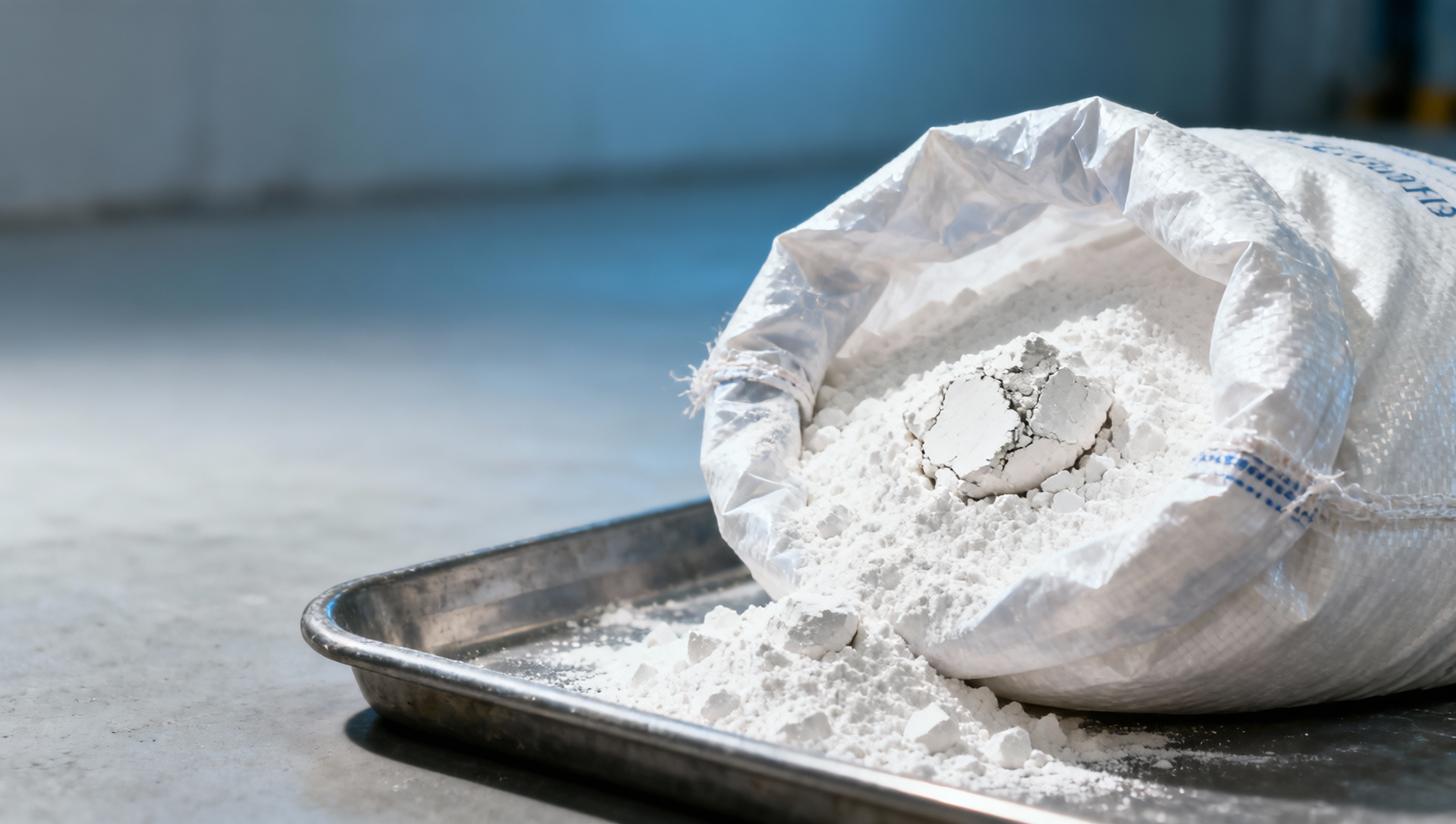
Sodium tripolyphosphate, commonly called STPP, is a water-soluble condensed phosphate used in detergent formulations, water treatment, and other industrial processes. During storage, its particles can develop bonds at their contact points. Enough of these bonds turn a free-flowing powder into clusters or, under more severe conditions, a bag-shaped block.
Moisture is a major contributor. Water reaching the powder can dissolve small amounts of material at particle surfaces. When conditions change and that water redistributes or evaporates, dissolved salts can recrystallize across adjacent particles, creating solid bridges. Moisture can also support hydration of STPP, which may further alter particle surfaces and strengthen agglomerates.
These changes do not require a visibly wet bag. Water vapor entering through a damaged liner or a poorly closed opening may be sufficient to cause localized caking over time. Conversely, not every lump proves moisture damage: dry powder can also consolidate under sustained pressure.
The useful distinction is between physical condition and chemical suitability. A caked product may still satisfy its chemical specification but no longer feed reliably through the equipment for which it was purchased.
Why caking appears in some bags but not others
Moisture takes the easiest route
Check bag seams, liner closures, punctures, and areas exposed to wet pallets or floors. An outer woven sack can look acceptable while its inner moisture barrier is torn. Likewise, a bag folded shut after partial use is not necessarily protected against humid warehouse air.
The location of the lumps offers clues. A hard crust beside a seam suggests a different exposure route from widespread consolidation throughout the bag. Damage concentrated on the bottom layer of a pallet deserves an inspection of the pallet, floor, and any nearby water source.
Temperature changes can create condensation
A cold bag brought into warm, humid air can develop condensation if its surface temperature is below the air’s dew point. Opening it immediately may expose cold powder to moisture as well. Temperature cycling during transport or warehouse storage can also redistribute moisture already present within the package.
Temperature fluctuation alone does not prove that condensation occurred. The surrounding humidity, material temperature, packaging integrity, and exposure time must be considered together. This is why “the warehouse was not hot” is not enough to rule out a moisture-related problem.
Pressure, time, and powder characteristics interact
Lower bags carry the load above them. Sustained compression increases particle contact and can make consolidation more pronounced, especially where moisture has already created weak bonds. Long storage gives these mechanisms more time to develop.
Particle-size distribution, fines content, and crystalline phase composition can influence handling and hydration behavior. Two grades with similar assay values may therefore behave differently in storage or during solution preparation. Do not assume that chemical purity alone guarantees identical flow performance.
What to check when opening a caked bag
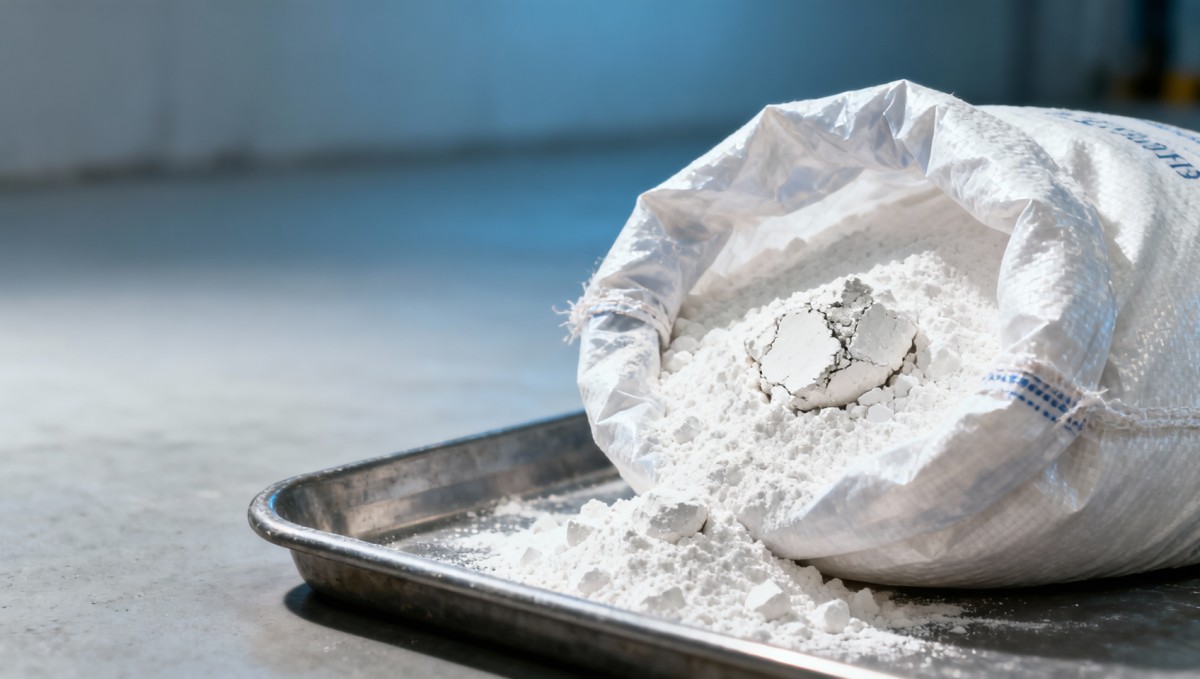
Before breaking up the material, record what you see. Once the contents are crushed and transferred, useful evidence about the original problem disappears. Photograph the unopened package, affected seams, pallet position, and the caking pattern inside.
- Confirm identity and traceability: record the product grade, lot number, receipt date, and opening date.
- Inspect the barrier: look for liner damage, loose closures, wet surfaces, staining, or evidence of previous exposure.
- Describe the lumps: note whether they are loose clusters, a surface crust, or a dense mass extending through the bag.
- Check for abnormal material: unexpected color, foreign particles, unusual odor, or visible contamination requires investigation rather than routine reworking.
- Compare nearby stock: inspect other bags from the same lot and, where available, a properly stored retained sample.
These observations guide the investigation; they do not establish compliance by themselves. Material that breaks apart easily is not automatically acceptable, and a hard lump is not automatically chemically degraded.
For industrial grade sodium tripolyphosphate, quality review may include moisture, assay, solution pH, insoluble matter, or other agreed specification items. Where prolonged wet exposure is suspected, a laboratory may need to assess phosphate composition because hydrolysis can change condensed phosphates. Select tests with the quality team and supplier rather than treating one moisture result as a complete diagnosis.
Can the material still be used?
The answer depends on both quality release and the process. A solution-preparation tank with suitable agitation may tolerate material that a small screw feeder cannot handle. Even chemically acceptable lumps can bridge a hopper, interrupt feed, or produce erratic dosing.
For a dissolution process, carry out a controlled small-scale check using the intended concentration, water quality, temperature, addition sequence, and mixing conditions. Observe dissolution time, persistent residue, and any difference from an approved reference. A clear solution alone does not establish purity or confirm every functional property.
For dry dosing, evaluate flow through the actual feeding arrangement or an approved representative test. Volumetric dosing deserves particular attention because changes in bulk density and packing can alter the delivered mass. Weighing the output is more informative than assuming the original feeder setting remains correct.
If quality personnel approve deagglomeration, use clean, compatible equipment under a documented procedure. Follow the safety data sheet for dust control and personal protection. Do not strike bags with improvised tools near operating machinery, reach into a blocked feeder, or bypass guards to clear a bridge.
Do not add water to restore powder flow or heat the material simply to “dry it out.” Water promotes dissolution and hydration, while uncontrolled heating can introduce new handling and quality problems. Adding an anti-caking agent also changes the formulation and requires explicit approval.
Storage controls that address the actual causes
Keep unopened material in its specified packaging in a dry, sheltered location. Use clean, dry pallets and maintain separation from floors, walls, leaks, washdown areas, and sources of steam. Follow the supplier’s stacking limits and warehouse load requirements rather than applying one universal pallet height.
Where condensation is a credible risk, allow sealed packages to approach the handling-area temperature before opening, provided this is consistent with supplier instructions. Monitor humidity and temperature where the stock actually sits; a reading beside an office door may not describe conditions near an exterior wall or loading bay.
There is no single relative-humidity limit that can be responsibly assigned to every STPP grade and packaging system. Ask for product-specific storage guidance, then use site records to identify the conditions associated with trouble.
Opened bags need a defined routine: close the inner liner promptly, use an approved moisture-resistant closure or compatible container, preserve identification, and record the opening date. Where consumption is slow, smaller packages may reduce repeated exposure more effectively than repeatedly resealing a large sack.
Stock rotation helps, but warehouse controls must remain chemical-specific. For example, Cupric nitrate trihydrate CAS#10031-43-3, used in catalyst preparation and synthesis, is moisture-sensitive and an oxidizing material. Its segregation and handling requirements cannot be copied from an STPP procedure. Shared procurement does not mean shared storage rules; each product’s current safety data sheet must govern.
When to involve the supplier—and what to send
Escalate promptly when several unopened bags show severe caking, packaging appears defective, contamination is suspected, or approved material no longer performs consistently. Keep affected stock identified and separated while the cause and disposition are reviewed.
A useful supplier review needs more than “the powder is hard.” Send photographs, lot details, the proportion of bags affected, storage duration, stacking arrangement, available humidity records, and receiving observations. Explain whether the operational problem is slow dissolution, feeder blockage, dosing variation, or another measurable change.
Luxi Chemical (Shandong) Co., Ltd. supplies chemical raw materials across categories including food additives, organic intermediates, and fertilizers, with import/export trade serving customers in more than 60 countries and regions. For a broad chemical supply chain, the useful discussion is product-specific: confirm the grade, packaging barrier, transport exposure, storage instructions, and acceptance criteria rather than relying on a general assurance of quality.
When caking returns, compare where it starts. Problems confined to opened bags point toward handling exposure; damage concentrated in lower pallet layers warrants a pressure and moisture review; widespread caking on arrival calls for investigation across packaging, transport, and product characteristics. Treat those patterns as leads, not verdicts. Preserve the evidence, confirm suitability for the process, and correct the exposure route before the next batch enters storage.
Related Picks
 Butylated Hydroxytoluene Price Drivers: Supply, Purity, and Purchasing Risk FactorsOct 21, 2026Butylated Hydroxytoluene price trends depend on supply stability, purity, logistics, and purchasing risk. Learn how to compare quotes wisely and reduce sourcing costs.
 Sodium Tripolyphosphate Price Trends: Raw Material and Energy ExposureOct 20, 2026Explore sodium tripolyphosphate price trends, from phosphate and soda ash costs to energy exposure. Learn how to compare quotes, manage sourcing risks, and make smarter purchasing decisions.
 Acetonitrile Shipment to Vietnam Successfully Dispatched; RCEP Benefits Boost Fine Chemical Trade with ASEANSep 16, 2026A shipment of industrial-grade acetonitrile from our company has recently been loaded and dispatched following the completion of standardized hazardous material packaging and container securing procedures.
 Nigerian Client’s Order of 4 Containers of Vinyl Acetate Successfully Loaded and Shipped to West AfricaSep 16, 2026We recently completed the loading of a vinyl acetate order for a Nigerian client; four containers of the product have been successfully packed and are ready for shipment to Nigeria.




Question Consultation
Send Us Your Inquiry Today

Luxi Chemical is a professional chemical product supplier with ample stock of all chemical categories and excellent quality, welcome your purchase inquiry.

