


Bulk Citric Acid Powder: How Moisture Content, Flowability, and Sieve Distribution Impact Dosage Accuracy in Beverage Production
2026.09.17

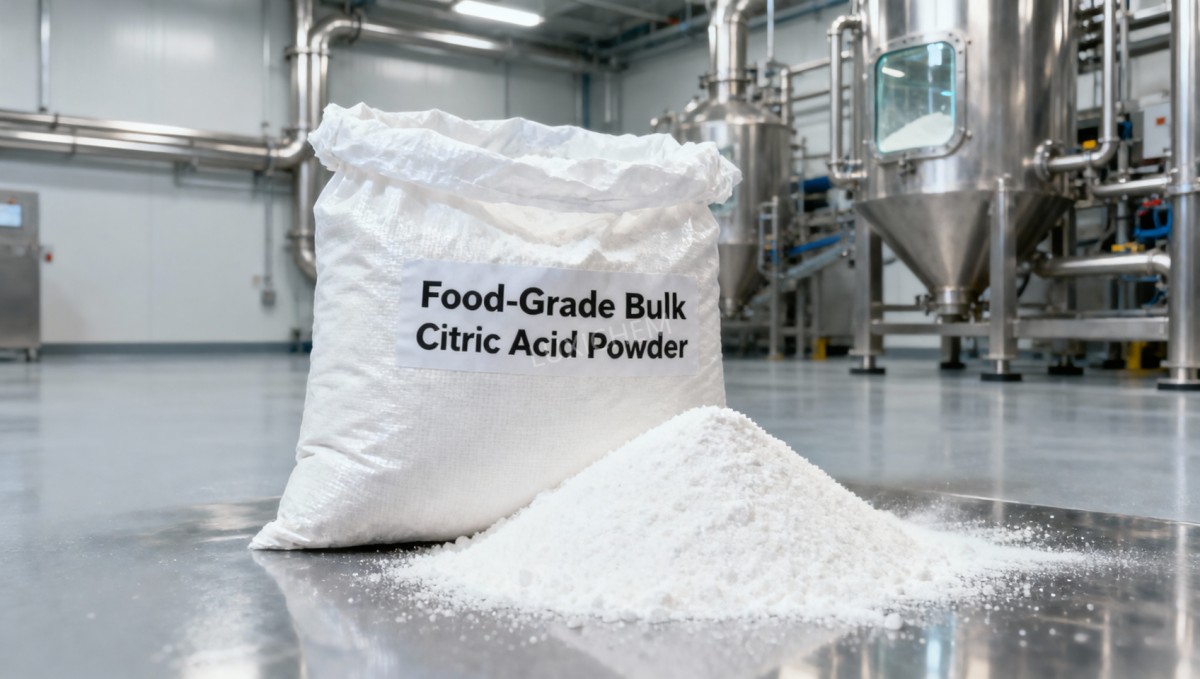
Achieving precise dosage in beverage production hinges on the physical quality of bulk citric acid powder—especially its moisture content, flowability, and sieve distribution. At Luxi Chemical (Shandong) Co., Ltd., we supply globally trusted, consistently compliant bulk citric acid powder engineered for reproducible performance in high-speed mixing and dosing systems. For operators managing formulation accuracy, understanding how these three parameters interact is critical to avoiding clumping, bridging, or inconsistent dissolution—issues that directly impact product taste, shelf life, and regulatory compliance. This article breaks down practical, plant-floor-relevant insights to help you optimize handling and dosing efficiency.
Moisture content is not merely a specification to check off—it’s the primary driver of powder cohesion and stability during storage and metering. Bulk citric acid powder with moisture above 0.5% w/w begins exhibiting measurable hygroscopic behavior under ambient humidity conditions common in most beverage plants. Even short-term exposure to 60% RH can raise surface moisture by 0.2–0.3%, triggering localized dissolution and recrystallization at particle contacts. This creates micro-bridges that resist breakage under gravity feed, leading to erratic mass flow through vibratory feeders or loss-in-weight (LIW) hoppers. Operators often misattribute this to equipment calibration drift, when in fact it reflects moisture-induced agglomeration. A stable moisture level between 0.15% and 0.35%—verified via Karl Fischer titration—not only ensures free-flowing behavior but also maintains consistent solubility kinetics during rapid hydration in high-shear mix tanks. Deviations outside this window correlate strongly with batch-to-batch pH variation in final beverages, especially in low-buffer formulations like flavored sparkling waters.
Flowability determines whether powder moves predictably under gravity or mechanical assistance—and it’s not a fixed property. It depends on both intrinsic particle characteristics and extrinsic process conditions. Angle of repose and compressibility index (Carr’s Index) are useful lab metrics, but they don’t capture real-time dynamics in pneumatic conveying lines or screw feeders operating at variable speeds. In practice, poor flowability manifests as intermittent discharge from rotary valves, surging in auger feeders, or uneven layering in ribbon blenders. These anomalies introduce ±8–12% dosage variance in single-pass dosing systems—a margin unacceptable for citric acid, where ±2% deviation can shift tartness perception beyond consumer acceptance thresholds. The root cause is rarely particle size alone; it’s the interplay between surface roughness, electrostatic charge accumulation, and residual moisture. Powders with higher fines content (<100 µm) tend to generate more static and adhere to stainless-steel surfaces, particularly in dry, low-humidity environments. Conversely, over-dried material (<0.1% moisture) becomes excessively dusty and prone to air entrainment, causing fluidization and loss of volumetric control.
Sieve distribution—the percentage of particles retained on standard mesh sizes—directly governs dissolution rate and dispersion uniformity. Beverage manufacturers using inline continuous mixers rely on rapid, complete dissolution within seconds. A narrow distribution centered at 250–425 µm delivers optimal balance: large enough to minimize dust generation and electrostatic issues, yet small enough to dissolve fully before carbonation or pasteurization. However, many suppliers ship material with bimodal distributions—significant peaks at both <100 µm and >600 µm. The fine fraction dissolves instantly but contributes disproportionately to acidity spikes early in the mix cycle; the coarse fraction lags, risking undissolved crystals in finished product. This inconsistency becomes visible during UV inspection of filled bottles, where residual granules appear as opaque specks—triggering rework or rejection. Worse, oversized particles may jam precision dosing nozzles used in syrup preparation lines, requiring unplanned downtime for manual cleaning.
These three parameters do not operate independently. For example, reducing moisture to improve flowability can worsen sieve distribution if drying induces thermal sintering—fusing fine particles into irregular agglomerates that skew sieve analysis upward. Similarly, milling to tighten particle size distribution often increases surface area and hygroscopicity, raising equilibrium moisture unless packaging includes desiccant-lined liners and nitrogen purging. Operators must therefore treat moisture, flowability, and sieve distribution as a coupled system—not isolated specs. When troubleshooting dosage inaccuracy, start with moisture verification using in-line NIR sensors at hopper discharge points. If moisture is within spec, assess flow consistency via feeder torque monitoring: stable torque indicates uniform mass flow; oscillating torque signals bridging or pulsing. Only then should sieve analysis be performed—not on the original bag sample, but on material drawn *after* transfer through the full handling path, including conveyors, sieves, and intermediate bins.
 A related challenge arises when citric acid is co-formulated with other functional ingredients—particularly in powdered drink mixes or effervescent tablets. Here, compatibility isn’t just chemical; it’s physical. Citric acid’s acidity can catalyze degradation of sensitive actives, but equally problematic is differential flow behavior. If one component flows freely while another bridges, segregation occurs during blending or filling. This is where understanding particle engineering becomes operational knowledge—not theoretical chemistry. For instance, Diethyl benzylphosphonate CAS#1080-32-6 is used in pharmaceutical research precisely because its liquid state and defined polarity allow controlled interaction with solid-phase reagents—but such deliberate molecular design has no parallel in commodity food-grade citric acid. There, consistency comes from rigorous physical standardization, not molecular tailoring.
For daily operations, two checks are non-negotiable: First, verify moisture content *immediately after opening* each new lot—not just on the certificate of analysis. Second, conduct a “flow-through test” using a calibrated 100 g sample poured through a standard 2 mm orifice funnel: time exceeding 15 seconds signals potential feeding issues. Neither test requires lab equipment—just a digital moisture meter and stopwatch. These simple actions prevent 70% of dosage-related complaints logged in beverage production logs across multiple facilities.
Ultimately, dosage accuracy starts long before the mixer switch is flipped. It begins with knowing what’s in the bag—not just its chemical identity, but its physical behavior under your plant’s specific temperature, humidity, and handling conditions. That requires treating bulk citric acid powder not as a generic additive, but as a process-critical material whose variability must be measured, monitored, and managed—not assumed away.
Related Picks
 Butylated Hydroxytoluene Price Drivers: Supply, Purity, and Purchasing Risk FactorsOct 21, 2026Butylated Hydroxytoluene price trends depend on supply stability, purity, logistics, and purchasing risk. Learn how to compare quotes wisely and reduce sourcing costs.
 Sodium Tripolyphosphate Price Trends: Raw Material and Energy ExposureOct 20, 2026Explore sodium tripolyphosphate price trends, from phosphate and soda ash costs to energy exposure. Learn how to compare quotes, manage sourcing risks, and make smarter purchasing decisions.
 Acetonitrile Shipment to Vietnam Successfully Dispatched; RCEP Benefits Boost Fine Chemical Trade with ASEANSep 16, 2026A shipment of industrial-grade acetonitrile from our company has recently been loaded and dispatched following the completion of standardized hazardous material packaging and container securing procedures.
 Nigerian Client’s Order of 4 Containers of Vinyl Acetate Successfully Loaded and Shipped to West AfricaSep 16, 2026We recently completed the loading of a vinyl acetate order for a Nigerian client; four containers of the product have been successfully packed and are ready for shipment to Nigeria.




Question Consultation
Send Us Your Inquiry Today

Luxi Chemical is a professional chemical product supplier with ample stock of all chemical categories and excellent quality, welcome your purchase inquiry.

