


Citric Acid Wholesale vs. Retail: Minimum Order Quantities, Packaging Options, and Logistics for Bulk Buyers
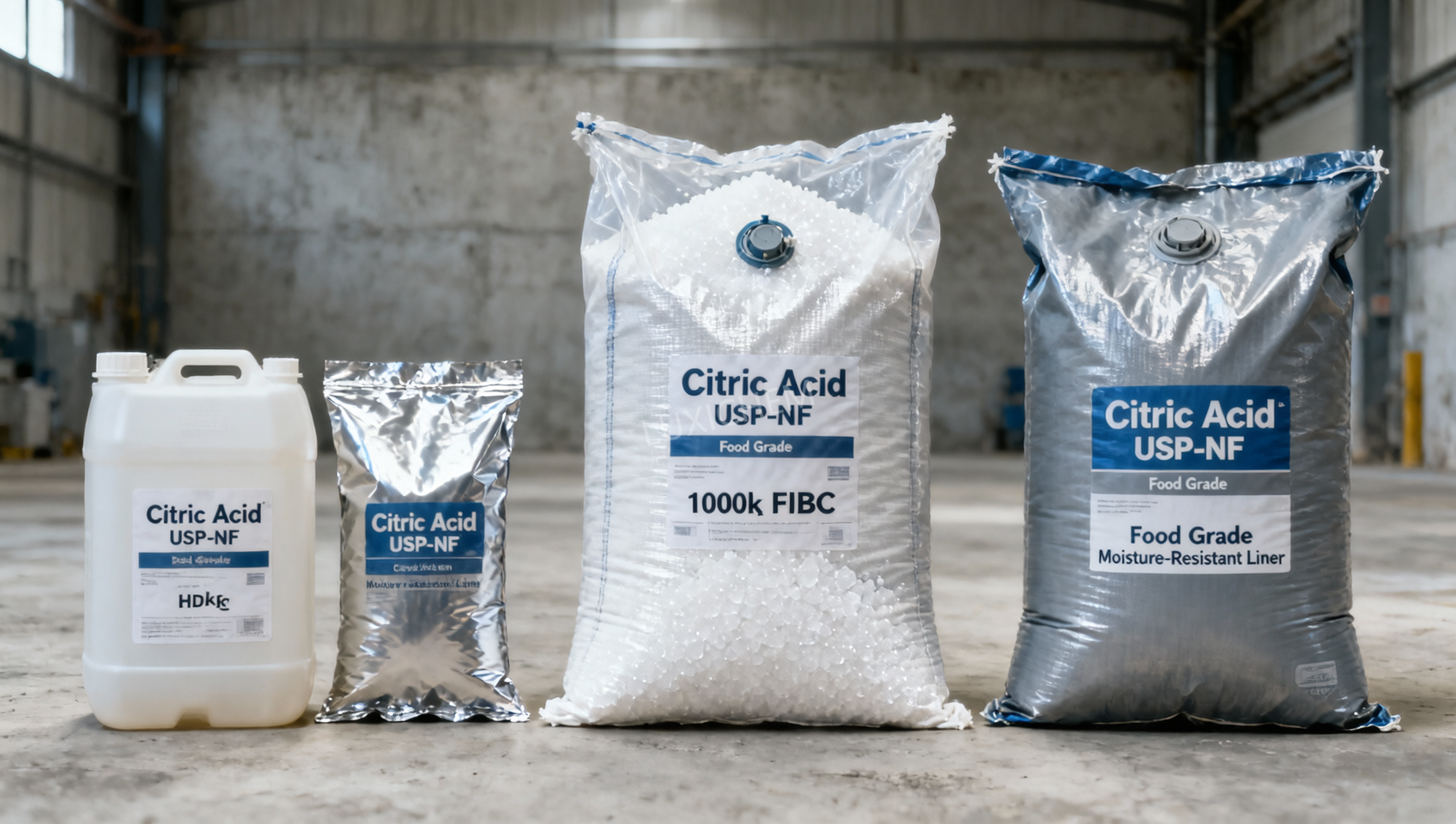
Sourcing citric acid wholesale? The distinction between wholesale and retail procurement isn’t merely about volume—it’s about how MOQs, packaging configurations, and logistics infrastructure directly shape production continuity, inventory carrying cost, and batch-to-batch consistency. Retail channels typically serve labs or pilot-scale operations with order thresholds under 25 kg, often in pre-sealed HDPE jars or vacuum-packed foil pouches. These formats prioritize shelf stability and unit-level traceability but introduce higher per-kilogram handling fees, fragmented documentation, and inconsistent lot numbering across shipments—factors that complicate regulatory audits for food-grade applications.
Minimum Order Quantities: Thresholds That Trigger Operational Shifts
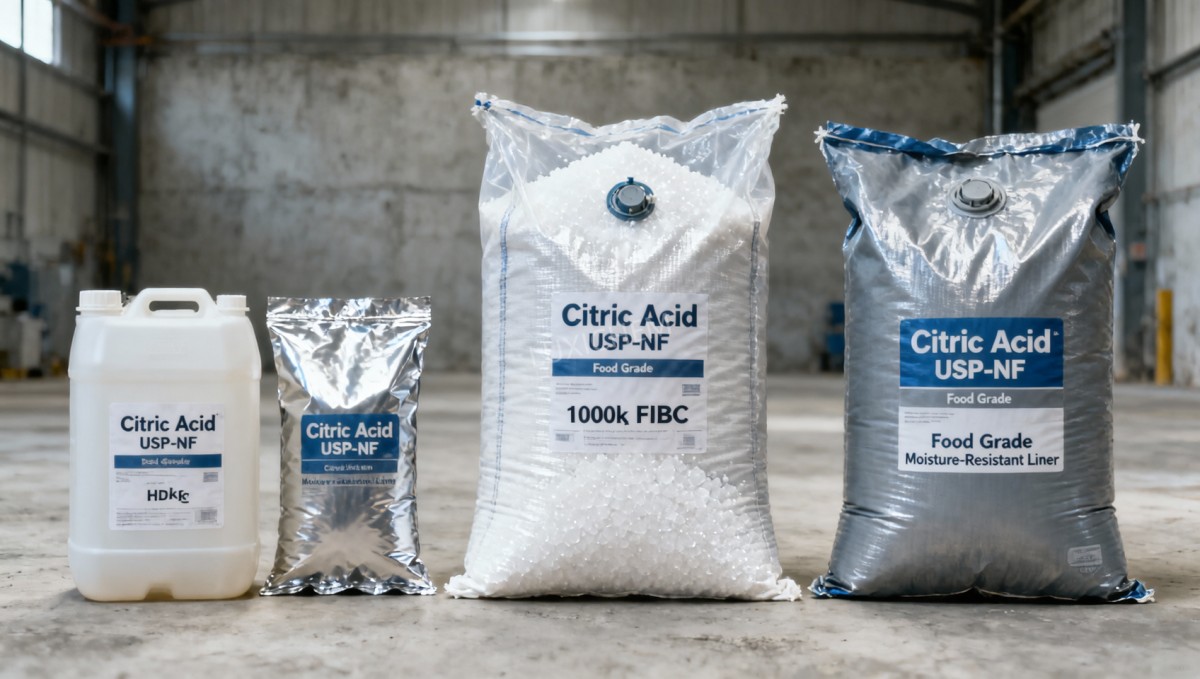
Wholesale MOQs for citric acid are rarely arbitrary. They reflect production batch economics, packaging line setup costs, and freight efficiency thresholds. Below 500 kg, most suppliers treat orders as semi-bulk—requiring palletized shrink-wrapping but still using standard 25 kg poly-lined paper bags. At 1,000 kg, the supply chain shifts: bulk liners (e.g., 500–1,000 kg FIBC jumbo bags) become standard, enabling direct discharge into silos or mixers without intermediate repackaging. Orders exceeding 5 metric tons often qualify for tank container shipment—especially for anhydrous grades—where moisture ingress risk demands inert gas purging and triple-layered liner integrity verification before loading. Crucially, MOQs also govern analytical reporting: retail lots may provide only CoA summaries; wholesale contracts routinely include full chromatograms, heavy metal test reports (Pb, As, Cd), and microbial plate counts—traceable to the original crystallization batch, not just the shipped unit.
Packaging Options: Beyond Container Size
Packaging isn’t just containment—it’s a functional interface between material properties and end-use processing. Citric acid monohydrate is hygroscopic; prolonged exposure to ambient humidity above 60% RH causes caking and flow disruption in automated feed systems. Retail packaging mitigates this via aluminum-laminated barrier films—but at the expense of recyclability and bulk discharge speed. Wholesale alternatives address this trade-off structurally: multi-wall kraft bags with internal polyethylene liners offer moisture resistance while allowing manual or pneumatic unloading. For continuous-process users, valve-port FIBCs with static-dissipative fabric reduce dust generation during filling and support direct connection to loss-in-weight feeders. Notably, food-grade citric acid shipped in bulk liners must comply with FDA 21 CFR §176.170 for indirect food additives—even when the liner itself isn’t in direct contact with final product—because residual migration pathways exist through vapor phase transport during storage.
Logistics for Bulk Buyers: Where Documentation Meets Physical Flow
International bulk logistics hinge on three non-negotiable checkpoints: customs classification alignment, transport hazard validation, and documentation chain integrity. Citric acid falls under HS code 2918.14, but misclassification as “other organic acids” (2918.90) triggers extended customs holds due to incomplete REACH pre-registration checks in EU ports. More critically, while citric acid itself isn’t classified as hazardous under UN TDG, its dust cloud can form combustible mixtures above 30 g/m³—requiring ATEX-compliant conveying equipment at receiving sites. Bulk buyers must verify that shipping documents explicitly state “non-hazardous for transport” *and* reference the supplier’s certified dust explosion index (Kst) test report. Without this, port authorities may require on-site testing—a 72-hour delay that disrupts just-in-time production schedules.
Documentation extends beyond CoAs. Wholesale shipments demand full lot traceability from raw material sourcing (e.g., molasses fermentation origin for bio-based grades) through crystallization temperature profiles and drying residence time logs. This level of granularity matters when investigating off-spec batches: if pH drift occurs in downstream beverage formulations, the root cause could lie in subtle variations in residual ash content—not detectable in routine purity assays but visible in ICP-OES elemental scans included in wholesale dossiers.
In some applications, citric acid functions alongside complementary buffering agents. For instance, in phosphate-buffered cleaning formulations for dairy processing equipment, Sodium phosphate monobasic CAS#7558-80-7 provides precise pH control within the 4.0–4.5 range, leveraging its pKa₂ of 6.82 to stabilize citric acid’s primary dissociation. Its hygroscopic nature requires sealed polyethylene-lined packaging identical to citric acid’s bulk requirements—making coordinated logistics planning essential when both materials are procured from integrated suppliers.
Operational Implications of Choice
Switching from retail to wholesale isn’t linear cost reduction—it’s recalibrating operational risk exposure. Lower per-unit pricing is offset by higher working capital tied up in larger inventories, stricter warehouse humidity controls (<50% RH), and mandatory requalification protocols after six months of storage. Conversely, retail procurement introduces hidden costs: repackaging labor (averaging 8–12 minutes per 25 kg bag for silo transfer), increased sampling frequency (every 50 kg vs. every 5,000 kg), and documentation reconciliation across dozens of small-lot CoAs. The break-even point typically emerges at annual consumption volumes exceeding 15 metric tons—where wholesale’s documentation rigor, packaging efficiency, and freight consolidation begin delivering measurable ROI beyond headline pricing.
What remains constant across procurement tiers is material specification discipline. “Food grade” isn’t a single standard: USP-NF, FCC, and EU E330 each impose distinct limits on sulfate ash (max 0.1% FCC vs. 0.05% EU), lead (≤2 ppm vs. ≤0.5 ppm), and optical rotation (±0.5°). Wholesale contracts enforce compliance against the buyer’s specified standard—not the supplier’s default—through contractual annexes that bind test methods (e.g., AOAC 983.14 for citric acid assay) and third-party lab accreditation (ISO/IEC 17025). This specificity prevents disputes when analytical results fall near specification boundaries—a frequent trigger for shipment rejection in high-value food manufacturing environments.
Ultimately, the wholesale decision hinges on process integration depth. If citric acid feeds directly into a continuous blending line with automated gravimetric dosing, bulk packaging and lot-level traceability aren’t conveniences—they’re prerequisites for maintaining HACCP critical control points. When material enters as discrete units requiring manual weighing and lot segregation, retail’s flexibility retains value—but only until scale exposes its throughput limitations.
Related Picks
 Butylated Hydroxytoluene Price Drivers: Supply, Purity, and Purchasing Risk FactorsOct 21, 2026Butylated Hydroxytoluene price trends depend on supply stability, purity, logistics, and purchasing risk. Learn how to compare quotes wisely and reduce sourcing costs.
 Sodium Tripolyphosphate Price Trends: Raw Material and Energy ExposureOct 20, 2026Explore sodium tripolyphosphate price trends, from phosphate and soda ash costs to energy exposure. Learn how to compare quotes, manage sourcing risks, and make smarter purchasing decisions.
 Acetonitrile Shipment to Vietnam Successfully Dispatched; RCEP Benefits Boost Fine Chemical Trade with ASEANSep 16, 2026A shipment of industrial-grade acetonitrile from our company has recently been loaded and dispatched following the completion of standardized hazardous material packaging and container securing procedures.
 Nigerian Client’s Order of 4 Containers of Vinyl Acetate Successfully Loaded and Shipped to West AfricaSep 16, 2026We recently completed the loading of a vinyl acetate order for a Nigerian client; four containers of the product have been successfully packed and are ready for shipment to Nigeria.




Question Consultation
Send Us Your Inquiry Today

Luxi Chemical is a professional chemical product supplier with ample stock of all chemical categories and excellent quality, welcome your purchase inquiry.

