


Buying Fungicides in Bulk: Comparing Cost per Treated Hectare
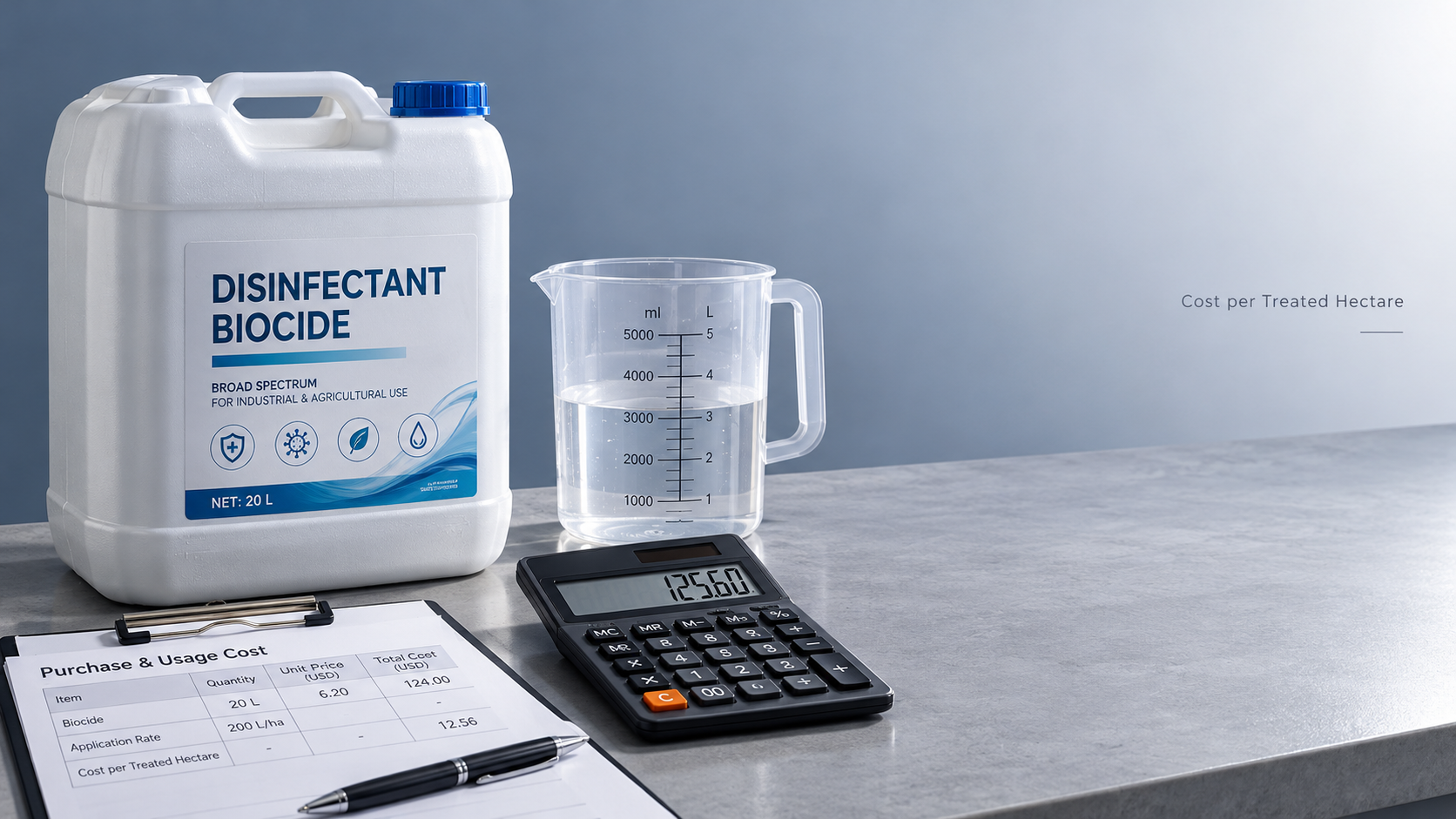
A bulk quotation can look attractive until the application rate is entered into the purchasing spreadsheet. A cheaper drum may treat fewer hectares, require more stock movements, or leave surplus inventory after the disease-control window closes. Comparing fungicides by price per kilogram or litre alone can therefore reward the wrong offer.
Start with cost per treated hectare per application: product price per unit multiplied by the label-approved rate per hectare. Then compare the full seasonal program, adding landed costs, application expenses, and inventory exposure. Only compare offers that are legally usable for the intended crop, disease, and destination market; a low calculated cost cannot compensate for an unsuitable product.
Establish the comparison before requesting prices
A useful quotation request defines the treatment requirement, not just the product volume. Purchasing teams need the crop, target disease, treatment area, intended timing, and delivery location before suppliers can quote against a common basis. Otherwise, one offer may cover a preventative treatment while another is intended for a different disease or application window.
Ask the agronomy or crop-protection team to identify acceptable products and application programs first. Procurement can then compare commercial terms within that approved set rather than treating every fungicide with a similar active ingredient as interchangeable.
- Use conditions: crop, target pathogen, application method, and any relevant protected-crop or open-field distinction.
- Approved rate basis: product quantity per hectare, including the conditions that determine which rate applies.
- Program constraints: permitted application intervals, maximum applications, seasonal limits, and resistance-management requirements.
- Supply specification: formulation, pack size, required delivery dates, and acceptable remaining shelf life.
- Commercial basis: currency, delivery terms, payment schedule, and which freight or import charges are included.
Where the label permits a rate range, do not automatically use the lowest rate to make the quotation look competitive. Use the rate appropriate to the planned conditions, confirmed by the responsible technical team. If conditions remain uncertain, calculate separate permitted-rate scenarios and keep their assumptions visible.
Build the hectare calculation in two layers
First, compare product consumption
The basic calculation is straightforward when units match:
Product cost per hectare per application = quoted price per kg or L × approved product rate in kg/ha or L/ha.
For a package quotation, divide the package price by its net contents first. Use net product quantity, not gross shipping weight. Keep solid and liquid units separate; converting between kilograms and litres requires the product’s verified density and a clear reason for doing so.
Active ingredient concentration is useful for checking specifications, but it is not a shortcut to treatment cost. A higher concentration may reduce product volume without producing a proportionate reduction in the approved rate. Different formulations or active ingredients can also have different use patterns. Calculate using each finished product’s own approved directions.
Then, replace the quoted price with the landed usable cost
A delivered comparison should capture the costs necessary to place usable stock at the receiving location. Depending on the purchasing arrangement, these may include freight, insurance, import charges, clearance, inland transport, and receiving costs. Separate recoverable taxes from nonrecoverable costs according to the buyer’s accounting treatment.
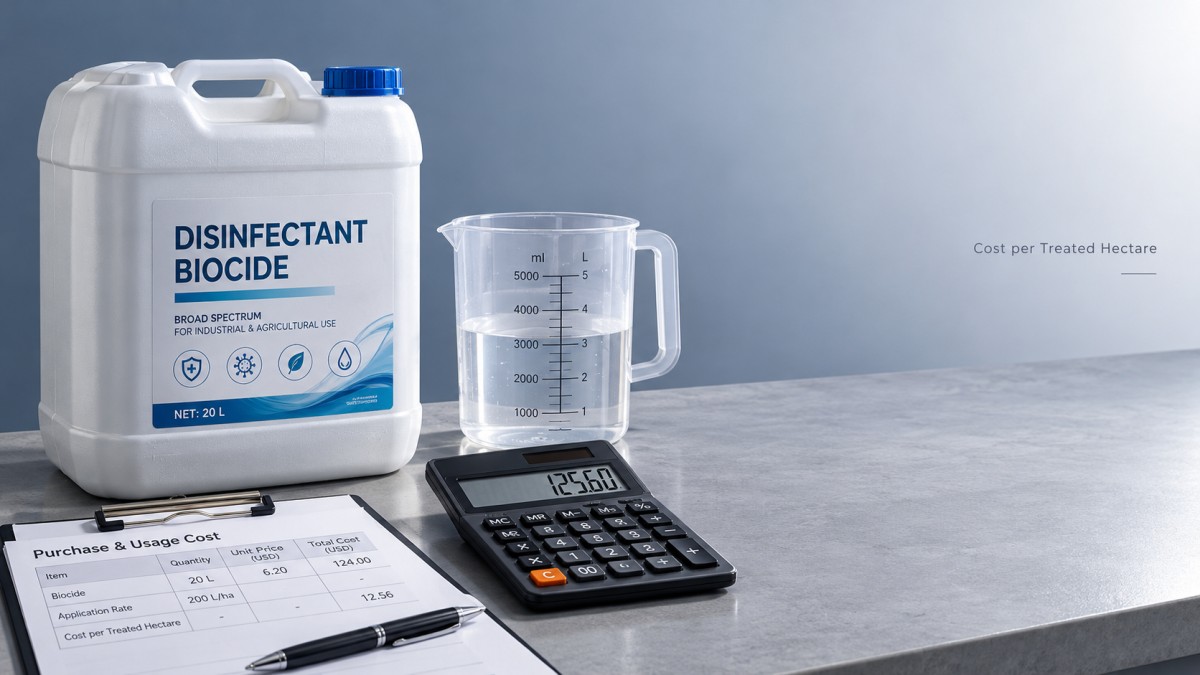
Allocate shared freight consistently. If several products travel together, use a defensible allocation basis reflecting the shipment’s cost drivers, such as chargeable weight or pallet space. An arbitrary allocation can make one quotation appear cheaper simply because another product absorbs its transport costs.
Separate a treated hectare from a seasonal hectare
The phrase “cost per hectare” becomes misleading when its denominator is unclear. One hectare sprayed once is one hectare-treatment. The same physical hectare treated several times generates several hectare-treatments, but it remains one field hectare in the seasonal budget.
Cost per hectare-treatment helps compare individual applications. Seasonal cost per field hectare helps compare complete disease-management programs. Both are useful, but they answer different purchasing questions.
For seasonal budgeting, list every planned treatment and its product cost. Add application costs only where they arise: machinery, labour, fuel, contractor charges, or other relevant operating expenses. If a treatment can share an already scheduled pass, include only the additional cost that genuinely belongs to that treatment. Do not assume tank-mixing is permitted or technically compatible without checking.
A product with a higher per-application cost may still fit a less expensive program, but fewer applications must be supported by approved directions and a credible agronomic plan. Claims about longer protection should not become automatic spreadsheet savings. Weather, disease pressure, crop development, and resistance strategy can change the program.
Use a base plan and a higher-pressure scenario where both are technically justified. Show which costs change under each scenario. This makes the budget more useful than a single seasonal figure that silently assumes favourable conditions.
Check whether the offers are technically comparable
Two quotations can share an active ingredient name while differing in formulation, registration, concentration, or permitted use. The commercial comparison should pause whenever those differences affect suitability. Procurement savings are meaningful only after the technical acceptance criteria are met.
Request the applicable product label, safety data sheet, specification, and batch-linked certificate of analysis. Confirm the manufacturer and supply chain, and check registration or authorization through the relevant destination-market process. A certificate of analysis supports batch conformity; it does not establish crop authorization or field performance by itself.
Formulation quality can also affect operational cost. Relevant acceptance criteria may include dispersibility, suspension behaviour, storage stability, or compatibility with the intended equipment, depending on formulation type. These characteristics should be assessed against agreed specifications rather than inferred from appearance or a low unit price.
For buyers also sourcing formulation inputs, Fumed silica CAS#112945-52-5 belongs in a separate raw-material evaluation, not in the finished-fungicide hectare-cost comparison. Its suitability for any proposed formulation use requires technical assessment; the product identity alone does not establish compatibility, performance, or authorization for agricultural use.
Resistance management is another boundary on substitution. Products with different brand names may share the same mode of action, while an apparently economical replacement may not fit the planned rotation. Have the responsible technical team confirm the program before committing to bulk quantities that could restrict later choices.
Test the bulk discount against stock that will actually be used
The lowest price tier often requires buying beyond the immediate treatment requirement. That creates a second calculation: whether the discount on consumed stock exceeds the cost and risk of carrying the balance.
Planned product requirement = sum of each treatment area multiplied by its approved product rate.
Calculate this by treatment where rates or covered areas differ, then adjust for pack-size rounding and any justified contingency. Avoid adding an unexplained percentage “for safety.” Extra stock should correspond to a defined uncertainty, such as a permitted additional treatment or a documented delivery risk.
Distinguish inventory remaining after the season from inventory expected to become unusable. Usable carryover is not automatically a total loss, but it ties up cash and requires suitable storage. Stock that cannot realistically be consumed before expiry needs a different financial treatment.
- Check remaining shelf life at the planned receipt date, not just the manufacturing date shown on an early quotation.
- Confirm storage requirements against available facilities, including temperature limits and segregation needs.
- Include financing, storage, and handling costs over the expected holding period.
- Agree on the treatment of damaged, short-dated, or nonconforming deliveries before dispatch.
Keep routine consumption cost and write-off exposure visible as separate lines. Otherwise, the comparison may either hide overbuying behind a low landed unit price or overstate cost by treating all closing inventory as waste.
Negotiate delivery structure, not only the unit price
When the forecast is uncertain, a staged-delivery agreement may be worth more than a larger discount on a single shipment. Ask suppliers to price both options on the same total volume assumption. Compare the resulting freight, storage, payment timing, and shelf-life position.
A call-off arrangement is only useful if the contract defines reserved quantities, release deadlines, lead times, batch acceptance, and responsibility for stock held by the supplier. Without those terms, the buyer may assume supply is secured while the supplier treats future releases as subject to availability.
Also check whether split shipments change import costs or minimum freight charges. Several smaller deliveries can reduce on-site inventory while increasing logistics cost. The correct comparison is the net effect across the treatment period, not an automatic preference for either shipment pattern.
Record quote validity and currency exposure. A quotation in a foreign currency may change rank before payment, particularly when deposit and balance payments occur at different times. Use the organization’s approved exchange-rate assumptions consistently and show any unhedged exposure separately.
Turn the comparison into an auditable purchase decision
The final comparison sheet should allow another person to reproduce the result without reconstructing the assumptions. Give each offer its own approved rate, net unit price, landed-cost allocation, planned treatment schedule, and inventory position. Keep technical acceptance separate from the cost ranking so that an ineligible product cannot appear as the recommended bargain.
Before issuing the order, reconcile the calculated requirement with the actual pack configuration. Whole-container rounding can change both the payable amount and the remaining stock. Report the total purchase commitment alongside cost per hectare; a favourable unit figure can still exceed the available cash budget.
Finally, test the decision against the variables most likely to move: application rate within the permitted range, additional justified treatments, freight changes, and unused stock. If a small change reverses the ranking, negotiate flexibility or clarify the assumption before increasing volume. The strongest bulk offer is the one that remains economical under the intended, approved treatment plan—not merely the one with the lowest price on the quotation.
Related Picks
 Butylated Hydroxytoluene Price Drivers: Supply, Purity, and Purchasing Risk FactorsOct 21, 2026Butylated Hydroxytoluene price trends depend on supply stability, purity, logistics, and purchasing risk. Learn how to compare quotes wisely and reduce sourcing costs.
 Sodium Tripolyphosphate Price Trends: Raw Material and Energy ExposureOct 20, 2026Explore sodium tripolyphosphate price trends, from phosphate and soda ash costs to energy exposure. Learn how to compare quotes, manage sourcing risks, and make smarter purchasing decisions.
 Acetonitrile Shipment to Vietnam Successfully Dispatched; RCEP Benefits Boost Fine Chemical Trade with ASEANSep 16, 2026A shipment of industrial-grade acetonitrile from our company has recently been loaded and dispatched following the completion of standardized hazardous material packaging and container securing procedures.
 Nigerian Client’s Order of 4 Containers of Vinyl Acetate Successfully Loaded and Shipped to West AfricaSep 16, 2026We recently completed the loading of a vinyl acetate order for a Nigerian client; four containers of the product have been successfully packed and are ready for shipment to Nigeria.




Question Consultation
Send Us Your Inquiry Today

Luxi Chemical is a professional chemical product supplier with ample stock of all chemical categories and excellent quality, welcome your purchase inquiry.

