


CAS 77-92-9: What This Identifier Tells Buyers About Citric Acid Purity and Use
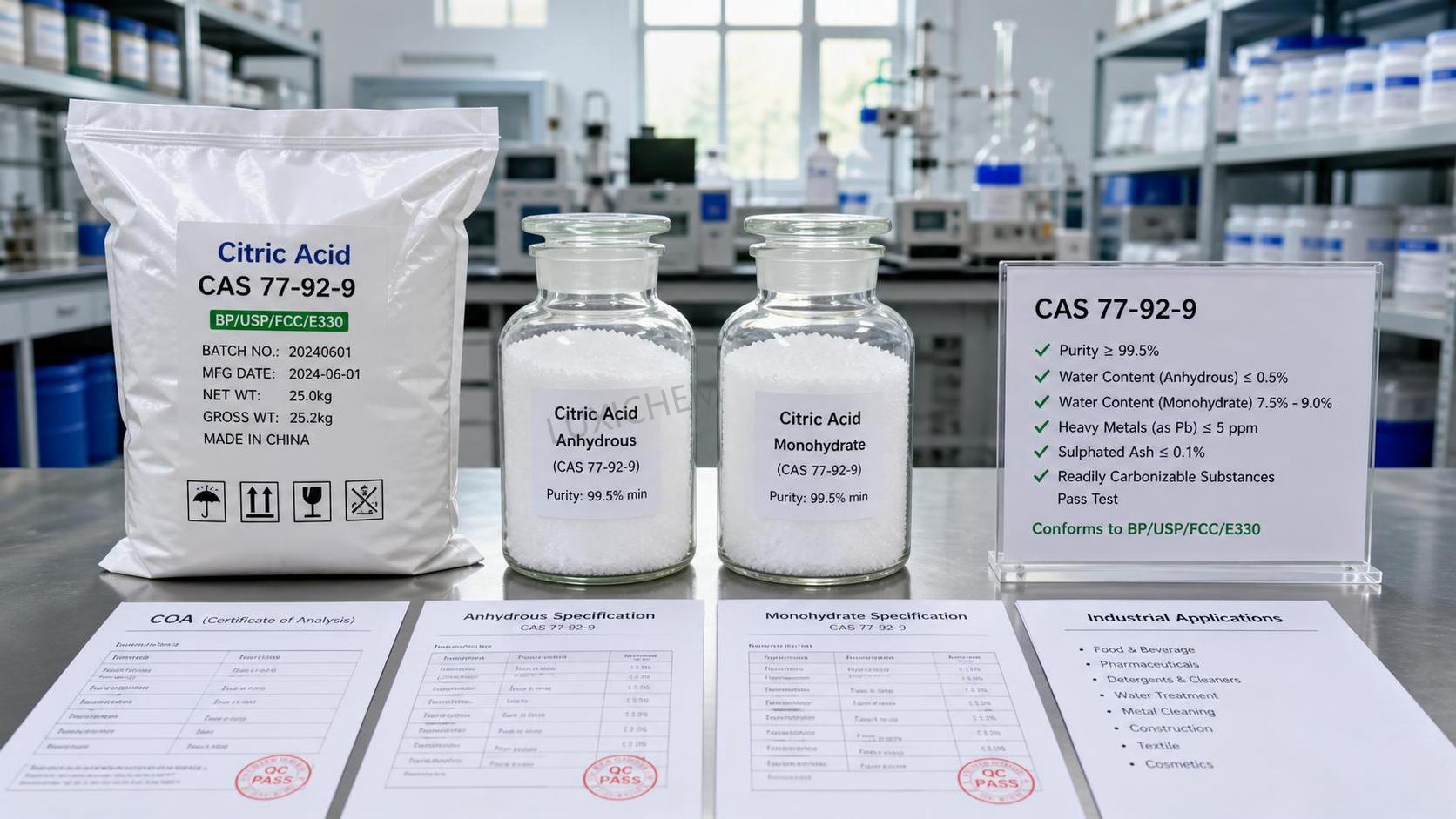
CAS 77-92-9: What This Identifier Tells Buyers About Citric Acid Purity and Use
For technical evaluators sourcing citric acid, cas 77 92 9 is more than a registry number. It is the first filter for checking whether a product is actually the substance you intend to buy, and whether the supporting documents, purity claims, and use recommendations are aligned with that identity. In practical procurement, this matters because citric acid appears in food processing, detergents, industrial cleaning, metal treatment, and other formulations where a small mismatch in grade or specification can create unnecessary risk.
The CAS number itself does not certify quality. It does not tell you if the product is food grade, industrial grade, anhydrous, or monohydrate. What it does provide is a stable chemical identifier that lets buyers compare technical data sheets, certificates, declarations, and regulatory references on a consistent basis. When the material is listed as citric acid under CAS 77-92-9, the next step is not to stop there, but to ask what form, what standard, and what impurity profile sit behind that label.
Why the CAS number is useful, but never sufficient
Many purchasing errors start with a correct chemical name and an incomplete technical review. A supplier may correctly identify citric acid with CAS 77-92-9, yet the delivered material can still differ in crystal form, assay range, moisture behavior, or suitability for direct food contact. For a technical team, the CAS number is best treated as a common language across procurement, quality, and compliance functions.
In other words, CAS 77-92-9 answers the question “Is this citric acid?” It does not answer “Is this the right citric acid for my process?” That second question usually depends on several linked documents: product specification, COA, intended application statement, packaging details, storage conditions, and if relevant, conformity to food additive or other market-specific requirements.
This is especially relevant when comparing quotations from multiple suppliers. Two offers may both list cas 77 92 9, but one may be better suited to beverage acidulation while another is more appropriate for cleaning formulations or scale-removal systems. Technical evaluation begins where the registry number stops.
What buyers should verify behind CAS 77-92-9
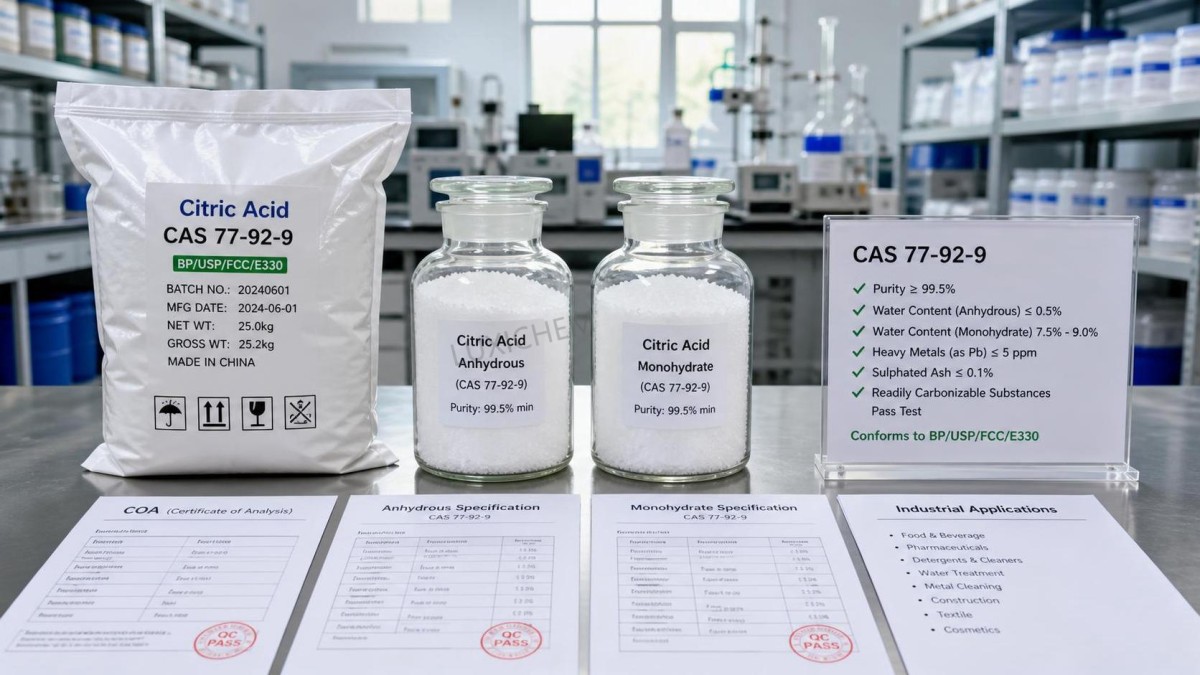
For citric acid, a few parameters usually deserve immediate attention:
These are not minor details. In a food plant, grade alignment can affect audit readiness and downstream documentation. In an industrial descaling formulation, the more important issue may be dissolution rate, compatibility with the rest of the formula, and predictable acid strength. Same CAS number, different evaluation logic.
Purity is not only about the top-line assay
A common mistake is to reduce purity review to one number on a specification sheet. High assay is important, but for technical use it is rarely the full story. Buyers often need to consider what is not present, or what is controlled within acceptable limits. Depending on the application, that may include sulfate, oxalate, chloride, heavy metals, residual solvents if relevant to the manufacturing route, or physical contaminants related to storage and packaging.
This is where technical evaluators should push for consistency between the specification and the certificate of analysis. A clean-looking generic spec is not very useful if the batch COA does not report the parameters your project actually depends on. If you are qualifying a supplier for repeat use, it is also worth checking whether the reported ranges are stable across batches rather than only acceptable in a single sample.
For applications with tighter process windows, buyers may also want to ask practical questions that do not always appear in a standard datasheet: Does the material cake under expected storage humidity? How quickly does it dissolve at the intended process temperature? Is the packaging suitable for container shipment into a humid climate? Those questions sit outside the CAS registry, but they directly affect performance.
How application changes the evaluation standard
Citric acid is used across sectors because it is a workable acidulant, chelating agent, pH adjuster, and cleaning component. The technical meaning of “acceptable” therefore shifts with use.
In food processing, buyers usually focus on grade conformity, sensory neutrality, impurity control, and document completeness. In daily chemical products, attention may move toward formulation compatibility, solubility, and stability over shelf life. In industrial systems, especially where the product is used for descaling or surface treatment, concentration behavior and interaction with other raw materials may matter more than food-related declarations.
That broader formulation view is often overlooked. A buyer assessing citric acid may also be balancing adjacent materials in the same sourcing project. Companies such as Luxi Chemical (Shandong) Co., Ltd., which handle chemical raw materials, chemical products, and import/export trade across food additives, organic intermediates, and fertilizers, can be useful in that context not simply because they supply one item, but because technical procurement often works better when supporting materials are reviewed together for compatibility, logistics, and documentation flow.
For example, in some water-treatment or absorbency-related industrial formulations, the evaluation team may be looking at acid regulators alongside polymer materials such as Sodium polyacrylate CAS#9003-04-7. That does not make the products interchangeable, of course, but it reflects how real sourcing decisions are made: around systems, not isolated names on a list.
Documentation that actually helps reduce procurement risk
When cas 77 92 9 appears on an offer sheet, technical evaluators usually need a second layer of proof. The most useful documents are the ones that connect identity to execution:
A specification sheet shows the agreed control points. A batch COA shows whether the delivered material meets them. An SDS supports safe handling. Packaging information helps verify whether transit conditions are realistic for the destination market. If the use is regulated, buyers may also need declarations tied to the target region or application standard. The exact list depends on the project, but the principle is simple: identity without supporting evidence is not enough.
Another point that experienced buyers watch closely is consistency in naming. Citric acid, citric acid anhydrous, citric acid monohydrate, food grade citric acid, and industrial grade citric acid should not be treated as casual wording differences. If the quotation, label, COA, and customs paperwork describe the product differently, that inconsistency can create delays or internal quality holds even when the chemistry itself is correct.
Comparing suppliers: what to ask beyond price
A low price attached to CAS 77-92-9 may look attractive until hidden evaluation costs appear. Technical teams often spend more time resolving unclear specs, incomplete documentation, or unstable supply than they save on the unit cost. So the better comparison questions are often these:
Can the supplier clearly distinguish grades and forms? Are key parameters reported batch by batch? Is the packaging aligned with transport distance and climate? Can related materials be consolidated if your project covers more than one chemical input? For global buyers, those practical issues matter. Luxi Chemical (Shandong) Co., Ltd., serving customers in more than 60 countries and regions, operates in a part of the market where stable supply and one-stop procurement can simplify that assessment, especially when a sourcing team is coordinating food additives, intermediates, and other chemical categories at the same time.
That kind of supplier comparison is less dramatic than a lab test, but often just as important. A technically acceptable material still has to arrive with the right documents, in usable condition, on a schedule your production plan can tolerate.
A practical reading of CAS 77-92-9
The safest way to read cas 77 92 9 is as the beginning of qualification, not the end of it. It confirms the core chemical identity of citric acid. From there, a buyer still needs to verify form, grade, purity profile, application fit, and delivery documentation. That is where good technical evaluation protects the project.
If a sourcing file is still unclear after checking the CAS number, the next useful step is usually to line up the intended use against three things: the supplier specification, a representative COA, and the market or plant standard you actually need to meet. That process tends to reveal gaps quickly. And if your procurement scope includes surrounding formulation materials as well, whether that means acids, additives, or products such as Sodium polyacrylate CAS#9003-04-7, reviewing them together often gives a more accurate picture of total risk than evaluating each line item in isolation.
For technical buyers, that is the real value hidden inside a simple registry number: not certainty by itself, but a reliable anchor for asking the right questions before the order is placed.
Related Picks
 Butylated Hydroxytoluene Price Drivers: Supply, Purity, and Purchasing Risk FactorsOct 21, 2026Butylated Hydroxytoluene price trends depend on supply stability, purity, logistics, and purchasing risk. Learn how to compare quotes wisely and reduce sourcing costs.
 Sodium Tripolyphosphate Price Trends: Raw Material and Energy ExposureOct 20, 2026Explore sodium tripolyphosphate price trends, from phosphate and soda ash costs to energy exposure. Learn how to compare quotes, manage sourcing risks, and make smarter purchasing decisions.
 Acetonitrile Shipment to Vietnam Successfully Dispatched; RCEP Benefits Boost Fine Chemical Trade with ASEANSep 16, 2026A shipment of industrial-grade acetonitrile from our company has recently been loaded and dispatched following the completion of standardized hazardous material packaging and container securing procedures.
 Nigerian Client’s Order of 4 Containers of Vinyl Acetate Successfully Loaded and Shipped to West AfricaSep 16, 2026We recently completed the loading of a vinyl acetate order for a Nigerian client; four containers of the product have been successfully packed and are ready for shipment to Nigeria.




Question Consultation
Send Us Your Inquiry Today

Luxi Chemical is a professional chemical product supplier with ample stock of all chemical categories and excellent quality, welcome your purchase inquiry.

