


CAS Number 77-92-9 Misuse in Procurement: Why ‘CAS Match’ Alone Fails to Validate Grade, Origin, or Intended Use
Why “CAS 77-92-9” Is Not a Procurement Passcode
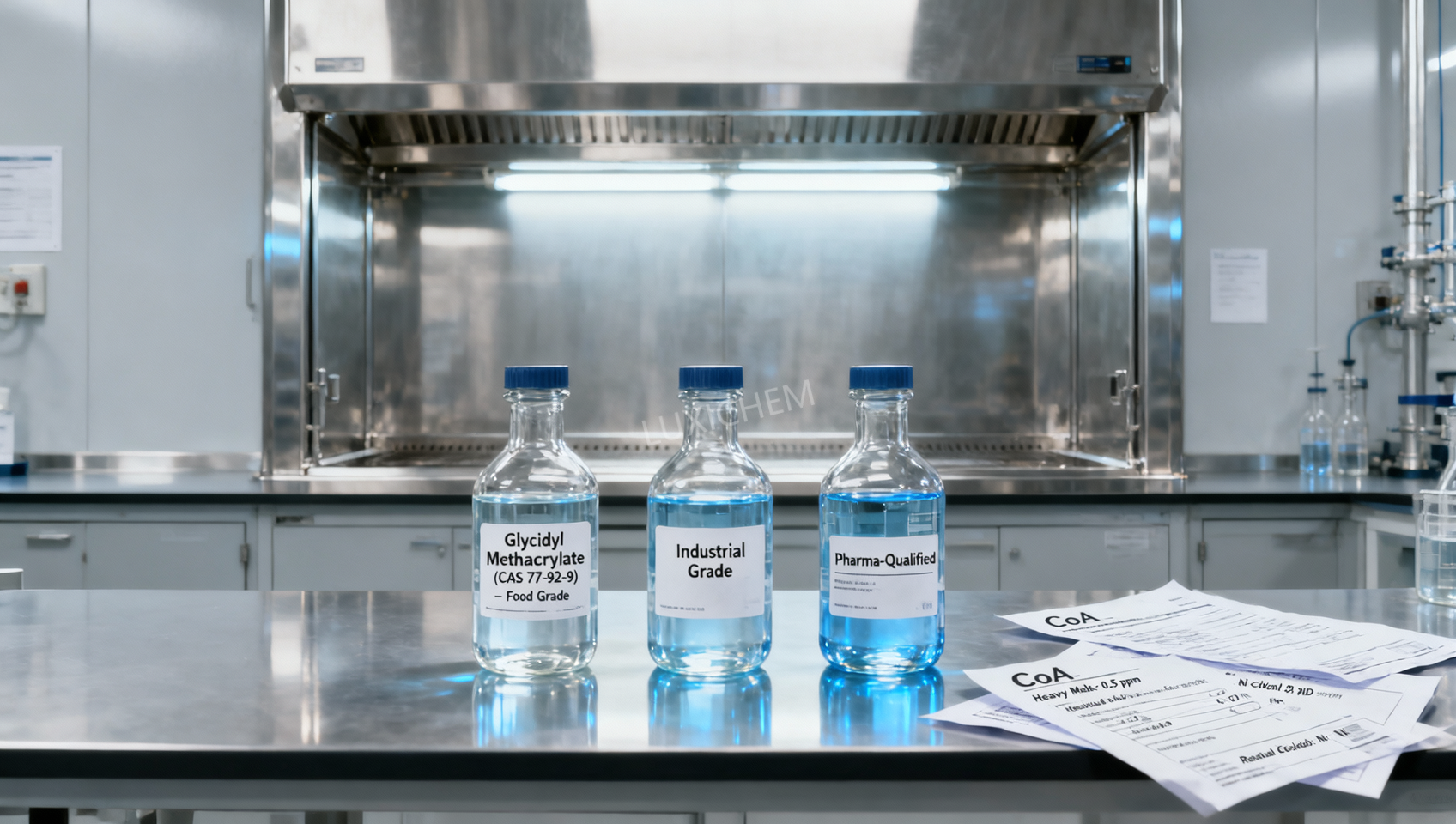
You’ve received three quotes for CAS number 77-92-9 — same identifier, same chemical name (glycidyl methacrylate), yet wildly different pricing, lead times, and documentation. One supplier lists “food-grade compliance”; another cites “industrial grade only”; the third offers no grade statement at all. You ask for CoA — and get identical purity specs: ≥98%. But your QA lab rejects the first shipment after trace metal analysis shows elevated cobalt levels. The second arrives with customs held in Rotterdam over origin documentation gaps. The third fails sterilization validation in your medical device coating process.
This isn’t outlier risk. It’s predictable failure — born from treating CAS 77-92-9 as a self-validating procurement shorthand.
CAS Match ≠ Functional Equivalence
A CAS Registry Number identifies a unique chemical structure — nothing more. It says nothing about synthesis route, residual catalysts, solvent carryover, polymerization state, or purification history. Glycidyl methacrylate (77-92-9) can be produced via:
- Epichlorohydrin + methacrylic acid (acid-catalyzed, higher chloride residue)
- Glycidol + methacrylic acid (base-catalyzed, lower halide but potential glycidol dimer impurities)
- Direct epoxidation of methyl methacrylate (metal-catalyzed, risk of nickel or copper traces)
Each route yields material with identical CAS, near-identical GC purity, and overlapping spec sheets — yet radically different suitability for food-contact polymers, biopharma excipients, or high-purity photopolymer resins. A “≥98% purity” CoA masks whether that 2% is water, unreacted glycidol, or ppm-level palladium — distinctions that determine regulatory acceptability, shelf life, and batch-to-batch reproducibility.
Where Grade Confusion Hits Procurement Hard
Procurement teams often inherit grade definitions from legacy specs or vendor marketing — not application requirements. For 77-92-9, common misalignments include:
- “Technical grade” misapplied to food-contact applications: No FDA 21 CFR 175.300 listing, yet used in resin monomers for packaging coatings — triggering audit findings.
- “Pharma-grade” claimed without ICH Q5/Q7 documentation: Lacks full impurity profiling, genotoxic assessment, or controlled manufacturing records — blocking API intermediate qualification.
- Origin opacity: Material labeled “Made in China” may contain imported raw materials from jurisdictions with differing REACH/CLP classification — creating downstream SDS inconsistencies and customs delays.
The cost impact isn’t just in rework or rejection. It’s in hidden working capital: extended quarantine periods, redundant testing per batch, engineering time spent troubleshooting formulation drift, and contractual exposure when specifications aren’t contractually defined beyond CAS and nominal purity.
What to Verify — Before You Issue the PO
Move past CAS matching. Anchor your specification to functional need. Ask suppliers — in writing — for evidence tied directly to your use case:
- Grade certification: Not “complies with industry standards,” but specific references: e.g., “meets USP-NF monograph for Glycidyl Methacrylate,” “certified to ISO 22000:2018 for food-contact intermediates,” or “manufactured under cGMP Annex 1 conditions.”
- Residual impurity profile: Request full chromatographic data — not just “≤100 ppm total impurities,” but quantified limits for glycidol, epichlorohydrin, heavy metals (Ni, Pd, Cu), and peroxides. Cross-check against your process sensitivity thresholds.
- Origin traceability: Demand batch-specific origin statements — including country of synthesis, purification site, and final packaging location. Verify alignment with your import regulations (e.g., EU PIC/S requirements, US FDA Prior Notice rules).
- Stability & handling data: Glycidyl methacrylate polymerizes exothermically. Ask for real-time accelerated stability studies (not just theoretical half-life), recommended inhibitors (MEHQ? BHT?), and validated storage conditions — especially if your facility lacks cold-chain logistics.
If a supplier hesitates on any of these — or provides templated responses — treat it as a signal. Not every supplier can support every grade requirement. That’s acceptable — if identified early.
When Material Complexity Demands More Than CAS
Similar challenges scale across chemistries where structure alone doesn’t define performance. Consider Polycarbonate CAS#25037-45-0: identical CAS covers resins ranging from low-MW standards for GPC calibration to high-flow injection molding grades with melt index 7 and thermal distortion resistance up to 140°C. A spec sheet stating “polycarbonate, ≥99.5%” tells you nothing about molecular weight distribution, gel content, or hydrolytic stability — factors that dictate whether the material survives steam sterilization cycles or maintains optical clarity in automotive lighting lenses.
The lesson isn’t to avoid CAS numbers. It’s to treat them as the first line of a multi-line specification — not the entire document. Your procurement checklist should reflect what *fails* in practice: inconsistent trace metals, undocumented synthesis routes, ambiguous origin chains, and grade claims decoupled from auditable compliance evidence.
Building Procurement Resilience
For repeat purchases of 77-92-9 or structurally similar intermediates, shift from transactional sourcing to technical partnership. Require initial qualification batches to undergo your own application-relevant testing — not just assay, but functional validation: polymerization kinetics in your formulation, extractables profiling under end-use conditions, or compatibility with downstream catalysts.
Document every deviation — not just failures, but near-misses: a batch with borderline peroxide content that passed assay but delayed your curing cycle; a CoA missing heavy metal data that forced emergency lab testing. These become your internal benchmark — sharper than any CAS match.
Ultimately, responsible procurement of chemicals like 77-92-9 isn’t about finding the lowest price per kilogram. It’s about reducing the total cost of uncertainty — in quality, compliance, and supply continuity. And that starts the moment you stop equating “CAS match” with “fit for purpose.”
Related Picks
 Butylated Hydroxytoluene Price Drivers: Supply, Purity, and Purchasing Risk FactorsOct 21, 2026Butylated Hydroxytoluene price trends depend on supply stability, purity, logistics, and purchasing risk. Learn how to compare quotes wisely and reduce sourcing costs.
 Sodium Tripolyphosphate Price Trends: Raw Material and Energy ExposureOct 20, 2026Explore sodium tripolyphosphate price trends, from phosphate and soda ash costs to energy exposure. Learn how to compare quotes, manage sourcing risks, and make smarter purchasing decisions.
 Acetonitrile Shipment to Vietnam Successfully Dispatched; RCEP Benefits Boost Fine Chemical Trade with ASEANSep 16, 2026A shipment of industrial-grade acetonitrile from our company has recently been loaded and dispatched following the completion of standardized hazardous material packaging and container securing procedures.
 Nigerian Client’s Order of 4 Containers of Vinyl Acetate Successfully Loaded and Shipped to West AfricaSep 16, 2026We recently completed the loading of a vinyl acetate order for a Nigerian client; four containers of the product have been successfully packed and are ready for shipment to Nigeria.




Question Consultation
Send Us Your Inquiry Today

Luxi Chemical is a professional chemical product supplier with ample stock of all chemical categories and excellent quality, welcome your purchase inquiry.

