


CAS Number 77-92-9 in Global Trade: Why It Matters for Customs and Documentation
CAS Number 77-92-9 in Global Trade: Why It Matters for Customs and Documentation
In global chemical trade, understanding cas number 77 92 9 is more than a technical detail. It sits at the intersection of product identity, customs filing, labeling, and regulatory communication. For companies moving chemical goods across borders, especially in food additives and related industrial chains, a missing or inconsistent CAS reference can trigger delays that have nothing to do with product quality and everything to do with documentation discipline.
CAS Number 77-92-9 refers to citric acid, one of the most widely traded organic acids in the world. Because citric acid appears in food processing, daily chemicals, pharmaceuticals, cleaning formulations, and certain industrial applications, it often moves through multiple channels: manufacturer to trader, trader to distributor, distributor to end user. The wider the chain, the more likely documentation will be touched by different teams, translated into different formats, and checked by different authorities. That is exactly why the CAS number matters.
For distributors and agents, the real issue is not “What is 77-92-9?” but “How does using it correctly help avoid avoidable trade friction?” In practice, it helps align commercial paperwork with technical paperwork, and that alignment tends to be where smooth customs clearance starts.
Why customs teams look at CAS numbers even when the product name seems obvious
Product names are not always enough. “Citric acid” sounds straightforward, but names can vary by language, purity grade, hydrate form, application field, or local naming habits. In some trade documents, buyers may describe the material by a functional term such as acidulant or food additive. In others, the supplier may use a full technical description. Customs brokers and compliance reviewers often rely on the CAS number as the stable identifier that cuts through naming variation.
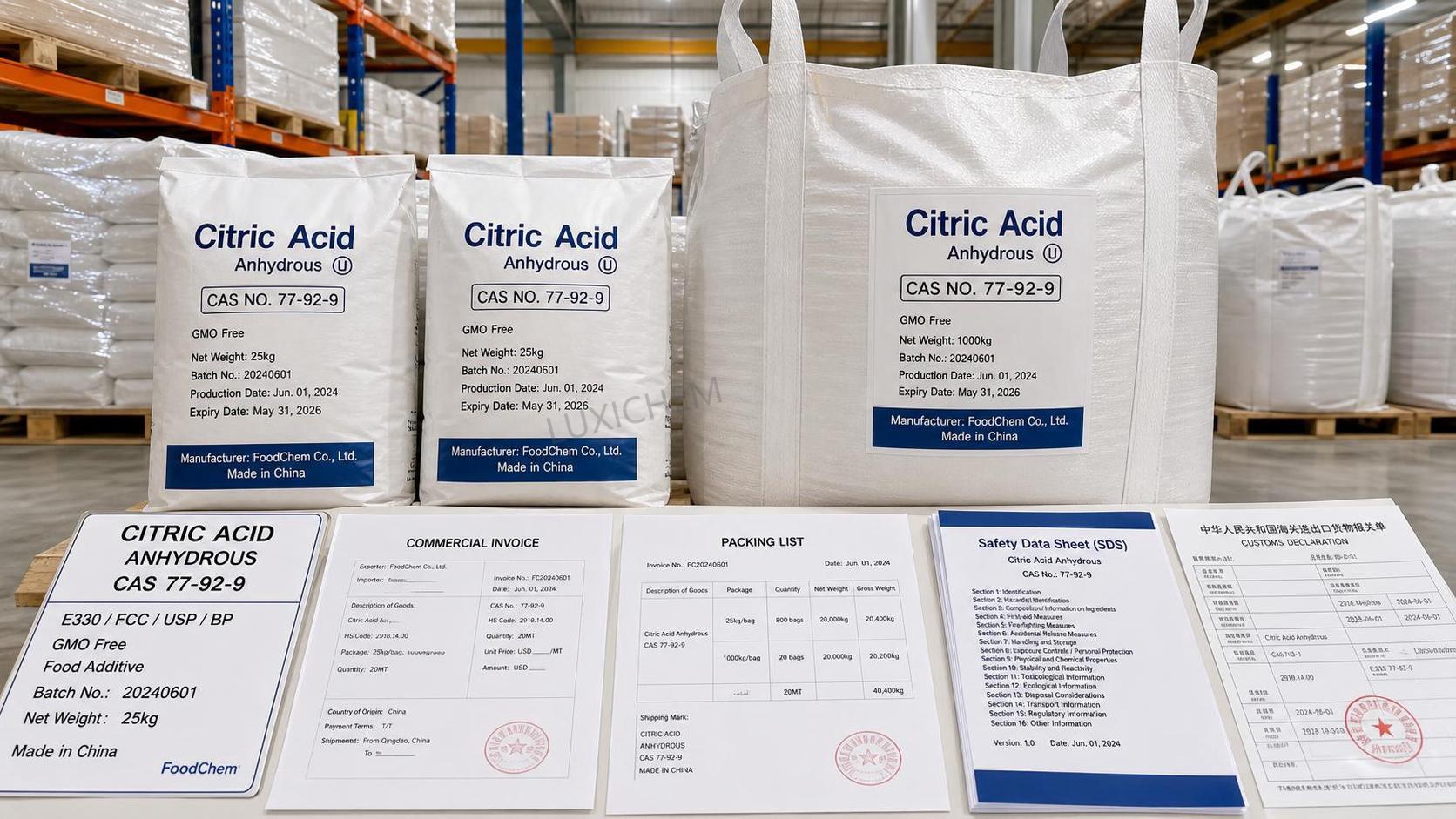
That does not mean a CAS number replaces everything else. It does not substitute for HS classification, product specification, packing declaration, or hazard assessment. But it gives all parties a common reference point. When the invoice says citric acid, the SDS lists CAS 77-92-9, the COA identifies the same substance, and the packing label is consistent, the file is easier to review. When those documents drift apart, questions start quickly.
A common trade-side mistake is assuming that because a material is routine, the paperwork can be simplified. In reality, routine products are often screened faster but also flagged faster when something looks inconsistent. Customs officers and freight compliance teams see enough standard goods to notice when a standard item is described in a nonstandard way.
Where 77-92-9 shows up in documentation—and where errors usually happen
In a typical export file for citric acid, the CAS reference may appear in the safety data sheet, technical data sheet, product specification, internal ERP item description, customs declaration support file, and sometimes customer-facing compliance sheets. The trouble is that these documents are often generated by different departments. Sales may use a short commercial name. Regulatory staff may use a standardized chemical identity. Warehousing may print a label version based on an older template.
That is where small inconsistencies become expensive. One document lists anhydrous grade, another refers to monohydrate, and a third only says citric acid with CAS 77-92-9. Depending on the destination market, that may still be manageable, or it may require clarification before release. The issue is not that customs always rejects such files, but that every clarification request adds time, broker communication, and sometimes storage cost.
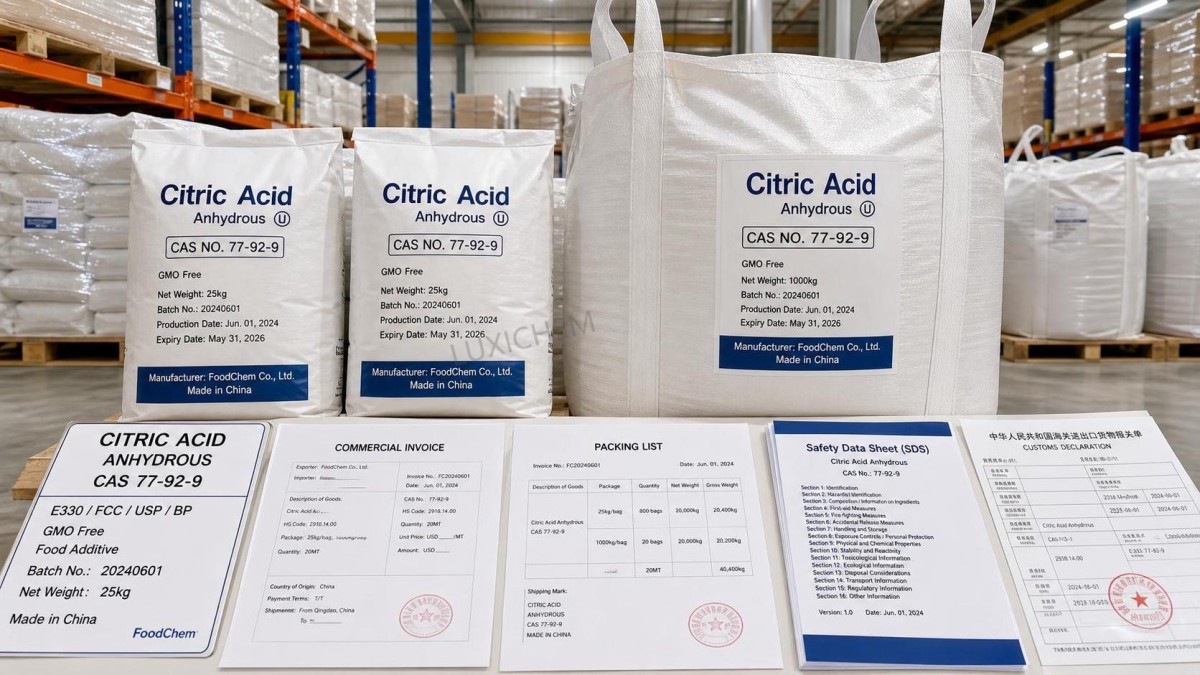
The safer approach is to treat the CAS number as one checkpoint in a larger document control process. Before shipment, many experienced exporters compare at least these points across the file set:
- chemical name and CAS number are consistent across SDS, invoice, and label;
- grade description matches the intended use and customer order;
- packing description and net weight format are uniform;
- HS code is reviewed separately rather than inferred only from CAS identity;
- destination-country requirements are checked where food, feed, or industrial use triggers different documentation expectations.
That last point is easy to underestimate. A single CAS number can appear in multiple regulatory contexts. The substance may be recognized globally, but the required supporting documents can still differ by market and by declared end use.
CAS number versus HS code: related, but not interchangeable
One of the more persistent misunderstandings in chemical trading is the idea that CAS numbers determine customs classification. They do not. CAS Number 77-92-9 identifies the substance, while the HS code determines tariff treatment and customs classification. The two are linked in practice because customs uses product identity to understand what is being shipped, but they serve different functions.
This matters when distributors prepare documents on behalf of overseas buyers. If a buyer requests “the CAS and HS code,” it is worth confirming whether they need the CAS for internal material registration, customs declaration support, safety review, or all three. Using the right CAS number will improve clarity, but it does not remove the need to verify the correct HS treatment under the importing country’s rules. Some classifications also depend on formulation, concentration, or product presentation, not just substance identity.
The practical value for distributors and cross-border partners
For companies that do not manufacture every product themselves, document accuracy becomes part of service quality. A distributor may not produce citric acid, but it is often the distributor who is asked to provide the final paperwork set, coordinate with brokers, and answer last-minute questions from the consignee. If the CAS number is wrong, omitted, or inconsistent with the SDS revision in circulation, the distributor is usually the first party contacted.
This is one reason experienced chemical trading companies build their catalog around compliant, clearly traceable product information rather than only price and availability. Luxi Chemical (Shandong) Co., Ltd., for example, operates across chemical raw materials, chemical products, and import/export trade, serving customers in more than 60 countries and regions. In that kind of trade environment, the value of a diversified product range is not only one-stop procurement. It is also the ability to maintain consistent product identity management across food additives, organic intermediates, and fertilizers where document expectations differ by application and destination.
That discipline matters beyond citric acid. Even when handling a different item such as HydroxyapatiteCAS#1306-06-5, the same basic rule applies: substance identity, technical documents, labels, and customs-facing descriptions need to tell the same story. The chemistry may change, but the documentation logic does not.
What buyers often overlook before shipment
Many buyers focus on price term, lead time, and packaging, then review technical documents only when the goods are already booked. That is late. For a product identified by cas number 77 92 9, the better time to check documentation is before PO confirmation or at least before final shipping instruction. A few questions are worth settling early:
- Is the required grade clearly defined in the order and reflected in the specification?
- Will the consignee need food-related documentation, industrial-use documentation, or both?
- Does the local broker expect the CAS number to appear on the invoice or only in supporting files?
- Are language translations aligned with the original technical description?
These are not abstract compliance questions. They affect whether a file can be processed in one pass. In some regions, importers also maintain internal approved-material systems keyed by CAS number. If the product description on the shipment documents is looser than the one in the importer’s system, the customs issue may be solved while the internal receiving issue remains. That is another kind of delay, and it is common enough to plan for.
A note on compliance language: be precise, but do not overstate
There is also a tendency in chemical trade to overload documents with compliance phrases that sound reassuring but do not answer the real question. Saying a product is “export standard” or “international quality” is rarely helpful in a customs context. What helps is a clear chemical identity, accurate CAS reference, consistent grade description, and documentation suited to the destination market.
The same caution applies to regulatory assumptions. Citric acid is widely used and generally familiar to authorities, but that does not mean every market asks for the same supporting materials. If the shipment is tied to food processing, the importer may need one set of documents; if it is for industrial blending, the expectation can be different. Those details usually need to be confirmed against current local requirements rather than copied from the previous shipment file.
In day-to-day trade, the companies that avoid repeated clearance problems are usually not the ones with the fanciest paperwork. They are the ones that keep the paperwork internally consistent. For cas number 77 92 9, that means treating the CAS entry as a control point, not a decorative line in the SDS. If your invoice, specification, labels, and broker instructions all align from the beginning, customs questions tend to become manageable exceptions instead of routine obstacles.
Before the next shipment of citric acid goes out, it is worth doing one simple check: open every document in the file and see whether the product identity reads as if it came from one source. If it does not, fix that first. In cross-border chemical trade, that small step often saves more time than chasing the problem after the cargo arrives.
Related Picks
 Butylated Hydroxytoluene Price Drivers: Supply, Purity, and Purchasing Risk FactorsOct 21, 2026Butylated Hydroxytoluene price trends depend on supply stability, purity, logistics, and purchasing risk. Learn how to compare quotes wisely and reduce sourcing costs.
 Sodium Tripolyphosphate Price Trends: Raw Material and Energy ExposureOct 20, 2026Explore sodium tripolyphosphate price trends, from phosphate and soda ash costs to energy exposure. Learn how to compare quotes, manage sourcing risks, and make smarter purchasing decisions.
 Acetonitrile Shipment to Vietnam Successfully Dispatched; RCEP Benefits Boost Fine Chemical Trade with ASEANSep 16, 2026A shipment of industrial-grade acetonitrile from our company has recently been loaded and dispatched following the completion of standardized hazardous material packaging and container securing procedures.
 Nigerian Client’s Order of 4 Containers of Vinyl Acetate Successfully Loaded and Shipped to West AfricaSep 16, 2026We recently completed the loading of a vinyl acetate order for a Nigerian client; four containers of the product have been successfully packed and are ready for shipment to Nigeria.




Question Consultation
Send Us Your Inquiry Today

Luxi Chemical is a professional chemical product supplier with ample stock of all chemical categories and excellent quality, welcome your purchase inquiry.

