


Citric Acid Anhydrous Manufacturers: 7 Factors That Separate Stable Partners from Traders
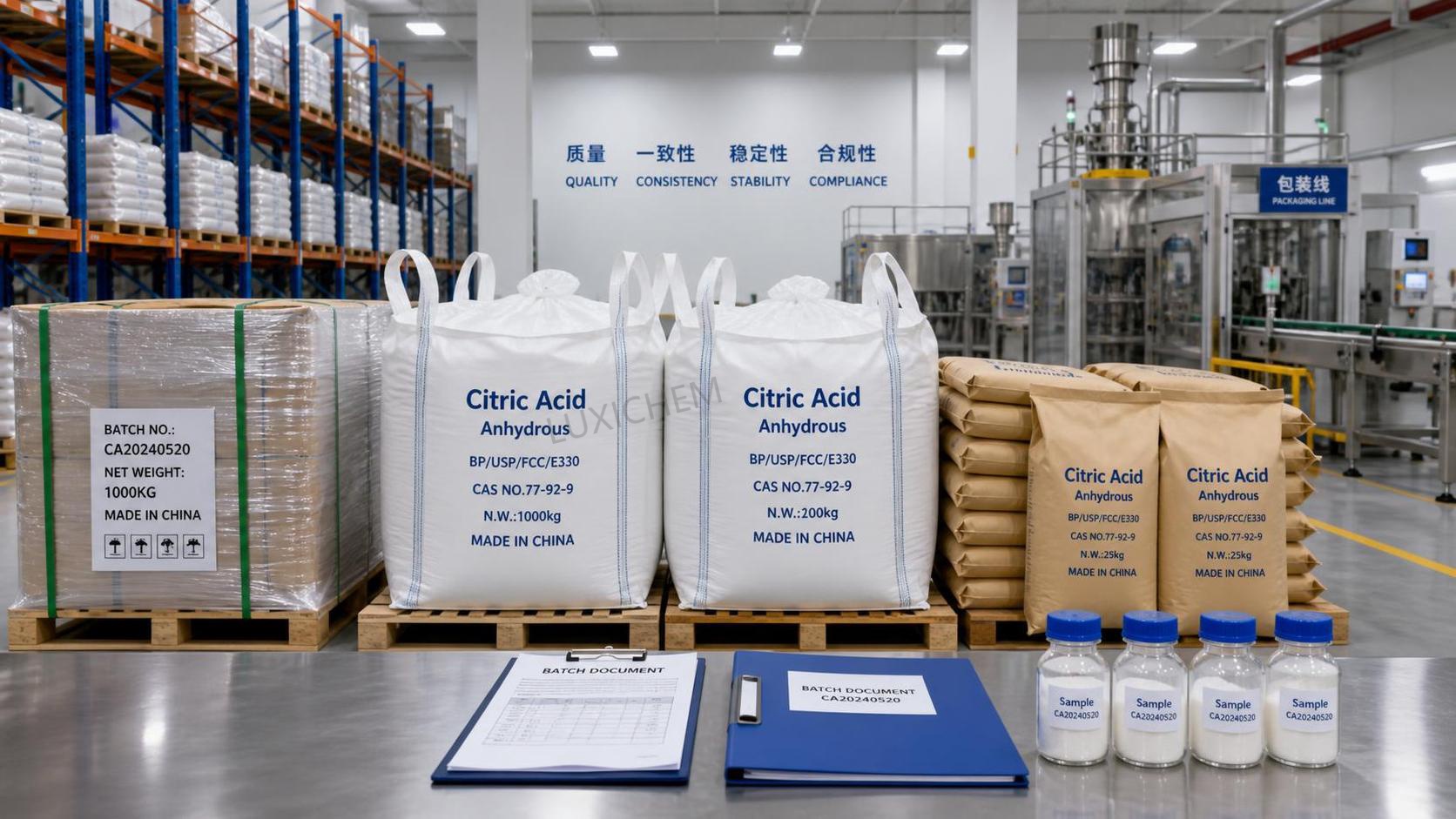
It often starts with a familiar procurement problem: two suppliers quote the same product, both claim steady quality, and both sound responsive during early discussions. Yet once internal review begins, the differences become harder to read. One company may look like a manufacturer, but only behaves like an intermediary. Another may offer an attractive first quote, but leaves unanswered questions around continuity, documentation, or lot-to-lot consistency. For teams comparing citric acid anhydrous manufacturers, this uncertainty can slow approvals and increase supply risk long before the first shipment is even booked.
The difficulty is not just technical. A weak choice can create repeated follow-up work across purchasing, quality, logistics, and compliance review. Delays in confirming specifications, unclear packaging standards, unstable lead times, or incomplete export paperwork can turn a simple sourcing task into a chain of avoidable problems. In practice, the safer decision usually comes from asking better questions rather than chasing the lowest number on the quotation sheet.
Many purchasing reviews become confusing because “manufacturer” is used loosely. Some suppliers own production assets and control their schedule, raw material planning, and quality process. Others rely on outside factories, switching sources as price changes. That does not automatically make traders unusable, but it does change the kind of risk you are accepting. If your goal is to identify stable citric acid anhydrous manufacturers for long-term cooperation, seven factors tend to separate reliable partners from sellers who mainly pass orders downstream.
1. The first useful distinction is control, not wording
A supplier may present itself with factory photos, product lists, and broad claims about output capacity. Those materials are common and not especially helpful by themselves. The practical question is simpler: who controls production planning and who controls nothing beyond communication?
When reviewing a supplier, look for signs of direct operational control. Can they explain their normal production cycle for citric acid anhydrous without giving vague answers? Can they discuss how they handle demand fluctuations, packaging changes, and order scheduling? Do they respond clearly when asked about lot release, moisture management, or storage conditions? A company that works closely with actual production usually answers these points in a grounded way. A trading-only seller often stays general and returns to price.
This matters because supply stability rarely fails at the quotation stage. It fails later, when an urgent shipment needs rescheduling, when a packaging revision is requested, or when one batch needs additional supporting documents. Control becomes visible exactly when something changes.
2. Consistency is more important than a single “good” sample
One of the easiest mistakes in sourcing is to treat a satisfactory sample as proof of long-term reliability. A sample can confirm that a supplier is capable of sending acceptable material once. It does not prove that the same quality level will be maintained across routine orders.
For citric acid anhydrous, stability from lot to lot matters because downstream production does not like variation, even when variation remains technically within a broad acceptable range. During evaluation, it helps to ask how the supplier manages specification consistency in regular production, not only what appears on a specification sheet. If answers stay limited to “we can meet your standard,” that is not enough.
More useful discussions include packaging environment, moisture exposure control, release procedure, retention practices, and how deviations are communicated. You are not necessarily looking for a perfect script. You are looking for evidence that consistency is managed as a routine process rather than treated as a sales promise.
In broader chemical sourcing, this way of thinking also helps when comparing unrelated products. For example, if a supplier handles materials with stricter handling expectations, such as Aluminum Phosphide CAS#20859-73-8, the review naturally shifts toward process discipline, documentation accuracy, and storage awareness. That does not substitute for evaluating citric acid anhydrous directly, but it reminds buyers to look at operational habits, not just product names.
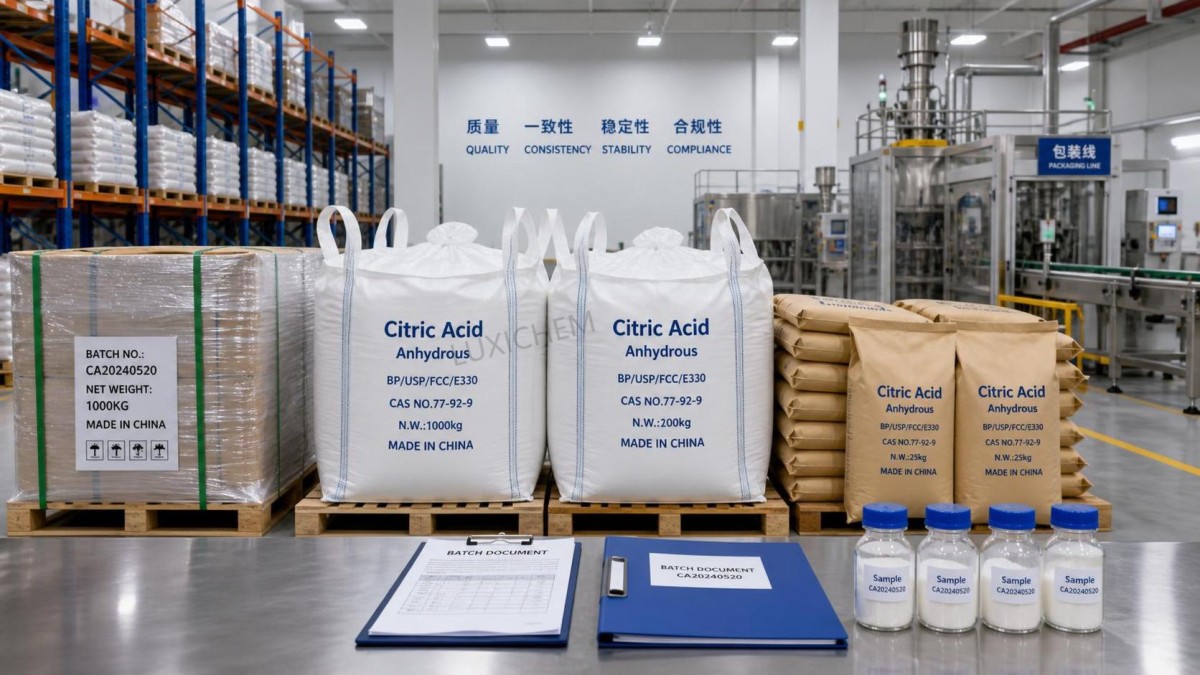
3. Documentation quality often reveals the real working level of the supplier
Teams sometimes focus so heavily on product price and specification that they overlook the supplier’s documentation habits. But paperwork quality is often one of the clearest indicators of whether future cooperation will be smooth or exhausting.
Stable partners usually provide documents in a way that is organized, timely, and internally consistent. Their product description, packing details, document format, and shipping information align with each other. If revisions are needed, they are handled with reasonable speed and fewer contradictions. By contrast, unstable suppliers may send mismatched information from one email to the next, provide incomplete files, or answer direct documentation questions with unrelated attachments.
For sourcing decisions, this matters because poor paperwork is rarely an isolated problem. It often points to weak internal coordination. If a supplier struggles to keep specification sheets, package descriptions, and export information consistent during evaluation, the same pattern may continue during booking, customs preparation, or post-shipment support.
A practical review method is to observe the full response process. Do answers arrive in a way that suggests the team knows the product and transaction flow? Or does each new question restart the conversation? The more fragmented the response, the more likely you are dealing with a seller who has limited control over the actual supply chain.
4. Delivery dependability should be tested through scenarios, not promises
Almost every supplier says delivery is stable. The issue is that “stable” means little without context. A better approach is to discuss specific operating situations and see how the supplier responds.
For example, what happens if the order volume changes after confirmation? What if packaging needs to be adjusted for a destination requirement? What if shipping space tightens or a vessel plan shifts? What if document correction is needed before release? Stable citric acid anhydrous manufacturers, or suppliers with strong factory-side coordination, tend to answer these questions by describing a sequence of actions. Trading-only suppliers often stay at the level of reassurance.
The goal here is not to trap the supplier. It is to understand how they behave when the transaction stops being routine. Many procurement problems do not come from major disputes; they come from ordinary friction that nobody planned for. A dependable partner usually has a visible method for dealing with that friction.
Lead time discussions should also go beyond the shortest-case answer. Ask about normal lead time, busy-period lead time, and any conditions that commonly extend dispatch. If you only collect the most optimistic response, your internal planning may be built on the least realistic scenario.
5. Product range can reduce operational risk, but only if it is relevant
Some buyers prefer specialized suppliers with a narrow focus. Others prefer broader chemical suppliers that can support consolidated purchasing. Neither model is automatically better. The useful question is whether the product range helps reduce real purchasing friction.
If your team frequently sources food additives together with adjacent chemical categories, a supplier with a wider portfolio may simplify communication, shipping coordination, and vendor management. On the other hand, a broad list of products means little if the supplier cannot support each line with reliable technical and document handling.
This is why product range should be reviewed as an operational capability rather than a catalog advantage. Does the supplier understand application differences across categories? Can they separate what they directly support from what they only broker? Are they able to explain packaging and transport considerations by product type? If a company handles multiple chemical lines, including items such as Aluminum Phosphide CAS#20859-73-8, you can often learn a lot by watching how carefully they distinguish between products with very different handling and compliance expectations.
A useful partner does not need to sell everything. They need to be clear about what they can support steadily and where the limits are. Clear boundaries are usually a better sign than exaggerated breadth.
6. Service quality is not about friendliness; it is about problem handling
Many suppliers are polite during the quotation stage. That alone does not help much. Real service quality appears in the middle of ordinary work: specification clarification, packaging confirmation, shipping updates, discrepancy follow-up, and post-order communication.
When comparing citric acid anhydrous manufacturers, pay attention to how the supplier handles small but important corrections. If an attachment is wrong, do they fix it accurately or send a rushed replacement that creates another issue? If you ask a detailed product question, do they answer directly or switch back to commercial language? If a timeline changes, do they inform you early or only after repeated follow-up?
These details may seem minor during supplier screening, but they strongly affect the total cost of coordination. A partner who answers clearly, escalates issues quickly, and keeps information consistent can save far more internal effort than a lower-priced source that generates avoidable back-and-forth at every step.
It also helps to assess continuity of contact. If every question passes through a different person with no visible handover quality, routine transactions can become unnecessarily fragile. Stable suppliers usually maintain a communication structure that makes follow-up easier, even when staff roles differ across sales, operations, and documentation.
7. The safest decision usually comes from a layered review, not a quick comparison
Procurement pressure often creates a false choice between speed and caution. In reality, the most efficient evaluations are not the shortest ones; they are the ones that remove uncertainty in the right order.
A practical decision process often starts with basic fit: specification alignment, packaging suitability, destination feasibility, and document availability. After that, the review should move toward operating reliability: consistency, production-side control, delivery response, and communication quality. Only then does price become meaningful in context. A low quote from a supplier with weak coordination can be expensive once delays, repeated clarifications, or preventable supply interruptions are factored into the work.
It also helps to compare suppliers based on the type of relationship you need. If the requirement is occasional spot purchasing and the internal team can absorb higher coordination effort, a trader may still be acceptable. If the requirement is recurring procurement with lower tolerance for disruption, then stronger preference should be given to suppliers that demonstrate factory-side control, disciplined documentation, and steadier execution.
This is where many selection exercises become clearer. The question is not simply “who offers citric acid anhydrous at the best price?” It is “who can support the purchasing process with fewer surprises over time?” Once that shift happens, the right supplier often becomes easier to identify.
When a supplier looks similar on paper, use friction to judge the difference
If several candidates appear comparable, do not focus only on certificates, brochures, or headline statements. Watch what happens when you ask for a document revision, a packaging clarification, or an explanation of lead-time assumptions. Friction exposes structure. Strong suppliers usually become more convincing under detailed review; weak ones become less clear.
For business assessment teams, that is often the most reliable way to separate stable partners from trading-only sellers. The strongest citric acid anhydrous manufacturers are not necessarily the ones making the loudest claims. They are the ones that remain consistent when the discussion moves from quotation to execution, from generic assurances to practical coordination, and from one shipment to an ongoing supply relationship.
In the end, supplier selection is less about finding a perfect company than about reducing avoidable uncertainty. If your review process tests control, consistency, documentation, delivery behavior, product relevance, and service response in realistic conditions, you are far more likely to choose a partner that supports steady procurement instead of adding hidden work later.
Related Picks
 Butylated Hydroxytoluene Price Drivers: Supply, Purity, and Purchasing Risk FactorsOct 21, 2026Butylated Hydroxytoluene price trends depend on supply stability, purity, logistics, and purchasing risk. Learn how to compare quotes wisely and reduce sourcing costs.
 Sodium Tripolyphosphate Price Trends: Raw Material and Energy ExposureOct 20, 2026Explore sodium tripolyphosphate price trends, from phosphate and soda ash costs to energy exposure. Learn how to compare quotes, manage sourcing risks, and make smarter purchasing decisions.
 Acetonitrile Shipment to Vietnam Successfully Dispatched; RCEP Benefits Boost Fine Chemical Trade with ASEANSep 16, 2026A shipment of industrial-grade acetonitrile from our company has recently been loaded and dispatched following the completion of standardized hazardous material packaging and container securing procedures.
 Nigerian Client’s Order of 4 Containers of Vinyl Acetate Successfully Loaded and Shipped to West AfricaSep 16, 2026We recently completed the loading of a vinyl acetate order for a Nigerian client; four containers of the product have been successfully packed and are ready for shipment to Nigeria.




Question Consultation
Send Us Your Inquiry Today

Luxi Chemical is a professional chemical product supplier with ample stock of all chemical categories and excellent quality, welcome your purchase inquiry.

