


Can citric acid preservative performance change at different pH levels?
Can Citric Acid Preservative Performance Change at Different pH Levels?
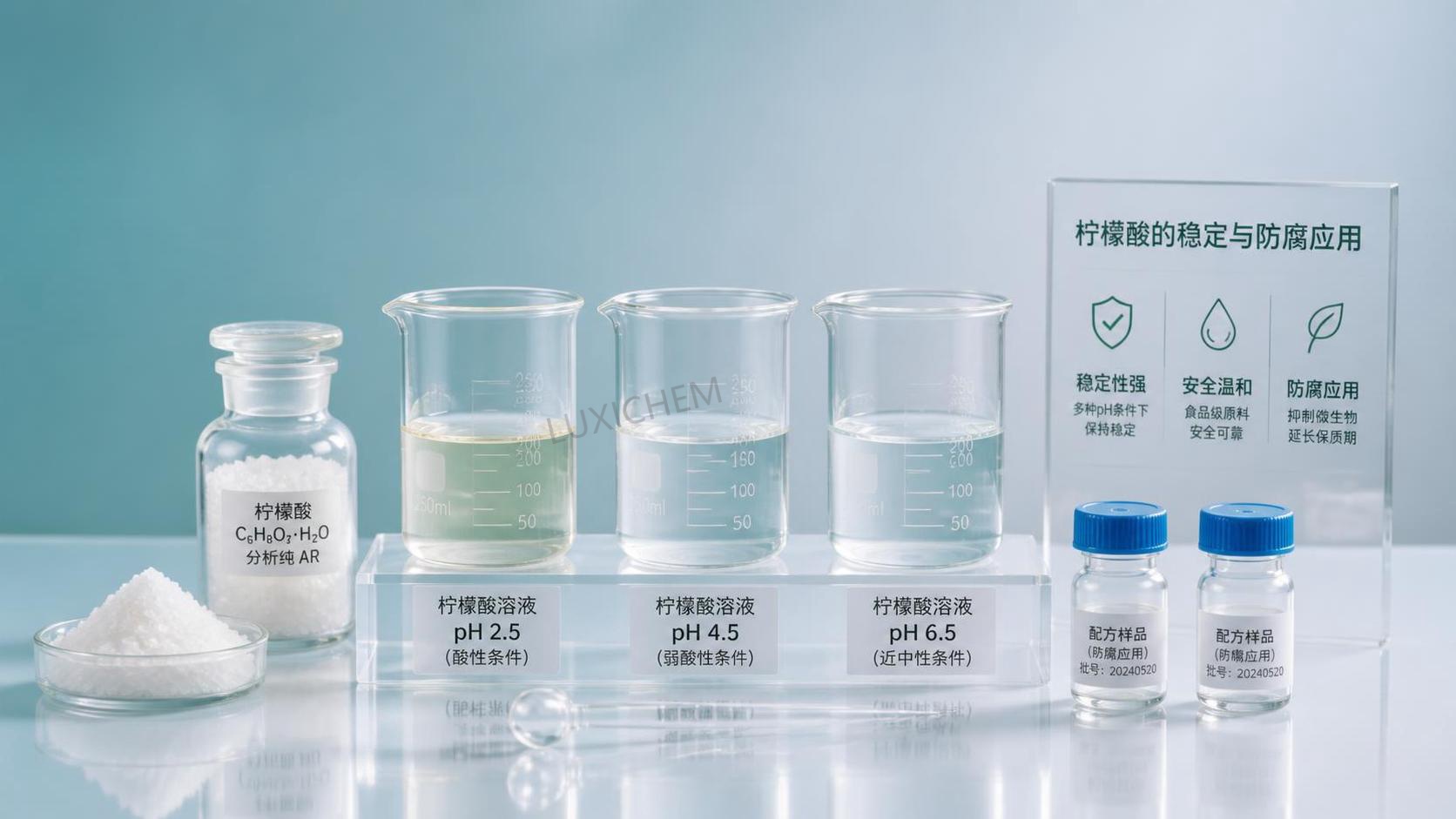
Yes. Citric acid preservative performance can change substantially as pH changes, and this is one of the most common reasons why an apparently sound formulation performs differently in production, storage, or challenge testing. Citric acid is often selected because it is familiar, broadly accepted in many applications, and useful as an acidulant, chelating agent, and process aid. However, treating it as a stand-alone antimicrobial preservative without examining the finished product pH can lead to disappointing results.
For technical evaluation, the key point is not simply whether citric acid is present. It is how much of it remains in its undissociated acid form at the actual pH of the system, what microorganisms are relevant, whether the formula contains other preservation hurdles, and how the product will be manufactured and used. A low-pH beverage, a neutral liquid detergent, and a high-moisture food preparation may all contain citric acid, but they should not be expected to show the same preservation behavior.
Why pH changes the behavior of citric acid
Citric acid is a triprotic organic acid. In water, it exists as a mixture of undissociated citric acid molecules and citrate ions. The balance between these forms shifts with pH. At lower pH, a greater proportion remains undissociated. As pH rises, more of the acid dissociates into ionic forms.
That distinction matters because undissociated organic acids are generally more able to cross microbial cell membranes than their charged forms. Once inside a cell, where the internal environment is usually less acidic, the acid can dissociate. This may disrupt intracellular pH control and place metabolic stress on the organism. The effect is not unique to citric acid, but it explains why acid-based preservation strategies usually work better in acidic products than in near-neutral ones.
Citric acid also reduces pH directly. In some systems, this pH reduction is the more important contribution, rather than a strong direct antimicrobial action from citric acid itself. This is an important practical distinction. If a formula performs well only because its pH has been lowered, a later adjustment with water, alkaline ingredients, fragrance bases, surfactants, or mineral-rich raw materials may weaken the preservation margin even though the citric acid dosage has not changed.
A technical assessor should therefore evaluate the finished product pH, not merely the pH of the aqueous phase before all ingredients are added. In emulsions and surfactant systems, the pH measured during laboratory batching can move after equilibration. In powdered products reconstituted by users, the relevant pH may be the pH after dilution rather than the pH of the dry blend.
Low pH is helpful, but it does not make citric acid a universal preservative
In acidic products, citric acid can support microbial control more effectively than it can in neutral or alkaline products. Acid-sensitive bacteria may be inhibited by the low-pH environment, while the undissociated fraction of the acid contributes additional stress. This is why citric acid is frequently considered in acidic food systems, fruit-based preparations, certain beverages, and some personal-care formats.
But low pH alone does not resolve every preservation risk. Yeasts and molds often tolerate acidic conditions better than many bacteria. Acid-tolerant spoilage organisms can also remain relevant where products contain sugars, botanical materials, proteins, or other nutrients. A syrup, fruit filling, sauce, or acidic cleanser may be hostile to some bacteria while still requiring attention to fungal contamination, packaging hygiene, water quality, and preservative compatibility.
This is where formulation discussions can become misleading. A citric acid preservative approach may be described as “effective in acidic conditions,” which is directionally true, but incomplete. Effective against which organisms? At what finished pH? In which matrix? After what storage period? Those questions cannot be answered from a raw-material specification alone.
The table is intentionally qualitative. Actual acceptance limits and preservative decisions should be based on the product category, relevant local requirements, microbiological risk assessment, and appropriate testing. It is not sensible to convert a general pH principle into a universal dosage rule.
The often-overlooked role of chelation
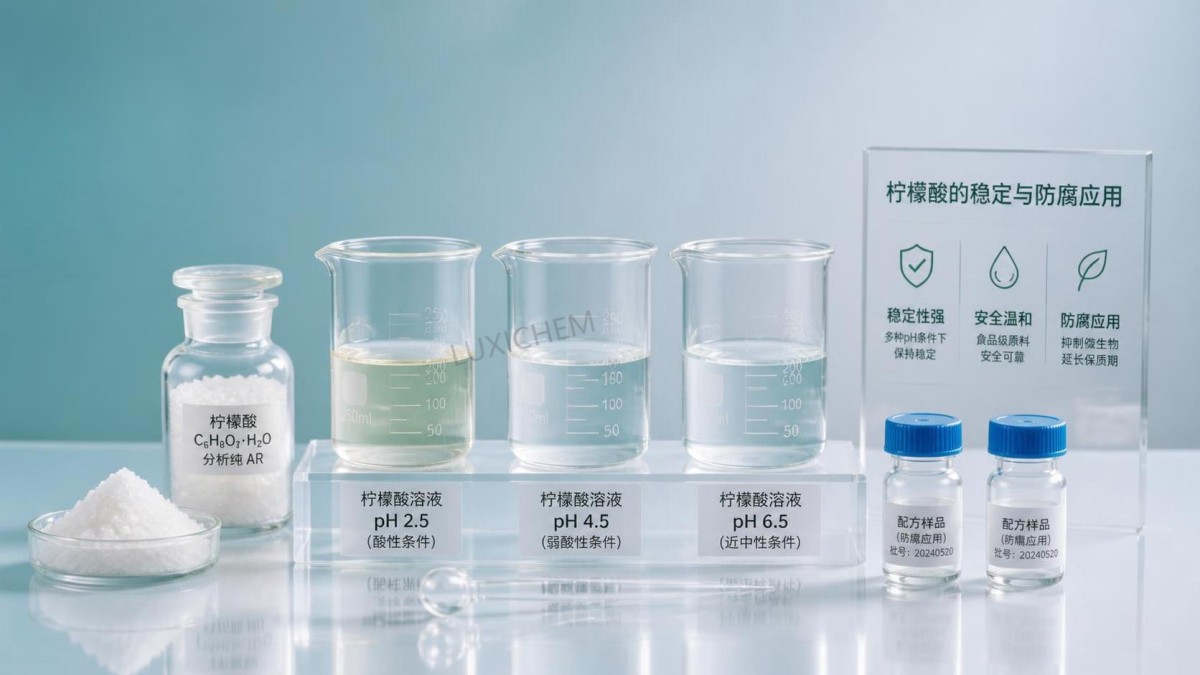
Citric acid can bind certain metal ions, which is one reason it is valuable beyond acidification. In food and daily chemical formulations, trace metals can contribute to oxidation, discoloration, off-odors, or instability of sensitive ingredients. By complexing metal ions, citric acid may improve the overall chemical stability of a system. That indirect effect can be commercially useful even when the direct antimicrobial contribution is modest.
Chelation should not, however, be confused with a guarantee of preservation. A formula may become more stable against oxidation while remaining vulnerable to microbial growth. Conversely, an antimicrobial system may look acceptable in a simple water solution but lose performance when salts, proteins, extracts, or surfactants alter its effective environment.
Raw-material compatibility deserves attention here. In a broad chemical purchasing program, materials may range from food additives and organic intermediates to fertilizers and inorganic compounds such as Triiron tetraoxide CAS#1317-61-9. These materials should never be evaluated as if they were interchangeable procurement items. For a citric-acid-containing formulation, the relevant questions are chemical grade, impurity profile, intended-use compliance, particle or solution handling, and potential interactions with the finished matrix. The convenience of sourcing multiple materials from one supplier does not remove the need for application-specific controls.
Where pH control becomes difficult in real formulations
The laboratory formula is rarely the whole story. Buffering ingredients can resist acidification, so adding citric acid may have less impact on pH than expected. Proteins, phosphates, carbonate-containing raw materials, certain surfactants, and natural extracts can all alter the acid demand. Water quality also matters. Water with appreciable alkalinity can consume part of the added acid before the desired pH is reached.
A familiar production issue is measuring pH immediately after acid addition, recording an acceptable value, and then finding a different result after mixing, deaeration, or overnight standing. In systems with suspended solids or emulsified phases, pH readings can be influenced by sampling location and electrode condition. A poorly maintained pH electrode is enough to send a preservation decision in the wrong direction.
Temperature introduces another layer. The pH of a formulation can change between hot processing and ambient storage, and microbial risk is normally judged in the finished, stored product rather than in a hot batch tank. When citric acid is used in heat-processed foods, assessors should also consider whether post-process contamination is possible and whether the packaging and filling operation preserve the intended hygienic barrier.
How to evaluate a citric acid preservative strategy properly
A practical evaluation starts with the formulation objective. Is citric acid being used to lower pH, assist a separate preservative system, chelate metals, adjust flavor, or perform several of these functions at once? The answer affects what should be tested. If it is mainly an acidulant, the evaluation should focus on pH robustness and sensory or performance limits. If it is expected to support preservation, microbial challenge testing or another suitable validation approach becomes more important.
It is useful to test more than one pH point around the proposed target, especially where production variation is realistic. A formulation that performs only at a narrow pH value may be difficult to control at commercial scale. Assessing the lower and upper ends of the internal pH specification gives a more honest picture of risk than validating a single ideal laboratory batch.
Technical teams should also examine whether the selected pH is compatible with packaging, viscosity, color, fragrance, taste, active ingredients, and consumer use. For example, forcing a lower pH solely to strengthen organic-acid performance may create corrosion concerns, destabilize an emulsion, change a detergent’s cleaning behavior, or make a food product unacceptably sour. Preservation is always a formulation trade-off, not a one-variable exercise.
For food applications, legal use conditions and additive declarations must be reviewed in the intended market. For cosmetics, home care, and industrial products, the relevant product safety, labeling, and biocidal-preservative rules can differ by jurisdiction. Citric acid’s accepted use in one product category should not be assumed to establish suitability in another. This is particularly relevant for exporters serving multiple regions.
A sensible procurement and quality-control view
For a material as widely used as citric acid, consistency often matters more than novelty. Technical teams usually need clear identity and quality documentation, reliable lot traceability, suitable packaging, and a specification that matches the intended application. A change in grade, moisture behavior, particle form, or impurity profile may affect dissolution, acidity adjustment, appearance, or process repeatability.
Luxi Chemical (Shandong) Co., Ltd. supplies chemical raw materials and chemical products across food additives, organic intermediates, and fertilizers, with import and export service for customers in many markets. For buyers managing multi-category sourcing, that breadth can simplify procurement coordination. Yet citric acid selection should still be tied to the actual formulation need: confirm the intended-use standard, request relevant technical documentation, evaluate incoming material against internal controls, and verify finished-product performance rather than relying on generic claims.
The most defensible conclusion is straightforward: citric acid works differently at different pH levels because its chemical form and functional contribution change with the environment. In acidic systems, it can be a useful part of a preservation design. As pH approaches neutrality, its direct antimicrobial value becomes less dependable, and other hurdles become more important. The right question is not “Does citric acid preserve?” but “What does it contribute at this product’s final pH, under this processing and storage condition?”
Related Picks
 Butylated Hydroxytoluene Price Drivers: Supply, Purity, and Purchasing Risk FactorsOct 21, 2026Butylated Hydroxytoluene price trends depend on supply stability, purity, logistics, and purchasing risk. Learn how to compare quotes wisely and reduce sourcing costs.
 Sodium Tripolyphosphate Price Trends: Raw Material and Energy ExposureOct 20, 2026Explore sodium tripolyphosphate price trends, from phosphate and soda ash costs to energy exposure. Learn how to compare quotes, manage sourcing risks, and make smarter purchasing decisions.
 Acetonitrile Shipment to Vietnam Successfully Dispatched; RCEP Benefits Boost Fine Chemical Trade with ASEANSep 16, 2026A shipment of industrial-grade acetonitrile from our company has recently been loaded and dispatched following the completion of standardized hazardous material packaging and container securing procedures.
 Nigerian Client’s Order of 4 Containers of Vinyl Acetate Successfully Loaded and Shipped to West AfricaSep 16, 2026We recently completed the loading of a vinyl acetate order for a Nigerian client; four containers of the product have been successfully packed and are ready for shipment to Nigeria.




Question Consultation
Send Us Your Inquiry Today

Luxi Chemical is a professional chemical product supplier with ample stock of all chemical categories and excellent quality, welcome your purchase inquiry.

