


Citric Acid 77-92-9 Specification Sheet: Key Data Points Quality Teams Should Check
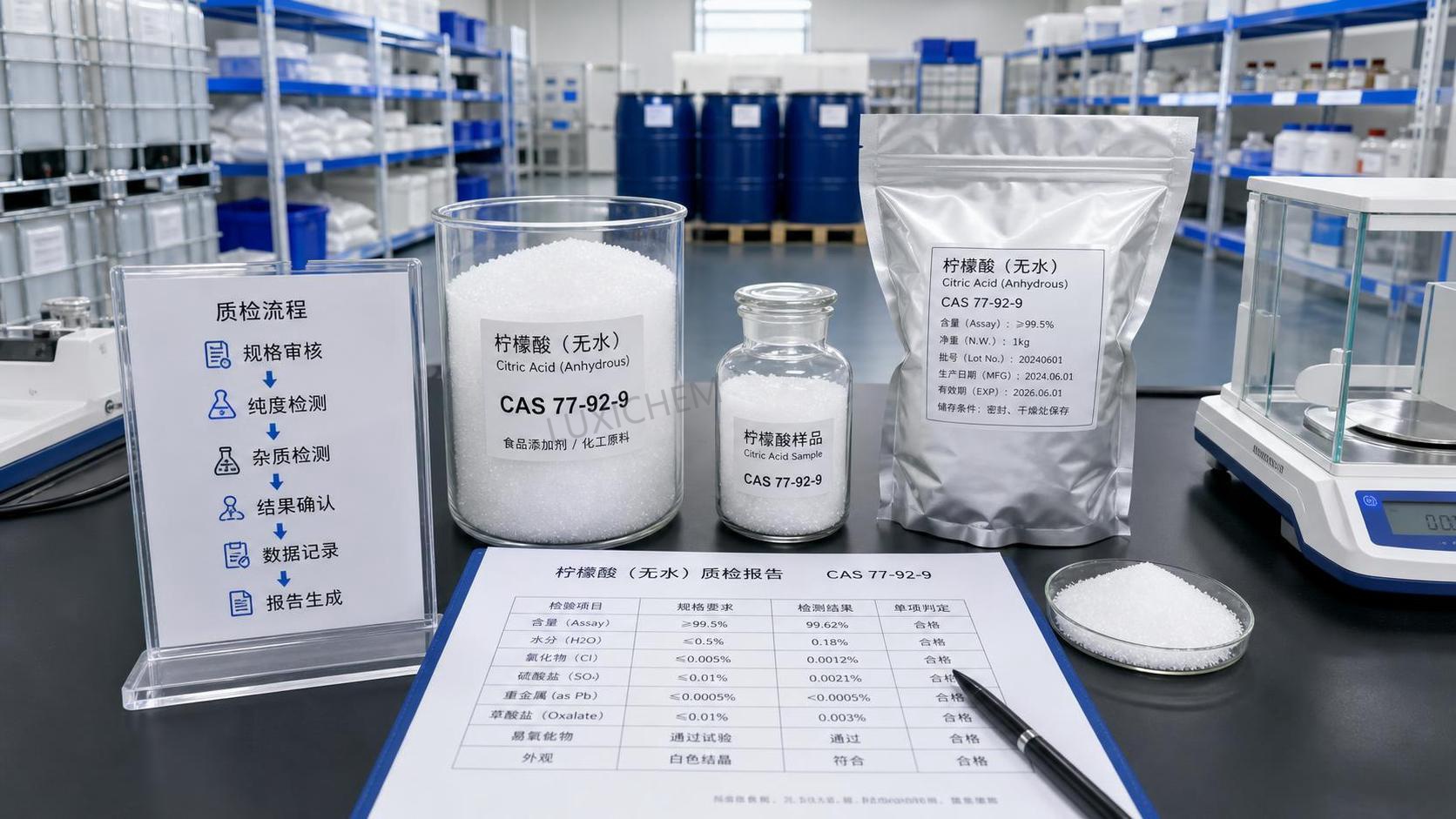
Citric Acid 77-92-9 Specification Sheet: What Deserves a Closer Look
For quality and safety teams, reviewing a citric acid 77 92 9 specification sheet is rarely a box-ticking exercise. It is where purchasing, compliance, process stability, and downstream performance all meet. On paper, two lots may both be labeled “citric acid.” In actual use, differences in assay, moisture, particle size, residue, or trace contaminants can show up quickly—sometimes in production yield, sometimes in storage behavior, and sometimes during an audit.
That matters because citric acid sits in a wide range of applications. In food processing, it is often judged not only on purity but also on taste consistency, dissolution, and documentation. In chemical and industrial settings, teams tend to look harder at stability, compatibility, and whether the supplied grade really matches the process requirement. A specification sheet should help answer those questions early, before a nonconforming lot reaches the line.
Companies working across multiple chemical categories usually see this issue more clearly. Luxi Chemical (Shandong) Co., Ltd., for example, serves customers in food additives, organic intermediates, fertilizers, and related chemical raw materials across many markets. In that kind of supply environment, one practical lesson keeps repeating: a spec sheet is useful only when quality teams read it in the context of the intended application, packaging route, and local compliance expectations—not as a standalone PDF.
Start with identity, grade, and basic form
The first check sounds obvious, but it is where avoidable mistakes still happen. Confirm the material identity using CAS number 77-92-9, product name, chemical name, and, where relevant, whether the sheet refers to anhydrous citric acid or monohydrate. Quality teams sometimes inherit legacy item codes or internal names that do not clearly distinguish the form. That can create confusion in moisture limits, handling behavior, and net active content calculations.
The grade statement matters just as much. A sheet intended for food use should not be reviewed the same way as one used for general industrial purposes. If the supplier references food additive standards, pharmacopeial standards, or an internal enterprise standard, the review should confirm that the cited basis is acceptable for the destination market and use case. If no grade basis is stated, that is already a signal to ask more questions.
Assay is important, but not enough on its own
Most teams look for purity or assay first, and they should. Assay gives a direct view of how much citric acid is actually present. But a “good” assay result by itself does not guarantee trouble-free use. In practice, a lot can meet assay requirements and still create issues if moisture is high, if insoluble matter is elevated, or if the particle distribution does not match the application.
This is especially relevant when citric acid is used in blending or dry-mix systems. If a buyer only checks assay, they may miss how the material behaves on the floor: caking risk, dust generation, uneven feeding, or slower dissolution. A specification sheet should therefore be read as a system of linked parameters, not a single purity declaration.
When teams compare offers from different suppliers, it also helps to check whether the assay is reported on the same basis. Differences in hydration form or testing standard can make two numbers look comparable when they are not.
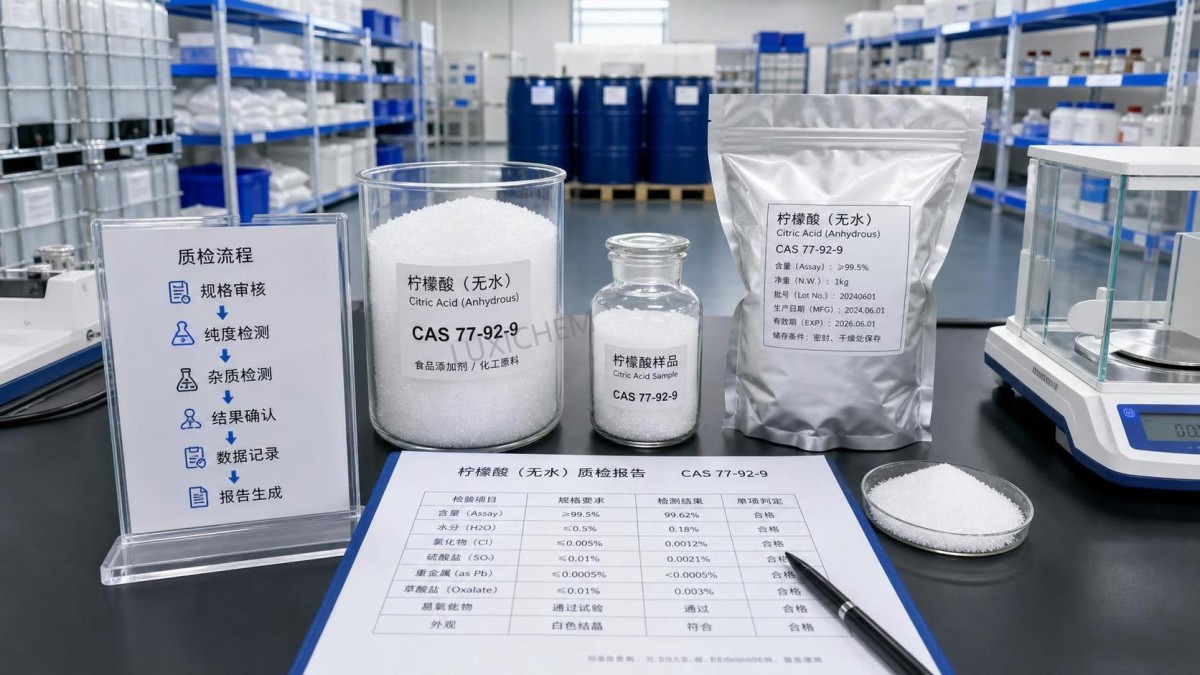
Moisture, loss on drying, and what they really tell you
Moisture-related data deserve more attention than they often get. On a citric acid 77 92 9 specification sheet, this may appear as water content, loss on drying, or a form-specific limit. For warehouse and production teams, this is not just a lab figure. It affects shelf behavior, clumping tendency, free-flowing performance, and in some processes, actual dosage accuracy.
If the product is moving through humid environments or long export routes, packaging and moisture control become tied to the spec review. A lot that is acceptable at release can still become problematic if the bagging material, liner quality, or container conditions are not suitable. That is why experienced reviewers do not separate the certificate values from packaging details. They read them together.
Heavy metals and impurity limits are where compliance risk often sits
For safety teams, one of the most sensitive parts of the sheet is the impurity section. Depending on the grade and the standard being followed, this may include lead, arsenic, mercury, total heavy metals, oxalate, sulfate, chloride, or residue after ignition. Not every market or end use checks the same items with the same limit, so the right question is not “Are impurities listed?” but “Are the listed impurities the ones that matter for this application and region?”
A common procurement shortcut is to accept a general statement like “meets food grade requirements” without seeing the actual controlled parameters. That may be enough for an early commercial discussion, but it is weak support for supplier approval. If your internal requirement or customer contract calls out specific contaminant thresholds, those items should appear clearly in the technical document set or be supported by separate test documentation.
It is also worth checking whether the test methods are identified. Limits without method context can become difficult to interpret, especially when comparing suppliers from different regions.
Appearance, color, and solubility are not cosmetic details
Appearance requirements may look simple—white crystals, colorless crystals, free-flowing powder—but they matter because they often correlate with process control and storage condition. If your operation dissolves citric acid before use, clarity in solution and insoluble matter become practical indicators. In beverage, food, and cleaning formulations, minor visual deviations can trigger customer complaints long before a lab detects a functional issue.
For industrial users, the concern is usually less about aesthetics and more about handling consistency. Material that bridges in hoppers or dissolves unevenly can slow operations even if the chemistry is technically within range. A specification sheet that says nothing about physical form may still be incomplete for actual production needs.
Don’t ignore mesh size and bulk handling characteristics
Not every citric acid sheet includes particle size data, but when the application depends on dissolution rate, mixing uniformity, or dust control, it should be requested. Quality teams sometimes assume this belongs only to production engineering. In reality, it is part of supplier qualification because changes in granulation or crystal size can alter performance without changing core purity values.
This is a familiar issue in multi-product chemical sourcing. A supplier handling broad raw material portfolios—from food acids to organic intermediates such as Styrene CAS#100-42-5—typically manages very different packaging, hazard classes, and logistics controls across product lines. That makes document discipline even more important: physical handling details should be product-specific, not assumed from another category.
Specification sheet vs. COA vs. SDS: each document answers a different question
One practical mistake is treating the specification sheet as if it replaces the certificate of analysis or the safety data sheet. It does not. The spec sheet tells you the agreed quality envelope. The COA shows the actual lot result. The SDS covers hazard communication, handling precautions, and emergency information. Quality and safety teams usually need all three aligned.
If the specification says one thing and the COA routinely reports a narrower or different set of values, ask why. Sometimes it is harmless; sometimes it shows that the supplier’s formal specification is outdated. If the packaging declared on the purchase order differs from the SDS transport or storage guidance, that also deserves review before shipment.
Packaging, labeling, and shelf-life details can affect acceptance more than expected
For export shipments, packaging details are not clerical add-ons. They influence contamination risk, moisture protection, traceability, and stock rotation. Check bag type, liner presence, net weight tolerance, pallet condition if applicable, batch marking format, and storage recommendations. If the product is repacked or distributed through a third-party warehouse, traceability language should still be clear enough for recall or deviation investigation.
Shelf life is another area where teams should avoid assumptions. The stated period should be tied to packaging and storage conditions. If those conditions are broad or vague, the practical usability window may need internal verification, especially for humid or high-temperature destinations.
A short review checklist that usually catches the real issues
What experienced reviewers usually ask before approving a supplier
If the spec sheet looks acceptable, the next layer is consistency. Are the limits stable across batches? Is the same testing basis used every time? Can the supplier provide supporting documents without delay? Those questions often separate a usable supplier from a merely competitive quotation.
For businesses serving diverse international markets, that consistency is often the deciding factor. Suppliers with stronger export discipline tend to understand that different customers may need different document sets even for the same material. That is particularly true when the portfolio spans food additives, industrial chemicals, and other raw materials. A well-managed supplier should be able to explain not just what the citric acid specification is, but why those control points are appropriate for the declared grade and shipment route.
In the end, a citric acid 77 92 9 specification sheet should help you make a yes-or-no decision with fewer assumptions. If it leaves open questions about grade, impurities, test basis, or packaging integrity, it is not yet doing its job. Good quality review is rarely about collecting more paperwork. It is about spotting the few missing details that could turn into a production, safety, or compliance problem later.
Related Picks
 Butylated Hydroxytoluene Price Drivers: Supply, Purity, and Purchasing Risk FactorsOct 21, 2026Butylated Hydroxytoluene price trends depend on supply stability, purity, logistics, and purchasing risk. Learn how to compare quotes wisely and reduce sourcing costs.
 Sodium Tripolyphosphate Price Trends: Raw Material and Energy ExposureOct 20, 2026Explore sodium tripolyphosphate price trends, from phosphate and soda ash costs to energy exposure. Learn how to compare quotes, manage sourcing risks, and make smarter purchasing decisions.
 Acetonitrile Shipment to Vietnam Successfully Dispatched; RCEP Benefits Boost Fine Chemical Trade with ASEANSep 16, 2026A shipment of industrial-grade acetonitrile from our company has recently been loaded and dispatched following the completion of standardized hazardous material packaging and container securing procedures.
 Nigerian Client’s Order of 4 Containers of Vinyl Acetate Successfully Loaded and Shipped to West AfricaSep 16, 2026We recently completed the loading of a vinyl acetate order for a Nigerian client; four containers of the product have been successfully packed and are ready for shipment to Nigeria.




Question Consultation
Send Us Your Inquiry Today

Luxi Chemical is a professional chemical product supplier with ample stock of all chemical categories and excellent quality, welcome your purchase inquiry.

