


Why Citric Acid as a Preservative Works Better in Some Formulas Than Others
Why Citric Acid as a Preservative Works Better in Some Formulas Than Others
A citric acid preservative often looks straightforward on paper. It is widely accepted, easy to source, familiar to formulators, and useful across food, personal care, and some industrial systems. Yet anyone who has spent time evaluating real formulas knows the same material can perform very differently from one product to another. In one beverage or sauce, it helps maintain stability and microbial control. In another system, especially one with a higher pH or more complex ingredient matrix, the effect is modest and sometimes disappointing.
The reason is simple, but not simplistic: citric acid does not preserve products in isolation. Its practical value depends on the chemistry around it. pH, buffering capacity, water activity, dissolved solids, protein or mineral content, thermal history, filling conditions, and packaging all influence whether it acts as a useful control point or just a supporting ingredient.
For technical evaluation teams, this matters because “works” should not mean only that citric acid is present in the recipe. It should mean the formula reaches the intended shelf-life target under expected storage and distribution conditions, while still meeting sensory, compliance, and processing requirements.
Citric acid is rarely the whole preservation system
Citric acid is best understood as a multifunctional acidulant with preservation support, not a universal standalone antimicrobial. In many formulations, its main contribution is lowering pH into a range where spoilage organisms become less competitive and where other preservative tools perform better. That distinction is important. If a team expects citric acid alone to compensate for weak hygiene control, marginal thermal treatment, or a formula with a high water activity and neutral pH tendency, the result is usually a mismatch between expectation and reality.
This is especially visible in food processing. In acidified beverages, fruit preparations, jams, sauces, and confectionery fillings, citric acid can be highly effective because the overall environment is already unfavorable to many microbes. In dairy-adjacent systems, protein-rich emulsions, or products designed around a milder taste profile, the same approach may not be enough without additional hurdles.
The same logic shows up in daily chemical applications. In a low-water or surfactant-heavy formula, preservation pressure may already be lower. In a water-rich gel or wipe solution, pH adjustment with citric acid may help, but preservative robustness still depends on the broader formulation architecture.
pH is the first checkpoint, but not the last one
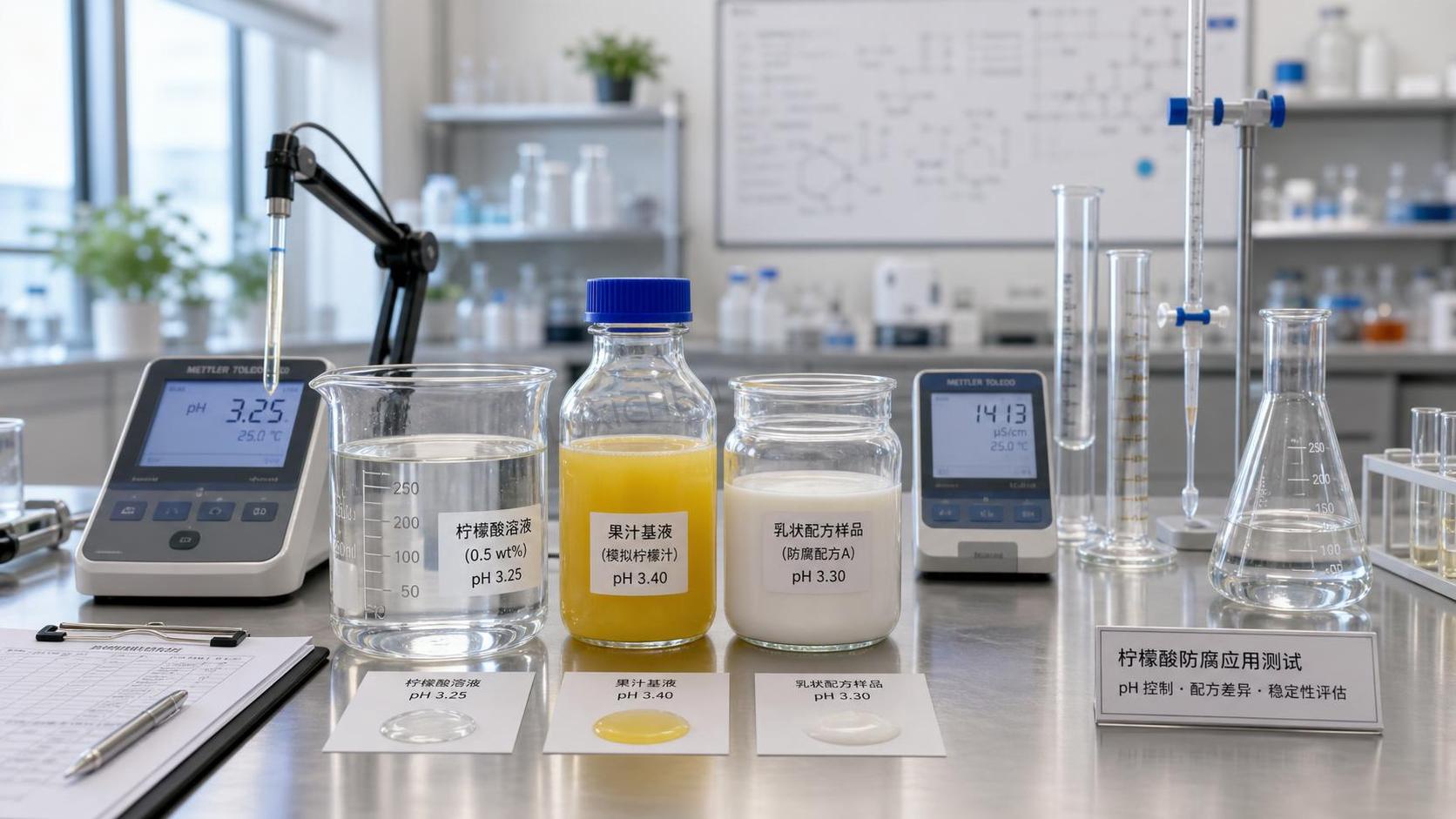
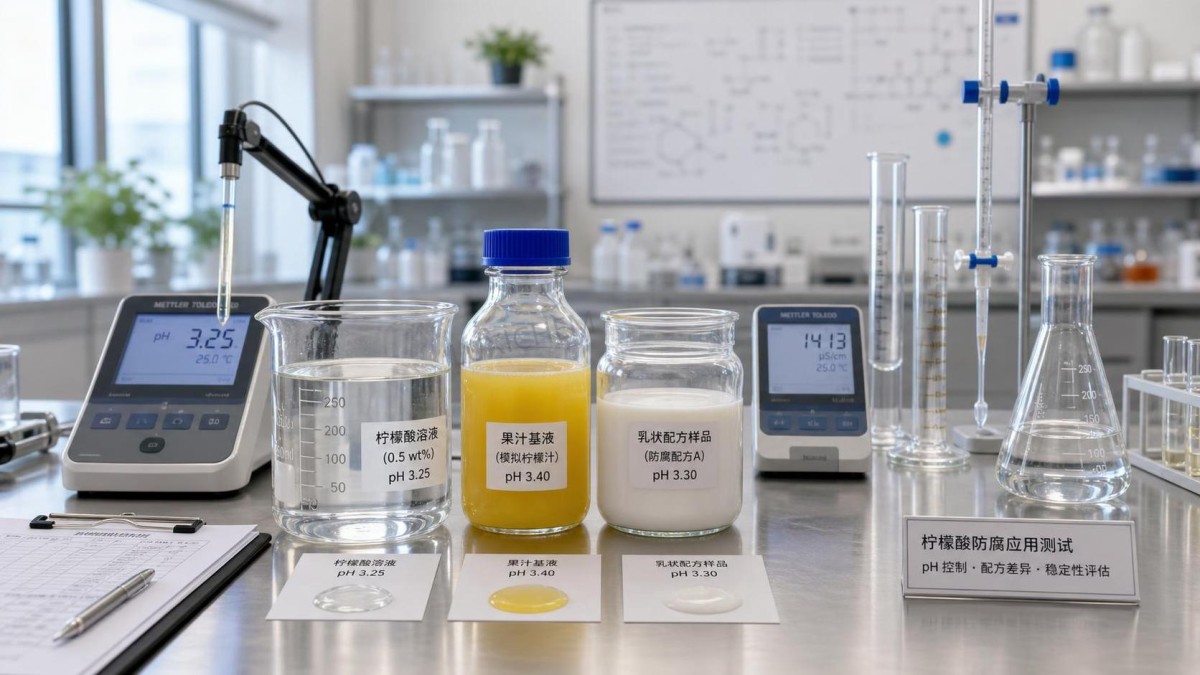
Most evaluation starts with pH for good reason. Citric acid shifts the environment toward acidity, and that can suppress growth of many spoilage organisms. But two products with the same measured pH do not necessarily show the same preservation outcome.
Why? Because pH is only the visible number. Buffering capacity tells you how resistant that formula is to pH change during processing and storage. A fruit drink and a protein beverage might both be adjusted to a similar pH at the bench, yet the protein system can behave very differently over time. Minerals, phosphates, and protein interactions may make the system more resistant to acidification or more sensitive to instability, depending on the exact composition.
That is one reason pilot batches matter. A formula that looks stable in a beaker can drift after heat treatment, ingredient aging, or contact with packaging components. Technical teams usually learn this quickly when scale-up begins.
Ingredient interactions often decide the real outcome
Citric acid is also a chelating agent, which can be useful. By binding certain metal ions, it may help limit oxidation pathways and improve quality stability in some formulas. But the same interaction profile can complicate things elsewhere. In systems containing calcium, magnesium, or other minerals, adding citric acid may influence solubility, mouthfeel, or appearance. In pectin-based applications, acidity affects gel behavior. In emulsified products, acidification can alter protein structure or emulsion stability.
This is where preservation work stops being a single-variable exercise. A formulator may want stronger microbial control, but not at the cost of phase separation, protein precipitation, excessive tartness, or a shortened process window. Citric acid works better when the formula has room to become more acidic without breaking the product’s sensory or physical design.
Technical evaluators often focus on antimicrobial logic first, then discover the limiting factor is not microbiology but texture, flavor, or process tolerance. That is normal. In real projects, the best preservative choice is usually the one that balances all those constraints rather than maximizing one parameter.
Water activity can make citric acid look stronger or weaker than it really is
One common mistake is to judge a citric acid preservative strategy without considering water activity. In reduced-moisture products, high-sugar systems, or formulations with significant humectant loading, microbial growth may already be restricted. In those cases, citric acid can appear highly effective because it is working alongside another strong hurdle.
In contrast, high-water formulas with neutral-tasting targets often expose the limits of citric acid much more quickly. If water activity remains favorable to microbial growth and the acceptable pH range is not very low, citric acid becomes more of a support ingredient than the main preservation mechanism.
That is why comparison across product categories can be misleading. A successful acidified syrup does not automatically validate the same approach in a ready-to-drink nutrition product or a mild cleansing liquid.
Processing conditions can help citric acid, or quietly cancel its benefits
Heat treatment, mixing order, hold time, and filling hygiene all influence preservative performance. Citric acid added early in the process may interact differently than when it is added late. In some systems, early acidification improves control. In others, it may destabilize sensitive ingredients before homogenization or thermal processing is complete.
Packaging is part of this picture too. Oxygen exposure, headspace management, and barrier properties affect not just oxidation, but sometimes the broader stability profile that determines whether a product remains safe and saleable through distribution. A technically sound formulation can still underperform if the packaging and filling environment are not aligned with the shelf-life target.
This is one area where experienced chemical suppliers add value beyond the material itself. Companies working across food additives, organic intermediates, and related processing sectors usually see the same pattern: the additive specification matters, but consistency of supply, documentation clarity, and application understanding matter just as much when a project moves from lab evaluation to repeat production. Luxi Chemical (Shandong) Co., Ltd., for example, operates across compliant chemical products used in food processing, agriculture, and daily chemical industries, so the conversation is often less about a single ingredient in isolation and more about whether the full procurement and application chain supports stable results batch after batch.
When citric acid needs a partner
In many practical formulations, citric acid performs best as part of a combined hurdle strategy. That may include thermal treatment, reduced water activity, sanitation control, oxygen management, or pairing with another preservative system that is better suited to the target microorganisms and product pH.
For some food applications, formulators also review complementary options such as Epsilon-polylysine CAS#28211-04-3, particularly when they need broader support without relying on a single acidification lever. The right pairing always depends on regulatory acceptance in the destination market, product category rules, sensory tolerance, and the actual microbial risk profile. There is no serious shortcut around that evaluation.
This is where technical teams should be careful not to confuse ingredient popularity with formulation fit. Citric acid is common because it is useful, not because it solves every preservation problem.
A practical way to evaluate fit before scale-up
If a formula shows uneven preservation performance, the most productive review usually includes a few plain questions:
- What is the actual in-pack pH after processing, not just the target pH before filling?
- How much buffering is coming from proteins, salts, or other functional ingredients?
- Is water activity already contributing meaningful microbial control?
- Does the product’s flavor profile allow more acidification, or is sensory acceptance already near the limit?
- Are heat treatment and filling conditions doing their share of preservation work?
- Do destination-market rules allow a broader preservative system if needed?
Those questions sound basic, but they usually reveal why one formula behaves well and another does not. Most failures are not caused by citric acid being “bad.” They come from asking it to do more than the system allows.
The bottom line for technical evaluation
A citric acid preservative works better in some formulas than others because preservation is always contextual. Low pH helps, but pH alone is not enough. Ingredient interactions, water activity, processing conditions, and sensory limits decide whether citric acid acts like a strong preservation tool or just a useful assistant.
If the goal is a reliable, compliant, scalable formula, the better approach is to evaluate citric acid as part of the whole system: recipe, process, packaging, and supply consistency. That is usually where the right answer appears—not in the ingredient list, but in how the formulation behaves under real manufacturing conditions.
Related Picks
 Butylated Hydroxytoluene Price Drivers: Supply, Purity, and Purchasing Risk FactorsOct 21, 2026Butylated Hydroxytoluene price trends depend on supply stability, purity, logistics, and purchasing risk. Learn how to compare quotes wisely and reduce sourcing costs.
 Sodium Tripolyphosphate Price Trends: Raw Material and Energy ExposureOct 20, 2026Explore sodium tripolyphosphate price trends, from phosphate and soda ash costs to energy exposure. Learn how to compare quotes, manage sourcing risks, and make smarter purchasing decisions.
 Acetonitrile Shipment to Vietnam Successfully Dispatched; RCEP Benefits Boost Fine Chemical Trade with ASEANSep 16, 2026A shipment of industrial-grade acetonitrile from our company has recently been loaded and dispatched following the completion of standardized hazardous material packaging and container securing procedures.
 Nigerian Client’s Order of 4 Containers of Vinyl Acetate Successfully Loaded and Shipped to West AfricaSep 16, 2026We recently completed the loading of a vinyl acetate order for a Nigerian client; four containers of the product have been successfully packed and are ready for shipment to Nigeria.




Question Consultation
Send Us Your Inquiry Today

Luxi Chemical is a professional chemical product supplier with ample stock of all chemical categories and excellent quality, welcome your purchase inquiry.

