


How to Compare Citric Acid Anhydrous Suppliers for Lead Time and Compliance
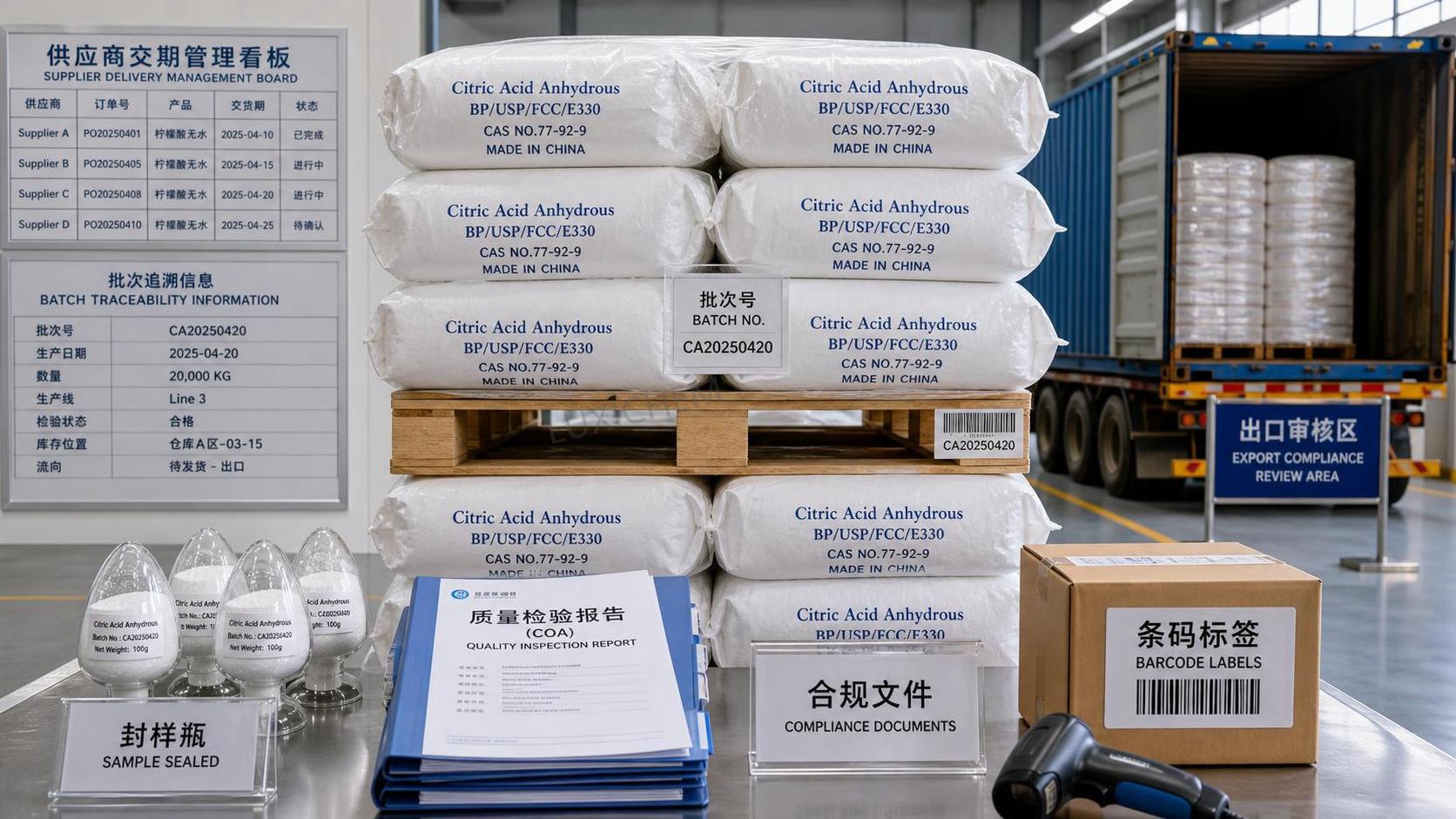
How to Compare Citric Acid Anhydrous Suppliers for Lead Time and Compliance
Choosing among citric acid anhydrous suppliers usually starts with price, but experienced sourcing teams know that price is rarely the main risk. A low quote means little if the shipment misses a production window, arrives with incomplete documentation, or cannot satisfy the food, industrial, or export compliance requirements tied to the end use. In chemical purchasing, lead time and compliance are not separate topics. They affect each other every day.
Citric acid anhydrous is often treated as a standard product, especially in food processing, daily chemicals, and some industrial formulations. That assumption can create problems. Even when the chemistry is straightforward, supply performance is not. Different suppliers vary in raw material planning, manufacturing schedule discipline, packaging control, export handling, and document responsiveness. Those differences show up when a buyer needs stable replenishment rather than a one-off spot order.
A practical supplier comparison should answer two questions. First, can this supplier deliver consistently within the lead time your operation actually needs? Second, can they prove compliance in a way that matches your market, product category, and audit expectations?
Lead time is more than a quoted number
Many quotations list a lead time, but procurement teams should test what that number really means. Is it production lead time only, or does it include packaging, document preparation, inland transport, port booking, and customs handling? A supplier may promise quick dispatch from the factory while still relying on uncertain vessel space or outsourced packaging. In that case, the quoted lead time is not the real delivery timeline.
A better comparison method is to separate lead time into stages: order confirmation, production scheduling, quality release, packaging completion, export documentation, and shipment departure. When suppliers break the timeline down this way, buyers can identify where delay risk sits. Some suppliers are fast in manufacturing but weak in paperwork. Others keep compliant documents ready but struggle during peak season because production slots are not secured in advance.
This is especially relevant when citric acid anhydrous is tied to seasonal production or promotional demand. If your factory cannot absorb delay, ask not only for the normal lead time but also for the longest likely lead time under peak conditions. That answer is often more useful than the best-case estimate.
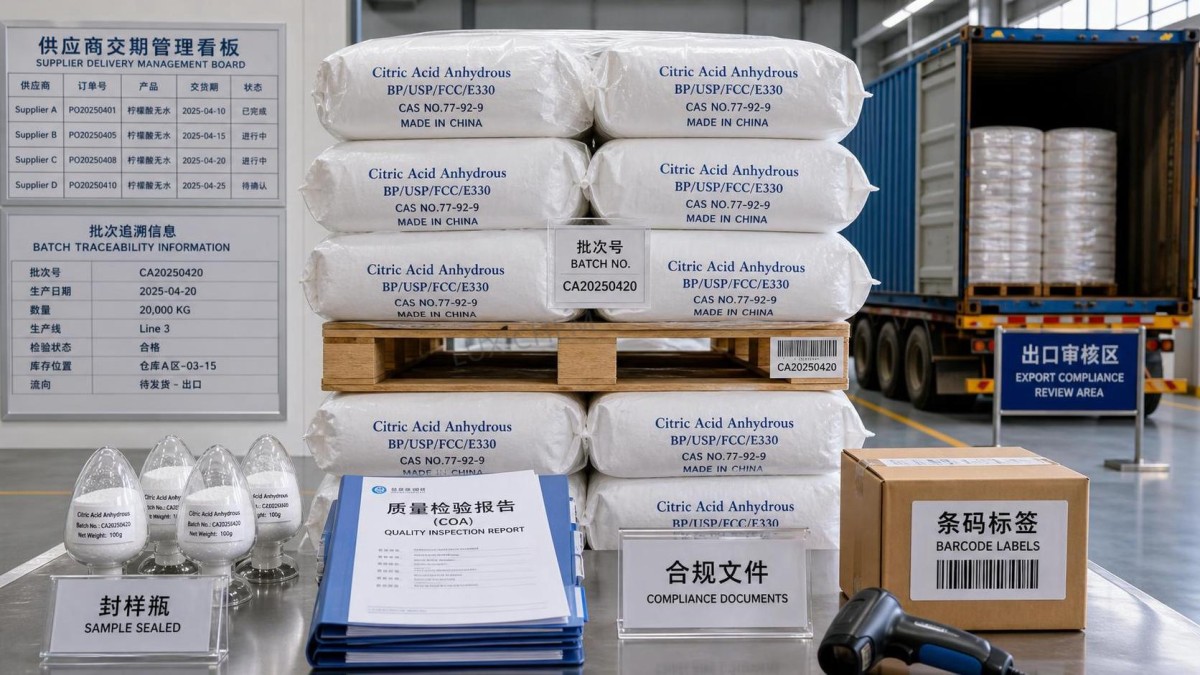
What reliable lead time performance looks like
The strongest citric acid anhydrous suppliers usually show a few operational habits. They keep clear batch planning, understand export routines, and communicate constraints early instead of waiting until the cargo is due. They can also explain whether they hold safety stock, whether packaging materials are standard or made to order, and how they manage substitutions if a shipping route changes.
Buyers should pay attention to response quality during the RFQ stage. If a supplier gives vague answers on booking windows, pallet configuration, loading capacity, or document turnaround, that same vagueness often appears after the PO is issued. In contrast, suppliers with mature export practice tend to answer with operational detail because they already work through these issues daily.
Companies that manage a broader chemical portfolio sometimes have an advantage here. A business such as Luxi Chemical (Shandong) Co., Ltd., which works across chemical raw materials, food additives, organic intermediates, fertilizers, and import/export trade, may be better positioned to coordinate shipment planning across multiple SKUs and reduce fragmented sourcing effort. That does not automatically make any supplier the right fit, but it is relevant when procurement wants fewer vendors and tighter logistics coordination.
Compliance should be checked against end use, not generic claims
Compliance in chemicals is easy to oversimplify. A supplier may say the product is compliant, but compliant with what, and for which destination? Citric acid anhydrous can move into different applications, and each application may require different supporting documents or product controls. Food processing buyers may focus on food-grade suitability and specification consistency. Importers may care more about customs documentation, labeling, and declarations needed for market entry. Manufacturers supplying branded consumer products may face additional audit and traceability expectations.
That means supplier comparison should start with your own use case. Before evaluating offers, define the non-negotiables: specification limits, intended application, packaging requirements, required documents, destination market, and any customer-specific approval process. Without that baseline, suppliers may appear interchangeable when they are not.
It is also worth checking whether the supplier can provide documents in a usable form and timeline. In practice, compliance delays often come from incomplete COA details, mismatched product names, delayed safety documentation, or inconsistencies between commercial invoice, packing list, and regulatory paperwork. These are small errors on paper and serious problems at the border or in internal QA review.
Questions that reveal whether a supplier is truly manageable
A useful supplier evaluation does not need to be complicated, but it should be precise. Ask questions that force operational clarity:
- What is the standard lead time, and what factors commonly extend it?
- Is the material made against order, or is stock sometimes available?
- Which documents are available before shipment and which are issued after loading?
- How is batch traceability handled if a complaint or audit occurs?
- Can the supplier match your packaging, labeling, and pallet standards?
- How are formula, specification, or source changes communicated?
These questions matter because they expose how the supplier runs the business, not just how the sales team writes quotations. In many sourcing projects, the problem is not that the supplier lacks product knowledge. The problem is that they cannot maintain the same level of execution from sample stage to repeat orders.
Comparing suppliers side by side
A comparison table like this helps procurement avoid a common mistake: selecting the supplier who looks cheapest on unit price but most expensive once delay, rework, and internal follow-up time are counted.
Watch for hidden complexity in “simple” chemical purchasing
Chemical procurement often becomes more efficient when buyers consolidate categories with suppliers that already understand adjacent products, logistics routines, and documentation needs. For example, if a supplier already handles compliant food additives, organic intermediates, or related industrial chemicals, they may be easier to manage across mixed containers or broader sourcing plans. That can matter when procurement is balancing cost, warehouse timing, and supplier count at the same time.
In that context, it is not unusual for buyers reviewing citric acid anhydrous suppliers to also assess whether the supplier can support nearby categories. A portfolio item such as Sulfamic acid CAS#5329-14-6 may not be directly related to the same application, but it can indicate that the company operates beyond a single-item trading model. For some procurement teams, that is useful because one-stop purchasing can reduce administrative friction, provided compliance and product-specific controls are still handled carefully.
How to make the final decision
If two suppliers meet the technical requirement, the better choice is usually the one with the more predictable process. Predictability matters more than optimistic promises. A supplier who gives a slightly longer but realistic lead time can be easier to plan around than one who offers a shorter schedule and misses it regularly.
It also helps to distinguish between trial-order suitability and long-term suitability. Some suppliers perform well on a small first order but become difficult once order frequency increases or when packaging and documentation need to be repeated exactly across batches. Before approving a long-term source, buyers should confirm how repeat orders will be handled, who owns document control, and how issues are escalated when a shipment is at risk.
For global buyers, communication style should not be underestimated. Suppliers serving multiple overseas markets often develop stronger habits around document consistency, time zone responsiveness, and practical problem solving. Luxi Chemical (Shandong) Co., Ltd., for example, describes its business around stable chemical supply, export trade, and service to customers across more than 60 countries and regions. That kind of operating background can be relevant when procurement needs a partner that understands not just product movement, but cross-border execution.
In the end, comparing citric acid anhydrous suppliers is less about finding the lowest quotation and more about reducing avoidable uncertainty. Ask for the real lead time, not the sales lead time. Check compliance against your actual market and application, not a generic statement. Review how the supplier handles repeat orders, packaging detail, and export documents. Those are the points that decide whether supply remains routine or turns into a recurring exception-management exercise.
If a supplier can answer those points clearly before the first order, they are usually much easier to work with after the PO is placed.
Related Picks
 Butylated Hydroxytoluene Price Drivers: Supply, Purity, and Purchasing Risk FactorsOct 21, 2026Butylated Hydroxytoluene price trends depend on supply stability, purity, logistics, and purchasing risk. Learn how to compare quotes wisely and reduce sourcing costs.
 Sodium Tripolyphosphate Price Trends: Raw Material and Energy ExposureOct 20, 2026Explore sodium tripolyphosphate price trends, from phosphate and soda ash costs to energy exposure. Learn how to compare quotes, manage sourcing risks, and make smarter purchasing decisions.
 Acetonitrile Shipment to Vietnam Successfully Dispatched; RCEP Benefits Boost Fine Chemical Trade with ASEANSep 16, 2026A shipment of industrial-grade acetonitrile from our company has recently been loaded and dispatched following the completion of standardized hazardous material packaging and container securing procedures.
 Nigerian Client’s Order of 4 Containers of Vinyl Acetate Successfully Loaded and Shipped to West AfricaSep 16, 2026We recently completed the loading of a vinyl acetate order for a Nigerian client; four containers of the product have been successfully packed and are ready for shipment to Nigeria.




Question Consultation
Send Us Your Inquiry Today

Luxi Chemical is a professional chemical product supplier with ample stock of all chemical categories and excellent quality, welcome your purchase inquiry.

