


Citric Acid Anhydrous vs Monohydrate: Which Form Suits Your Process Better?
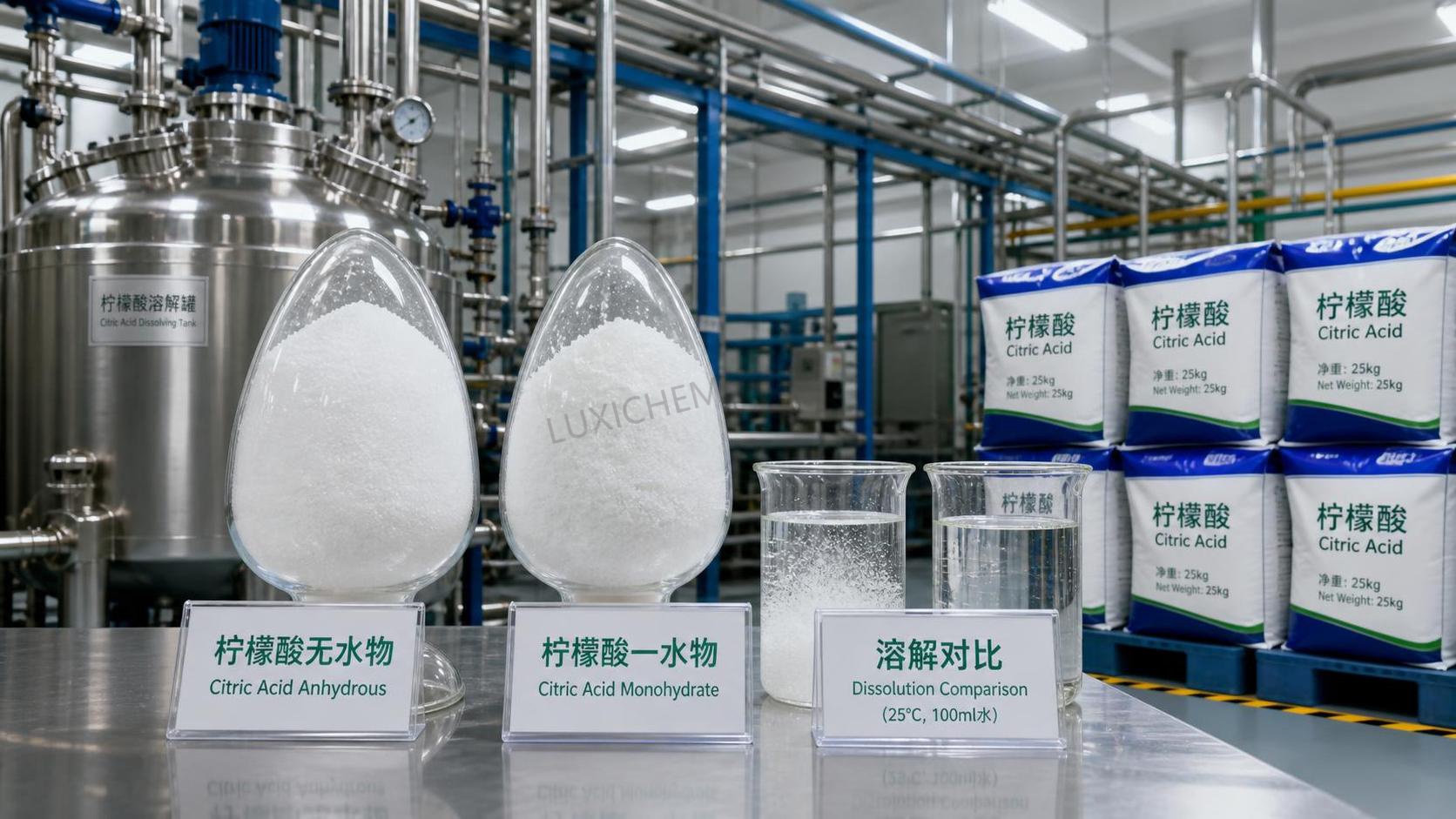
In many plants, the choice between citric acid anhydrous and monohydrate is not made in the lab first. It shows up later—when powder flow becomes inconsistent, when moisture-sensitive blends start drifting, when packaging conditions tighten, or when a seemingly minor raw material decision begins affecting downstream performance. That is why technical evaluation teams often look beyond simple purity claims and ask a more useful question: which form fits the actual process better?
For buyers and formulation engineers comparing options, citric acid anhydrous is often considered when water contribution, bulk handling behavior, or dry blend stability matter. Monohydrate, on the other hand, may remain the practical choice where standard food or industrial processing conditions are more forgiving. The difference is small on paper but meaningful in production. Understanding that difference helps reduce trial-and-error during sourcing, validation, and scale-up.
Citric acid exists in both forms as the same core organic acid, but the crystal structure is different. Anhydrous citric acid contains no water of crystallization, while monohydrate contains one molecule of bound water. Chemically, both deliver acidity, chelation, and buffering functionality. Operationally, however, they can behave differently in storage, blending, dissolution, and temperature-sensitive applications.
Why the “better” option depends on process conditions, not just specification sheets
Technical teams rarely select a material only because it looks cleaner in a datasheet comparison. The more relevant evaluation is functional fit. In real manufacturing, the preferred form depends on several process questions:
- Is the formulation moisture-sensitive?
- Will the acid be used in a dry blend, tablet, powder premix, or granulated product?
- Does the process involve rapid dissolution or controlled dissolution?
- Are storage humidity and warehousing conditions stable?
- Does the final product require strict weight or solids balance?
- Will the acid be exposed to elevated temperature during processing?
If your team is assessing raw materials for food additives, daily chemical formulations, agricultural auxiliaries, or related compound systems, these are the questions that usually separate a workable choice from a merely acceptable one.
Citric acid anhydrous: where it tends to make more sense
Citric acid anhydrous is often favored where the absence of crystal water is operationally useful. In dry systems, even a small amount of bound water can matter. Powder premixes, effervescent products, moisture-reactive blends, and some hygroscopic formulations may benefit from the anhydrous form because it gives formulators tighter control over total moisture input.
Another reason evaluation teams choose the anhydrous form is concentration efficiency by weight. Since monohydrate includes bound water, anhydrous citric acid delivers more active acid content on a mass basis. This can simplify calculations in applications where the acid contribution must be tightly controlled, especially in large-batch standardization or high-volume continuous manufacturing.
Its behavior can also be attractive in processes where caking risk, dry-flow consistency, or low-moisture packaging are recurring concerns. That said, the exact powder handling profile still depends on particle size distribution, packaging quality, storage humidity, and transport conditions—not only the hydrate form.
Where monohydrate may be the easier fit
Monohydrate remains common across many food and industrial applications for a practical reason: in ordinary process environments, it performs reliably and is widely understood. If your system dissolves the acid completely in water early in the process, and if the formulation is not especially moisture-sensitive, monohydrate often works without creating any meaningful disadvantage.
In liquid preparation, beverage systems, cleaning formulations, or standard acidification steps where crystal water does not affect the finished product, the monohydrate form may be fully adequate. Some production teams also find it easier to source within existing purchasing patterns, especially when the application has a long history of using that form and the validation burden of changing specifications is high.
So the decision is not about “modern” versus “traditional” material. It is more about whether the process gains anything real from removing that one molecule of water.
Practical comparison points for technical evaluation
When comparing both forms, most technical reviews should focus on performance under actual manufacturing conditions rather than only basic identity tests.
1. Moisture contribution
This is usually the first decision point. If your system includes reactive ingredients, sensitive carriers, compressible powders, or shelf-life risks linked to water uptake, anhydrous material deserves serious consideration. In contrast, if the acid is immediately dissolved in a high-water process, this advantage may be less relevant.
2. Assay and formulation calculation
Because anhydrous citric acid has no crystal water, the effective acid content per kilogram differs from monohydrate. For batch calculations, especially in large-scale compounding, this affects dosage, solids balance, and specification alignment. Teams switching from one form to the other should never treat them as one-to-one replacements without recalculation.
3. Thermal behavior
Heat exposure can reveal differences. In some drying, granulation, or elevated-temperature steps, monohydrate may lose crystal water, potentially affecting physical properties during processing. Anhydrous material can be preferable where thermal consistency matters, though the exact benefit depends on the temperature range and residence time.
4. Dissolution profile
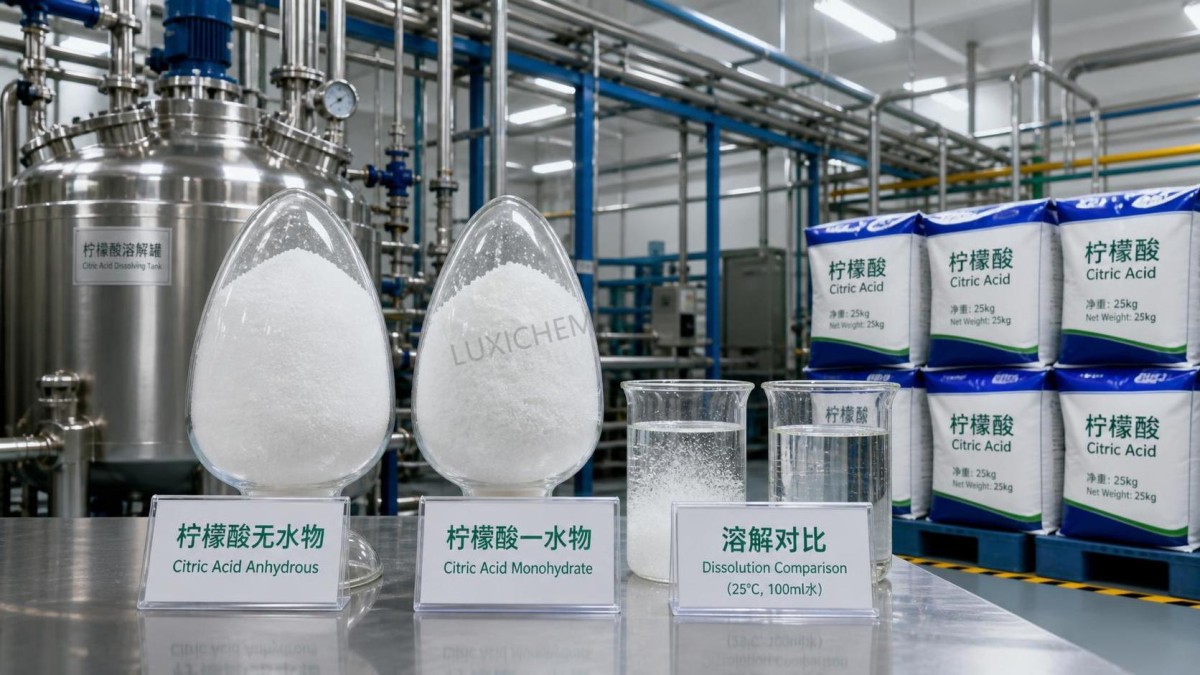
Both forms are soluble, but the practical dissolution experience may vary depending on crystal size, agitation, liquid temperature, and addition method. If the process relies on rapid make-up of solutions or in-line dosing, procurement teams should request material samples and validate under real operating conditions rather than assume equivalent behavior.
5. Storage and packaging sensitivity
Warehouse humidity, container sealing, and climate during shipment matter more than many teams initially expect. Even a suitable material can underperform if packaging is weak or handling discipline is inconsistent. For global buyers sourcing into hot, humid, or variable environments, reviewing packing format and logistics controls is almost as important as choosing between anhydrous and monohydrate.
A useful rule: match the hydrate form to the point of process risk
If the risk in your production line is chemical reactivity, moisture pickup, solids calculation, or heat-related change, the anhydrous form often earns priority. If the risk is more about supply continuity, routine dissolution, or maintaining an already validated formulation, monohydrate may be the lower-friction option.
This distinction matters for sourcing strategy. Some teams over-specify anhydrous material in applications where it creates no measurable value. Others stay with monohydrate simply because it is familiar, even though recurring quality deviations suggest the formulation would benefit from a drier input. Good evaluation is less about preference and more about identifying where the process is least tolerant.
Application-oriented selection thinking
In food processing, citric acid anhydrous is commonly reviewed for powdered beverages, seasoning systems, confectionery premixes, and moisture-conscious dry blends. In these settings, free-flowing behavior and water control can influence not just processing but also shelf stability.
In daily chemical formulations, the selection may depend on whether the acid is used in a powder cleaner, bath product, effervescent system, or liquid descaler. Dry consumer products often push evaluators toward anhydrous material, while fully aqueous production may leave little reason to move away from monohydrate.
In agricultural or industrial compounding, the decision can be linked to blending compatibility, granulation conditions, and transportation climate. Sometimes the better choice is determined less by chemistry than by how the material survives warehousing and handling before it ever reaches the reactor or mixer.
Companies with broad sourcing portfolios often face this issue across multiple product lines. At Luxi Chemical (Shandong) Co., Ltd., where customers span food additives, organic intermediates, fertilizers, and related industrial materials, selection discussions are rarely limited to the textbook properties of one ingredient. Buyers usually need to balance technical fit, packaging practicality, and procurement efficiency across more than one raw material stream. That is especially true for international supply chains serving different climate zones and regulatory expectations.
Common mistakes during evaluation
One frequent mistake is assuming both forms can be swapped without impact if the target pH remains the same. pH outcome is only part of the story. Water balance, dosage correction, flow behavior, and process thermal response may still change.
Another mistake is evaluating only a benchtop dissolution test. In real production, feeder performance, batch charging speed, and humid storage can affect outcomes just as much as lab solubility. A pilot run or line-side simulation is often more revealing than a standard beaker comparison.
Some teams also focus heavily on unit price while overlooking the total process cost. A cheaper material can become more expensive if it increases rejects, extends drying time, alters tablet quality, or forces tighter storage control. Technical procurement should compare delivered value in use, not only purchase price per metric ton.
That broader mindset is common in chemical sourcing beyond citric acid as well. Even when evaluating unrelated specialty materials such as Paclitaxel CAS#33069-62-4, technical buyers still look at fit-for-purpose criteria: handling, stability, compliance context, and how the material integrates into the full supply and production workflow.
A short decision framework for engineering and sourcing teams
If your team needs a practical screening method, start here:
- Choose anhydrous first if the formulation is dry, moisture-sensitive, effervescent, heat-exposed, or tightly standardized by solids content.
- Keep monohydrate under consideration if the acid is dissolved early, the process is water-rich, and current validation history favors continuity.
- Request particle-size and packaging details, not just purity and assay.
- Run application-specific trials before approving substitution.
- Review warehousing and transport conditions as part of the raw material decision.
These steps help move the discussion away from general assumptions and toward measurable process fit.
So, which form suits your process better?
There is no universal winner, but there is usually a clearer winner for a given process. If water control, thermal stability during processing, and exact formulation loading are important, citric acid anhydrous is often the more suitable choice. If your operation is solution-based, established, and relatively tolerant to crystal water, monohydrate may remain the sensible option.
For technical evaluation personnel, the best decision comes from mapping the material form to the process constraint that matters most. Once that constraint is clear, the comparison becomes much easier—and sourcing becomes less about guessing and more about engineering judgment.
In the end, selecting citric acid is rarely just about acidity. It is about how that acid behaves in your real system, under your storage conditions, on your line, with your formulation targets. That is the level where the difference between anhydrous and monohydrate actually becomes valuable.
Related Picks
 Butylated Hydroxytoluene Price Drivers: Supply, Purity, and Purchasing Risk FactorsOct 21, 2026Butylated Hydroxytoluene price trends depend on supply stability, purity, logistics, and purchasing risk. Learn how to compare quotes wisely and reduce sourcing costs.
 Sodium Tripolyphosphate Price Trends: Raw Material and Energy ExposureOct 20, 2026Explore sodium tripolyphosphate price trends, from phosphate and soda ash costs to energy exposure. Learn how to compare quotes, manage sourcing risks, and make smarter purchasing decisions.
 Acetonitrile Shipment to Vietnam Successfully Dispatched; RCEP Benefits Boost Fine Chemical Trade with ASEANSep 16, 2026A shipment of industrial-grade acetonitrile from our company has recently been loaded and dispatched following the completion of standardized hazardous material packaging and container securing procedures.
 Nigerian Client’s Order of 4 Containers of Vinyl Acetate Successfully Loaded and Shipped to West AfricaSep 16, 2026We recently completed the loading of a vinyl acetate order for a Nigerian client; four containers of the product have been successfully packed and are ready for shipment to Nigeria.




Question Consultation
Send Us Your Inquiry Today

Luxi Chemical is a professional chemical product supplier with ample stock of all chemical categories and excellent quality, welcome your purchase inquiry.

