


What to Ask a Citric Acid Anhydrous Supplier Before Approving a Bulk Order
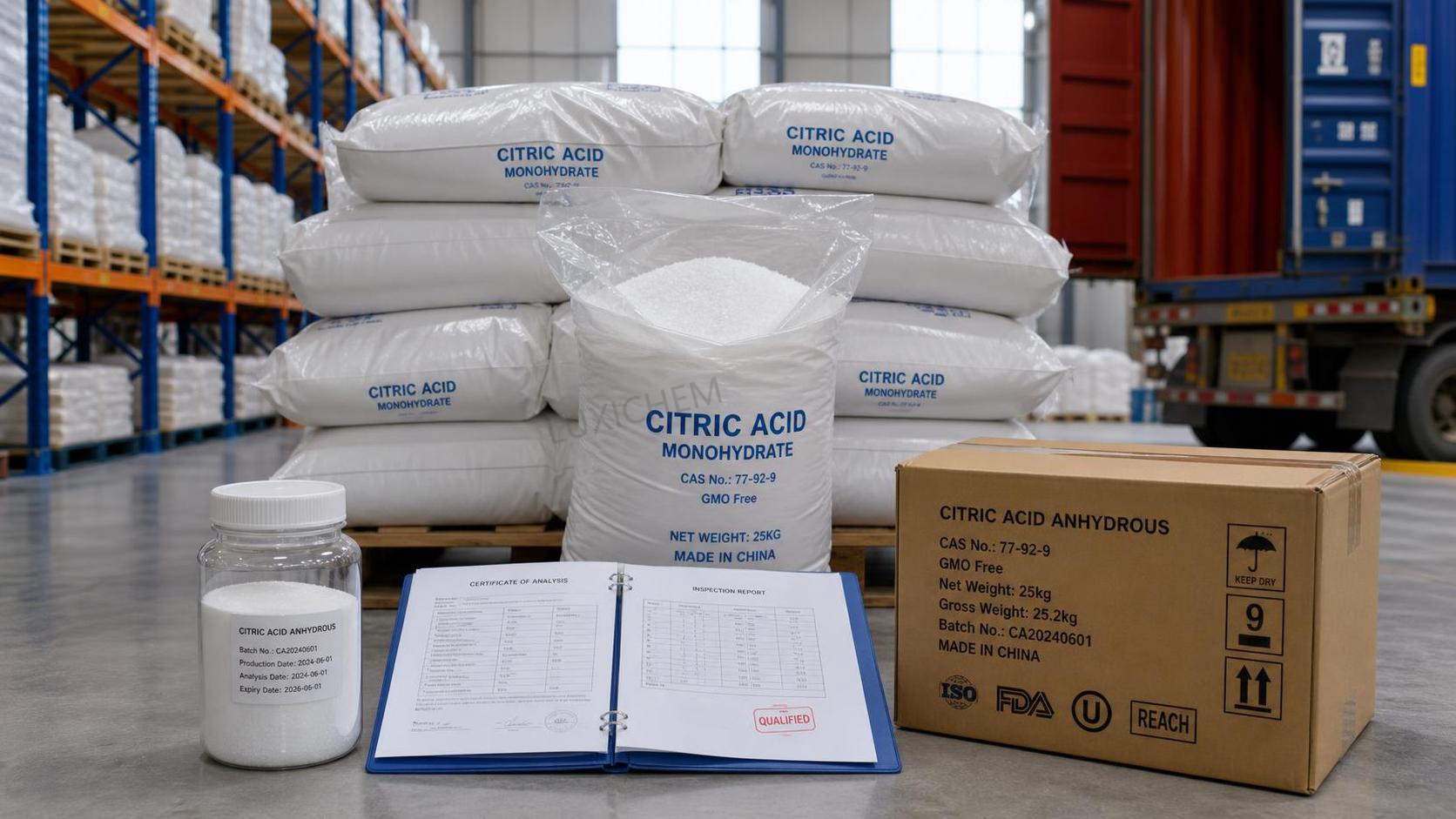
Approving a bulk order of citric acid anhydrous without asking the right questions can turn a low quoted price into a high actual cost. A shipment that arrives with unsuitable particle size, unstable packing, incomplete documents, or inconsistent assay may disrupt production schedules, create rework, or force a last-minute substitute purchase. The discussion with a citric acid anhydrous supplier should therefore move quickly past headline price and into the details that decide whether the material will perform as expected after loading, transit, storage, and use.
Start with the specification that will appear on the purchase contract, not the marketing sheet. Ask for the exact limits on assay, moisture, sulfate, oxalate, chloride, heavy metals if relevant to the intended application, residue on ignition, and any internal control points used before release. “Citric acid anhydrous” is not a complete technical description on its own. Two suppliers may both offer conforming material while controlling different side parameters, and those differences can affect dissolution time, blending behavior, dust generation, caking tendency, or downstream taste and stability in food-related formulations.
Ask how the material is controlled, not only what the certificate says
A certificate of analysis is useful, but it is only a summary of release data. The stronger question is how each batch is sampled, how retained samples are stored, whether testing is done in-house or partially outsourced, and what happens when a result falls near the specification limit. If a supplier cannot explain the release sequence clearly, the risk is not only quality failure; it is also delay. Borderline batches often consume time in re-testing, internal review, or document revision, and those delays usually appear after a vessel booking or production slot has already been scheduled.
It is also worth asking whether the assay and moisture values trend tightly from batch to batch or regularly swing across a broad range while still remaining nominally acceptable. Stable process control usually matters more than a single perfect certificate. When formulations are sensitive, a narrow operating window can reduce adjustment work during dosing and mixing.
Granular, powder, or mesh range can change handling costs
One of the most common purchasing mistakes is assuming that all citric acid anhydrous behaves the same in use. Ask about particle size distribution, whether the material is fine powder, granular, or controlled to a mesh range, and whether the supplier can keep that range consistent across multiple lots. Fine material may dissolve quickly but can dust heavily during transfer. Coarser material may improve handling in some dry blending systems but alter dissolution rate in liquid preparation tanks. If the line uses automatic feeding, particle flow through hoppers and screw conveyors should be considered before approval.
Where the application portfolio includes several additives with different sensitivities, this question becomes more practical. A facility that also sources preservation ingredients such as Epsilon-polylysine CAS#28211-04-3 may already know that small physical differences between compliant materials can affect batching rhythm, dust control, and cleaning frequency. The same operational logic applies here: a certificate may pass while plant handling still becomes less efficient.
Ask for a recent specification sheet with particle information stated clearly. If the answer is vague, ask for a typical sieve analysis or at least a statement of whether particle size is controlled as a release criterion, a typical value, or not controlled at all.
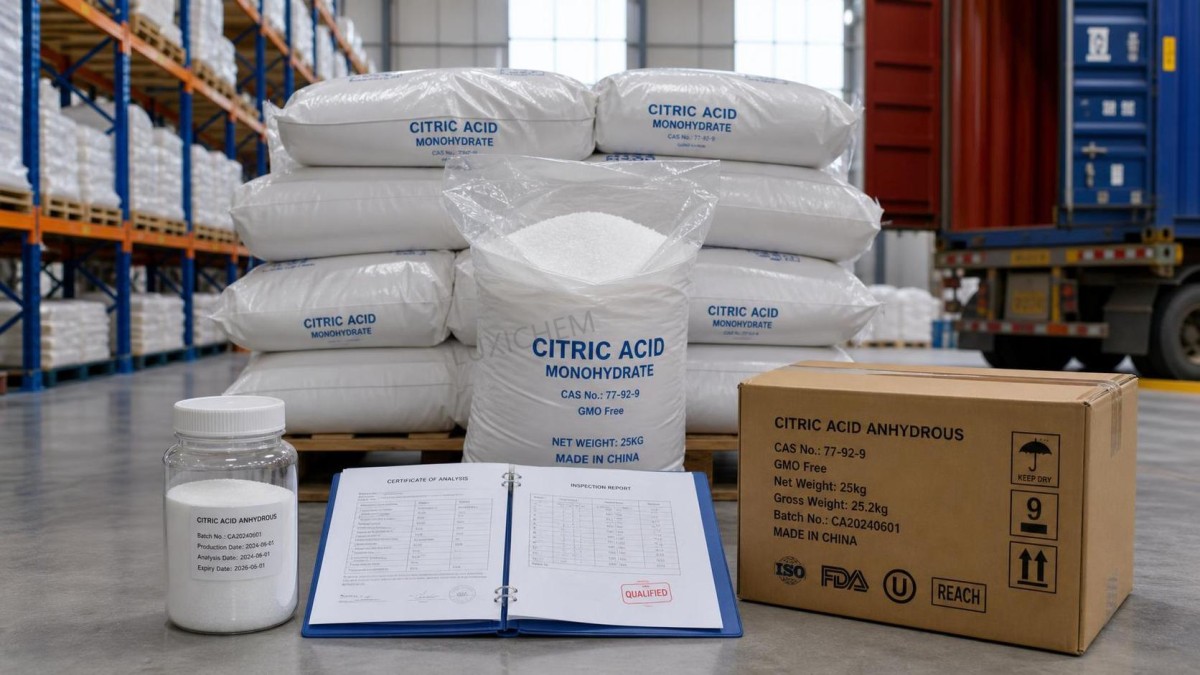
Clarify packaging details down to liner type and pallet condition
Packaging questions often sound administrative until a container arrives with torn seams, moisture pickup, or collapsed stacks. Ask what the standard packing format is, the net weight per bag, whether there is an inner liner, what material the liner is made from, and how the bags are sealed. Ask whether pallets are used, whether fumigation or non-wood pallets are available if needed, and how many bags are typically loaded into a container. These are not warehouse trivia. They affect unloading speed, contamination risk, and the amount of damaged cargo that may need to be quarantined on arrival.
Citric acid anhydrous is hygroscopic enough that packaging integrity matters during long transit or storage in humid conditions. If shipment may pass through hot ports, rainy seasons, or prolonged customs holds, ask what moisture-protection measures are standard. Some suppliers may add desiccants, use stronger outer bags, or apply container lining on request. Others may leave those steps entirely to the customer’s instruction. That difference should be known before contract approval, not when a claim is being assembled.
Do not accept “stable supply” as a complete answer
Availability should be discussed in operational terms. Ask where the material will be produced, whether the offer comes from one plant or several sources, how lot numbering is managed across sources, and whether identical specification and packaging are maintained if origin changes. If the supplier uses alternative production sites to cover demand peaks, ask whether those sites generate interchangeable documentation and whether pre-shipment samples can still represent the actual lot that will be delivered.
Lead time needs similar precision. Request a realistic range for production, packing, booking, and document preparation. A supplier may quote short lead time under normal conditions but rely on raw material arrivals, shared packaging lines, or third-party warehouses that create variability. It is better to identify those dependencies early than to build a production plan around an optimistic dispatch estimate.
For repeat business, ask how the supplier handles sudden increases in monthly volume. Some suppliers can support an initial order smoothly but become inconsistent when order size expands. That inconsistency may show up as split shipments, mixed production dates, or substitutions in packaging, each of which adds internal work even if the chemical remains within spec.
Export documentation deserves direct technical questions
Bulk international orders fail as often on paperwork as on chemistry. Ask which shipping documents are routinely issued, whether the safety data sheet matches the exact product and packaging configuration, and how quickly the final certificate of analysis, packing list, commercial invoice, and origin-related documents can be released after loading. If customs clearance in the destination market is sensitive to wording, labeling, or tariff classification, confirm that those details have been handled before for similar cargo.
The discussion should also include labeling language, lot traceability on each bag, production date format, shelf-life statement if applicable, and whether the container seal number is recorded on the shipping set. A citric acid anhydrous supplier with real export discipline usually answers these questions concretely. A weak answer often means the commercial side and the documentation side are disconnected, which increases the chance of avoidable delay.
Ask how complaints are investigated
Most orders proceed without serious issues, but approval should still cover what happens when they do not. Ask how nonconformities are reported, whether retained samples are available for cross-check, how quickly the supplier can issue a written preliminary response, and what evidence is normally required for a claim involving damaged packing, off-spec results, or contamination concerns. A clear complaint process does not guarantee a favorable outcome, but it reduces time lost to argument over procedure.
This is especially important when the cargo will be repacked, blended, or partially consumed soon after receipt. If a dispute arises after the original packaging is broken, the ability to trace lots and compare retention samples becomes more important than general statements about cooperation.
Cost should be broken into landed and usable cost
The quoted unit price only tells part of the story. Ask questions that expose hidden cost drivers: packing strength, loading efficiency, expected transit loss, documentation fees, payment terms, and whether partial shipments are likely. If the material frequently cakes, bridges in feeders, or generates excess dust, then labor, cleaning time, and production interruptions become part of the real cost. A slightly higher offer from a more consistent citric acid anhydrous supplier may result in lower total operating cost if it reduces these frictions.
It is also worth asking whether the quoted basis includes tolerance on shipment quantity. Small variances can complicate inventory planning, especially where the receiving process is tied to fixed batch schedules. Clarify whether the supplier ships by exact contract weight, with a permitted tolerance, or by full-container optimization. The answer affects accounting and short-term stock calculations.
Storage behavior after arrival should be discussed before approval
Ask for recommended storage conditions in practical terms rather than generic wording. A useful answer should address humidity exposure, stacking limits, whether opened bags should be resealed immediately, and whether prolonged storage can change flowability even if the assay remains acceptable. If the receiving warehouse is not climate-controlled, that information becomes part of purchasing evaluation because it may influence how much stock can safely be held.
When material is intended for multiple product lines, ask whether the supplier has observed any recurring handling issues in common applications such as beverage premixes, dry seasoning systems, tablet or powder blends, or cleaning formulations. The purpose is not to demand process advice, but to identify whether the material’s physical form has caused known transfer or dissolution issues under ordinary industrial conditions.
Samples are useful only if they represent the shipped material
A pre-approval sample should not be treated as proof unless it is linked to routine production. Ask whether the sample comes from standard output, pilot packing, retained stock, or a specially selected lot. Also ask whether future shipments will come from the same process and packing line. Attractive samples sometimes hide weak production consistency. If the order is large enough to matter, a retained approval sample, agreed specification sheet, and packaging reference should all be tied to the purchase record.
Finally, ask one simple question that often reveals the overall reliability of the offer: what are the most common reasons a shipment of this product gets delayed or disputed? The answer may mention booking congestion, bag damage, documentation mismatch, moisture concerns, or inspection timing. A direct and specific response usually says more about the supplier’s operating maturity than a polished brochure or a low opening price.
Related Picks
 Butylated Hydroxytoluene Price Drivers: Supply, Purity, and Purchasing Risk FactorsOct 21, 2026Butylated Hydroxytoluene price trends depend on supply stability, purity, logistics, and purchasing risk. Learn how to compare quotes wisely and reduce sourcing costs.
 Sodium Tripolyphosphate Price Trends: Raw Material and Energy ExposureOct 20, 2026Explore sodium tripolyphosphate price trends, from phosphate and soda ash costs to energy exposure. Learn how to compare quotes, manage sourcing risks, and make smarter purchasing decisions.
 Acetonitrile Shipment to Vietnam Successfully Dispatched; RCEP Benefits Boost Fine Chemical Trade with ASEANSep 16, 2026A shipment of industrial-grade acetonitrile from our company has recently been loaded and dispatched following the completion of standardized hazardous material packaging and container securing procedures.
 Nigerian Client’s Order of 4 Containers of Vinyl Acetate Successfully Loaded and Shipped to West AfricaSep 16, 2026We recently completed the loading of a vinyl acetate order for a Nigerian client; four containers of the product have been successfully packed and are ready for shipment to Nigeria.




Question Consultation
Send Us Your Inquiry Today

Luxi Chemical is a professional chemical product supplier with ample stock of all chemical categories and excellent quality, welcome your purchase inquiry.

