


Citric Acid Anhydrous vs. Monohydrate: Hydration State Impact on Reaction Kinetics in Solid-State Polymerization
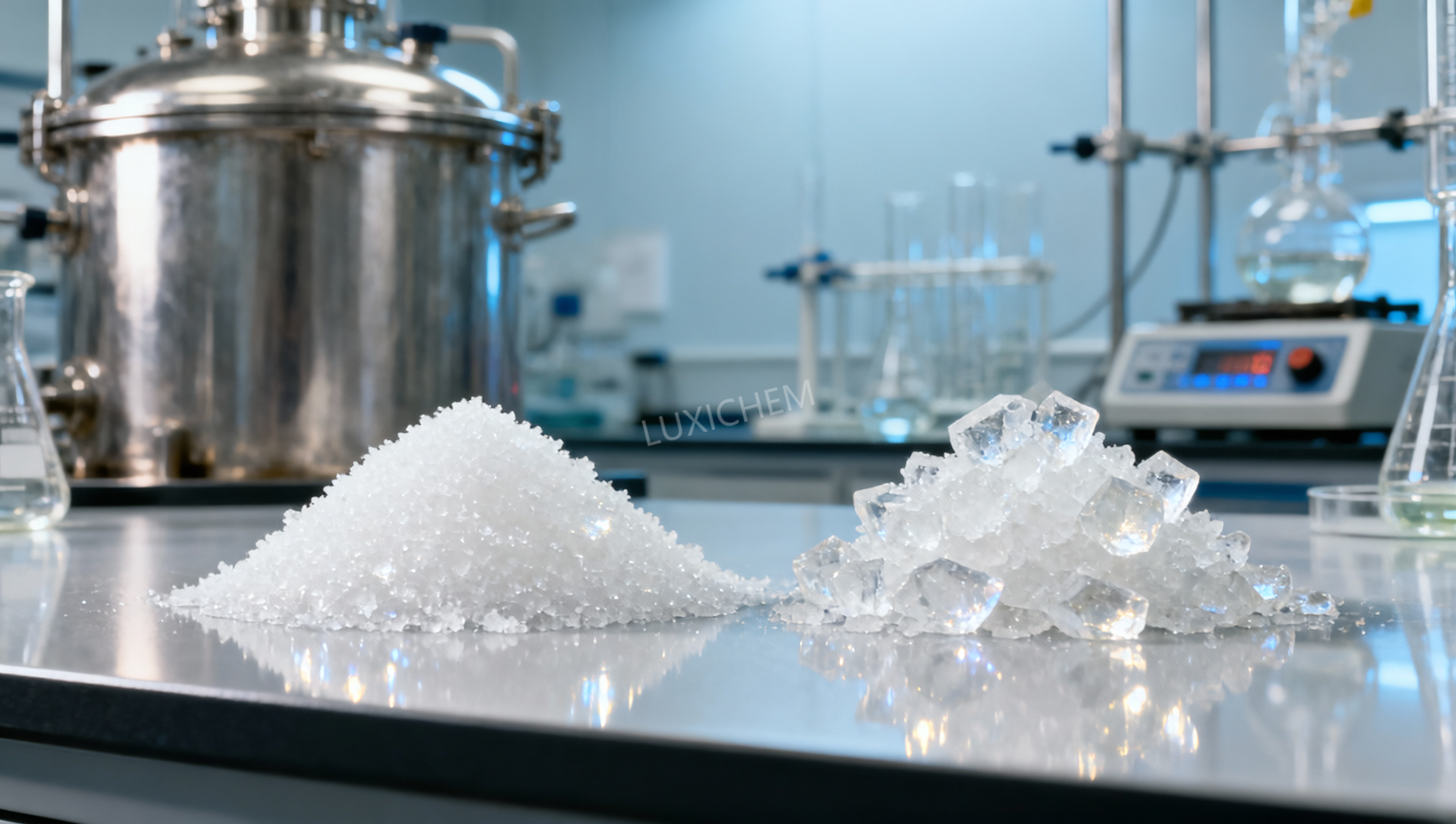
For technical evaluators assessing solid-state polymerization systems, understanding the hydration state of citric acid anhydrous is critical—its absence of water molecules directly influences reactivity, diffusion kinetics, and esterification efficiency versus citric acid monohydrate. In polycondensation reactions where water removal is thermodynamically and kinetically limiting, the presence of lattice-bound water in citric acid monohydrate introduces competing equilibria that delay onset of chain extension and reduce effective acid functionality per mass unit. This article compares structural, thermal, and kinetic behaviors of both forms—empowering informed material selection for R&D and industrial-scale processes.
Structural and Thermodynamic Implications of Hydration State
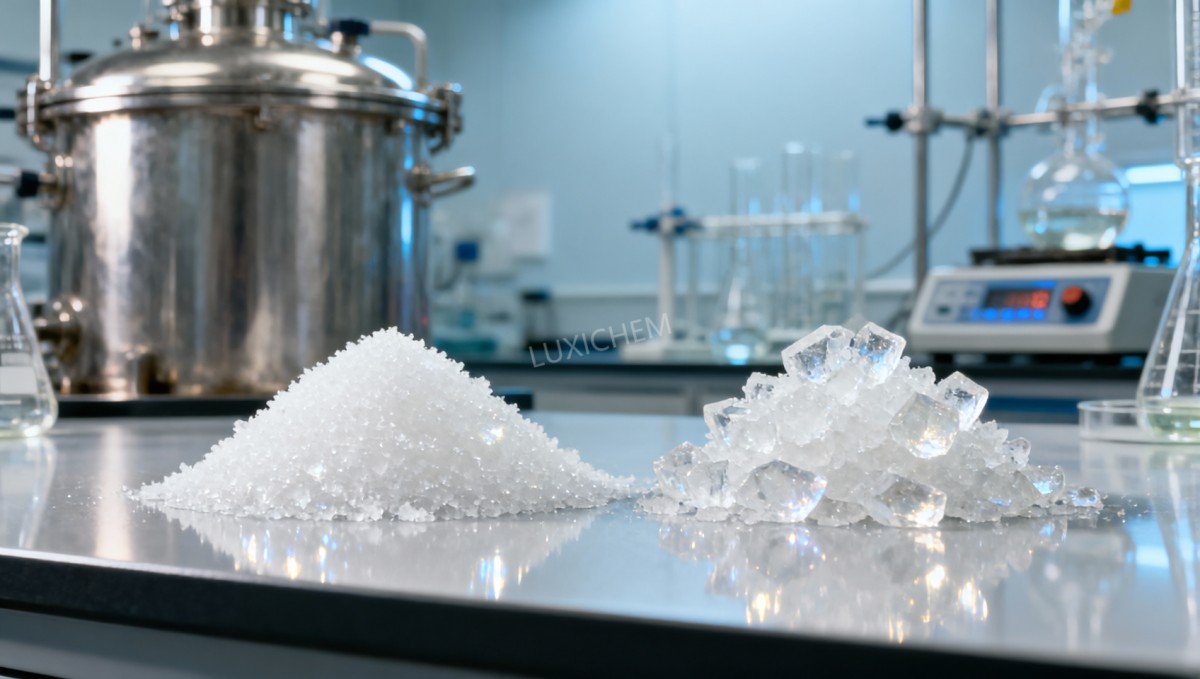
Citric acid anhydrous (C6H8O7) crystallizes in a triclinic lattice with no water of hydration, whereas citric acid monohydrate (C6H8O7·H2O) incorporates one stoichiometric water molecule per formula unit within its crystal structure. This distinction governs not only molar mass (192.12 g/mol vs. 210.14 g/mol) but also molecular packing density and hydrogen-bonding topology. The monohydrate exhibits lower lattice energy due to disruption of carboxyl–hydroxyl interactions by interstitial water, resulting in reduced thermal stability: dehydration begins at ~40 °C and completes near 153 °C, coinciding with the onset of decomposition. In contrast, citric acid anhydrous remains structurally intact up to ~175 °C before decomposition, enabling higher-temperature processing windows without premature loss of acidity or carbonization.
This thermal gap has direct kinetic consequences during solid-state polymerization of polyesters such as poly(ethylene citrate) or citrate-based polyurethanes. When monohydrate is heated above its dehydration temperature under inert atmosphere, rapid water release generates localized vapor pressure within the solid matrix—inducing microvoid formation, particle agglomeration, and non-uniform mixing with diols or diamines. These morphological disruptions impede interfacial contact between functional groups and suppress effective collision frequency. Citric acid anhydrous avoids this artifact entirely, maintaining consistent particle morphology and surface area throughout the pre-polymerization phase.
Kinetic Impact on Esterification and Diffusion Control
Reaction kinetics in solid-state polymerization are governed by three interdependent factors: chemical reactivity (governed by proton availability and steric accessibility), interdiffusion of reactive species (limited by free volume and chain mobility), and mass transfer of condensate (water or alcohol). Citric acid anhydrous enhances all three. Its higher acid equivalent weight (192.12 g/mol vs. 210.14 g/mol) translates to ~9.4% more carboxyl groups per gram—directly increasing active site concentration. More critically, the absence of bound water eliminates the need for concurrent dehydration steps during initial heating, allowing immediate protonation of hydroxyl groups and accelerating the rate-determining nucleophilic attack step.
Diffusion-limited regimes become dominant once oligomers exceed ~1,500 Da. Here, citric acid monohydrate’s residual moisture—even after pre-drying—acts as a plasticizer, lowering local glass transition temperature (Tg) and increasing segmental mobility transiently. However, this effect is non-uniform and spatially heterogeneous, leading to preferential reaction at moisture-rich zones and incomplete conversion in drier regions. Citric acid anhydrous provides predictable, moisture-independent diffusion behavior: its consistent crystallinity yields reproducible free volume distribution, enabling reliable modeling of Fickian diffusion coefficients for glycol co-monomers across temperature gradients.
Process Sensitivity and Common Misinterpretations
A frequent misjudgment arises when comparing reaction rates using gravimetric water evolution data alone. Monohydrate shows earlier and sharper weight loss due to dehydration—not esterification—leading some to erroneously conclude faster kinetics. True esterification onset must be confirmed via complementary techniques: 13C NMR tracking of carbonyl shift (172–175 ppm for ester vs. 178–180 ppm for acid), FTIR monitoring of C=O stretching band narrowing, or rheological detection of melt viscosity rise. Without such verification, observed “acceleration” may reflect artifact-driven decomposition rather than productive condensation.
Another critical boundary condition is storage history. Citric acid monohydrate exposed to ambient humidity (>60% RH) readily absorbs additional surface moisture, increasing effective water content beyond stoichiometric 5.2%. This excess water further depresses Tg, promotes hydrolytic side reactions, and accelerates discoloration. Citric acid anhydrous, while hygroscopic, adsorbs water reversibly on surfaces without lattice incorporation—making it more amenable to controlled drying (e.g., vacuum desiccation at 60 °C for 2 h) prior to charging into reactors. Its moisture regain is linear and predictable; monohydrate’s is hysteretic and history-dependent.
Functional Solvent Compatibility in Multi-Component Systems
In formulations requiring co-solvents or processing aids—particularly where viscosity control or uniform dispersion is essential—compatibility with polar aprotic carriers becomes decisive. Diethylene glycol CAS#111-46-6 serves as a representative example: its high boiling point (245 °C), low volatility, and strong hydrogen-bond accepting capacity enable stable suspension of citric acid particles without premature dissolution or recrystallization. Its miscibility with water and most organic solvents allows formulation flexibility across aqueous, semi-aqueous, and solvent-free routes. Crucially, its hygroscopicity does not interfere with citric acid anhydrous integrity, unlike glycols with lower boiling points (e.g., ethylene glycol) that may volatilize before complete esterification or introduce trace water via residual moisture.
Operational Recommendations for Scale-Up
For laboratory-scale screening, citric acid anhydrous enables tighter kinetic control: reaction onset temperature can be lowered by 10–15 °C relative to monohydrate without sacrificing conversion yield, reducing thermal stress on heat-sensitive diols. At pilot scale, feedstock consistency matters—monohydrate batches from different suppliers often vary in dehydration kinetics due to differences in crystallite size distribution and surface area, introducing batch-to-batch variability in torque profiles and gel time. Citric acid anhydrous exhibits narrower particle size distributions and higher bulk density, improving feeding accuracy in continuous extruders and minimizing bridging in hopper-fed reactors.
Final polymer properties also diverge meaningfully. Polymers synthesized from citric acid anhydrous consistently show higher number-average molecular weights (Mn > 8,500 Da vs. < 6,200 Da under identical conditions), narrower dispersity (Đ = 1.8–2.1 vs. 2.4–3.0), and improved thermal stability (Td,5% elevated by 8–12 °C). These advantages stem not from intrinsic monomer superiority but from elimination of stochastic water-mediated side reactions—hydrolysis of nascent ester linkages, decarboxylation, and Maillard-type browning—that disproportionately affect monohydrate-derived systems.
In summary, the hydration state of citric acid is not merely a specification footnote—it defines the fundamental kinetic landscape of solid-state polyester synthesis. Citric acid anhydrous delivers deterministic reactivity, reproducible diffusion behavior, and scalable process fidelity. Where precise kinetic control, thermal robustness, and molecular weight predictability are required, its structural integrity offers measurable advantages over the monohydrate form—particularly in applications demanding high-performance bio-based polymers with narrow property distributions.
Related Picks
 Butylated Hydroxytoluene Price Drivers: Supply, Purity, and Purchasing Risk FactorsOct 21, 2026Butylated Hydroxytoluene price trends depend on supply stability, purity, logistics, and purchasing risk. Learn how to compare quotes wisely and reduce sourcing costs.
 Sodium Tripolyphosphate Price Trends: Raw Material and Energy ExposureOct 20, 2026Explore sodium tripolyphosphate price trends, from phosphate and soda ash costs to energy exposure. Learn how to compare quotes, manage sourcing risks, and make smarter purchasing decisions.
 Acetonitrile Shipment to Vietnam Successfully Dispatched; RCEP Benefits Boost Fine Chemical Trade with ASEANSep 16, 2026A shipment of industrial-grade acetonitrile from our company has recently been loaded and dispatched following the completion of standardized hazardous material packaging and container securing procedures.
 Nigerian Client’s Order of 4 Containers of Vinyl Acetate Successfully Loaded and Shipped to West AfricaSep 16, 2026We recently completed the loading of a vinyl acetate order for a Nigerian client; four containers of the product have been successfully packed and are ready for shipment to Nigeria.




Question Consultation
Send Us Your Inquiry Today

Luxi Chemical is a professional chemical product supplier with ample stock of all chemical categories and excellent quality, welcome your purchase inquiry.

