


Crude Glycerin Purification: Key Impurities and Their Removal Methods
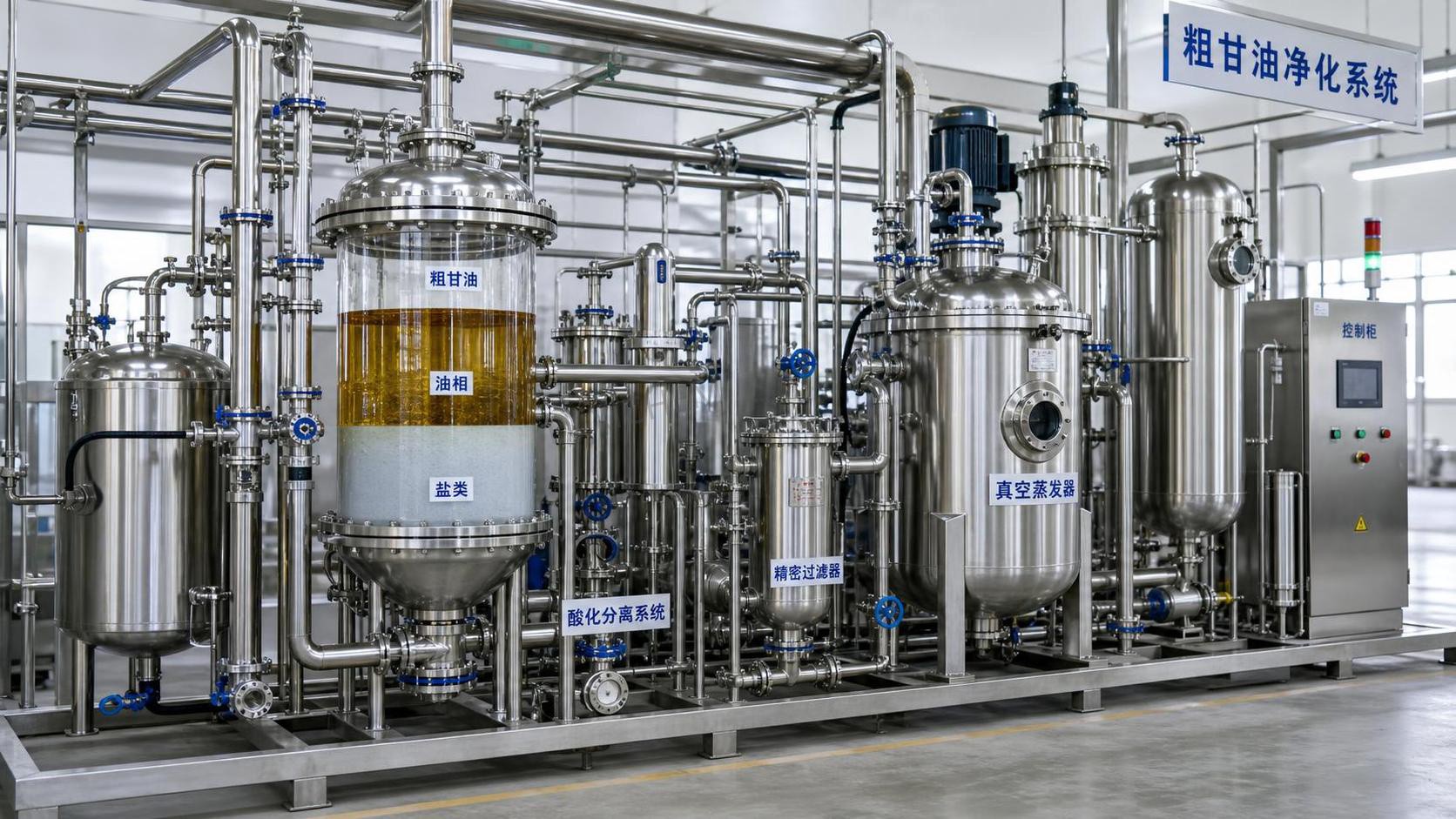
Crude glycerin is not a uniform material. Its composition depends on whether it comes from biodiesel transesterification, fatty-acid saponification, oleochemical processing, or another glycerol-containing stream. Two batches with similar “glycerin content” can behave very differently in storage, evaporation, distillation, or downstream formulation because the impurity package—not glycerol alone—determines processability.
The practical objective is therefore not always to produce pharmaceutical-grade glycerol. It is to remove the contaminants that interfere with the intended use at the lowest technically defensible level of treatment. A boiler fuel blend, an anaerobic digestion feed, a technical humectant feedstock, and a distillation-grade glycerol feed require very different impurity control strategies. The most costly mistake is selecting a purification train before identifying which impurities are present, in what form, and why they matter.
What crude glycerin typically contains
Crude glycerin from biodiesel production commonly contains glycerol, water, residual methanol, soaps, inorganic salts, catalyst residues, unreacted oils, fatty acid methyl esters, free fatty acids, and colored organic compounds. The exact balance changes with feedstock quality, catalyst system, alcohol recovery efficiency, washing practice, and phase-separation performance.
A crude glycerin stream should be treated as a variable process liquor rather than a standardized commodity until it has been sampled and characterized. Density, pH, ash, water content, methanol content, total glycerol, matter organic non-glycerol (MONG), chloride, sodium or potassium, and color provide a useful starting profile. Where downstream use is sensitive, trace metals and specific organic contaminants may also need attention.
Methanol: the first impurity to control
Residual methanol is often the most urgent issue because it creates both safety and quality concerns. It can remain dissolved in the glycerin-rich phase after biodiesel separation, particularly when phase disengagement is incomplete or when the process operates with excess alcohol. Its concentration cannot be judged reliably by odor alone.
Removal normally relies on volatility differences. Flash evaporation or vacuum stripping is commonly used before more intensive purification because methanol is easier to remove than water and glycerol under controlled conditions. Vacuum operation reduces the required temperature and helps limit thermal darkening of glycerol-containing material. Recovered methanol may be suitable for reuse only after confirming water and contaminant levels against the requirements of the reaction system.
Safety controls are integral to methanol removal. Equipment must account for flammable vapor handling, pressure relief, vapor condensation, static control, ventilation, and the potential for oxygen ingress. Operators should also recognize that reducing the liquid’s methanol content does not automatically eliminate vapor hazards in receivers, condensers, vents, or maintenance isolation points.
Gas chromatography is commonly used where a quantified methanol result is needed. Routine process control may rely on a validated internal method, but the method must be suitable for a matrix containing water, salts, soaps, and high-boiling glycerol. Sampling from a poorly mixed tank can produce misleading results because methanol and organic phases may not be distributed uniformly.
Soap removal begins with understanding pH and acidulation
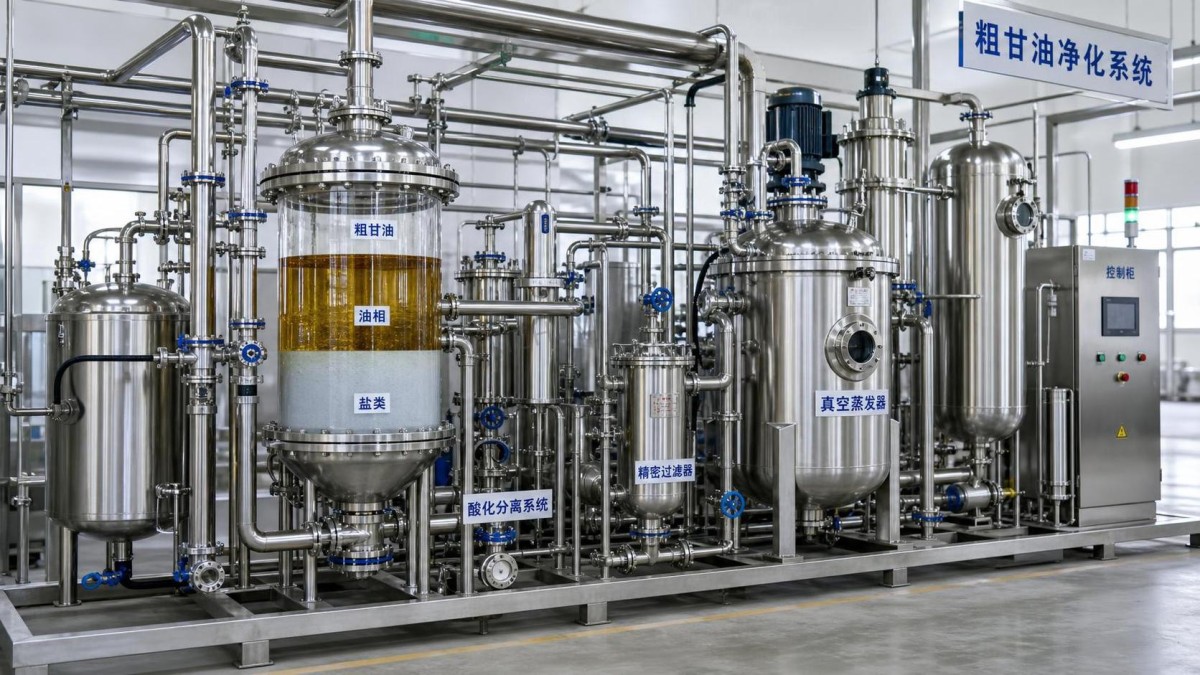
Soap is usually formed when alkaline catalyst contacts free fatty acids in the feedstock. In crude glycerin, soaps contribute to viscosity, emulsification, suspended solids, and poor separation between aqueous and organic phases. They can also make filtration appear ineffective because the filter is asked to solve a chemical stability problem rather than a particle-removal problem.
Acidulation converts soaps into free fatty acids and inorganic salts. In simplified form, sodium or potassium soaps react with an acid to form a free fatty-acid phase that can separate from the glycerol-rich aqueous phase. The acid choice must be made with the downstream salt burden in mind. Sulfuric acid, hydrochloric acid, and phosphoric acid do not create the same salt profile, corrosion implications, or disposal considerations.
Over-acidification creates its own problems. A strongly acidic glycerin stream may increase corrosion risk, complicate later adsorption or ion-exchange treatment, and require further neutralization. The target is controlled soap splitting and clean phase separation, not simply the lowest possible pH. Temperature, residence time, agitation intensity, and settling time all influence whether the liberated fatty acids coalesce into a removable layer or remain as a persistent emulsion.
After acidulation, gravity settling may be sufficient for coarse phase separation, but centrifugation is often more reliable where throughput is high or density differences are small. Warm separation can reduce viscosity and improve coalescence, although excessive heat can intensify color formation and odor development.
Salts, ash, and catalyst residues limit high-purity recovery
Alkali catalysts and neutralization chemistry leave sodium, potassium, sulfates, chlorides, phosphates, carbonates, or related inorganic residues in crude glycerin. These are frequently reported as ash after ignition, but ash is a broad indicator rather than a complete explanation of downstream performance. A low ash result does not prove that the material is free from ionic contamination, and a high ash result does not identify which ions are present.
For applications that tolerate technical-grade glycerin, controlled neutralization followed by filtration may be adequate. Where low conductivity, low ash, or low metal content is required, more selective treatment is necessary. Ion exchange can remove dissolved ions effectively, but only after pretreatment has reduced oils, suspended solids, and high organic loading. Otherwise, resins foul quickly and regeneration frequency becomes uneconomic.
Membrane systems can also be considered for certain streams, but their suitability depends heavily on pretreatment and feed variability. Soap, oil droplets, colloids, and high-viscosity glycerol solutions can cause rapid flux decline. Membrane selection should follow pilot-scale compatibility testing rather than assumptions based only on nominal pore size or molecular-weight cutoff.
Conductivity is useful as a fast operational indicator, particularly after demineralization, but it should not be used as the sole release criterion. Non-ionic organic contamination, color bodies, and residual water can remain even when conductivity is low.
Water removal is simple in principle but demanding in operation
Water is often the largest non-glycerol component by mass. Removing it improves glycerol concentration, reduces freight costs, and may be essential before distillation or use in moisture-sensitive formulations. Yet dehydration is not just an energy calculation. As water content falls, viscosity rises, heat transfer changes, foaming may become more difficult to control, and entrainment can increase.
Vacuum evaporation is generally preferred over atmospheric boiling because it lowers thermal stress. Glycerol can darken or degrade when exposed to excessive temperature, prolonged residence time, or localized overheating. The risk becomes greater when salts and organic residues are present, since these impurities can promote fouling on heat-transfer surfaces and create hot spots.
Evaporator performance should be monitored through more than final water content. Vacuum stability, condensate quality, foam-control demand, product color, heat-transfer coefficient, and cleaning frequency reveal whether the system is operating within a sustainable range. Antifoam selection also deserves caution: an antifoam that solves evaporation problems may complicate later purification or make a downstream application unacceptable.
Organic residues are the reason color and odor persist
Unreacted oils, fatty acid methyl esters, free fatty acids, sterols, oxidation products, and other non-glycerol organics are often grouped under broad measures such as MONG. This is useful for screening, but it does not identify the specific material responsible for color, odor, instability, or distillation fouling.
Settling, decanting, centrifugation, and fine filtration remove free oil and suspended matter, but dissolved or colloidal organics may remain. Activated carbon, bleaching earth, or other adsorbents can reduce color and selected odor-active compounds. Their use requires controlled trials because adsorption is not selective only for unwanted compounds; glycerol losses, filtration burden, and spent-media handling must be considered.
Vacuum distillation is the more rigorous route when high-purity glycerol is required. It can separate glycerol from many heavy, nonvolatile contaminants, but it is sensitive to feed pretreatment. A feed with excessive salts, soaps, or suspended solids can foul reboilers, increase residue formation, and undermine product color. Distillation should therefore be regarded as the final polishing stage of a purification train, not a substitute for upstream separation.
The same principle applies when glycerol streams are handled alongside fine-chemical materials. A product such as N,N-Diethylpropargylamine CAS#4079-68-9 has its own storage, purity, and compatibility requirements; it should not be assumed that process controls developed for a crude, salt-bearing glycerin stream are transferable to a moisture-sensitive or specialty chemical system.
Choose treatment according to the destination of the glycerin
Purification targets should be set from the downstream specification, not from a generic desire for maximum purity. For energy recovery or some biological applications, methanol control, salt content, and compatibility with the receiving system may be more important than color. For technical chemical use, water, ash, pH, and organic residues may define fitness. For refined glycerol applications, the specification is substantially tighter and usually requires a combination of methanol recovery, acidulation, phase separation, demineralization, decolorization, evaporation, and vacuum distillation.
Food, feed, cosmetic, pharmaceutical, and other regulated uses require particular caution. “Crude glycerin” is not interchangeable with glycerol that meets a recognized monograph or application-specific standard. The relevant quality requirements depend on the destination market, intended use, traceability expectations, contaminant limits, and manufacturing controls. Process operators should avoid treating a high glycerol assay as evidence that the material is suitable for sensitive applications.
Sampling and control points determine whether purification is repeatable
Many apparent purification failures are actually sampling failures. A tank containing separated fatty acids, settled salts, and a glycerol-rich phase can yield very different results depending on sample depth and recirculation status. Samples should represent the material being transferred or processed, not only the clearest portion of the tank.
Useful control points normally include crude feed receipt, post-methanol removal, post-acidulation phase separation, post-filtration or demineralization, evaporation discharge, and final storage. At each stage, the test method should answer a process question: whether methanol stripping is complete, whether soap splitting has occurred, whether salts are falling, whether water removal is stable, or whether the product remains within its release specification.
Crude glycerin purification works best when each unit operation removes a defined impurity class. Acidulation is for soaps, not for reducing water. Evaporation is for water and volatile components, not for dissolved salts. Filtration is for solids, not for stable emulsions. Distillation can deliver high purity, but only if upstream treatment prevents salts, oils, and degraded organics from reaching the still. Matching the separation method to the impurity mechanism is what turns an inconsistent by-product into a controllable process material.
Related Picks
 Butylated Hydroxytoluene Price Drivers: Supply, Purity, and Purchasing Risk FactorsOct 21, 2026Butylated Hydroxytoluene price trends depend on supply stability, purity, logistics, and purchasing risk. Learn how to compare quotes wisely and reduce sourcing costs.
 Sodium Tripolyphosphate Price Trends: Raw Material and Energy ExposureOct 20, 2026Explore sodium tripolyphosphate price trends, from phosphate and soda ash costs to energy exposure. Learn how to compare quotes, manage sourcing risks, and make smarter purchasing decisions.
 Acetonitrile Shipment to Vietnam Successfully Dispatched; RCEP Benefits Boost Fine Chemical Trade with ASEANSep 16, 2026A shipment of industrial-grade acetonitrile from our company has recently been loaded and dispatched following the completion of standardized hazardous material packaging and container securing procedures.
 Nigerian Client’s Order of 4 Containers of Vinyl Acetate Successfully Loaded and Shipped to West AfricaSep 16, 2026We recently completed the loading of a vinyl acetate order for a Nigerian client; four containers of the product have been successfully packed and are ready for shipment to Nigeria.




Question Consultation
Send Us Your Inquiry Today

Luxi Chemical is a professional chemical product supplier with ample stock of all chemical categories and excellent quality, welcome your purchase inquiry.

