


Glycerine or Glycerin? Which Term Matters in Global Chemical Purchasing?
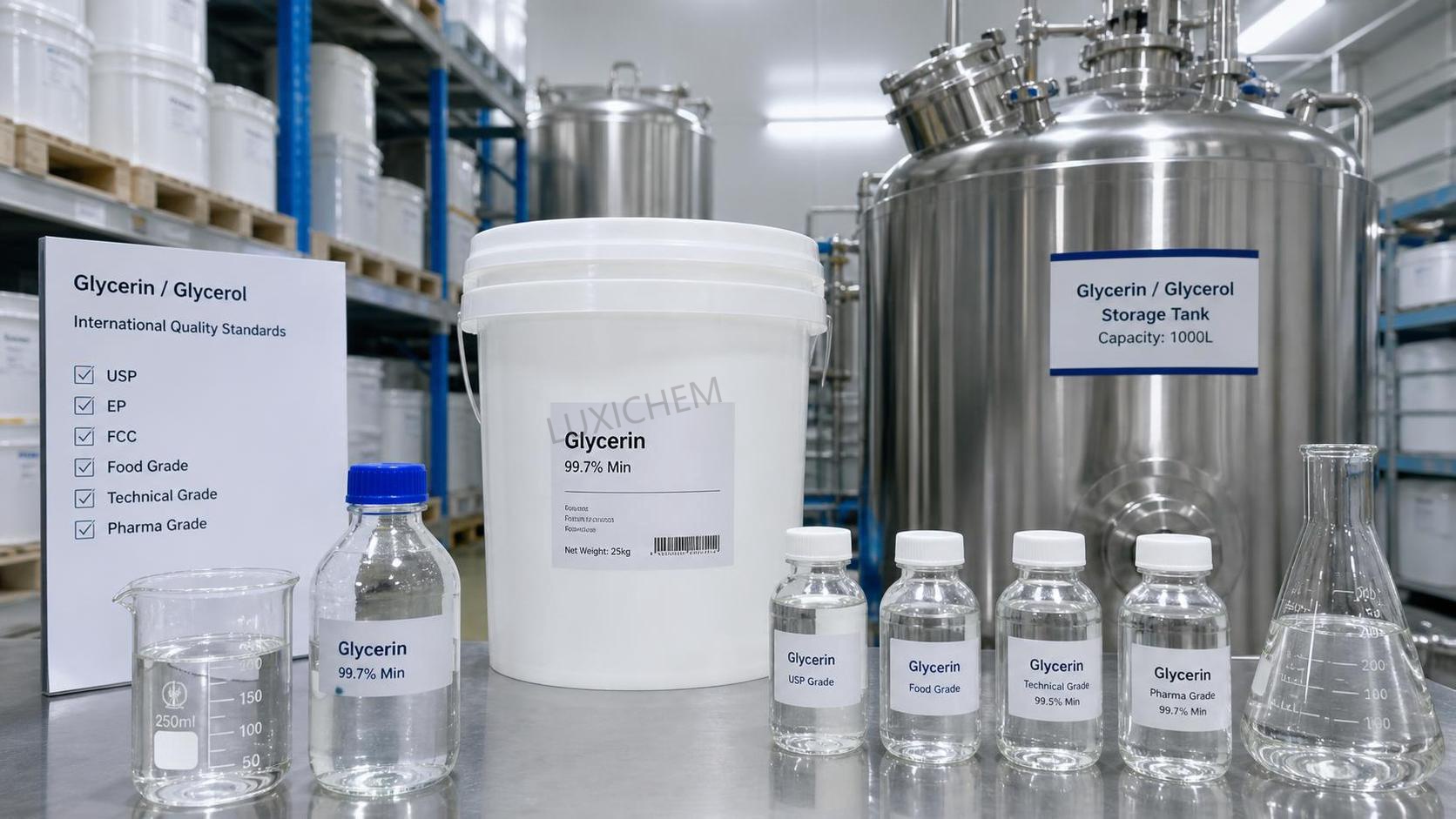
“Glycerine” and “glycerin” normally refer to the same chemical substance: glycerol, CAS No. 56-81-5. The spelling difference is not a difference in molecular structure, purity, source, or performance. Yet in international chemical trade, the term used on a quotation, specification sheet, label, customs declaration, or customer-facing document can still matter because it affects search results, document consistency, market familiarity, and the risk of an avoidable clarification request.
The practical rule is straightforward: treat glycerol, glycerin, and glycerine as related naming expressions, but do not use the spelling alone to identify the product being purchased. The decisive identifiers are the CAS number, grade, concentration, source declaration where relevant, applicable standard, and documented quality parameters.
One chemical, three common names
Glycerol is the systematic and widely recognized chemical name for propane-1,2,3-triol. It is a trihydric alcohol with the molecular formula C3H8O3. In trade, however, the material is frequently described as glycerin or glycerine, particularly when sold as a refined liquid for food, pharmaceutical, personal-care, tobacco, industrial, or technical uses.
The distinction is mainly linguistic:
- Glycerin is the spelling more common in the United States and in commercial usage influenced by US documentation.
- Glycerine is more common in the United Kingdom, many Commonwealth markets, and parts of international trade.
- Glycerol is widely used in scientific literature, chemical inventories, customs nomenclature, technical specifications, and pharmacopeial contexts.
A buyer searching for “glycerine 99.5%” and another searching for “glycerin USP grade” may therefore be looking for substantially the same base chemical. Their actual requirements may still be very different. One may need a material suitable for food formulations, while the other may require compliance with a pharmaceutical monograph, a low-water specification, or a documented animal-origin-free supply chain.
The spelling identifies how a market talks about the material. It does not establish what is in the drum, IBC, flexitank, or bulk tank.
Why the spelling issue creates commercial friction
Search behavior is the first place where the difference becomes visible. A supplier database, online marketplace, ERP system, or internal approved-vendor list may treat “glycerin” and “glycerine” as separate search terms. If the system is not configured with synonyms, product records can be missed or duplicated. This is especially common when one team enters product names from supplier documents while another uses customer terminology.
The second issue is document alignment. A sales contract may state “Refined Glycerine,” while the safety data sheet uses “Glycerol,” the certificate of analysis says “Glycerin,” and the shipping mark uses an abbreviated grade designation. None of those labels is necessarily wrong. However, inconsistency can slow down customer qualification, customs review, banking document checks, or internal quality approval when no clear cross-reference is provided.
A simple but effective practice is to use a combined product description in commercial documentation:
Glycerin (Glycerine / Glycerol), CAS No. 56-81-5
Once the product is clearly identified, the remaining description should focus on the actual commercial specification: purity, water content, density, color, odor, grade, packing, origin statement if requested, and applicable compliance documents.
The same discipline matters across chemical portfolios. For example, a name may be commercially familiar while the CAS number and transport classification carry the legal and technical identity. A material such as Styrene CAS#100-42-5 cannot be qualified by its trade name alone because it has specific flammability, inhibitor, storage, and transport considerations. Glycerol is less hazardous in normal commercial handling, but the underlying documentation principle is the same: name recognition is useful; unambiguous identification is essential.
What must be confirmed beyond “glycerine”
Glycerol products can vary substantially in commercial suitability even when they share the same CAS number. A request for “glycerine” without further qualification is incomplete for most international transactions.
Grade is the first distinction. Technical-grade material may be appropriate for industrial processing, chemical synthesis, or certain non-regulated applications. Food-grade material must satisfy the applicable food-use requirements in the destination market. Pharmaceutical-grade material is commonly requested where compendial compliance, tighter impurity control, validated quality systems, or formal documentation is required. Cosmetic and personal-care buyers may use their own specifications or accept food/pharmaceutical references depending on the formulation and market.
Terms such as USP, BP, Ph. Eur., FCC, or equivalent national standards should not be treated as generic marketing phrases. A grade claim should correspond to the current applicable monograph or standard and be supported by the relevant documentation. A product described as “USP grade” in an offer should not automatically be assumed to meet every customer-specific requirement, especially where the buyer requires a particular revision, testing method, audit standard, or origin declaration.
Concentration is equally important. Refined glycerol is commonly traded at high concentration, often expressed as a minimum assay or percentage by weight. Water content affects viscosity, density, freezing behavior, freight economics, and formulation performance. Two offers with similar headline purity can still differ in tolerances, methods of analysis, and batch consistency.
Source matters in selected end uses. Glycerol may be obtained from oleochemical processes, biodiesel production, or synthetic routes. A request for vegetable origin, palm-free origin, non-animal origin, kosher, halal, non-GMO status, or traceability information is not answered by the word glycerin or glycerine. Such requirements need explicit supplier declarations and, where applicable, supporting certification from the appropriate party.
Impurity limits can determine suitability. Depending on the grade and use, buyers may examine color, odor, water, ash or sulfated ash, chloride, sulfate, heavy metals, aldehydes, reducing substances, diethylene glycol, ethylene glycol, and other parameters specified by a customer standard or pharmacopeia. The relevant test list should be agreed before shipment rather than inferred after a sample has passed a general purity check.
CAS number is the anchor, but it is not the whole specification
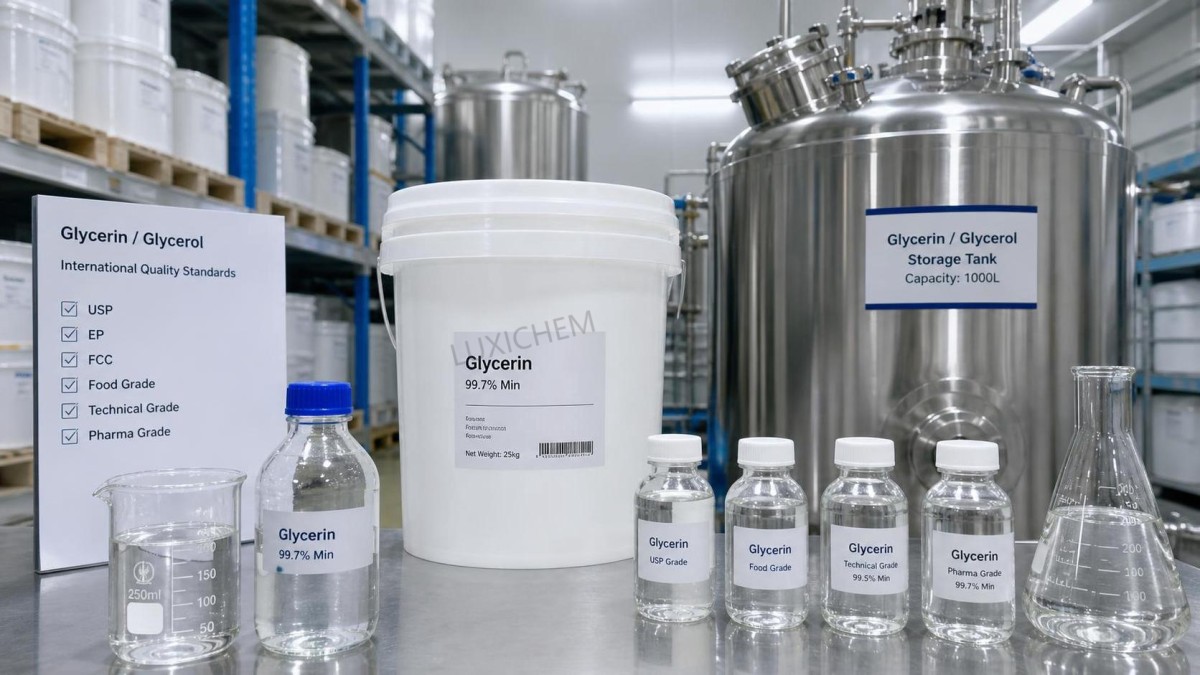
CAS No. 56-81-5 is the most useful common identifier for glycerol in supplier qualification and document review. It reduces ambiguity created by spelling variants and translations. It should appear consistently on technical data sheets, safety data sheets, certificates of analysis, and product labels where appropriate.
Still, CAS identification only establishes the chemical identity. It does not establish:
- the grade or regulatory suitability;
- the intended application;
- the manufacturing source;
- the concentration supplied;
- the permitted impurity profile;
- the packing configuration;
- the customer’s destination-market labeling obligations.
This distinction prevents a frequent purchasing error: comparing products based only on CAS number and headline assay. A high-assay glycerol can be technically sound for one industrial use yet unsuitable for a food, pharmaceutical, or sensitive personal-care application because its supporting documents, traceability, or impurity controls do not match the required standard.
How naming changes across sales, regulatory, and logistics documents
Commercial documents should use wording that customers readily recognize. In North American customer communication, “glycerin” may be the more familiar term. In markets where British English conventions prevail, “glycerine” may read more naturally. Neither choice changes the product identity.
Technical documents often benefit from a fuller naming format. For example:
Product name: Glycerol
Synonyms: Glycerin; Glycerine
CAS No.: 56-81-5
Molecular formula: C3H8O3
This format is useful because it connects the customer-facing term to the scientific identifier without creating the impression that separate substances are involved.
For customs purposes, classification should be based on the customs tariff rules and the product’s actual composition, not on the English spelling used in a sales invoice. International tariff nomenclature commonly refers to the substance as glycerol. The HS classification used for a shipment must be checked against the importing country’s current tariff schedule and any local statistical or regulatory subdivisions. A supplier’s reference HS code can assist preparation, but it should not replace import-side confirmation.
Labels require similar care. The product name should match the safety data sheet and shipping documentation closely enough to avoid confusion. Where local language or chemical labeling rules apply, the importer or responsible party may need to adapt the label wording while retaining the correct substance identification. “Glycerin” on a consumer-facing label and “glycerol” in technical compliance documentation can coexist, provided the information is accurate and properly controlled.
Do not confuse spelling differences with grade differences
A persistent misunderstanding is that glycerine means a more refined or more “natural” material than glycerin. That is not a reliable distinction. Nor does one spelling automatically indicate pharmaceutical grade, vegetable origin, food compliance, or superior purity.
Another mistake is to assume that “vegetable glycerine” is a universal grade description. It is mainly a source statement. It may be commercially important for formulation, certification, or customer preference, but it does not independently define assay, impurity limits, pharmacopoeial compliance, or food-law status.
Likewise, “crude glycerine” and refined glycerine are not interchangeable. Crude glycerol streams may contain water, salts, soaps, methanol residues, fatty matter, catalysts, or other process-related impurities depending on their origin. Refined products are processed to achieve a defined specification. A quotation should make this distinction explicit because the price, logistics, quality risk, and potential application range differ sharply.
Questions that prevent an incomplete inquiry
A strong inquiry does not need to be long, but it should eliminate uncertainty. Instead of asking only for “glycerine price,” a usable request identifies the material and the decision conditions around it.
- Is the required product technical, food, pharmaceutical, cosmetic, or another defined grade?
- What minimum assay and maximum water content are required?
- Which standard, monograph, or customer specification applies?
- Is vegetable, non-animal, palm-free, or another origin declaration necessary?
- Which documents must accompany the shipment: COA, SDS, specification sheet, certificate of origin, allergen statement, halal or kosher certificate, or other declarations?
- What packing is required: drums, IBCs, flexitank, ISO tank, or bulk delivery?
- Which destination country and end use apply?
These questions also make quotations comparable. Without them, one supplier may quote a technical material in bulk while another quotes a higher documented grade in drums. The apparent price gap would then reflect different products and service scopes rather than a meaningful difference in commercial competitiveness.
When one term should be preferred
Use the term that fits the immediate document and market, while preserving the common chemical identifier. “Glycerin” is usually sensible in US-oriented customer materials. “Glycerine” may be preferable where that spelling is established in local trade practice. “Glycerol” is often the clearest primary term in technical specifications, scientific documents, and standardized chemical references.
For international quotations and supplier databases, combined wording is often the most resilient option: “Glycerine/Glycerin (Glycerol), CAS No. 56-81-5.” It supports searchability across markets and signals that all naming variants refer to the same base substance.
The term itself matters mainly because unclear language creates administrative friction. The product decision rests elsewhere: whether the material’s grade, concentration, source, analytical limits, documentation, packing, and destination-market status match the intended use. Once those points are defined, the choice between glycerine and glycerin becomes a matter of communication rather than chemistry.
Related Picks
 Butylated Hydroxytoluene Price Drivers: Supply, Purity, and Purchasing Risk FactorsOct 21, 2026Butylated Hydroxytoluene price trends depend on supply stability, purity, logistics, and purchasing risk. Learn how to compare quotes wisely and reduce sourcing costs.
 Sodium Tripolyphosphate Price Trends: Raw Material and Energy ExposureOct 20, 2026Explore sodium tripolyphosphate price trends, from phosphate and soda ash costs to energy exposure. Learn how to compare quotes, manage sourcing risks, and make smarter purchasing decisions.
 Acetonitrile Shipment to Vietnam Successfully Dispatched; RCEP Benefits Boost Fine Chemical Trade with ASEANSep 16, 2026A shipment of industrial-grade acetonitrile from our company has recently been loaded and dispatched following the completion of standardized hazardous material packaging and container securing procedures.
 Nigerian Client’s Order of 4 Containers of Vinyl Acetate Successfully Loaded and Shipped to West AfricaSep 16, 2026We recently completed the loading of a vinyl acetate order for a Nigerian client; four containers of the product have been successfully packed and are ready for shipment to Nigeria.




Question Consultation
Send Us Your Inquiry Today

Luxi Chemical is a professional chemical product supplier with ample stock of all chemical categories and excellent quality, welcome your purchase inquiry.

