


Grape Seed Extract Standardization: Reading Proanthocyanidin Specifications
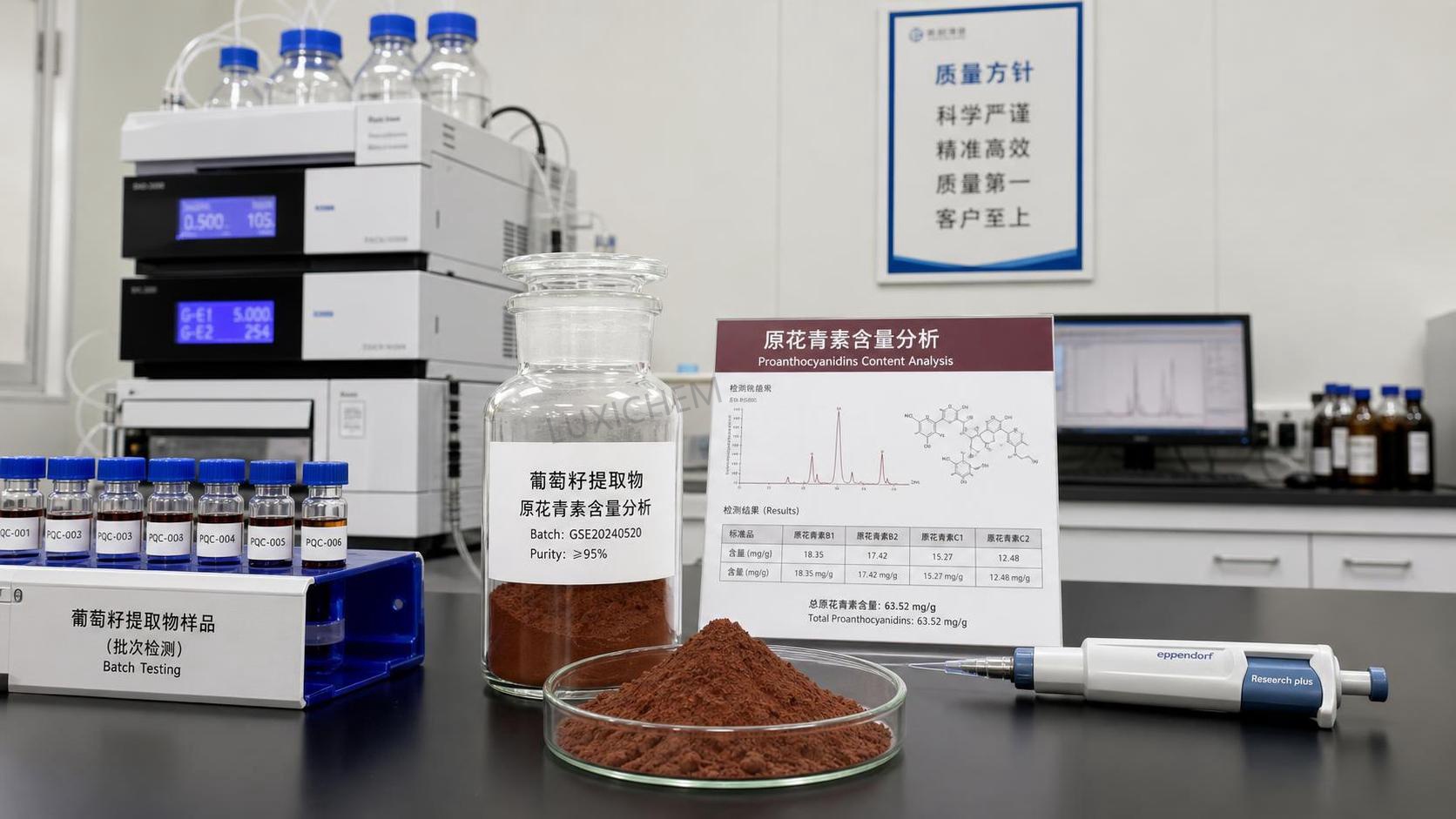
A Grape Seed Extract specification is only meaningful when the proanthocyanidin value can be tied to a defined test method, a defined material basis, and practical contaminant controls. A high number on a certificate of analysis does not automatically mean a more consistent or suitable ingredient. For release decisions, the first question should be: what exactly does this result measure?
Grape Seed Extract is commonly supplied as a plant-derived powder for nutraceuticals, functional foods, and related formulations. Its quality is often expressed through oligomeric proanthocyanidins (OPCs), a group of polyphenolic compounds associated with the extract’s characteristic antioxidant capacity. Because grape seed extracts are chemically complex mixtures rather than single purified substances, specification reading requires more context than checking one assay result.
Start With the Meaning of “Proanthocyanidins”
Proanthocyanidins are not one molecule. They include catechin- and epicatechin-based units joined into oligomers and larger polymers. Their composition can shift with grape variety, seed maturity, extraction solvent, processing temperature, concentration steps, and drying conditions. Two materials may therefore both be sold as Grape Seed Extract while having different molecular profiles, color, solubility, sensory impact, and behavior in a finished product.
This matters because a specification may refer to “total proanthocyanidins,” “OPCs,” “polyphenols,” or an assay expressed as an equivalent of a reference compound. These terms should not be treated as interchangeable. Total phenolics can include substances other than proanthocyanidins. An OPC result may focus on a particular fraction or rely on a color reaction whose response differs among compounds. The certificate must state the analyte description clearly enough for the buyer to understand what is being controlled.
A practical review begins with three matching questions:
- Is the claimed proanthocyanidin level reported on an as-is basis or a dry basis?
- Does the supplier identify the analytical method and calculation basis?
- Is that same method suitable for comparing this lot with prior approved lots?
If any answer is unclear, the numerical result is weak evidence of lot-to-lot consistency.
The Test Method Is Part of the Specification
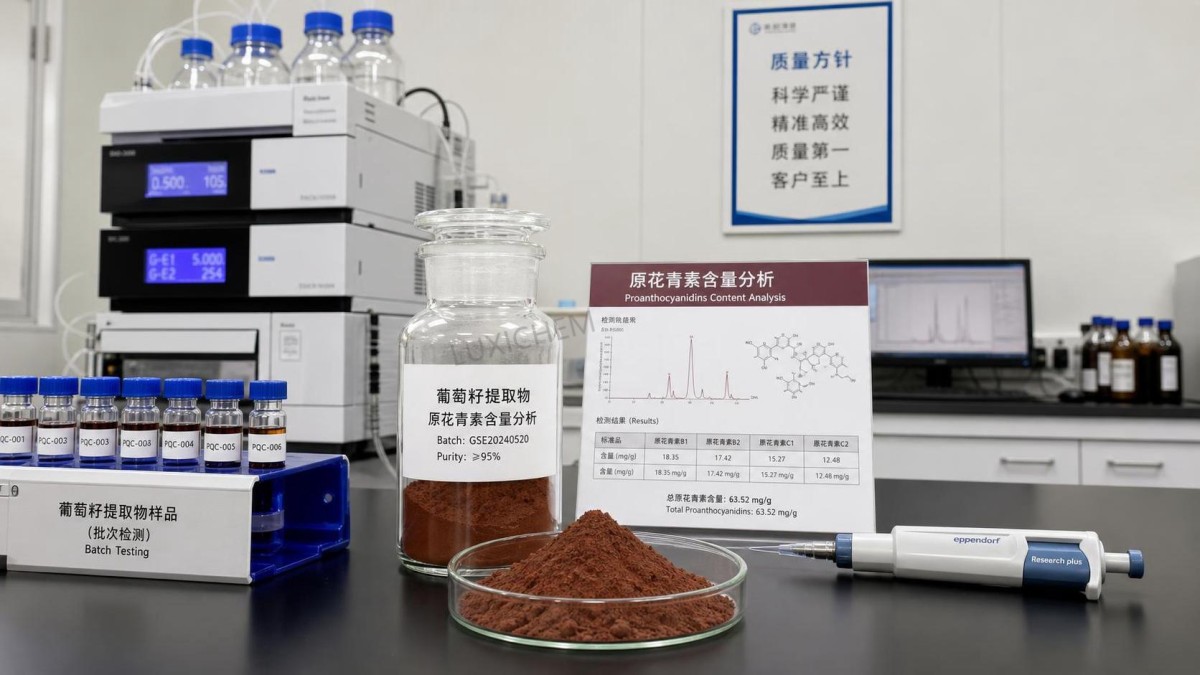
Colorimetric methods are widely used for plant extracts because they are relatively fast and practical for routine control. They can be useful for trend monitoring when the same validated procedure, reference material, sample preparation, and reporting basis are maintained. Their limitation is selectivity: different phenolic structures may produce different response strengths. A result from one colorimetric method cannot be directly compared with a result generated by another method unless equivalence has been demonstrated.
Chromatographic profiling can provide more structural information, particularly when a manufacturer needs to monitor markers, verify identity, or investigate a shift in raw-material composition. However, chromatography also needs a defined target list, extraction procedure, and acceptance logic. It does not replace a total-content assay automatically; it answers a different question.
The most defensible purchasing practice is to define the method in the purchase specification, not merely the minimum percentage. When an incoming batch is tested by a different laboratory, method transfer, sample homogeneity, extraction time, calibration approach, and reporting convention can all create an apparent discrepancy. A disputed result is often a method-alignment issue before it is a material-quality issue.
Read the Assay Alongside the Material Basis
Moisture and loss on drying deserve more attention than they usually receive. A hygroscopic botanical powder can gain water during storage or transport. When assay is expressed on an as-is basis, moisture uptake can lower the reported concentration even if the dry-matter composition has not changed. Conversely, comparing a dry-basis result with an as-is result can create a false impression of improvement or decline.
For routine receiving inspection, establish which value governs release. If the formulation dose and label claim are calculated using supplied powder weight, an as-is specification may be operationally relevant. If the purpose is comparing extraction efficiency or intrinsic composition across lots, dry-basis reporting may be more informative. Both can be useful, but they should never be mixed in a trending chart without conversion.
Appearance should support, rather than replace, analytical control. Grape Seed Extract commonly appears as a brown to reddish-brown powder, with variation influenced by concentration and oxidation state. An unusual odor, hard caking, visible foreign matter, or a material that does not disperse as expected should trigger investigation. Color alone is not a reliable release criterion because natural raw materials vary and processing conditions influence shade.
Purity Does Not Mean “One High Assay Number”
For a botanical extract, purity is a package of controls. It includes confirmation that the material is genuinely derived from the declared botanical source, that extraction processing is appropriately managed, and that relevant unwanted constituents are within the limits required by the intended use. A supplier specification should give a coherent identity story: botanical name or source description, plant part, extraction medium where relevant, carrier status, and a traceable batch identity.
Pay close attention to carriers and processing aids. Some extracts are standardized or spray-dried using permitted excipients to improve flow, reduce stickiness, or deliver a target assay range. That does not make the material unsuitable, but it changes the delivered composition. The presence and amount of any carrier should be declared because it affects dosing calculations, finished-product labeling, and comparisons with an extract sold on a different basis.
For applications where a formula already contains several flavonoid-rich ingredients, chemical identity must remain separate from functional category. For example, Rutin CAS#153-18-4 is a defined plant-derived flavonoid used in pharmaceutical, nutraceutical, food, and functional-food contexts. It may appear alongside botanical antioxidant ingredients in a formulation, but it is not a substitute for a grape seed proanthocyanidin assay. A single-compound material and a standardized multi-component extract need different identity and release strategies.
Contaminant Review Should Follow the Product’s Exposure Route
Safety review should be designed around how the Grape Seed Extract will be used. A powder intended for an oral finished product needs controls that reflect oral exposure, expected consumer population, daily use level, and the other ingredients in the formula. The relevant certificate section usually includes microbiological parameters, heavy metals or elemental contaminants, pesticide-residue controls where applicable, and residual solvents when solvents are used during extraction.
The important point is not to treat the certificate as a checklist of isolated passes. Review the limits, units, methods, and reporting format. “Not detected” is incomplete without an understanding of the detection limit. A result reported in a different unit may look acceptable while being impossible to compare with the internal standard. For multi-supplier programs, harmonizing units and acceptance criteria before approval prevents confusion at receiving.
Residual solvent control needs the same discipline. Water extraction and alcohol-based extraction are not interchangeable manufacturing descriptions, and the process may affect both the compositional profile and the residue package. A supplier should be able to connect the reported solvent test to the actual processing route of the batch.
Build a Release Decision Around Consistency, Not a Single Lot
An incoming lot can meet a minimum proanthocyanidin requirement while still being a poor match for the approved material. This can happen when the extract has a materially different odor, color, moisture level, particle behavior, or chromatographic profile. Such shifts may affect blending, encapsulation, beverage clarity, tablet compression, or sensory properties even before the active assay falls outside its limit.
A workable control plan normally combines document review with risk-based confirmation testing. At minimum, compare the certificate against the approved specification, verify batch traceability and packaging condition, retain a representative sample, and trend the parameters most likely to affect downstream performance. More extensive identity or contaminant testing is appropriate when changing supplier, changing origin, receiving an unfamiliar production lot, or responding to an unexplained trend shift.
Luxi Chemical (Shandong) Co., Ltd. supports sourcing across chemical raw materials, food additives, organic intermediates, and related products. In one-stop procurement arrangements, traceable documentation and clear material specifications are especially important: they allow each ingredient to be evaluated on its own analytical basis instead of being accepted through a generic document-review process.
Questions Worth Settling Before Approval
Before adding a new Grape Seed Extract grade to an approved supplier list, quality and safety teams should obtain answers that can be placed directly into the internal specification:
- What botanical source and plant part are used, and is the extract identity verified against that source?
- Which proanthocyanidin method is used, including reference standard, sample preparation, and calculation basis?
- Are assay, moisture, and other concentration-sensitive values reported on compatible bases?
- Does the product contain a carrier, processing aid, or declared diluent that changes delivered dosage?
- Which contaminant controls are linked to the intended application and extraction route?
- What stability conditions preserve the approved material profile through storage and distribution?
The best specification is not necessarily the longest one. It is the one that makes the material identifiable, makes the proanthocyanidin claim reproducible, and connects safety limits to the real finished-product use. Once those links are established, a certificate of analysis becomes a practical release tool rather than a document containing an attractive but isolated assay number.
Related Picks
 Butylated Hydroxytoluene Price Drivers: Supply, Purity, and Purchasing Risk FactorsOct 21, 2026Butylated Hydroxytoluene price trends depend on supply stability, purity, logistics, and purchasing risk. Learn how to compare quotes wisely and reduce sourcing costs.
 Sodium Tripolyphosphate Price Trends: Raw Material and Energy ExposureOct 20, 2026Explore sodium tripolyphosphate price trends, from phosphate and soda ash costs to energy exposure. Learn how to compare quotes, manage sourcing risks, and make smarter purchasing decisions.
 Acetonitrile Shipment to Vietnam Successfully Dispatched; RCEP Benefits Boost Fine Chemical Trade with ASEANSep 16, 2026A shipment of industrial-grade acetonitrile from our company has recently been loaded and dispatched following the completion of standardized hazardous material packaging and container securing procedures.
 Nigerian Client’s Order of 4 Containers of Vinyl Acetate Successfully Loaded and Shipped to West AfricaSep 16, 2026We recently completed the loading of a vinyl acetate order for a Nigerian client; four containers of the product have been successfully packed and are ready for shipment to Nigeria.




Question Consultation
Send Us Your Inquiry Today

Luxi Chemical is a professional chemical product supplier with ample stock of all chemical categories and excellent quality, welcome your purchase inquiry.

