


How BHT dosage influences oxidation stability in polymers
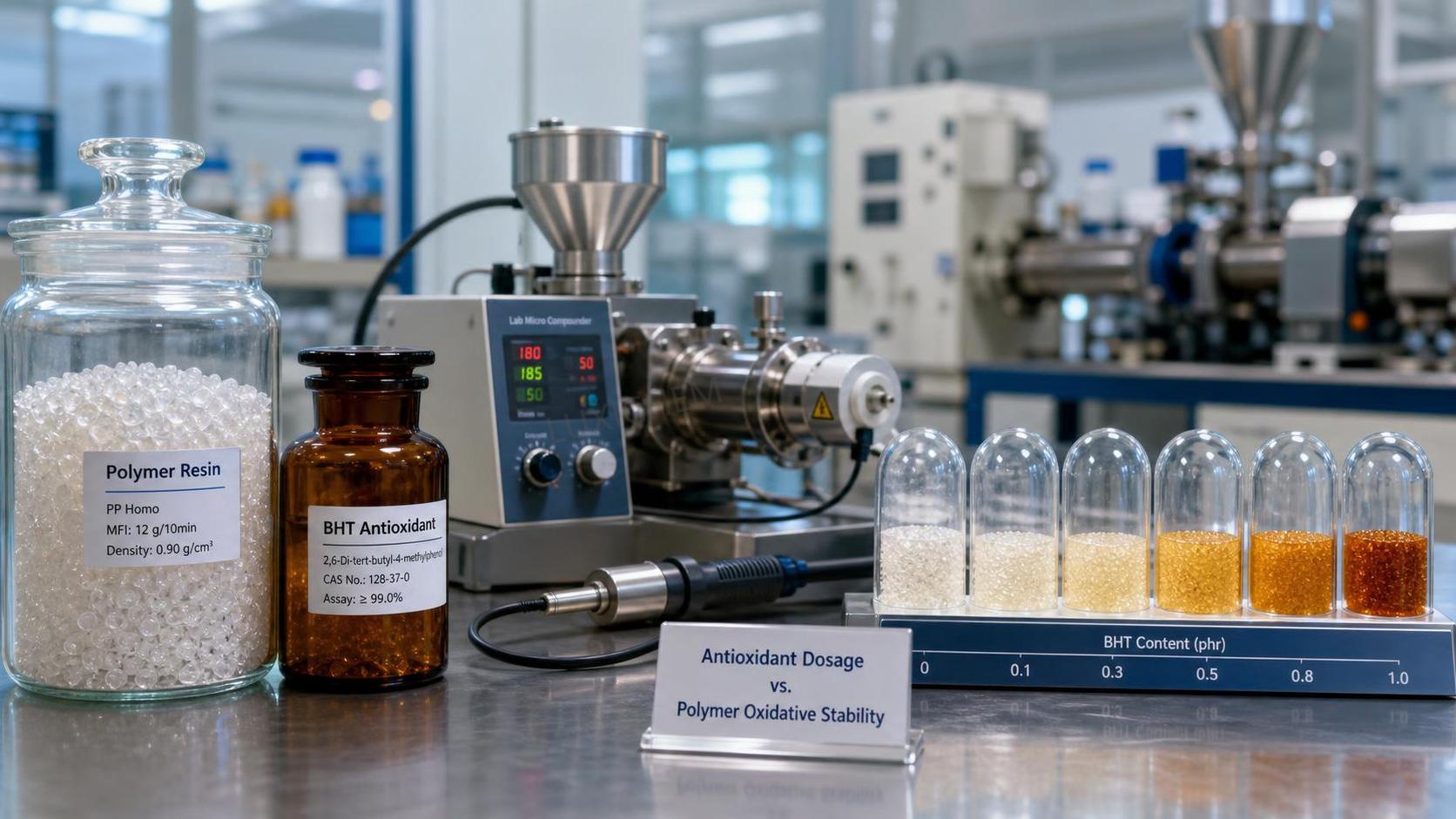
Oxidation failures in polymers rarely begin as a dramatic event. A processor may first see a slight increase in melt-flow variation, a faint yellowing after repeated heat history, reduced impact retention after aging, or odor and surface defects in a finished part. In each case, the temptation is to “add more antioxidant.” With Butylated Hydroxytoluene (BHT), that response can help only when the original dosage is below the protection demand of the resin and process.
The practical answer is that BHT dosage influences oxidation stability through a balance between radical scavenging capacity, dispersion, volatility, polymer compatibility, thermal history, and interaction with the rest of the formulation. Too little BHT leaves hydroperoxide-forming reactions insufficiently controlled. Too much does not automatically provide proportionally greater protection and may introduce migration, blooming, volatility, odor, color, or process-consistency concerns. The appropriate level must therefore be established against the polymer, conversion conditions, target lifetime, and other additives rather than selected as an isolated number.
Why dosage changes the oxidation response
Polymer oxidation is a chain reaction. Heat, oxygen, light, residual catalysts, metal contamination, mechanical shear, and radiation can generate polymer radicals. These radicals react with oxygen and form peroxy radicals, which can abstract hydrogen atoms from neighboring polymer chains. Hydroperoxides then accumulate and decompose into additional reactive species. The visible result may be discoloration or loss of gloss, but the more important consequence is often molecular-weight change: chain scission can reduce toughness and viscosity, while crosslinking can make a material less processable or more brittle.
BHT is a hindered phenolic antioxidant. Its phenolic hydrogen can be transferred to a peroxy radical, interrupting propagation and producing a comparatively stabilized antioxidant radical. This mechanism makes BHT especially relevant as a primary antioxidant, meaning it helps suppress the radical chain reaction after radicals have formed.
Dosage matters because each active molecule has a finite role in quenching reactive species. At a low concentration, BHT may be consumed early in processing or aging, leaving the polymer unprotected during the period that matters most. Raising the dose can increase the available radical-trapping reserve and delay observable degradation. However, the response is not linear forever. Once the formulation has adequate radical interception for the actual oxidation load, the limiting factor may shift to hydroperoxide decomposition, oxygen diffusion, poor additive distribution, or BHT loss during high-temperature processing.
A technical evaluation should therefore ask a more useful question than “What is the highest safe addition?”: What oxidation mechanism is still active at the current BHT level, and is BHT the appropriate means of controlling it?
Start with the actual failure stage
The same resin can require different antioxidant strategies before extrusion, during molding, and in end use. BHT dosage should be judged against the stage where protection is failing.
This distinction prevents an unproductive dosage escalation. A resin that degrades in a hot extruder may respond differently from one that performs well during conversion but fails after thermal aging. In the first case, residence time, barrel temperature, oxygen entrainment, and metal contact deserve attention. In the second, the package may need better long-term retention or support from stabilizers designed for the relevant service environment.
The lower-dose problem: protection is consumed before it is needed
Insufficient BHT often reveals itself indirectly. A formulation may initially meet a basic appearance requirement yet show a larger-than-expected shift after a second heat history. Another common pattern is acceptable laboratory performance with inconsistent plant results, where normal temperature variation or a longer residence time pushes the material beyond its remaining antioxidant reserve.
At low dosage, three effects are especially important:
- Early depletion: BHT can be consumed while scavenging radicals generated during resin manufacture, pellet storage, drying, compounding, or the first melt pass.
- Uneven local protection: A nominally correct loading does not protect effectively if the additive is poorly distributed. Regions with lower local concentration can oxidize first.
- Weak tolerance to process variation: A narrowly dosed system may work only under ideal residence time and temperature conditions. Routine fluctuations then become visible as inconsistent color, flow, or mechanical properties.
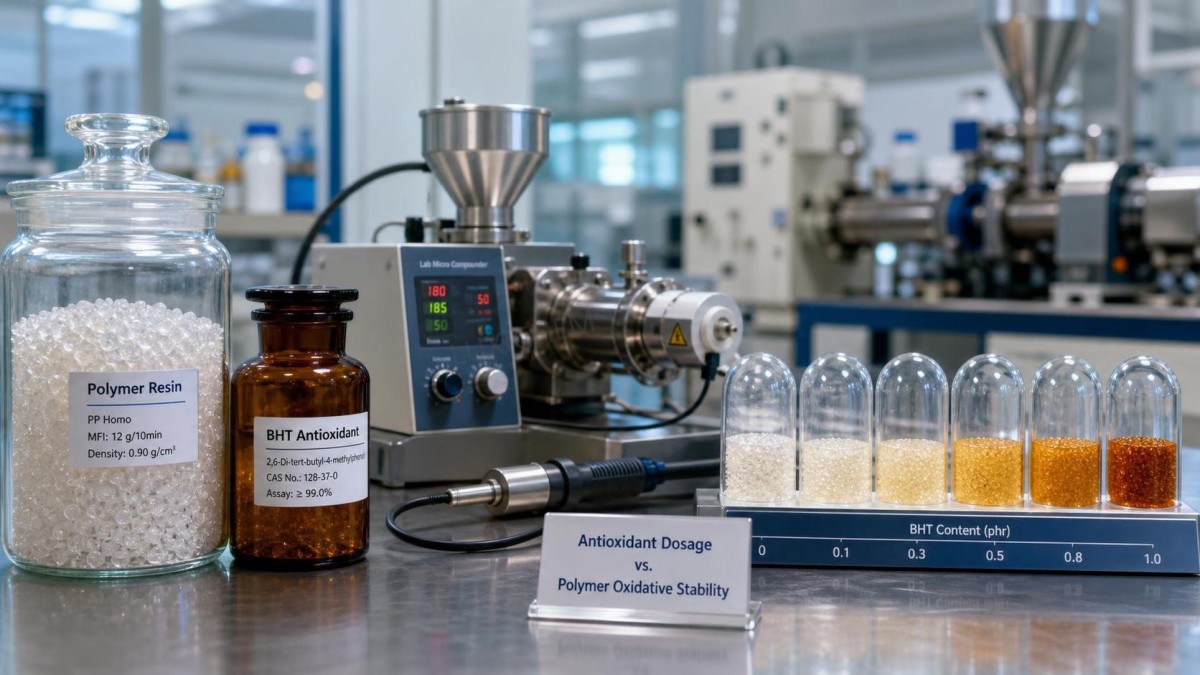
A low-dose diagnosis should not rely on color alone. Color may change slowly in some polymers while molecular-weight loss progresses. Conversely, a slight color shift can occur without substantial structural damage. Evaluators should combine appearance with melt-flow behavior, rheological response, mechanical retention, and an aging method relevant to the intended application. Comparing a control formulation with incremental BHT additions under the same processing and aging conditions is more informative than comparing unrelated production batches.
Why adding more BHT reaches a plateau
Increasing the BHT concentration usually improves protection only until another limitation becomes dominant. This is where formulation work often becomes more technical than a simple dosage adjustment.
First, BHT must remain in the polymer at an effective concentration. It has relatively low molecular weight compared with many polymeric stabilizers and may be more prone to volatilization, extraction, or migration than higher-molecular-weight alternatives. At elevated processing temperatures, some portion can be lost before it provides the expected protection. Adding more may partly compensate, but it can also raise the amount available to migrate later, especially in applications sensitive to surface appearance, odor, fogging, or contact transfer.
Second, BHT is primarily a chain-breaking antioxidant. It does not replace a secondary antioxidant where hydroperoxide decomposition is the controlling requirement. Hydroperoxides can continue to generate radicals even when a primary antioxidant is present. In systems exposed to demanding melt processing, a primary-secondary antioxidant combination is often considered because the secondary component addresses hydroperoxide breakdown while BHT interrupts radical propagation. The effectiveness of such a package depends on compatibility, processing temperature, moisture sensitivity, and the specific polymer chemistry.
Third, excess addition can complicate physical behavior. The relevant risk is not that every higher level will cause a defect, but that the margin for side effects can become less favorable. Possible signals include plate-out on equipment, haze, surface bloom, odor, color contribution, altered extractables, or changing performance after storage. These issues should be evaluated in the actual resin system rather than assumed from the antioxidant’s nominal dosage alone.
Polymer chemistry determines how far BHT can carry the system
Not all polymers oxidize through the same vulnerable sites. Polyolefins, styrenic materials, elastomers, engineering resins, and recycled blends have different sensitivity to heat, oxygen, residual impurities, and chain architecture. A BHT level that is adequate for a low-severity application in one polymer can be inadequate or inefficient in another.
Polyolefin formulations often require close attention to processing history because high temperatures and shear can consume stabilizers rapidly. Recycled material may have lower residual antioxidant content, pre-existing hydroperoxides, contaminants, or variable feedstock quality. In that situation, simply matching the BHT level used for virgin resin can produce inconsistent results. The incoming material’s oxidative condition and the number of planned heat cycles should be considered.
In elastomers and rubber compounds, filler loading, cure chemistry, and metal-containing ingredients can alter oxidation behavior. In coatings, adhesives, and thin films, oxygen exposure and migration to the surface may matter more than they do in a thick molded part. For clear or lightly colored products, even a small appearance change can determine whether a dosage is acceptable, despite otherwise adequate oxidative protection.
Dispersion can make a nominal dosage misleading
Antioxidant concentration is usually specified as a formulation percentage, but the polymer only benefits from BHT where it is properly dispersed. Agglomeration, poor masterbatch quality, insufficient mixing, or incompatible carrier selection can create localized antioxidant-poor zones. Those zones become initiation points for degradation, while an assay of the total batch may still suggest that the correct amount was added.
Powder flow and additive distribution also become relevant when a formulation contains reinforcing fillers, matting agents, or rheology modifiers. A suitable silica-based material may help manage powder handling or dispersion characteristics in selected systems, but it should not be treated as an antioxidant substitute. Where the formulation requires a stable inorganic functional additive, Silicon dioxide CAS#7631-86-9 may be considered for functions such as flow aid, adsorption, thickening, or reinforcing filler performance, subject to compatibility testing. Its presence can still affect mixing behavior, moisture management, and the distribution of organic additives, all of which may influence how consistently the selected BHT dosage performs.
When results vary unexpectedly, verify the addition route before changing the concentration. Direct dry blending, liquid dosing, pre-dispersed masterbatch addition, and incorporation during compounding can produce materially different distributions. Sampling should also represent the full batch rather than a single point in the process.
A practical way to establish the working range
Technical evaluation is more reliable when dosage screening is structured around one defined performance question. The goal might be retaining melt stability through a specified number of processing passes, preserving impact performance after thermal exposure, limiting color change, or maintaining a target viscosity range. Trying to optimize every property in one initial screen can obscure the reason a formula changes.
- Document the baseline resin condition. Record resin grade, prior heat history, recycled content where applicable, storage conditions, moisture state, residual catalyst concerns, and current additive package. A degraded or variable starting resin can make a sound BHT dose appear ineffective.
- Hold processing conditions constant. Use comparable temperature profile, screw configuration, throughput, residence time, drying procedure, and pellet handling. Otherwise, a dosage comparison becomes a process comparison.
- Test several deliberately spaced levels. Include the current dose or a no-BHT control where appropriate, a lower point, and stepwise higher points. The point is to identify the response curve and its plateau, not to select a number by intuition.
- Measure processing and aging behavior separately. Melt-flow or rheology changes after processing indicate one aspect of protection; retained properties after controlled aging indicate another. Both are needed when the material will see more than one heat history.
- Inspect for adverse effects after conditioning. Evaluate color, odor, surface quality, migration or bloom tendency, and any application-specific extraction or contact requirements. Immediate post-processing observations may miss delayed effects.
- Challenge the result with realistic variation. Once a candidate range is found, test moderate changes in residence time or temperature that reflect actual operating tolerance. A formulation that works only in a narrow processing window may be unsuitable for routine production.
The selected level should be the lowest concentration that provides adequate stability with an acceptable margin under expected processing and service conditions. “Adequate margin” does not mean excess antioxidant without limit; it means resilience against normal variation without creating new concerns in the finished product.
Interpreting results that seem contradictory
Some dosage trials produce mixed signals. A higher BHT level may improve color but not retain impact strength after aging. That pattern can indicate that visible oxidation has been suppressed while chain scission continues through pathways not sufficiently controlled by the primary antioxidant alone. Alternatively, flow stability may improve during extrusion while later odor becomes unacceptable, pointing to a retention or migration issue rather than a lack of initial antioxidant activity.
Another confusing result is no apparent improvement after a significant dosage increase. Before concluding that BHT is ineffective, examine whether the material is losing antioxidant during processing, whether oxygen exposure is excessive, whether metal contamination is catalyzing oxidation, or whether hydroperoxide decomposition is dominating. In highly filled systems, also confirm that mixing energy and sequence are sufficient to distribute the additive package.
For applications with food-contact, pharmaceutical, cosmetic, or other tightly controlled end-use requirements, the technical dosage decision must be checked separately against applicable formulation, migration, and regional compliance obligations. Performance testing alone cannot establish suitability for a regulated use.
When BHT should be part of a package rather than the entire answer
BHT can be an effective component of polymer stabilization, particularly where radical scavenging, short-to-moderate thermal exposure, and economical formulation are central considerations. It is less likely to be the complete answer when the polymer faces repeated high-temperature processing, long outdoor exposure, high oxygen access, demanding color requirements, or strong migration limitations. In those cases, the better decision may involve changing the antioxidant balance, improving process control, reducing oxygen or contaminant exposure, modifying the addition method, or selecting a more persistent stabilizer system.
The most useful dosage outcome is not a universal number. It is a validated working range tied to a known resin condition, mixing route, processing window, and defined aging target. That approach shows whether increasing Butylated Hydroxytoluene is genuinely improving oxidation stability—or merely masking a different limitation in the formulation or process.
Related Picks
 Butylated Hydroxytoluene Price Drivers: Supply, Purity, and Purchasing Risk FactorsOct 21, 2026Butylated Hydroxytoluene price trends depend on supply stability, purity, logistics, and purchasing risk. Learn how to compare quotes wisely and reduce sourcing costs.
 Sodium Tripolyphosphate Price Trends: Raw Material and Energy ExposureOct 20, 2026Explore sodium tripolyphosphate price trends, from phosphate and soda ash costs to energy exposure. Learn how to compare quotes, manage sourcing risks, and make smarter purchasing decisions.
 Acetonitrile Shipment to Vietnam Successfully Dispatched; RCEP Benefits Boost Fine Chemical Trade with ASEANSep 16, 2026A shipment of industrial-grade acetonitrile from our company has recently been loaded and dispatched following the completion of standardized hazardous material packaging and container securing procedures.
 Nigerian Client’s Order of 4 Containers of Vinyl Acetate Successfully Loaded and Shipped to West AfricaSep 16, 2026We recently completed the loading of a vinyl acetate order for a Nigerian client; four containers of the product have been successfully packed and are ready for shipment to Nigeria.




Question Consultation
Send Us Your Inquiry Today

Luxi Chemical is a professional chemical product supplier with ample stock of all chemical categories and excellent quality, welcome your purchase inquiry.

