


How Polypropylene Pellets Affect Molding Stability, Shrinkage, and Cycle Time
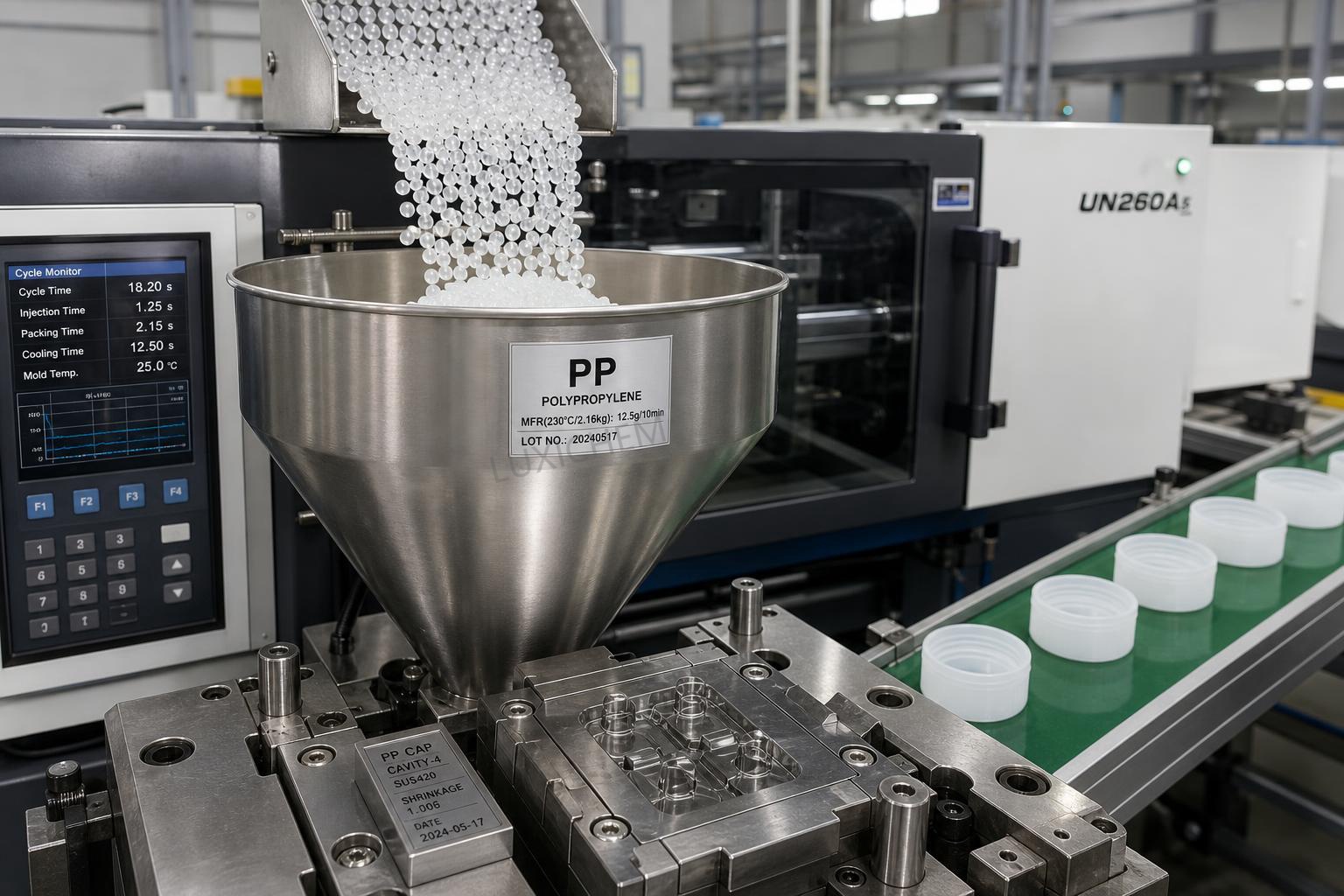
Processing Stability Starts at the Pellet
Stable molding is usually traced back to a narrow and predictable material window. With polypropylene pellets, that window is affected by pellet size distribution, moisture on the surface, bulk density, additive dispersion, and lot-to-lot melt flow consistency. When pellets feed uniformly through the hopper and plasticize at a steady rate, the screw recovers with less fluctuation, cushion variation tends to narrow, and pressure response becomes easier to control. When the pellet stream is inconsistent, the machine may still run, but the process often starts drifting through small signs such as erratic shot weight, changing back pressure response, or a melt temperature profile that no longer matches the original setup.
Polypropylene itself does not absorb water in the same way as strongly hygroscopic resins, but that often leads to an incorrect assumption that pellet condition never matters. Surface contamination, condensed moisture from poor storage transitions, and fines generated during handling can still disturb feeding and melt homogeneity. In practical terms, unstable molding often begins before the material reaches the barrel. Bridging in the hopper throat, dust accumulation near feed zones, or mixed pellets from different grades can alter the actual feed rate even when the machine settings remain unchanged.
The result is a process that appears mechanically unstable but is actually material-driven. A pressure spike during filling may be misread as a nozzle restriction. A short shot may be blamed on clamp motion or venting. In reality, the first variable worth isolating is often the polypropylene pellets themselves: whether they are consistent in geometry, clean in handling, and matched to the intended molding grade.
Melt Flow Variation and Its Effect on Daily Production
Melt flow rate is one of the most visible indicators of how polypropylene pellets will behave in the machine. A higher-flow grade generally fills more easily, responds well to thinner walls, and may allow lower peak injection pressure. A lower-flow grade usually offers a different balance of stiffness, impact behavior, and melt strength, but it demands more energy to fill complex geometries. Problems start when the nominal grade is correct but the actual flow behavior shifts from batch to batch or when regrind ratios change the effective viscosity more than expected.
If melt flow is higher than the validated process window, the cavity may fill too quickly under the same velocity setting. Gate freeze can occur earlier, packing may become less effective, flash risk may rise at parting lines, and dimensions may shift because the pressure profile no longer matches the original cooling pattern. If melt flow is lower, fill time tends to stretch, shear heating can increase at narrow gates, and the machine may compensate with higher pressure or longer hold, which affects cycle time directly.
For extrusion, the same inconsistency often appears as output pulsation, unstable die pressure, or variation in profile dimensions. In injection molding, it is seen more clearly through part weight and cavity balance. Operators often focus on barrel temperature first, but temperature changes only mask part of the issue if the pellets entering the process do not behave uniformly. A stable melt flow range reduces the amount of corrective adjustment required during shift changes and material changeovers.
Shrinkage Is Influenced by More Than Mold Temperature
Polypropylene is semi-crystalline, so shrinkage is strongly linked to crystallization during cooling. That makes pellet properties especially important because they influence how the melt packs, cools, and solidifies. Even when the mold surface temperature is held constant, different pellet formulations or different levels of nucleating agents, fillers, and recycled content can change shrink behavior noticeably. A part that appears dimensionally stable in the first hour may begin drifting after the mold reaches a more settled thermal state or after a new material lot is introduced.
Shrinkage increases when the cavity does not receive enough effective packing pressure before the gate freezes. Pellets with lower viscosity may fill easily, yet if they freeze at the gate differently or relax more during cooling, final dimensions may move in unexpected directions. Conversely, a more resistant melt can create higher internal orientation in the flow path, and that orientation may release later as warpage or uneven shrinkage across the part.
This is why two shipments of polypropylene pellets sold under a similar description may not produce identical dimensions unless the formulation, additive package, and flow characteristics are tightly aligned. For molded containers, caps, appliance housings, and technical components, shrinkage is not just a design matter; it is a processing response shaped by material behavior at the pellet level. When dimensional drift appears, it is useful to review whether screw recovery time, melt cushion, peak cavity pressure, and gate seal time changed along with the material lot.
In plants that handle multiple chemical intermediates and polymer-related raw materials, traceability practices used for other materials, including products such as 2-Ethylanthraquinone CAS#84-51-5, reflect a broader rule that also matters in polypropylene processing: once lot identity becomes blurred in storage or transfer, root-cause analysis becomes slower and dimensional variation is harder to explain.
Cycle Time Moves with Material Behavior, Not Only Machine Speed
Cycle time is often discussed as a machine setting problem, yet the achievable cycle is strongly linked to how polypropylene pellets melt and solidify. If pellets plasticize efficiently, the screw can recover during cooling without forcing higher barrel temperatures or back pressure. If the melt reaches the cavity with predictable viscosity, fill and pack can be tuned to complete earlier without creating sink, flash, or post-mold distortion. But if pellet inconsistency requires frequent correction, the process usually absorbs that uncertainty by running slower.
Cooling time is especially sensitive to the actual crystallization behavior of the grade being used. Some polypropylene materials can demold cleanly at a shorter cooling time because stiffness develops fast enough before ejection. Others may look ready based on surface appearance but still deform after ejection, leading to hidden scrap or assembly problems later. In that case, the nominal cycle time on the machine screen is misleading because the real production cycle includes sorting, rework, and unplanned stops.
Pellet geometry also contributes indirectly. Uniform pellets feed more predictably and help maintain stable screw recovery. Irregular pellet shapes, excessive fines, or contamination can interrupt feed, increase screw slip, and lengthen plastication. A cycle that appears limited by mold cooling can actually be constrained by recovery time when feed consistency is poor. On high-cavitation tools, even small variations in recovery or cushion can force a more conservative cycle just to preserve part-to-part consistency.
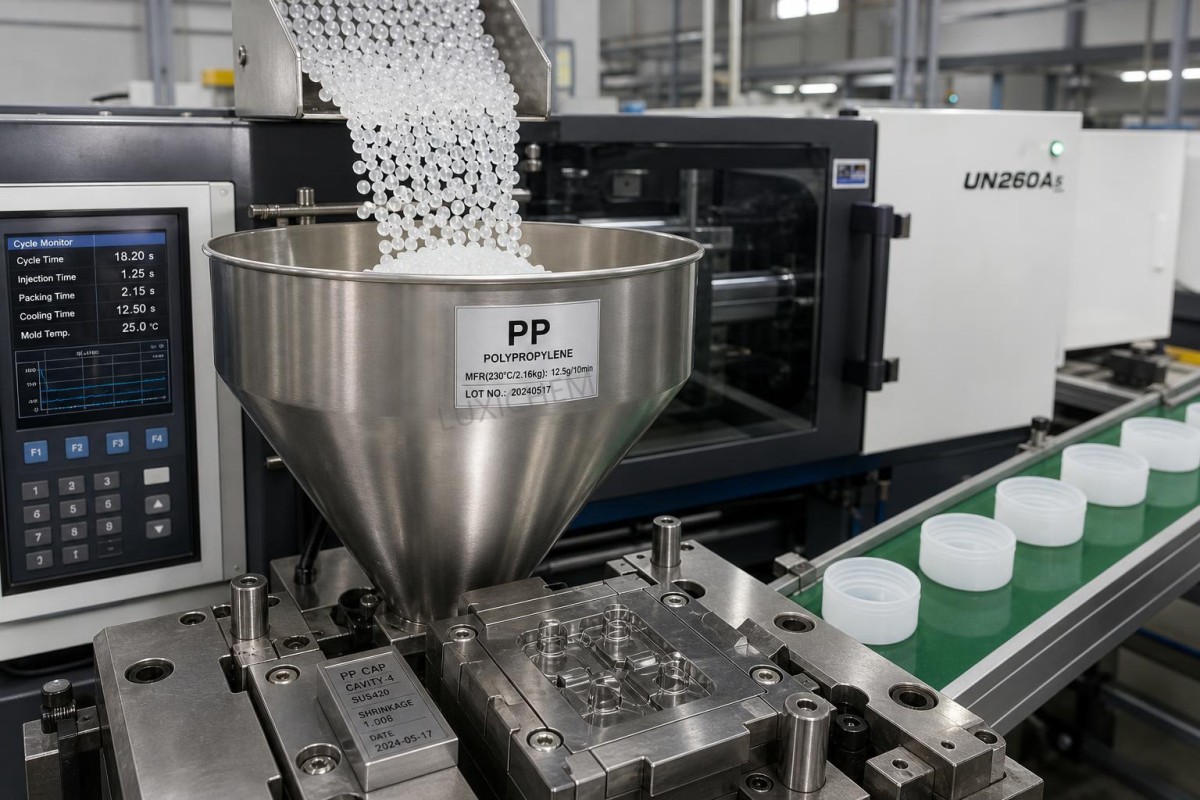
Common Process Signals That Point Back to Polypropylene Pellets
Several recurring defects are often treated as mold or machine faults first, although material condition is the more likely source. Splay marks on polypropylene parts may come from contamination or trapped volatiles introduced through poor storage conditions rather than from a simple temperature mistake. Black specks can originate from degraded material left in dead zones, but they may also be linked to dust or foreign particles mixed into the pellet stream during conveying. Variation in gloss can suggest cavity temperature imbalance, yet it may also reflect inconsistent melt history caused by unstable feed.
Sink marks and warpage need the same discipline. If holding pressure has already been increased and cooling time extended, but the part still moves after ejection, the question shifts to whether the pellets are delivering the same packing response as the last validated lot. When gate freeze occurs earlier than expected, the machine may complete the hold phase on paper while the part receives very little effective compensation in the cavity. That disconnect is common when the material behavior changes slightly but the process sheet is treated as fixed.
Another frequent misjudgment concerns color masterbatch or additive blending. When pellets are dry-blended poorly, local concentration differences can alter flow and crystallization in ways that mimic mechanical instability. The machine then appears to need constant tuning, although the real issue is that the melt entering the front zone is not compositionally uniform from shot to shot.
Storage, Handling, and Transfer Matter More Than They Look
Polypropylene pellets can leave the supplier in acceptable condition and still become unstable in production through ordinary handling mistakes. Bags stored near heat sources may compact or pick up surface contamination after repeated opening. Material transferred from cold storage into a warm process room can carry condensation on the outer pellet surface if the transition is not managed properly. Pneumatic conveying set too aggressively may generate fines, and those fines can accumulate in hoppers, filters, and feed throats until screw recovery becomes inconsistent.
Segregation during transfer is another overlooked issue. If a blend contains pellets of different size, density, or additive loading, repeated movement can separate the mix rather than preserve it. The first portion charged to the hopper may then run differently from the last. That is one reason why a machine may start a shift cleanly and become unstable later without any apparent equipment change.
- Material identification should remain attached to each lot through receiving, staging, and line-side use; relabeling by memory invites grade confusion.
- Opened containers need a controlled reseal method so dust, moisture, and foreign pellets do not enter during partial consumption.
- Conveying speed, elbow wear, and hopper cleanliness deserve periodic review because feed problems often build gradually rather than appearing as a single failure.
Matching the Grade to the Tool Reduces Correction Work
Not every polypropylene grade is suitable for every mold simply because the polymer family is the same. Thin-wall packaging, living hinges, automotive trim, and rigid utility parts can require different combinations of melt flow, impact behavior, stiffness, nucleation, and filler content. Using a grade outside the intended processing range often forces the machine to operate at the edge of pressure, temperature, or cooling capacity. The process may still produce acceptable parts for a period, but stability becomes fragile and any upstream variation in the pellets is amplified.
Filled polypropylene deserves extra caution. Mineral-filled grades can reduce shrinkage and improve stiffness, yet they change flow response, wear behavior, and cooling characteristics. If the filler distribution is inconsistent, cavity balance and surface finish can drift at the same time. Random copolymer and impact copolymer grades also respond differently from homopolymer grades in terms of flow and dimensional behavior. Treating them as interchangeable because they are all polypropylene is a common shortcut that increases troubleshooting later.
Tool design also shapes the answer. A mold with long flow paths, small gates, thin ribs, or limited venting has a narrower tolerance for pellet variation. In those cases, selecting polypropylene pellets with tightly controlled flow behavior is often more effective than chasing the problem with repeated machine adjustments.
Where Process Control Should Focus
Useful control points are the ones that separate material variation from machine variation. Recording only barrel temperatures and cycle count rarely explains why a process drifted. More informative signals include screw recovery time, actual cushion stability, transfer pressure consistency, gate seal time, part weight trend, and any shift in the visual appearance of incoming pellets. A slight change in pellet sheen, fines level, or color tone should not be dismissed if dimensional or cycle problems appear at the same time.
When troubleshooting, isolating one variable is more effective than broad retuning. If shrinkage suddenly increases, raising hold pressure, melt temperature, and cooling time together may hide the root cause for a few hours but creates a larger validation problem later. It is usually better to confirm the material lot, compare recovery behavior with the previous run, inspect hopper and throat condition, and then adjust the process based on what actually moved.
Polypropylene pellets affect molding stability, shrinkage, and cycle time because they define how consistently the polymer enters every stage of the process: feeding, melting, filling, packing, crystallizing, and ejection. Once that material behavior becomes predictable, the machine settings start behaving like real controls instead of constant corrections.
Related Picks
 Butylated Hydroxytoluene Price Drivers: Supply, Purity, and Purchasing Risk FactorsOct 21, 2026Butylated Hydroxytoluene price trends depend on supply stability, purity, logistics, and purchasing risk. Learn how to compare quotes wisely and reduce sourcing costs.
 Sodium Tripolyphosphate Price Trends: Raw Material and Energy ExposureOct 20, 2026Explore sodium tripolyphosphate price trends, from phosphate and soda ash costs to energy exposure. Learn how to compare quotes, manage sourcing risks, and make smarter purchasing decisions.
 Acetonitrile Shipment to Vietnam Successfully Dispatched; RCEP Benefits Boost Fine Chemical Trade with ASEANSep 16, 2026A shipment of industrial-grade acetonitrile from our company has recently been loaded and dispatched following the completion of standardized hazardous material packaging and container securing procedures.
 Nigerian Client’s Order of 4 Containers of Vinyl Acetate Successfully Loaded and Shipped to West AfricaSep 16, 2026We recently completed the loading of a vinyl acetate order for a Nigerian client; four containers of the product have been successfully packed and are ready for shipment to Nigeria.




Question Consultation
Send Us Your Inquiry Today

Luxi Chemical is a professional chemical product supplier with ample stock of all chemical categories and excellent quality, welcome your purchase inquiry.

