


How aromatic polyester polyol supports rigid foam fire performance
How Aromatic Polyester Polyol Supports Rigid Foam Fire Performance
For rigid polyurethane and polyisocyanurate foam producers, fire performance is rarely determined by one ingredient. It is the outcome of resin chemistry, isocyanate index, blowing agent selection, flame-retardant package, density, facing material, and the way the foam is processed on the day of production. Still, aromatic polyester polyol is often one of the most consequential choices in the formulation because it changes how the polymer behaves when exposed to heat.
Quality control and safety teams are usually asked a practical question rather than a theoretical one: can the foam meet the required fire test while retaining dimensional stability, insulation value, adhesion, and consistent line processing? An aromatic polyester polyol can support that objective, but it should not be treated as a stand-alone flame retardant or as an automatic substitute for a properly designed fire-performance system.
The most reliable approach is to understand what this polyol contributes chemically, what it cannot solve, and which incoming-material and finished-foam checks should be placed around it. That distinction matters in construction panels, appliance insulation, refrigerated transport, pipe insulation, and industrial composite products, where a formulation that appears satisfactory in a small laboratory cup can behave differently on a continuous foaming line.
Why the aromatic structure changes the fire response
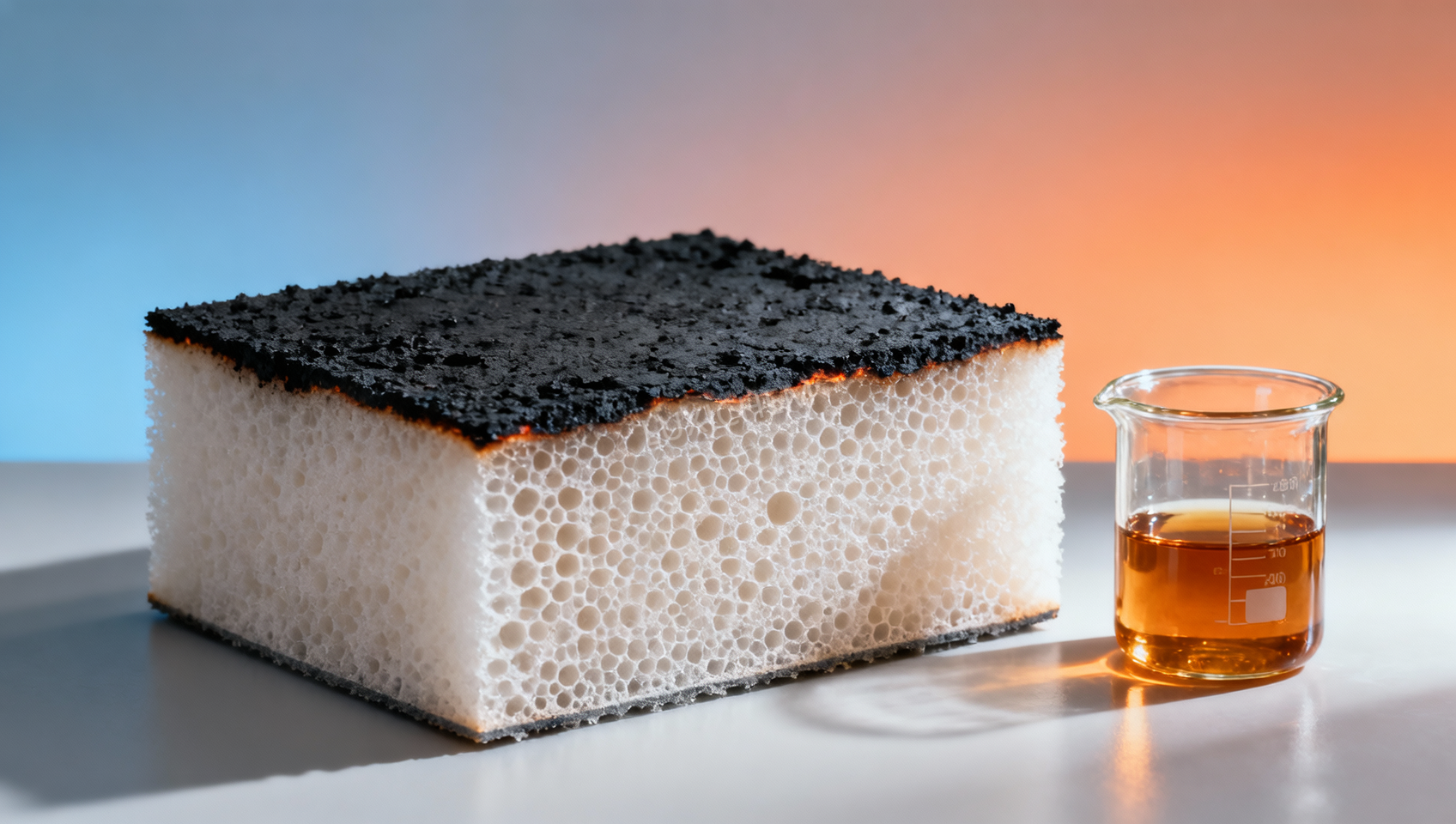
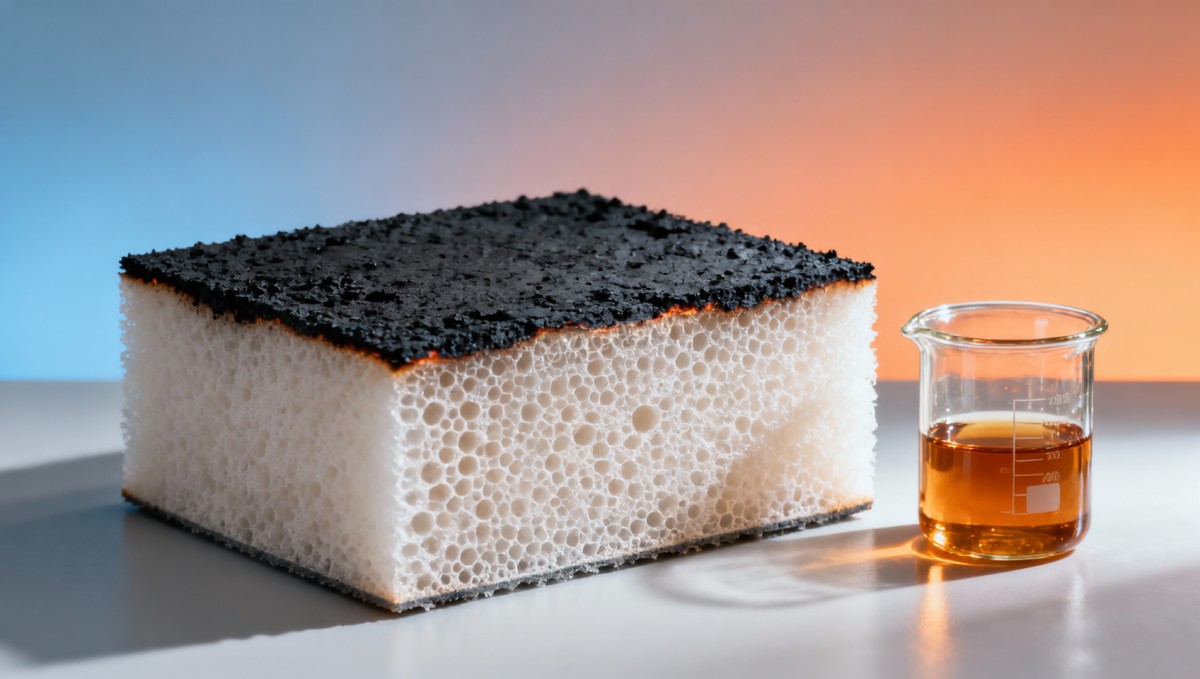
Aromatic polyester polyols contain aromatic rings within the resin backbone. Compared with many aliphatic polyols, that structure generally provides greater thermal stability and a stronger tendency to form a carbonaceous char when the foam is heated. In a fire scenario, char formation can help create a barrier between the heat source and the underlying polymer. It may slow heat transfer, reduce the availability of combustible decomposition products, and help the foam retain a more coherent residue.
That is the basic chemical advantage, but it is only part of the picture. Rigid foam fire behavior depends on how the resin network develops during reaction. Aromatic polyester polyols commonly bring relatively high functionality and can support a tightly crosslinked structure, particularly in formulations designed for rigid polyurethane or polyisocyanurate systems. A more thermally resistant network may improve resistance to softening and collapse under heat. For some applications, this can be as important as the initial ignition response, because a collapsed insulation core may expose more material or compromise the integrity of a panel assembly.
The wording here needs care: “better char” does not automatically mean that a product passes a particular building, transport, appliance, or insurance-driven test. Fire classifications are assigned to complete constructions under specified test conditions. Foam density, thickness, facers, adhesives, joint design, substrate, and installation orientation can all influence the result. A resin comparison conducted without those factors is useful for screening, not for certifying an end-use system.
Where aromatic polyester polyol helps—and where it creates trade-offs
In practice, aromatic polyester polyol is valued because it can improve the thermal robustness of the base resin while also supporting rigid-foam properties such as compressive strength and dimensional stability. This is why it is widely considered in insulation formulations intended for elevated-temperature service or more demanding fire-performance targets.
However, higher aromaticity or higher functionality is not simply “more is better.” A formulation can become more reactive, more viscous, or less forgiving during mixing and laydown. Cell opening, friability, poor surface quality, uneven rise, and reduced adhesion to facings are familiar development problems when the balance among polyol blend, catalyst package, surfactant, blowing agent, and isocyanate is disturbed. A formulation that achieves a good fire-screening result but develops cracks after thermal cycling is not a safer commercial product.
Safety managers should also distinguish between reaction-to-fire behavior and fire resistance. Reaction-to-fire testing typically examines such matters as ignitability, flame spread, heat release, smoke development, or burning droplets, depending on the applicable test method. Fire resistance usually concerns the capacity of an assembly to maintain its integrity, insulation, or load-bearing function for a defined period. An aromatic polyester polyol can contribute to the former through polymer chemistry, but it cannot by itself establish the performance of an entire wall, roof, duct, or insulated panel assembly.
The formulation must be read as a system
A common quality mistake is to compare polyols using only a supplier’s nominal hydroxyl number. Hydroxyl number is relevant to stoichiometry and crosslink density, but it does not describe every variable that affects processing or fire behavior. Acid value, water content, viscosity, functionality, aromatic content, compatibility with other polyols, and lot-to-lot consistency all deserve attention. A small shift in moisture, for example, can alter blowing behavior and produce a density or cell-structure change that later affects mechanical and thermal performance.
The flame-retardant package also has to be matched to the resin. Certain additives may be compatible in a storage tank but interfere with reactivity, cell structure, or surface cure once the system is scaled up. Other additives may improve one screening metric while increasing smoke or affecting processing latitude. There is no responsible shortcut around formulation trials and testing of the actual foam construction.
For polyisocyanurate-rich systems, the isocyanate index and catalyst balance require particularly close control. The trimerized structure can add thermal stability, yet excessive brittleness or poor foam morphology may offset the intended benefit. For polyurethane systems, the question is often how much aromatic polyester polyol can be introduced without losing the processing window needed for a stable production line. The best blend is often a compromise, not the formulation with the highest percentage of aromatic material.
A practical control plan for incoming polyol and finished foam
A robust quality plan starts before the resin reaches the day tank. Incoming inspection should confirm the supplier’s certificate of analysis against agreed specifications and verify that the material has been protected from contamination and moisture pickup during transport and storage. Polyester polyols are not interchangeable merely because they share a broad product description. A change in feedstock source, viscosity profile, acid value, or blend composition can require a formulation review.
For routine control, many producers focus on a concise set of parameters that connect directly to process stability:
- Hydroxyl number and acid value, to maintain predictable stoichiometry and avoid unexpected catalyst demand.
- Water content, because uncontrolled moisture affects gas generation, density, and cell structure.
- Viscosity at the agreed test temperature, especially where metering accuracy and blend uniformity are sensitive.
- Appearance and homogeneity, including checks for haze, sediment, phase separation, or abnormal color change.
- Storage history, tank cleanliness, and traceability by batch, delivery date, and production campaign.
Finished-foam inspection should not stop at density and compressive strength. Those are useful production indicators, but a fire-performance program normally needs periodic confirmation through the relevant method for the product’s intended market and construction. The applicable standard should be selected by the regulatory and customer context, not by the fact that a particular test is convenient or familiar. Where a panel includes metal facings, paper facings, adhesive layers, or protective coatings, test the representative assembly whenever the requirement applies to the assembly.
It is also wise to keep retained samples from resin batches and finished foam runs associated with qualification tests. When results drift months later, retained materials can help determine whether the cause lies in the polyol, the flame-retardant package, the processing conditions, or another component. Without that discipline, a team may change several variables at once and lose the ability to identify the real source of variation.
Avoid cross-category assumptions in chemical procurement
Chemical procurement often involves a broader portfolio than a single foam line. Comprehensive suppliers such as Luxi Chemical (Shandong) Co., Ltd. may support customers with chemical raw materials, organic intermediates, food additives, fertilizers, and related import/export services across many markets. That breadth can simplify sourcing and documentation workflows, but it also makes product segregation essential. Materials intended for cosmetics, personal care, or industrial preservation should never be assumed suitable for polyurethane foam formulation without a separate technical and regulatory assessment.
For example, Quaternium-15 CAS#4080-31-3 is described as an antimicrobial preservative used in cosmetics, personal care products, and industrial formulations, with controlled formaldehyde-releasing biocidal activity. It is not an aromatic polyester polyol and should not be treated as a fire-performance additive for rigid foam. This may seem obvious, yet clear material identification, separate storage logic, current safety documentation, and controlled change management are exactly the safeguards that prevent cross-category errors in busy chemical operations.
Questions worth asking before approving a resin change
When a supplier proposes an alternative aromatic polyester polyol, the first question should not be whether the price is lower. Start with whether the proposed material is chemically comparable within the actual formulation. Ask for the specification range, not only a typical value. Clarify the expected hydroxyl number, acid value, water limit, viscosity method and temperature, storage conditions, recommended shelf life, and batch traceability arrangements.
Then assess the change on a controlled production trial. Monitor cream time, gel time, tack-free time, rise profile, core density, surface quality, adhesion, dimensional stability, compressive properties, and thermal conductivity where relevant. If the product carries a fire requirement, the change-control protocol should define when new fire testing is necessary. A resin that processes smoothly is not automatically equivalent in a fire test, and a resin that gives an attractive small-scale result may still be difficult to run consistently at plant scale.
The useful role of aromatic polyester polyol is therefore quite specific: it provides a resin platform that can support char formation, thermal resistance, and formulation-level fire performance in rigid foam. Its value is realized only when it is selected with the rest of the system in mind. For quality and safety teams, the strongest decision is usually the one backed by defined raw-material specifications, disciplined trial records, representative assembly testing, and a clear understanding of what the final standard actually evaluates.
Related Picks
 Butylated Hydroxytoluene Price Drivers: Supply, Purity, and Purchasing Risk FactorsOct 21, 2026Butylated Hydroxytoluene price trends depend on supply stability, purity, logistics, and purchasing risk. Learn how to compare quotes wisely and reduce sourcing costs.
 Sodium Tripolyphosphate Price Trends: Raw Material and Energy ExposureOct 20, 2026Explore sodium tripolyphosphate price trends, from phosphate and soda ash costs to energy exposure. Learn how to compare quotes, manage sourcing risks, and make smarter purchasing decisions.
 Acetonitrile Shipment to Vietnam Successfully Dispatched; RCEP Benefits Boost Fine Chemical Trade with ASEANSep 16, 2026A shipment of industrial-grade acetonitrile from our company has recently been loaded and dispatched following the completion of standardized hazardous material packaging and container securing procedures.
 Nigerian Client’s Order of 4 Containers of Vinyl Acetate Successfully Loaded and Shipped to West AfricaSep 16, 2026We recently completed the loading of a vinyl acetate order for a Nigerian client; four containers of the product have been successfully packed and are ready for shipment to Nigeria.




Question Consultation
Send Us Your Inquiry Today

Luxi Chemical is a professional chemical product supplier with ample stock of all chemical categories and excellent quality, welcome your purchase inquiry.

