


What viscosity range is practical for aromatic polyester polyol processing?
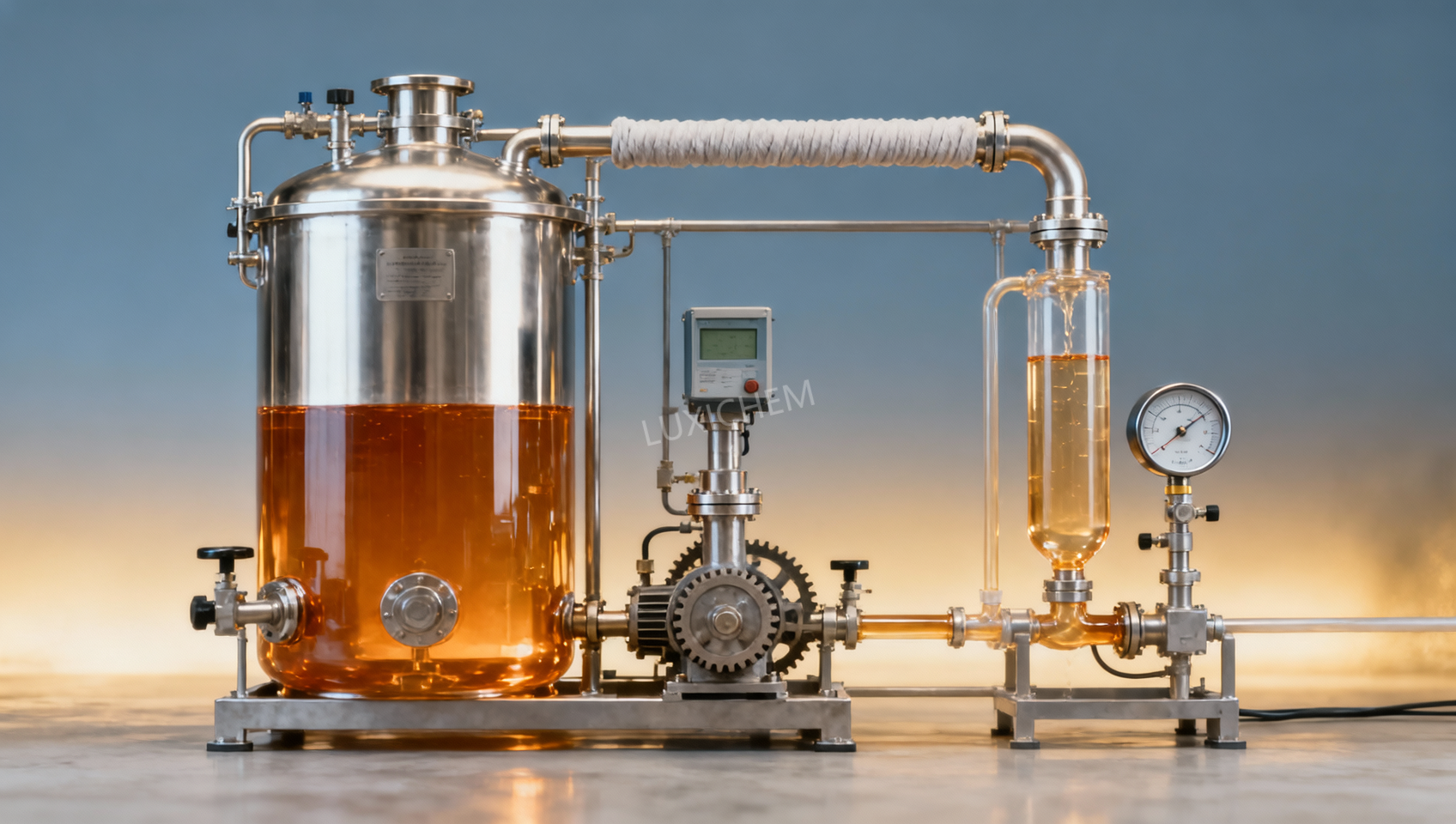
There is no single “correct” viscosity for aromatic polyester polyol processing, because the value that matters is the viscosity at the actual pumping, metering, and mixing temperature—not only the number printed on a certificate of analysis at 25°C. For many rigid polyurethane and polyisocyanurate operations, a practical working target is often about 300 to 1,500 mPa·s (cP) at the metering temperature. Within this window, transfer lines, pumps, mix heads, and dosing systems can usually operate with reasonable stability.
At 25°C, however, aromatic polyester polyol may be specified anywhere from roughly 1,000 to 8,000 mPa·s, and some highly aromatic or high-functionality grades are substantially more viscous. Such grades are not automatically difficult to use. They simply require heating, appropriate line design, and confirmation that viscosity at the point of use is compatible with the equipment. A 5,000 mPa·s product at room temperature may become entirely manageable at a controlled elevated temperature, while a nominally low-viscosity product can still create production problems if it has cooled, partially crystallized, absorbed moisture, or varies between batches.
Use the viscosity at the process point, not the room-temperature number alone
Aromatic polyester polyols are commonly evaluated by Brookfield viscosity or another rotational-viscometer method. The reported figure is meaningful only when accompanied by the test temperature, spindle or measurement method, and ideally the product’s handling history. Comparing one supplier’s “2,000 cP” product with another’s “2,000 cP” product is incomplete if one value was measured at 25°C and the other at 50°C.
For operating decisions, the useful question is more specific: What viscosity will the liquid have after it leaves the day tank and reaches the pump inlet, metering pump, static mixer, or mix head? That condition can differ materially from both bulk storage temperature and laboratory test temperature.
In a heated system, viscosity is influenced by:
- bulk tank temperature and temperature uniformity;
- heat loss in hoses, valves, filters, and recirculation loops;
- residence time during idle periods;
- the polyol’s molecular structure, hydroxyl value, functionality, and residual oligomer distribution;
- blending with other polyols, catalysts, flame retardants, surfactants, fillers, or recycled streams;
- water contamination and chemical change during extended hot storage.
A viscosity target should therefore be treated as an operating control range, not as an isolated raw-material specification.
A practical range depends on the task being performed
Transfer pumping is usually the least demanding step. Positive-displacement pumps can move relatively viscous aromatic polyester polyols, provided that suction conditions are adequate and the fluid is warm enough to avoid starvation or cavitation. The problem becomes more acute at the metering stage, where a small error in flow can change the polyol-to-isocyanate ratio and affect foam density, dimensional stability, adhesion, friability, or cure behavior.
For routine continuous metering, many operations seek a viscosity that allows smooth pump rotation and repeatable output without excessive pressure. A range near 300–1,500 mPa·s at the process point is often a sensible starting zone for equipment evaluation. The lower portion of this range can help with fine metering and rapid blending. The middle and upper portion may still be fully workable when the system uses appropriately sized gear pumps, heated lines, and controlled recirculation.
Below roughly 200–300 mPa·s, the material may be easy to pump, but the formulation should be checked rather than assuming lower viscosity is better. A significant reduction in viscosity can reflect a change in polyol composition, dilution, elevated temperature, or a different hydroxyl-value balance. Those changes may alter reactivity, crosslink density, flame behavior, or final foam properties.
Above approximately 1,500–2,000 mPa·s at the metering point, the risk of process instability rises. This does not mean the material is unusable. It means that the line must be assessed for pump torque, pressure drop, filter loading, hose diameter, heat tracing, and output repeatability. When the same material enters a small mix head at a lower-than-intended temperature, the apparent problem may show up as pressure fluctuation or poor component ratio control rather than as an obvious “high viscosity” alarm.
Why aromatic polyester polyols become difficult to handle
The viscosity of an aromatic polyester polyol is linked to its chemical architecture. Grades derived from aromatic feedstocks often provide useful rigidity, fire performance, and insulation-related properties in polyurethane systems, but their molecular composition can also make them more viscous than many standard polyether polyols. High aromatic content, higher functionality, and heavier oligomer fractions can all increase resistance to flow.
Temperature is the most immediate operating lever. Heating lowers viscosity, but it should not be used without limits. Raising a tank temperature until a pump runs smoothly may solve a short-term transfer issue while creating a longer-term quality risk if the product remains hot for extended periods. Excessive heat exposure can contribute to color change, viscosity drift, degradation, or reactions associated with contamination. The appropriate temperature must come from the product supplier’s handling guidance and the material’s actual behavior in the process—not from a generic rule applied to every grade.
Uniformity matters as much as the displayed tank temperature. A heated tank can contain a warm zone near the jacket and a cooler, more viscous zone near the outlet, particularly where agitation or recirculation is inadequate. The pump then receives material different from the tank-average condition. This is a common reason why a system appears acceptable during startup but becomes unstable after a pause or during low-throughput production.
Room-temperature viscosity is useful for storage and logistics
Although operating viscosity is the main concern during production, room-temperature viscosity remains important. It influences unloading, drum or IBC handling, winter storage, restart behavior, and the time required to condition material before use.
A product in the 1,000–3,000 mPa·s range at 25°C is often comparatively straightforward to transfer after moderate conditioning, assuming it remains homogeneous. A 3,000–8,000 mPa·s grade can be practical, but it generally demands more disciplined temperature control. With higher-viscosity grades, a plant should not assume that warming the bulk container alone is enough. The outlet valve, suction hose, pump body, filter housing, and the first section of the supply line may remain much cooler than the liquid in the tank.
Very high room-temperature viscosity is not necessarily a quality defect. Some formulations require it to achieve their intended performance. The operational question is whether the site can reliably bring that material into its target processing range without overheating it or causing unacceptable downtime.
Do not confuse viscosity problems with moisture or solids problems
A sudden change in handling behavior should not automatically be corrected by increasing temperature. Aromatic polyester polyols are generally sensitive to moisture management in polyurethane processing. Water can react with isocyanate, generating carbon dioxide and changing foam behavior. Moisture uptake may not always appear as a dramatic viscosity increase, but it can cause irregular processing, unexpected pressure behavior, poor surface quality, or off-ratio effects.
Before changing operating temperature, check whether the issue is caused by water, cold spots, a blocked filter, sediment, an incorrect recirculation configuration, or a batch-to-batch difference. A stable viscosity reading from a sample taken at the tank top does not prove that the material reaching the pump inlet has the same condition.
Solid additions require separate attention. Flame retardants, pigments, mineral fillers, and certain specialty additives can increase apparent viscosity, especially when dispersion is incomplete or particles settle during storage. Alumina is one example of a high-density inorganic solid used in industrial applications; where it is included in a compatible formulated system, its particle size, loading level, surface treatment, and dispersion quality can change flow behavior substantially. Material information for Aluminum oxide CAS#1344-28-1 is relevant to such formulation work, but it should not be treated as interchangeable with the liquid polyol or assumed to improve processing simply because it is chemically stable.
If solids are present, viscosity should be measured after representative mixing. A sample drawn before agitation may give a misleadingly low value, while a sample from settled material near a tank outlet may be unrepresentatively high.
Set a usable range with a short equipment-based check
A practical viscosity window should be established from the equipment’s behavior rather than copied directly from another formulation or site. Start with the polyol supplier’s recommended handling temperature and verify the material at the actual process location. Record viscosity, line pressure, pump speed, pump output, component ratio, and material temperature under normal production conditions.
The most informative checks are performed at more than one throughput. A system may meter accurately at a high flow rate but lose stability during low-output operation, when material spends longer in cooler hoses or recirculation lines. It is also useful to observe restart behavior after an idle period, since a temperature gradient often develops then.
A workable operating window is one in which:
- pump inlet pressure remains stable and no starvation occurs;
- metered output remains repeatable at the intended production rate;
- pressure does not rise sharply across filters, hoses, or mixing equipment;
- the component ratio remains within the formulation’s permitted control limits;
- the required temperature does not exceed the product’s recommended storage or handling limit;
- downstream polyurethane performance remains consistent.
This approach avoids a frequent mistake: specifying a narrow viscosity number without defining where and at what temperature it must be achieved. A realistic control specification may state both values, such as room-temperature viscosity for receiving inspection and a lower process-viscosity range at the metering temperature.
When a different grade is more sensible than more heat
Heating capacity can compensate for viscosity only to a point. If stable operation requires unusually high temperatures, frequent manual intervention, very slow startup, or recurring line-pressure problems, the better solution may be a different aromatic polyester polyol grade or a revised blend. A lower-viscosity grade may reduce energy use and improve dosing reliability, but it must be evaluated against hydroxyl value, acid value, functionality, compatibility with other polyols, reactivity with the isocyanate package, and the required physical properties of the finished polyurethane.
Blending with a lower-viscosity compatible polyol can also improve flow, but it is a formulation decision rather than a simple handling fix. Even a modest blend change can affect cream time, gel time, closed-cell content, dimensional stability, and adhesion. The correct response to a viscosity issue is therefore not always “thin the material”; it is to identify whether the restriction is logistical, mechanical, thermal, or formulation-related.
The most practical benchmark is straightforward: aromatic polyester polyol should arrive at the metering point at a stable, verified viscosity that the equipment can dose accurately. For many systems, 300–1,500 mPa·s at operating temperature provides a useful working range, while room-temperature grades around 1,000–8,000 mPa·s can remain practical when heating and line design are adequate. The room-temperature number is only the starting point. Consistent temperature, clean and dry handling, representative viscosity measurement, and stable metering performance determine whether the grade is truly suitable for production.
Related Picks
 Butylated Hydroxytoluene Price Drivers: Supply, Purity, and Purchasing Risk FactorsOct 21, 2026Butylated Hydroxytoluene price trends depend on supply stability, purity, logistics, and purchasing risk. Learn how to compare quotes wisely and reduce sourcing costs.
 Sodium Tripolyphosphate Price Trends: Raw Material and Energy ExposureOct 20, 2026Explore sodium tripolyphosphate price trends, from phosphate and soda ash costs to energy exposure. Learn how to compare quotes, manage sourcing risks, and make smarter purchasing decisions.
 Acetonitrile Shipment to Vietnam Successfully Dispatched; RCEP Benefits Boost Fine Chemical Trade with ASEANSep 16, 2026A shipment of industrial-grade acetonitrile from our company has recently been loaded and dispatched following the completion of standardized hazardous material packaging and container securing procedures.
 Nigerian Client’s Order of 4 Containers of Vinyl Acetate Successfully Loaded and Shipped to West AfricaSep 16, 2026We recently completed the loading of a vinyl acetate order for a Nigerian client; four containers of the product have been successfully packed and are ready for shipment to Nigeria.




Question Consultation
Send Us Your Inquiry Today

Luxi Chemical is a professional chemical product supplier with ample stock of all chemical categories and excellent quality, welcome your purchase inquiry.

