


Why aromatic polyester polyol can improve foam insulation value
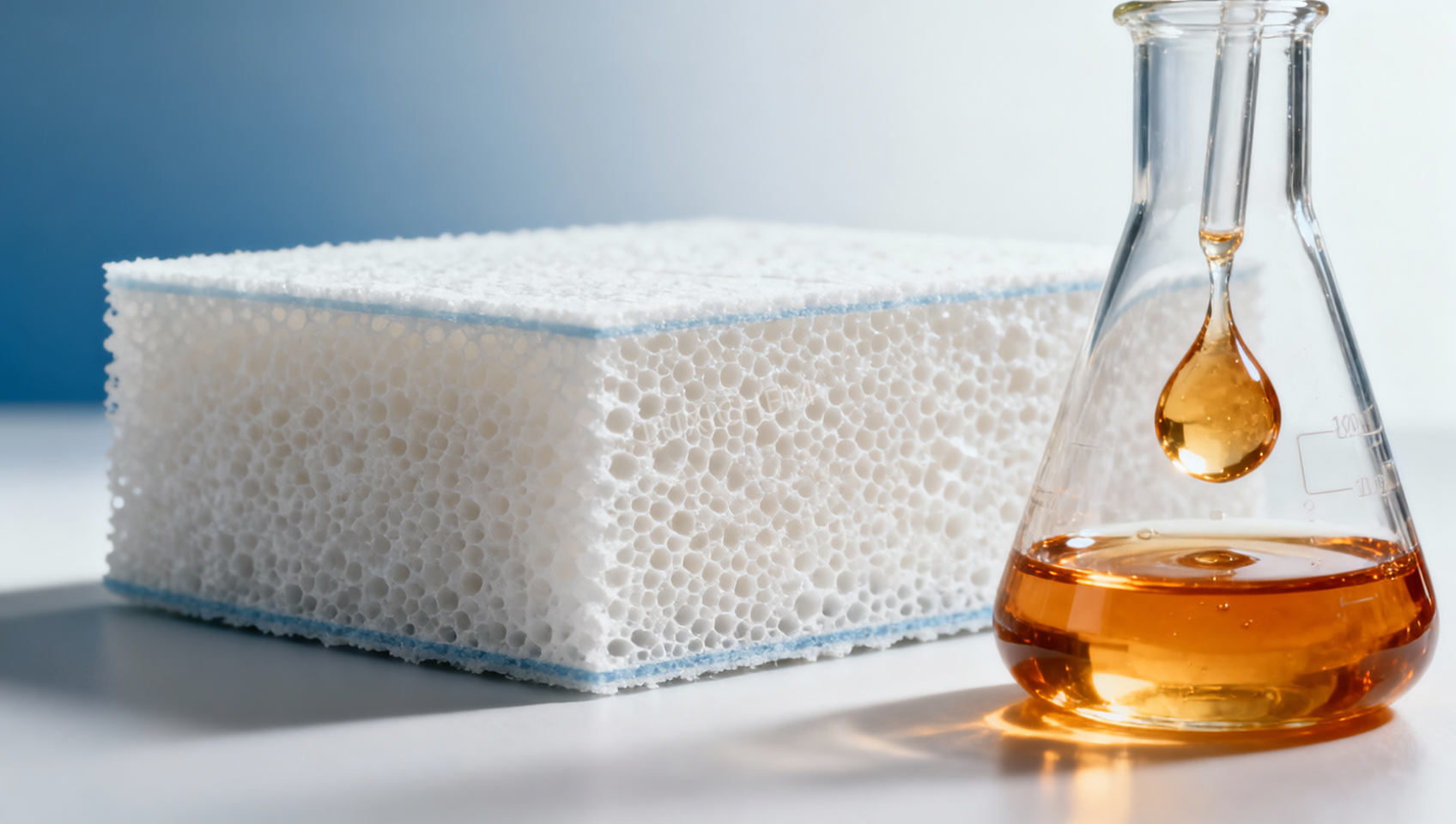
The insulation value of polyurethane and polyisocyanurate foam is not determined by density alone. It depends on how effectively the foam limits heat transfer while retaining its shape, cell structure, and performance under service conditions. Aromatic polyester polyol is important because it helps create the rigid, highly crosslinked polymer network required in many insulation foams—particularly PIR boards, rigid PUR panels, appliance insulation, spray foam systems, and certain pipe-insulation formulations.
Its main contribution is indirect but significant: the chemical structure of the polyol supports a foam morphology and cured network that can deliver low thermal conductivity, high compressive strength, and better dimensional stability than many softer or lower-functionality polyol systems. It is therefore better understood as a formulation tool for improving insulation performance, rather than as a single ingredient that automatically raises R-value.
Why the chemical structure matters
Aromatic polyester polyols are polyester polyols containing aromatic rings in their molecular backbone. They are commonly produced from aromatic raw materials or recycled aromatic polyester streams combined with multifunctional alcohols and acids. Compared with many aliphatic polyester polyols and conventional polyether polyols, they generally have a more rigid molecular structure and relatively high functionality.
That rigidity matters after reaction with an isocyanate. Polyurethane foam forms when hydroxyl groups in the polyol react with isocyanate groups to create urethane linkages. In PIR formulations, a higher isocyanate index also promotes isocyanurate formation. The resulting network is not a flexible material: it is a tightly crosslinked matrix designed to hold millions of closed gas-filled cells in place.
Aromatic segments reduce chain mobility. In practical terms, the cured foam is less prone to softening or relaxing when exposed to elevated temperatures than a system built around more flexible molecular segments. This does not mean every aromatic polyester polyol will produce the same result; functionality, molecular weight distribution, hydroxyl number, viscosity, acid value, blowing-agent compatibility, and catalyst selection all influence the final foam. Still, the aromatic backbone gives formulators a useful starting point where rigidity is a design priority.
Insulation value comes from both polymer and cells
Rigid foam insulation works largely because its closed cells trap a low-conductivity blowing-agent gas. Heat transfer through the material includes conduction through the polymer walls, conduction through the cell gas, radiation across cells, and convection if cells become too large or too open. The polymer resin cannot eliminate these mechanisms by itself. What it can do is help establish and preserve a cell structure that controls them.
Aromatic polyester polyol can support lower thermal conductivity when it enables a fine, uniform, predominantly closed-cell structure. Stronger cell walls and a more rigid cured network can reduce the risk of cell collapse during foam rise and cure. Better cell integrity also helps retain the blowing agent for longer, although long-term thermal aging is still influenced by foam facers, thickness, diffusion pathways, storage conditions, and the gas composition within the cells.
A low initial lambda value should therefore not be treated as the entire insulation story. A foam may test well immediately after manufacture but lose part of its advantage if the gas composition changes over time or if the board warps, cracks, absorbs moisture, or develops voids at joints. The practical value of aromatic polyester polyol lies in supporting a durable structure, not merely an attractive laboratory number.
Higher rigidity can improve dimensional stability
Insulation boards and composite panels must remain flat and dimensionally controlled after production. They can experience heat from roof assemblies, exothermic reactions during manufacture, temperature cycling in cold storage, or stresses introduced by metal facings and adhesives. If the foam shrinks excessively, bows, delaminates from a facer, or pulls away from joints, thermal bridges and installation problems can follow.
The aromatic character and crosslinking potential of polyester polyols can improve resistance to deformation. This is especially relevant in rigid insulation applications where foam must support loads, maintain panel geometry, and remain bonded to facings. A more rigid foam generally resists compression better, which helps protect the insulation layer during handling and service.
However, rigidity has a limit. A formulation pushed too far toward high crosslink density may become brittle. Brittleness can create edge damage during cutting, cracking under impact, or poorer tolerance of thermal stress. Good insulation design is not simply a search for the hardest possible foam. It is a balance between compressive strength, tensile or friability behavior, adhesion, thermal conductivity, processing latitude, and the intended service environment.
Why aromatic polyester polyol is widely associated with PIR foam
PIR insulation foam is generally produced at an isocyanate index above that used for standard polyurethane foam. Under suitable formulation and processing conditions, excess isocyanate forms isocyanurate structures, giving the cured foam improved high-temperature resistance and a more thermally stable network. Aromatic polyester polyol fits well with this formulation direction because it already contributes rigidity and aromatic content to the resin phase.
This combination is one reason aromatic polyester polyols are often discussed in relation to roof boards, insulated sandwich panels, ducts, refrigeration equipment, and industrial insulation. In these uses, the material must do more than reduce heat flow. It must also retain shape, survive fabrication, adhere to substrates, and meet the performance requirements of the finished construction or equipment system.
It is important not to equate “aromatic” with a guaranteed fire classification. Fire performance depends on the complete foam system: isocyanate index, polyol blend, flame retardant package where used, foam density, facers, joints, panel construction, thickness, and the specific test method. Aromatic polyester polyol can contribute to char formation and thermal resistance, but it does not remove the need for full-system fire testing under the requirements applicable to the end product.
Thermal conductivity is influenced by formulation choices beyond the polyol
Aromatic polyester polyol may improve the formulation platform, but it cannot compensate for poor control elsewhere. Several variables can have an equal or greater effect on insulation value:
- Blowing agent selection: The thermal conductivity of the cell gas has a major influence on initial foam performance. Compatibility with the resin system and the rate of gas diffusion also matter.
- Closed-cell content: Open cells allow air and moisture to enter more readily, reducing insulation efficiency and affecting long-term stability.
- Cell size and uniformity: Large or irregular cells can increase heat transfer and weaken the foam mechanically.
- Foam density: Very low density may weaken cell walls, while excessive density increases polymer content and may not produce proportional thermal benefits.
- Processing temperature and mixing: Poor mixing, unstable reactivity, or unsuitable line temperatures can create voids, uneven density, and inconsistent board quality.
- Facer and panel design: Metal, glass-fiber, paper, or laminated facers affect adhesion, moisture behavior, and the finished product’s thermal and mechanical performance.
For this reason, a polyol comparison should not rely only on the reported hydroxyl number or a single foam-density result. The more useful question is whether the candidate polyol produces repeatable thermal and mechanical performance under the intended processing conditions and with the selected blowing agent, catalyst package, surfactant, flame retardant, and isocyanate.
Key material properties to examine
When aromatic polyester polyol is evaluated for insulation foam, the material data sheet provides only the starting point. A few parameters deserve particular attention because they influence both formulation behavior and final properties.
Hydroxyl number indicates the concentration of reactive hydroxyl groups. Higher values generally support higher crosslink density, but the useful range depends on the target foam and the rest of the formulation. A high hydroxyl number may improve rigidity while narrowing processing tolerance if not balanced properly.
Functionality affects network formation. More reactive sites per molecule can produce a more tightly crosslinked resin, contributing to compressive strength and heat resistance. It can also increase viscosity and brittleness, making the choice of co-polyols important.
Viscosity affects pumping, metering, mixing, and compatibility with additives. A resin that is difficult to process may require heating or adjustment of the blend. Processing changes should be assessed carefully because they can alter cream time, rise profile, and cell structure.
Acid value and moisture content require control. Excess acidity can affect catalyst demand and resin stability, while water reacts with isocyanate to generate carbon dioxide. In rigid insulation foam, unintended water variation can shift density, cell pressure, and dimensional stability. Consistent incoming quality is therefore as important as nominal chemistry.
Compatibility with physical blowing agents, flame retardants, surfactants, and co-polyols is often decisive. Phase separation or poor solubility can create visual defects and uneven foam. A polyol that looks attractive on paper may be unsuitable for a particular continuous board line or spray process if the premix is not stable.
Aromatic polyester polyol is not a universal replacement
The material is most valuable where rigid foam performance is the priority. It is less naturally suited to applications requiring softness, high elongation, or strong low-temperature flexibility. Formulations intended for flexible polyurethane foam, elastomers, or coatings may use very different polyol chemistries because the property targets are different.
It should also not be confused with a simple industrial alcohol or a direct drop-in substitute for a foam-grade polyester polyol. For example, Cyclohexanol CAS#108-93-0 is an alicyclic alcohol used as an intermediate and solvent in several chemical value chains, including cyclohexanone and nylon-related production. It is not an aromatic polyester polyol and does not provide the multifunctional prepolymer structure needed to build a rigid insulation foam network. Distinguishing raw-material intermediates from formulated polyols avoids an easy but consequential sourcing error.
How to interpret “improved insulation value” in practice
The strongest claim that can reasonably be made is conditional: aromatic polyester polyol can improve foam insulation value when its chemistry is matched to a formulation designed for rigid, closed-cell foam and when processing is controlled well enough to preserve that structure. Its benefits are usually seen as part of a package—lower thermal conductivity potential, higher compressive strength, better dimensional stability, and improved thermal robustness.
It does not guarantee a lower lambda value in every system, and it does not make a formulation immune to aging, moisture exposure, poor adhesion, or poor fire performance. Comparing alternatives requires testing finished foam or the finished panel, not just comparing raw-material descriptions. Relevant evaluation normally includes thermal conductivity at defined conditioning states, density distribution, closed-cell content, compressive properties, dimensional change at specified temperatures and humidities, adhesion to facers, and any required reaction-to-fire or system fire tests.
For insulation materials, the useful question is not whether aromatic polyester polyol is “better” in the abstract. The relevant question is whether its rigidity, functionality, and processing behavior help the complete foam system maintain lower heat transfer and physical integrity throughout the conditions it is expected to face. Where those requirements are central, aromatic polyester polyol remains one of the most important building blocks in high-performance rigid foam design.
Related Picks
 Butylated Hydroxytoluene Price Drivers: Supply, Purity, and Purchasing Risk FactorsOct 21, 2026Butylated Hydroxytoluene price trends depend on supply stability, purity, logistics, and purchasing risk. Learn how to compare quotes wisely and reduce sourcing costs.
 Sodium Tripolyphosphate Price Trends: Raw Material and Energy ExposureOct 20, 2026Explore sodium tripolyphosphate price trends, from phosphate and soda ash costs to energy exposure. Learn how to compare quotes, manage sourcing risks, and make smarter purchasing decisions.
 Acetonitrile Shipment to Vietnam Successfully Dispatched; RCEP Benefits Boost Fine Chemical Trade with ASEANSep 16, 2026A shipment of industrial-grade acetonitrile from our company has recently been loaded and dispatched following the completion of standardized hazardous material packaging and container securing procedures.
 Nigerian Client’s Order of 4 Containers of Vinyl Acetate Successfully Loaded and Shipped to West AfricaSep 16, 2026We recently completed the loading of a vinyl acetate order for a Nigerian client; four containers of the product have been successfully packed and are ready for shipment to Nigeria.




Question Consultation
Send Us Your Inquiry Today

Luxi Chemical is a professional chemical product supplier with ample stock of all chemical categories and excellent quality, welcome your purchase inquiry.

