


How does fumed silica control sagging in coatings?
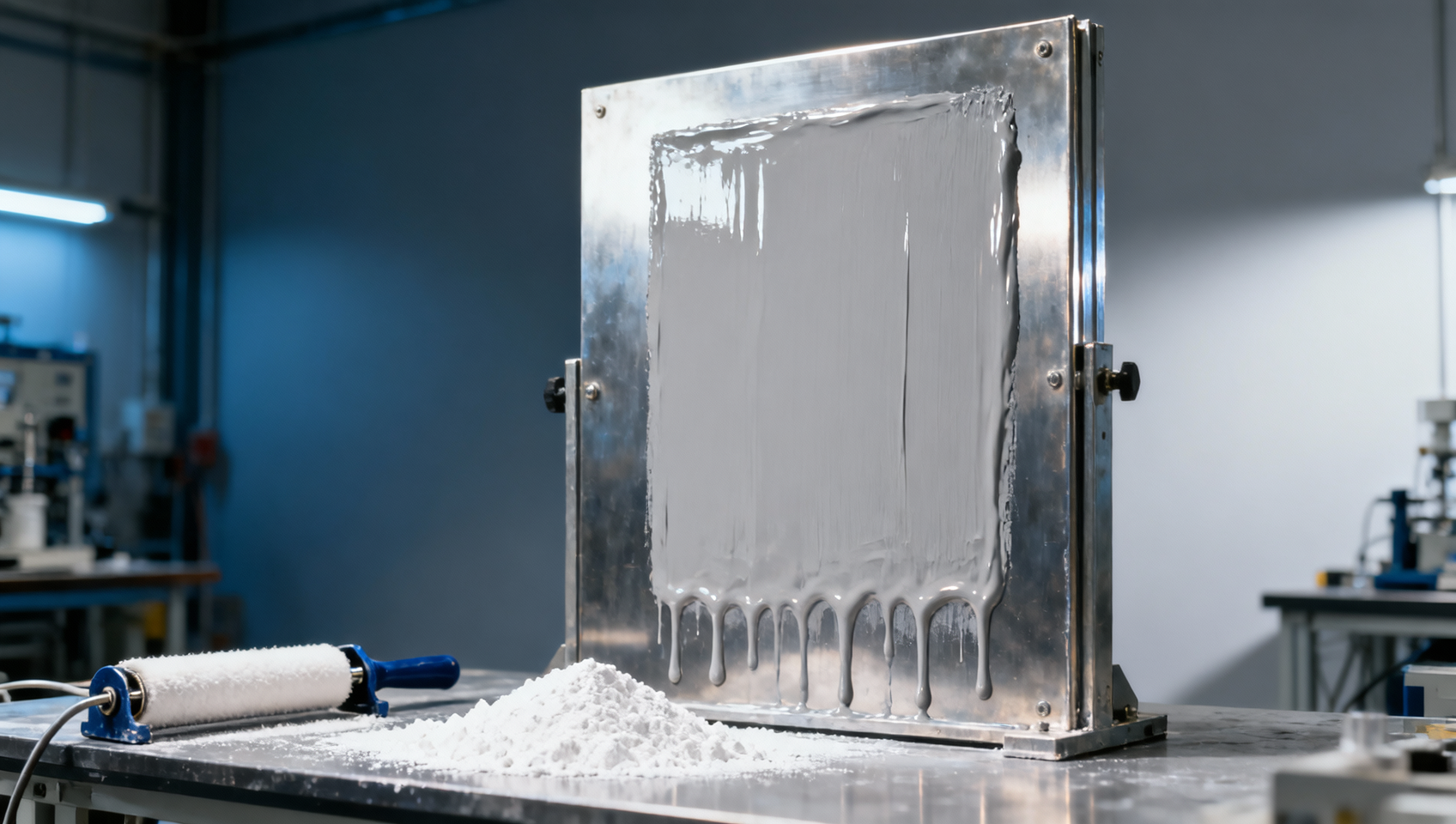
Sagging can compromise coating uniformity, appearance, and film thickness, especially on vertical surfaces. Fumed Silica helps address this challenge by forming a reversible particle network.
This network increases viscosity at rest while allowing the coating to flow during application. Its effectiveness depends on surface treatment, dispersion, and formulation compatibility.
For technical evaluators, the decisive question is whether a selected grade delivers enough sag resistance at the required film thickness without compromising application, leveling, or appearance.
How Does Fumed Silica Prevent a Coating From Sagging?
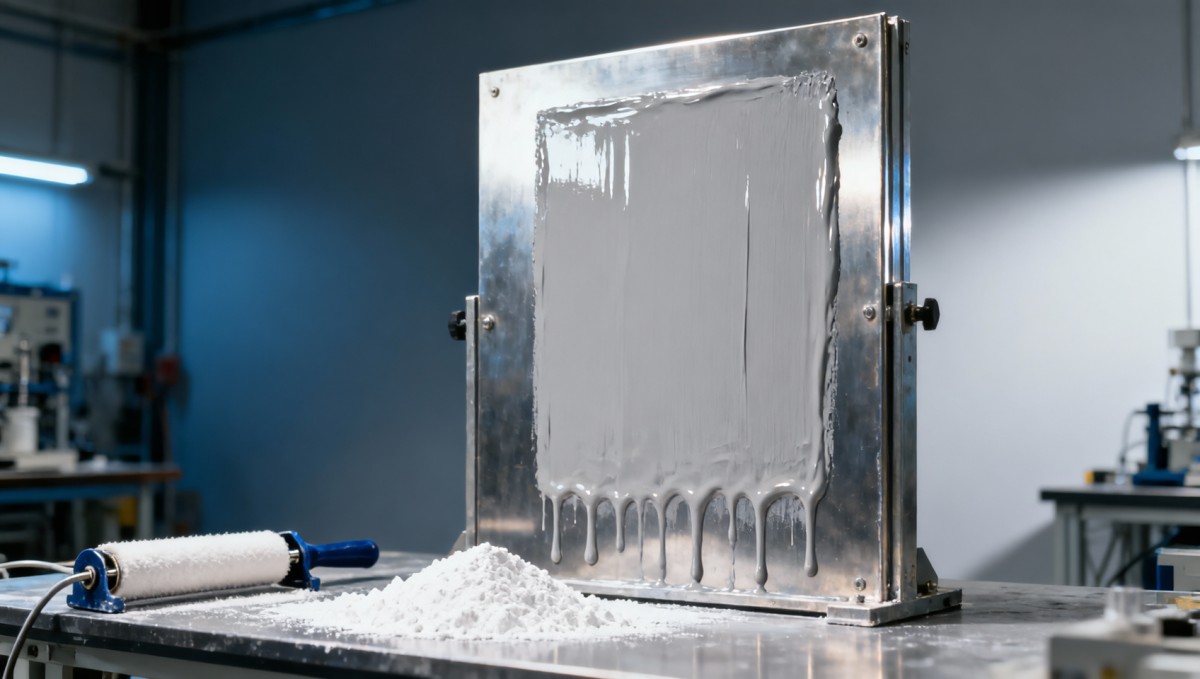
Fumed silica consists of very small primary particles fused into aggregates, which can associate further into larger structures. Their high surface area makes particle interactions significant.
When these particles interact throughout a liquid coating, they can form a three-dimensional network. This structure resists movement of the wet film under gravity.
At rest, the network contributes to a higher apparent viscosity and may create a measurable yield stress: a minimum stress needed to initiate sustained flow.
During brushing, spraying, rolling, or pumping, applied shear disrupts much of the network. The coating then flows more readily than its viscosity at rest would suggest.
After application, particle interactions rebuild the structure. If recovery is sufficiently fast, the coating resists downward movement before gravity creates runs or uneven film thickness.
This time-dependent breakdown and rebuilding is known as thixotropy. It differs from shear thinning alone, which describes viscosity changing with shear rate without specifying recovery time.
Effective anti-sag performance therefore depends on more than achieving high viscosity. The network must also recover at a useful rate under the coating’s actual application conditions.
Which Properties Determine Anti-Sag Performance?
Surface chemistry: Untreated, hydrophilic fumed silica has surface silanol groups that can form hydrogen bonds. These interactions can support network formation in compatible formulations.
Hydrophobic grades are chemically treated to modify their surfaces. Depending on the treatment and surrounding medium, they can provide more suitable wetting or rheological behavior.
The choice is formulation-specific. A hydrophobic grade is not automatically better for solventborne coatings, and a hydrophilic grade is not automatically best for every waterborne system.
Surface area and structure: Specific surface area affects the available interaction sites, while aggregate characteristics influence how particles form a network after incorporation.
Higher surface area can increase thickening efficiency in some systems, but it may also increase viscosity excessively or make dispersion more demanding. Compare grades experimentally.
Resin and solvent composition: Resin polarity, molecular weight, solvent blend, and available hydrogen-bonding species all influence how strongly silica particles interact with each other.
Strong interactions between silica and other formulation components can compete with particle-to-particle association. Consequently, a grade effective in one binder may perform differently in another.
Dosage: Increasing silica concentration generally strengthens the network, but the response is not necessarily linear. Beyond a useful range, viscosity or texture can become unacceptable.
Dispersion: Insufficient dispersion can leave coarse agglomerates and inconsistent performance. The goal is to distribute aggregates effectively without assuming that more processing always improves results.
How Should Evaluators Select a Fumed Silica Grade?
Start by defining the coating system: binder chemistry, solvent or water content, solids level, pigment volume concentration, intended application method, and target wet film thickness.
Next, identify the most important performance constraints. A high-build industrial coating may prioritize sag resistance, while a clear finish may place greater weight on transparency.
Ask suppliers for the grade’s surface treatment, specific surface area, recommended applications, safety information, and relevant technical data. Confirm whether samples represent normal commercial material.
Use supplier guidance to select a small screening set, such as one untreated grade and two differently treated grades appropriate to the coating chemistry.
Include an untreated control formulation and keep the binder, pigment package, solvent balance, and mixing procedure consistent. Change only the silica grade and concentration initially.
Evaluate at multiple concentrations rather than selecting a winner from one dosage. Compare samples at equal loading and, where useful, at similar application viscosity.
Equal-loading comparisons reveal dosage efficiency. Equal-viscosity comparisons can reveal whether one grade provides better sag resistance or recovery for a comparable application feel.
Check the results after equilibration and storage, not just immediately after mixing. Network development, entrained air, and temperature can affect early measurements.
How Much Fumed Silica Should Be Added?
There is no universal dosage. The appropriate level depends on silica grade, binder chemistry, solids content, dispersion quality, and the sag resistance required in service.
For initial screening, a formulator might test approximately 0.2%, 0.5%, and 1.0% by weight of the total formulation, subject to supplier guidance and practical constraints.
These are trial points, not guaranteed operating limits. Some coatings require less or more, and a useful range should be established through application testing.
Always state the dosage basis. A percentage calculated on total formulation weight cannot be compared directly with a percentage based on binder solids or resin weight.
At each level, record application viscosity, low-shear viscosity, recovery behavior, sag resistance, leveling, and appearance. Select the lowest robust dosage that meets all requirements.
Excessive addition can increase pump pressure, impair spray atomization, leave brush marks, or reduce gloss. It may also make the coating harder to incorporate consistently.
How Does Dispersion Affect Results?
Fumed silica is supplied as a low-bulk-density powder and can be difficult to wet. Poor incorporation may produce floating material, dust, or persistent agglomerates.
Add the powder gradually into an appropriate liquid phase under controlled agitation, following the grade supplier’s instructions. The best addition point varies with the formulation.
Some systems benefit from incorporating silica into resin or solvent before sensitive additives are introduced. Others require a different sequence to achieve wetting and compatibility.
Use a suitable disperser and document blade geometry, batch size, mixing time, temperature, and practical shear conditions. Laboratory and production equipment rarely transfer energy identically.
Inspect dispersion quality using a fineness gauge or another suitable method, while recognizing that a gauge reading alone does not prove an optimal rheological network.
Excessive processing can heat the batch, change solvent balance, or alter the particle structure and rheological response. Establish a mixing window rather than relying on maximum speed.
When scaling up, compare finished coating properties as well as mixing conditions. Similar mixing time alone does not demonstrate equivalent wetting or dispersion.
Control airborne powder exposure using appropriate containment, ventilation, and personal protective equipment. Consult the supplier’s safety data sheet and applicable workplace exposure requirements.
Which Tests Show Whether Sag Control Is Working?
Inclined or vertical sag testing: Apply a controlled series of wet film thicknesses to a suitable panel and expose it vertically under defined conditions.
Record the highest thickness that remains free of unacceptable sag. Use a recognized method such as ASTM D4400 where appropriate, and document substrate and orientation.
Rheology: Measure viscosity across relevant shear rates and evaluate recovery after high shear. A rotational rheometer can help distinguish application flow from rebuilding behavior.
A three-interval thixotropy test can compare low-shear structure, high-shear breakdown, and subsequent recovery. Define shear rates and timing around the intended application process.
Application trials: Spray, brush, or roll the coating using representative equipment. Check atomization, build per pass, edge coverage, and visible runs.
Appearance: Assess leveling, gloss, haze, and surface texture after the specified drying or curing schedule. A sag-free film can still be commercially unacceptable.
Storage stability: Recheck viscosity, settling, redispersibility, and application performance after defined storage conditions. Confirm that any accelerated test reflects relevant product risks.
Keep temperature, humidity, substrate preparation, wet film thickness, and test timing consistent. Differences in evaporation or curing can otherwise obscure the additive’s contribution.
How Do Sag Resistance and Leveling Affect Each Other?
After application, the coating needs enough time to smooth out application marks, but it must also resist gravity. These requirements can compete.
If structure rebuilds too slowly, a thick film may sag before it stabilizes. If it rebuilds too quickly, brush marks or orange peel may remain.
The best balance depends on the application method and drying profile. A fast-evaporating spray coating and a slow-curing protective coating face different timing constraints.
Evaluate recovery together with actual film appearance rather than treating a single viscosity value as the acceptance criterion. Adjust grade, loading, or complementary additives accordingly.
Other rheology modifiers may help tune the balance, but combinations should be tested for compatibility. Interactions can change both low-shear structure and application behavior.
What Can Cause Unexpected Results?
Good viscosity but poor sag resistance: Check wet film thickness, recovery rate, temperature, and solvent evaporation. A single viscosity measurement may not capture the problem.
Strong sag resistance but poor leveling: Reduce dosage or screen a grade with different recovery behavior. Confirm that application conditions are not causing the texture.
Inconsistent batches: Review addition sequence, powder wetting, equipment loading, batch temperature, and raw-material variation. Compare processing records before changing the formulation.
Haze or gloss loss: Investigate agglomerates, dispersion quality, refractive-index differences, and dosage. Clear coatings are particularly sensitive to visible defects.
Weak response after reformulation: Changes to resin, solvent, surfactant, or pigment dispersant can alter silica interactions. Re-screen the grade when major ingredients change.
Separate formulation effects from test variability by repeating measurements and including a control. A single successful panel does not establish reliable production performance.
What Should Buyers Confirm Before Qualification?
Request a representative sample, technical data sheet, safety data sheet, and information on batch consistency. Confirm packaging, storage recommendations, and available commercial quantities.
Agree on measurable acceptance criteria, including the sag limit at a specified wet film thickness, application viscosity, appearance, and stability after storage.
Calculate cost in use rather than comparing only price per kilogram. A higher-priced grade may be economical if it meets requirements at a lower loading.
Include dispersion time, handling controls, application losses, and potential rework in the evaluation. These factors can materially affect the total cost of implementation.
Luxi Chemical supplies chemical products for international customers across several sectors. Its separate nutritional portfolio includes Vitamin B12 CAS#68-19-9, which is unrelated to coating sag control.
Confirm product availability, applicable specifications, and supporting documentation directly with the supplier. Do not assume a listed portfolio item establishes availability of a particular silica grade.
Conclusion
Fumed silica controls sag by creating a shear-sensitive particle network that supports the wet coating after application while allowing it to flow under shear.
Its practical value depends on selecting a compatible surface treatment, dispersing it consistently, and balancing network recovery against leveling and application requirements.
For a reliable decision, compare candidate grades at defined dosages, test realistic film builds, and verify appearance and stability under conditions representative of production.
Related Picks
 Butylated Hydroxytoluene Price Drivers: Supply, Purity, and Purchasing Risk FactorsOct 21, 2026Butylated Hydroxytoluene price trends depend on supply stability, purity, logistics, and purchasing risk. Learn how to compare quotes wisely and reduce sourcing costs.
 Sodium Tripolyphosphate Price Trends: Raw Material and Energy ExposureOct 20, 2026Explore sodium tripolyphosphate price trends, from phosphate and soda ash costs to energy exposure. Learn how to compare quotes, manage sourcing risks, and make smarter purchasing decisions.
 Acetonitrile Shipment to Vietnam Successfully Dispatched; RCEP Benefits Boost Fine Chemical Trade with ASEANSep 16, 2026A shipment of industrial-grade acetonitrile from our company has recently been loaded and dispatched following the completion of standardized hazardous material packaging and container securing procedures.
 Nigerian Client’s Order of 4 Containers of Vinyl Acetate Successfully Loaded and Shipped to West AfricaSep 16, 2026We recently completed the loading of a vinyl acetate order for a Nigerian client; four containers of the product have been successfully packed and are ready for shipment to Nigeria.




Question Consultation
Send Us Your Inquiry Today

Luxi Chemical is a professional chemical product supplier with ample stock of all chemical categories and excellent quality, welcome your purchase inquiry.

