


Why does water treatment chemical dosage change with pH?
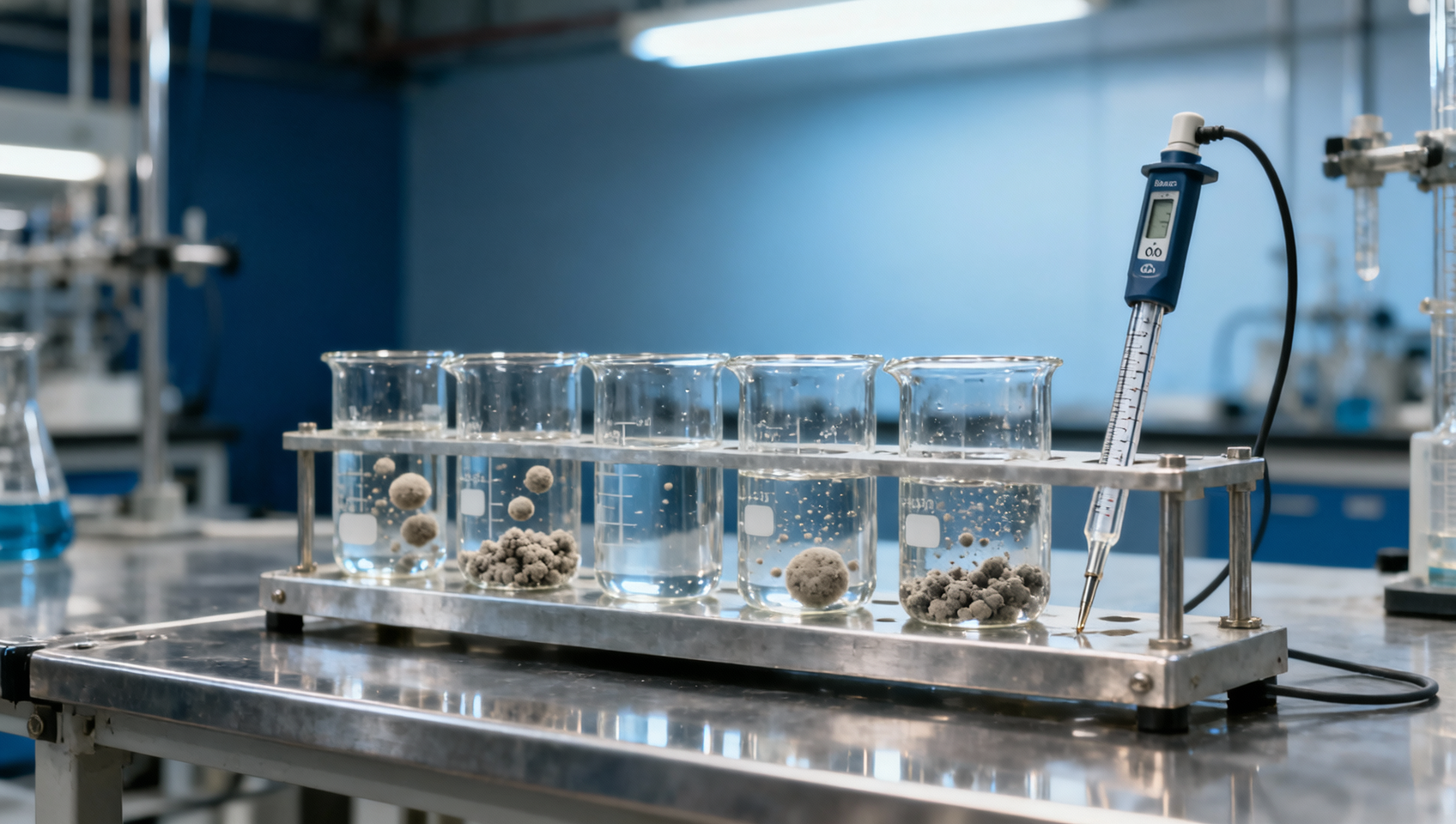
A change in pH can change the dose of Water Treatment Chemicals because it changes which chemical forms are present, how contaminants behave, and how readily treatment reactions proceed. The same coagulant dose, for example, can produce a dense floc at one pH and a weak floc at another. Chlorine can leave the same measured free residual while delivering different disinfection performance.
pH alone does not determine the correct dose. Alkalinity, temperature, contaminant concentration, mixing and contact time also affect the result. A useful adjustment therefore connects the pH measured at the reaction point with the treatment objective and the quality of the water leaving the process.
pH changes the chemistry of the dose
Many treatment chemicals react with water before they act on contaminants. Aluminium and iron coagulants form a range of dissolved and solid species as pH changes. These species differ in charge and solubility, so their ability to destabilize particles and form settleable floc also changes. A coagulant dose established at one pH is not automatically transferable to another.
pH also affects the surface charge and solubility of substances already in the water. Suspended particles, dissolved organic matter and dissolved metals do not all respond in the same way. Some treatment processes require particles to aggregate; others require a dissolved contaminant to form a solid that can be separated. The best pH for one objective is not necessarily the best for another.
For acid and alkali dosing, the relationship is particularly easy to misread. pH describes hydrogen ion activity, not the total quantity of acid or base needed to reach a target. Two waters with the same starting pH can require very different doses if their buffering capacities differ.
Coagulation: the reaction pH can move during dosing
When aluminium or ferric salts hydrolyze, they consume alkalinity and can lower pH. In poorly buffered water, adding more coagulant may push the reaction outside the effective range for the selected product. The result can look like underdosing: small flocs, poor settling or increased filtered-water turbidity. Adding still more coagulant can deepen the pH shift rather than correct the problem.
The reverse situation also occurs. At a higher pH, a metal coagulant can remain in, or return to, more soluble forms, reducing the formation of the solid hydroxide floc needed for capture. The workable range depends on the coagulant formulation, water composition and removal objective; a single universal setpoint is not appropriate.
Measure both the incoming pH and the pH after coagulant addition and rapid mixing. Also measure alkalinity using the same reporting basis over time, commonly as calcium carbonate. A falling post-dose pH alongside low remaining alkalinity suggests that pH control deserves attention before the coagulant dose is increased.
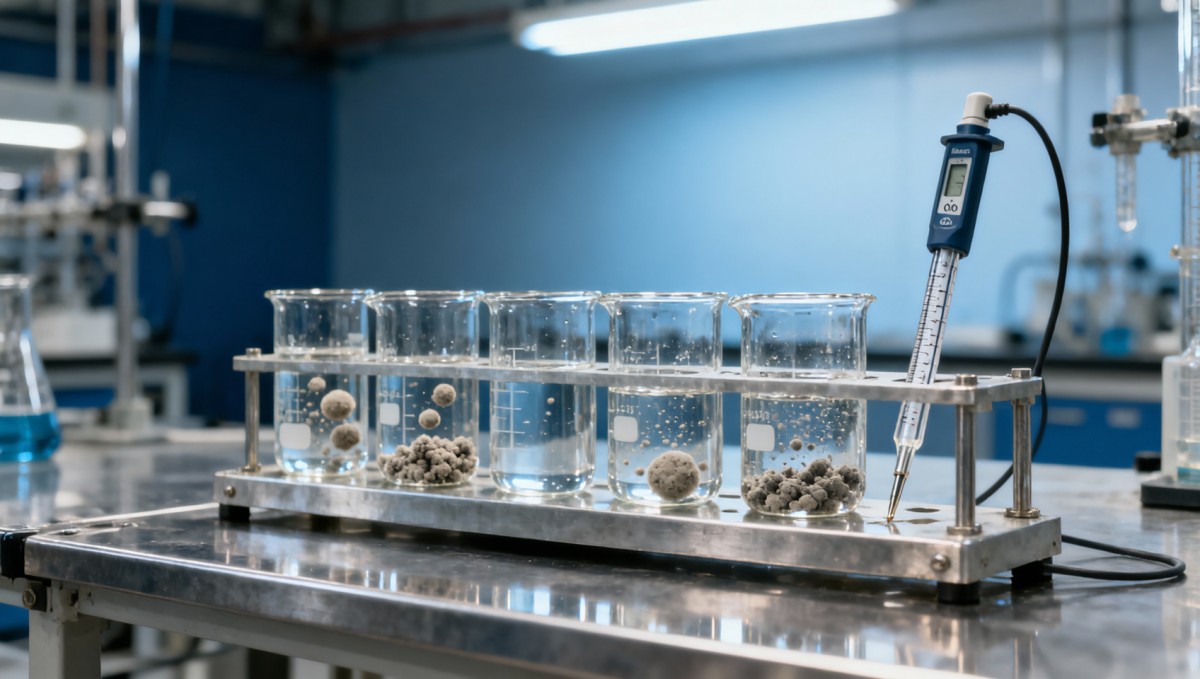
Use jar tests to separate pH effects from dose effects
A useful jar test changes pH and coagulant dose in a controlled pattern rather than changing both without a record. Test several pH conditions with more than one dose, using representative raw water and the plant's intended chemical addition sequence. Include an untreated sample where practical.
Reproduce rapid mixing, flocculation and settling as closely as the equipment allows. Record pH after chemical addition as well as after settling, since the initial adjustment may not hold. Compare settled or filtered turbidity, floc size and settling behavior; where relevant, include residual aluminium or iron and organic matter removal. A visually impressive floc is not sufficient evidence if treated-water quality or residual metal is unacceptable.
If pH correction is required, test the acid or alkali addition point too. Adding a concentrated adjustment chemical directly into a coagulant stream can create local extremes that are not represented by the final bulk pH. Mixing and dilution affect the outcome as much as the numerical setpoint.
Disinfection: a residual is not the whole result
Free chlorine in water exists mainly as hypochlorous acid and hypochlorite ion. As pH rises, a larger fraction is present as hypochlorite; as pH falls, the hypochlorous acid fraction increases. Hypochlorous acid is generally the more effective disinfecting form, so the same free chlorine residual and contact time do not necessarily provide the same inactivation at different pH values.
This does not translate into a fixed rule to increase chlorine whenever pH rises. First distinguish the disinfectant residual from the initial applied dose. Chlorine demand from ammonia, organic matter and other reactive substances consumes part of the dose, and the residual must remain available over the required contact time. Temperature, target organisms and the applicable treatment requirements also matter.
For an established process, compare pH at the disinfection contactor, free and total chlorine where relevant, contact time and temperature. If a change in pH coincides with a residual change, investigate whether the chemical feed, source water or demand also changed. Follow the site-specific validated disinfection criteria; a residual reading by itself does not establish that the required treatment has been achieved.
Measurement method matters as well. A sample taken before adequate mixing, or analyzed after an uncontrolled delay, can give a misleading comparison. Use the approved test method and sample handling procedure consistently when evaluating a dosage change.
Precipitation and pH adjustment have different dose curves
Metal removal illustrates why the desired final pH and the amount of alkali required are separate questions. Raising pH can reduce the solubility of certain dissolved metals by promoting hydroxide precipitation. The resulting solids must then form particles large enough for clarification or filtration. If pH remains too low, soluble metal can pass through; at excessive pH, some amphoteric metals can become more soluble again.
Complexing agents and other dissolved constituents can keep metals in solution even when the bulk pH appears suitable. An apparent increase in metal concentration after treatment can also reflect suspended solids passing through a filter or differences between dissolved and total metal samples. Compare like with like, and confirm the sampling and filtration method before interpreting the result as a precipitation failure.
Alkali demand depends on the acids and buffers present as well as the desired endpoint. Construct a titration or bench-scale dose curve using a representative sample: add measured increments, mix thoroughly and record stabilized pH. The curve reveals whether a small additional dose produces a large pH movement near the target. It also exposes water that needs substantial reagent before pH begins to rise.
High-strength wastewater can be uneven, so a curve from one sample is a starting point rather than a permanent feed recipe. Automatic control needs a representative measurement location, adequate mixing and enough residence time to see the effect of the previous addition. Excessive controller response or a probe too close to the injection point can cause alternating acid and alkali doses without producing stable tank pH.
The source of a pH shift matters
A pH change can originate in the incoming water, a preceding treatment stage or the chemical feed itself. Carbon dioxide exchange, changes in alkalinity, blending, biological activity and industrial discharges can all alter the relationship between a measured pH and treatment demand. A shift caused by lower alkalinity deserves a different response from one caused by a failed feed pump.
Consider two samples with the same pH but different alkalinity. They start at the same reading, yet the lower-alkalinity sample can experience a larger pH drop after an equal coagulant dose. Conversely, a higher-alkalinity sample can require more acid to reach the same coagulation pH. Neither result can be predicted reliably from pH alone.
Temperature adds another distinction. It affects reaction rates, floc formation and pH measurement. Cold water can produce slower floc growth even when the measured pH remains within the established range. Increasing coagulant without examining mixing and settling time can therefore conceal the actual constraint.
Distinguish a treatment reagent from a contaminant
Not every chemical encountered in an industrial water stream is a treatment additive. Tetrachloroethylene CAS#127-18-4 is an industrial solvent associated with applications such as dry cleaning and metal degreasing. If present in wastewater, it is a contaminant to characterize and manage, not a reagent to add for pH adjustment or coagulation.
A change in pH alone is not a reliable indicator of solvent removal. Sampling, analysis and the choice of removal process must reflect the contaminant's properties and the site conditions; volatile compounds also require appropriate handling during sampling and treatment.
Turn a pH excursion into a defensible dose change
Start with the process outcome that changed: settled-water turbidity, filtered-water quality, disinfectant residual or dissolved metal concentration. Confirm that the pH reading is representative of the point where the relevant reaction occurs. A calibrated probe in a well-mixed stream is more useful than a reading taken immediately beside an injection line.
Review the chemical feed rate against actual water flow and product concentration. A constant pump setting does not guarantee a constant dose when flow changes, a delivery line is restricted, or a solution has been prepared at a different strength. Check the units used in records: dose expressed as product is not interchangeable with dose expressed as active ingredient.
When the measurement and feed system are sound, use a small controlled change or a bench test to identify the direction of response. Allow sufficient time for water to travel through the process before judging the downstream result. Record the starting conditions, adjustment, reaction pH and outcome so that a later shift can be compared on the same basis.
If the process approaches a discharge, drinking-water or equipment limit, follow the site's operating procedure rather than making an unrestricted correction. Confirm that the pH adjustment has not created a downstream issue, such as a loss of disinfectant effectiveness, excess residual metal or unstable final pH.
Related Picks
 Butylated Hydroxytoluene Price Drivers: Supply, Purity, and Purchasing Risk FactorsOct 21, 2026Butylated Hydroxytoluene price trends depend on supply stability, purity, logistics, and purchasing risk. Learn how to compare quotes wisely and reduce sourcing costs.
 Sodium Tripolyphosphate Price Trends: Raw Material and Energy ExposureOct 20, 2026Explore sodium tripolyphosphate price trends, from phosphate and soda ash costs to energy exposure. Learn how to compare quotes, manage sourcing risks, and make smarter purchasing decisions.
 Acetonitrile Shipment to Vietnam Successfully Dispatched; RCEP Benefits Boost Fine Chemical Trade with ASEANSep 16, 2026A shipment of industrial-grade acetonitrile from our company has recently been loaded and dispatched following the completion of standardized hazardous material packaging and container securing procedures.
 Nigerian Client’s Order of 4 Containers of Vinyl Acetate Successfully Loaded and Shipped to West AfricaSep 16, 2026We recently completed the loading of a vinyl acetate order for a Nigerian client; four containers of the product have been successfully packed and are ready for shipment to Nigeria.




Question Consultation
Send Us Your Inquiry Today

Luxi Chemical is a professional chemical product supplier with ample stock of all chemical categories and excellent quality, welcome your purchase inquiry.

