


How to select water treatment chemicals using jar tests
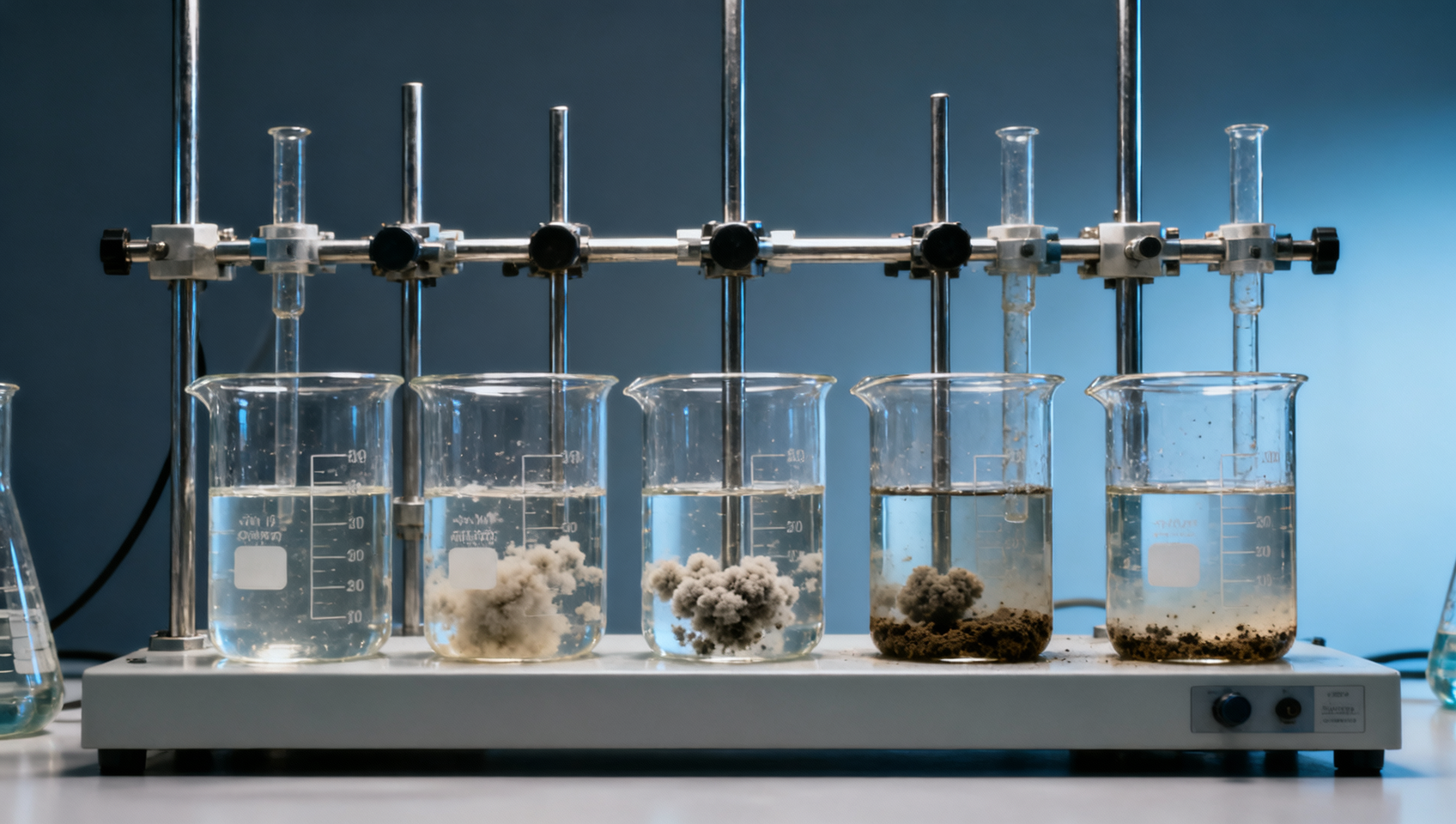
Select Water Treatment Chemicals by comparing how each candidate performs in the same representative water sample, at realistic doses and under mixing and settling conditions relevant to the treatment process. A useful jar test identifies a workable dose range, confirms treated-water quality, and reveals operational effects such as pH change, sludge formation and floc strength. The clearest jar alone is not necessarily the best choice.
Define the treatment objective before preparing the jars. A drinking-water clarification process may prioritize settled turbidity and filter performance, while an industrial wastewater process may also need to reduce color, phosphorus, emulsified oil or a specific metal. Each objective calls for an appropriate measurement: turbidity is useful for suspended particles, but it cannot establish whether dissolved contaminants have been removed.
Choose candidates and set a meaningful comparison
Coagulants destabilize suspended or colloidal material so that particles can aggregate. Common candidates include aluminum- and iron-based salts and prehydrolyzed inorganic coagulants. Their performance varies with pH, alkalinity, temperature and the nature of the particles. Organic coagulants can be considered where compatible with the intended treatment and discharge requirements. A flocculant, often a polymer, is usually tested after coagulation to promote larger, more readily separated aggregates; it is not automatically a substitute for an effective coagulant.
Start with products suited to the separation process and water chemistry. Compare products across dose ranges rather than matching them at one arbitrary volume. Commercial formulations differ in concentration and density, so equal milliliters per liter do not necessarily represent equal active ingredient or equivalent treatment. Record both the as-supplied dose and, when reliable composition data are available, the dose expressed on a comparable active basis.
A jar test addresses a defined treatment function, not every chemical used around a water system. For example, Dimethyl disulfide CAS#624-92-0 is associated with applications such as refinery catalyst sulfiding; its listed industrial uses do not establish it as a coagulant or flocculant for water clarification. Keep such chemicals outside a clarification screening program unless a specific, documented treatment purpose and appropriate safety assessment justify their evaluation.
Collect water that represents the operating problem
Use a fresh sample from the point where chemical addition would occur. Collect enough for all jars, repeat tests and analytical measurements, and mix the bulk sample before distributing it so that settling solids are not concentrated in only the first or last jars. Avoid vigorous handling that changes an emulsion or breaks fragile particles. If the process has significant variation between shifts, storms or production batches, test those conditions separately instead of averaging them into a sample that represents none of them.
Measure the starting pH, temperature, turbidity and alkalinity where relevant. Record any known process changes and existing chemical additions. Alkalinity matters because some metal-salt coagulants consume it; a water with limited buffering can shift to an unfavorable pH as the dose rises. A sample with adequate initial pH but low alkalinity can therefore respond very differently from one with the same pH and stronger buffering.
Test promptly where feasible. If holding is unavoidable, document the time and storage conditions and assess whether the sample still resembles the water entering treatment. Changes in temperature, biological activity, oxidation or particle settling can alter the apparent optimum.
Build the dose series around the process
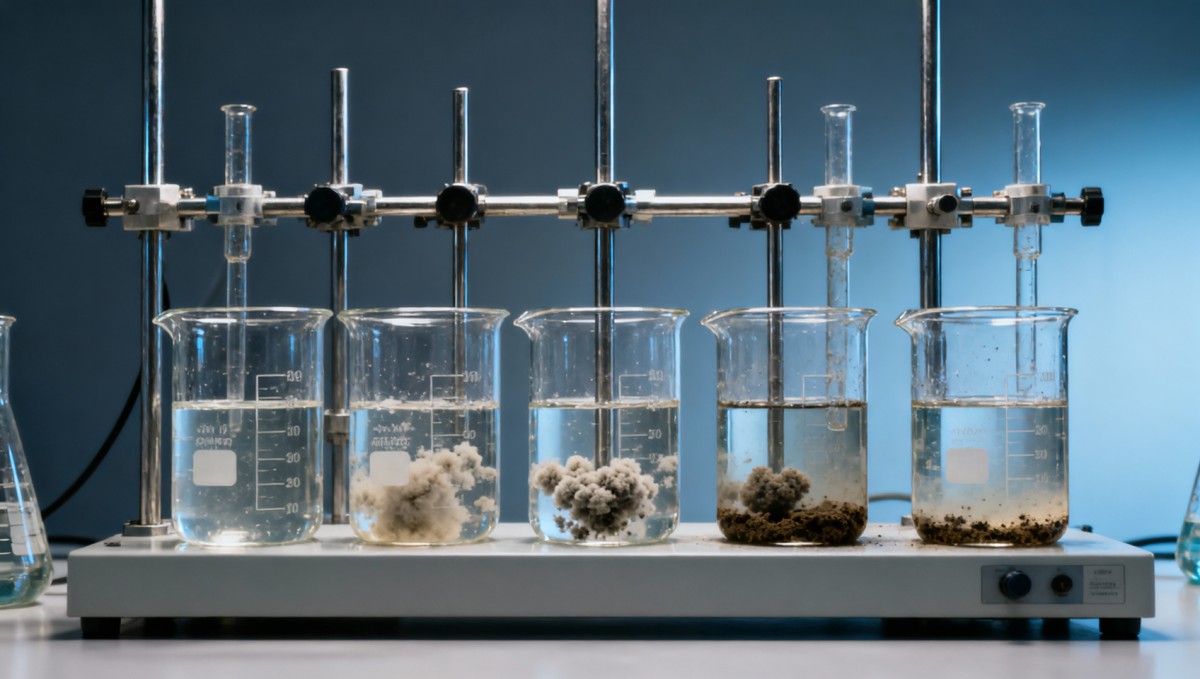
Use equal sample volumes in clean jars and include an untreated control whenever capacity permits. For an initial screen, select a broad dose range that includes a low dose, intermediate doses and a high dose consistent with the product information and process constraints. A second, narrower series around the best-performing region is more informative than declaring a single optimum from widely spaced doses.
Prepare dilutions consistently using water that does not interfere with the test. Follow product-specific preparation and aging instructions, especially for polymers: concentration, hydration, mixing intensity and storage time can change their performance. Add small quantities with suitable volumetric equipment, and prepare fresh working solutions when stability is uncertain.
For a one-liter jar, a dose of 10 mg/L as supplied corresponds to 10 mg of commercial product in that jar. If using a working solution, calculate the addition from its actual concentration. A 1 g/L working solution requires 10 mL to deliver 10 mg of product. Account for any dilution already made, and distinguish a mass-based solution from a volume-based dilution. A liquid formulation measured by volume also requires its density to convert volume to product mass.
Keep the rapid-mix time and intensity, slow-mix period, settling time, addition point and sampling depth consistent across the series. Use settings that approximate the plant's available mixing and separation sequence where possible. A laboratory stirrer speed is not directly interchangeable with a full-scale mixing intensity: vessel geometry, impeller size and liquid depth all affect the energy delivered to the water.
Test pH as a separate variable
When performance changes strongly with pH, use a separate set of jars to explore a practical pH range at selected coagulant doses. Record both initial and final pH; a target set before addition may not be the pH at which floc actually forms. If acid or alkali is added, include its addition and mixing sequence in the procedure, because local overconcentration and timing can affect the result.
A low residual turbidity achieved only with a pH that the downstream process cannot accommodate is not a ready-to-use result. Consider corrosion, biological treatment, filtration and the final discharge or product-water requirements when defining an acceptable operating window.
Observe floc, then measure the water
During rapid mixing, note whether the chemical disperses uniformly. During slow mixing, observe the time until visible floc appears, its relative size and whether it remains intact. After settling, look for a distinct sludge layer, floating material and fine particles remaining above the settled solids. A large floc that breaks when gently mixed or resuspends during sampling may perform poorly through pumps, channels or filters.
Collect supernatant from the same depth and at the same elapsed time in each jar without disturbing the settled layer. Measure turbidity with a calibrated instrument rather than relying only on appearance. Depending on the treatment objective, analyze color, dissolved organic matter, phosphorus, metals, oil or other relevant constituents using methods appropriate to the sample. For dissolved and total measurements, apply a consistent filtration and preservation procedure; otherwise, the distinction between particulate removal and dissolved removal becomes blurred.
These observations guide the next experiment; they do not identify a cause by themselves. For example, a cloudy jar can result from underdosing or overdosing. Without a dose series and final pH measurements, correcting the problem by simply adding more chemical can move the process farther from its optimum.
Compare coagulant and polymer combinations
Once a workable coagulant and pH range have been identified, test a small range of flocculant doses at a fixed coagulant condition. Add the polymer at the point corresponding to the intended plant sequence, typically after initial coagulant dispersion. Compare the combination with a coagulant-only jar. If a polymer improves settling speed but leaves more residual turbidity, determine whether the actual clarifier and filters can accommodate that trade-off.
Polymer charge type, molecular characteristics and preparation affect performance. Too much polymer can produce sticky or dispersed material, interfere with subsequent separation or increase residual polymer concerns. A very small laboratory addition is also sensitive to dilution and pipetting errors, so repeat promising results with freshly prepared solutions before treating small differences as meaningful.
Keep the comparison focused: changing coagulant, polymer, pH and mixing simultaneously makes it difficult to determine which change caused the result. After identifying a promising combination, vary one major factor at a time or use a planned test matrix that preserves the ability to interpret interactions.
Turn jar results into an operating choice
Select a dose window that consistently meets the treatment objective, rather than the lowest reading from one jar. Compare nearby doses, repeat the leading conditions and include challenging water samples. A slightly higher residual at one point may be preferable if the condition remains stable over a wider range of raw-water quality and produces floc compatible with the available separation equipment.
Review the consequences beyond the supernatant. Higher coagulant doses can increase sludge production and change sludge handling; pH adjustment adds another control requirement. For metal-salt coagulants, assess residual aluminum or iron when relevant to the treated-water specification. A dose that gives low turbidity but leaves an unacceptable residual or creates difficult-to-handle sludge is not an acceptable selection.
Document the water source and collection time, baseline measurements, product identity, solution preparation, doses, mixing sequence, settling time, sampling method and analytical results. Preserve units throughout: dose as commercial product, active ingredient and, where applicable, metal content are different quantities. Record observations and rejected conditions as well as the preferred range, so later changes in performance can be compared with the original test.
Before full-scale adoption, confirm the selected conditions in a controlled plant trial or pilot appropriate to the risk. Jar tests approximate coagulation and settling, but they do not reproduce every feature of continuous flow, hydraulic short-circuiting, sludge blanket behavior or filter operation. Monitor treated-water quality, pH, chemical feed and solids handling during the trial, and adjust the operating range using actual process response.
Related Picks
 Butylated Hydroxytoluene Price Drivers: Supply, Purity, and Purchasing Risk FactorsOct 21, 2026Butylated Hydroxytoluene price trends depend on supply stability, purity, logistics, and purchasing risk. Learn how to compare quotes wisely and reduce sourcing costs.
 Sodium Tripolyphosphate Price Trends: Raw Material and Energy ExposureOct 20, 2026Explore sodium tripolyphosphate price trends, from phosphate and soda ash costs to energy exposure. Learn how to compare quotes, manage sourcing risks, and make smarter purchasing decisions.
 Acetonitrile Shipment to Vietnam Successfully Dispatched; RCEP Benefits Boost Fine Chemical Trade with ASEANSep 16, 2026A shipment of industrial-grade acetonitrile from our company has recently been loaded and dispatched following the completion of standardized hazardous material packaging and container securing procedures.
 Nigerian Client’s Order of 4 Containers of Vinyl Acetate Successfully Loaded and Shipped to West AfricaSep 16, 2026We recently completed the loading of a vinyl acetate order for a Nigerian client; four containers of the product have been successfully packed and are ready for shipment to Nigeria.




Question Consultation
Send Us Your Inquiry Today

Luxi Chemical is a professional chemical product supplier with ample stock of all chemical categories and excellent quality, welcome your purchase inquiry.

