


How polyester polyol for rigid foam affects compressive strength
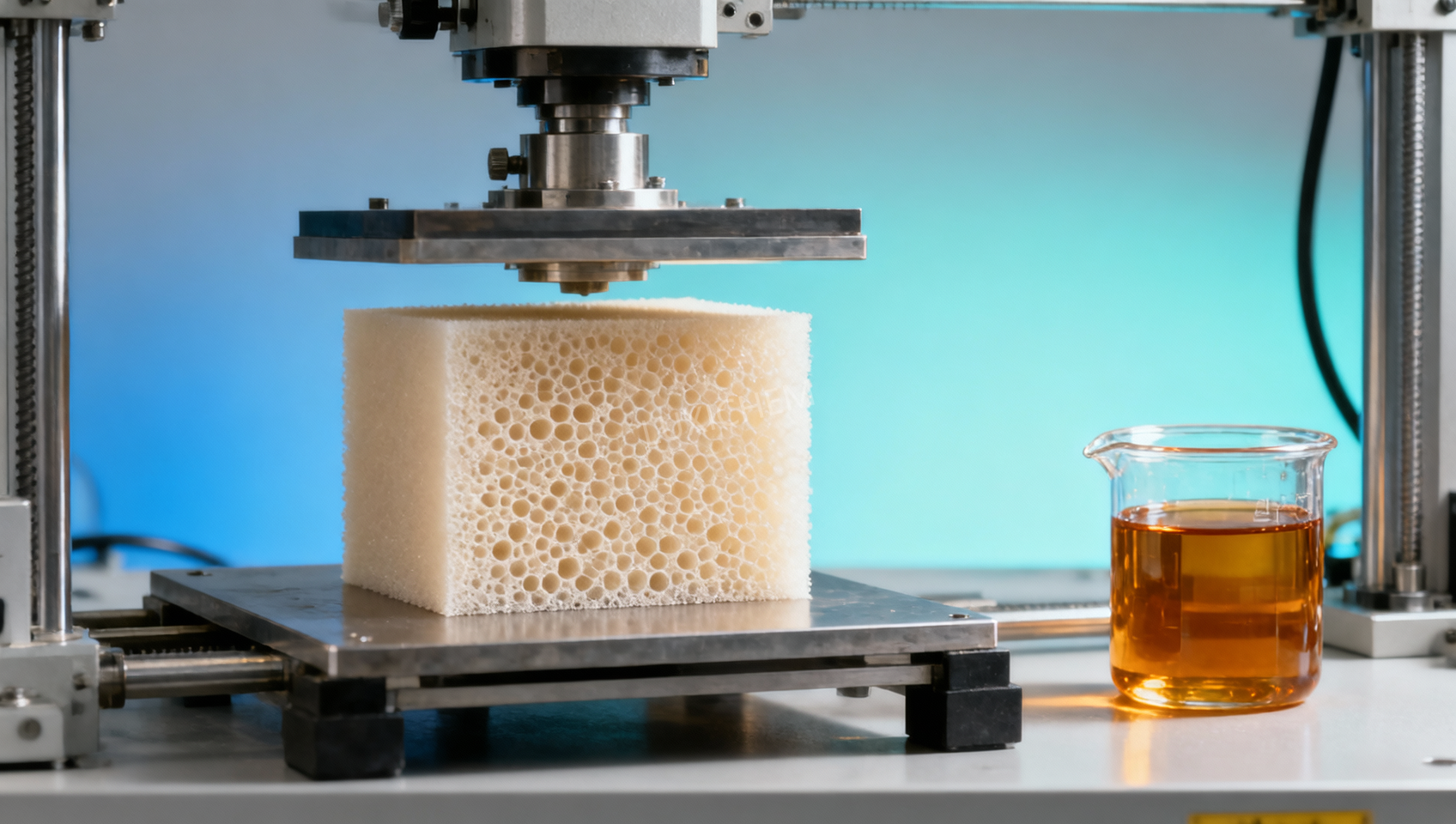
Compressive strength in rigid polyurethane and polyisocyanurate foam is not determined by density alone. The polyester polyol establishes much of the foam’s structural potential: its functionality, hydroxyl value, molecular architecture, aromatic content, viscosity, water content, and batch consistency influence crosslink density, cell morphology, cure profile, and ultimately the load the foam can sustain at a defined deformation.
For a foam formulation already operating near its density or processing limits, changing the polyester polyol can raise or reduce compressive strength even when the nominal isocyanate index and target free-rise density remain unchanged. The apparent contradiction is resolved by looking at the polymer network and the cellular structure together. A rigid foam must have sufficiently strong struts and cell walls, a uniform cell structure, and enough dimensional stability to preserve those features during cooling, conditioning, and service.
Compressive strength is a measured response, not an isolated material property
Rigid foam compressive strength is commonly reported as the stress at a specified strain, rather than as a single inherent “strength” value. Test direction matters because foam is anisotropic: rise-direction properties can differ materially from properties measured perpendicular to the rise direction. Sample conditioning, specimen dimensions, foam skin removal, test speed, density, and strain level can all affect the reported result.
ASTM D1621 is widely used for compressive properties of rigid cellular plastics, while ISO 844 specifies determination of compression properties for rigid cellular plastics. For thermal-insulation products supplied into European construction applications, EN 826 is also commonly relevant. These methods should not be treated as interchangeable merely because each produces a compression number. The applicable product specification should define the standard, orientation, conditioning environment, deformation level, and acceptance basis before comparing one polyester polyol grade with another.
A meaningful quality-control conclusion therefore requires more than: “Foam A tested higher than Foam B.” The first question is whether both foams had comparable density, orientation, cure state, and test conditions. The second is whether the result reflects genuine polymer-network improvement or only a density shift caused by changed blowing, mixing, or mold filling behavior.
How polyester polyol chemistry influences the load-bearing network
Polyester polyols react with isocyanates to form urethane linkages; in rigid foam systems, the reaction environment may also create urea, isocyanurate, and other structures depending on the formulation and index. Polyester polyols generally contribute higher polarity and, in many rigid-foam designs, greater inherent stiffness than long-chain flexible polyether polyols. This does not make every polyester polyol a high-strength choice. The effect depends on its molecular design and how it interacts with the full formulation.
Functionality is a central variable. A polyol with more reactive hydroxyl groups per molecule can form a more highly crosslinked network, provided the reaction is balanced and conversion is adequate. Higher crosslink density generally supports rigid-cell-wall strength and resistance to deformation. However, excessive crosslinking can make foam brittle, increase internal stress, narrow the processing window, and worsen cracking or friability. A high compressive result on one freshly molded specimen is not sufficient if the same material loses integrity after thermal cycling or shows poor dimensional stability.
Hydroxyl value indicates the concentration of hydroxyl groups and is used to calculate isocyanate demand. A higher hydroxyl value often corresponds to lower equivalent weight and can support a tighter network, but it must be interpreted alongside functionality and molecular distribution. Two polyols with similar hydroxyl values can produce different foam behavior if one is predominantly linear and the other has more branching, aromatic content, or low-molecular-weight fractions.
Molecular rigidity also matters. Aromatic or cyclic units within a polyester backbone can increase segment stiffness and improve the resistance of the cured matrix to compressive deformation. Their benefit may be especially apparent in insulation foams where elevated-temperature performance and dimensional control are important. The trade-off is that a more rigid polyol can increase viscosity, reduce compatibility with some formulation components, and change nucleation and flow during processing.
Acid value and residual functionality require close control. Residual carboxylic acid groups can alter catalyst response, influence storage stability, and create uncertainty in the reaction balance. In a moisture-sensitive isocyanate system, even a small departure from the established incoming-material profile can affect cream time, gel time, rise, and cure. The resulting loss of cell uniformity may have a larger effect on compressive strength than the theoretical difference in polyol backbone stiffness.
Why density explains only part of the result
Within a comparable formulation family, compressive strength often increases with foam density because more solid polymer is available in the cell edges and walls. That relationship is useful, but it can be misleading when used as the sole release criterion. A dense foam with coarse, irregular, partially collapsed, or highly anisotropic cells may underperform a lower-density foam with a uniform closed-cell structure and well-developed struts.
The polyester polyol influences density indirectly through viscosity, miscibility, reactivity, and the balance between gelling and blowing. If a polyol change slows network formation relative to gas generation, cells may overexpand before sufficient polymer strength develops. If gel occurs too early, flow may be restricted, causing density gradients, voids, knit-line weakness, or inadequate mold filling. Both cases can produce a nominal density that looks acceptable at one sampling location while leaving local compression performance unreliable.
Cell size and cell regularity are particularly important. Fine, evenly distributed cells tend to distribute compressive loads more consistently. Large cells, ruptured windows, thin struts, and localized agglomerates create stress concentrations. A polyester polyol that improves theoretical crosslink density but destabilizes the emulsified blowing-agent phase may therefore reduce usable compressive performance.
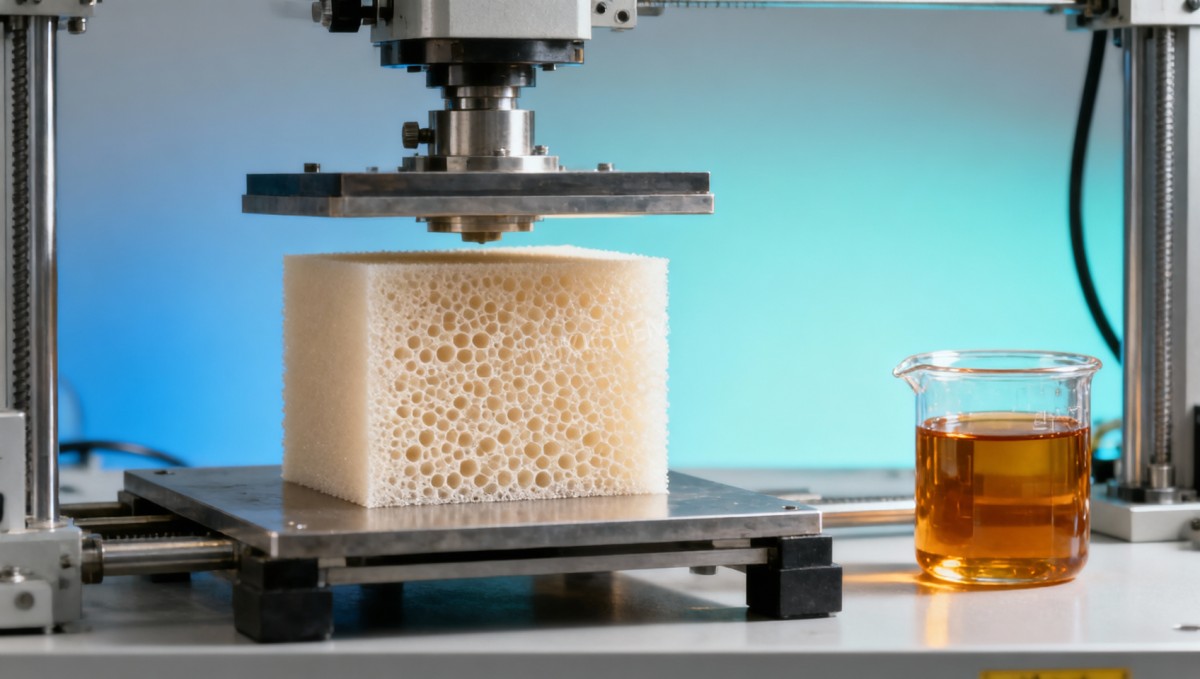
The processing window can override a favorable laboratory formulation
Bench-scale formulations are often evaluated under controlled temperatures, mixing energy, and short material residence times. Production conditions introduce variation in raw-material temperature, drum handling, transfer-line residence, pump calibration, impingement pressure, mold temperature, substrate temperature, and ambient humidity. Polyester polyols are not interchangeable simply because their hydroxyl values appear close on a certificate of analysis.
Viscosity variation is a common source of hidden risk. A higher-viscosity grade may require changes in preheat conditions or mixing parameters to achieve the same dispersion of surfactant, blowing agent, catalysts, and flame-retardant package. Inadequate mixing can create local isocyanate-ratio variation and nonuniform cells. Conversely, a lower-than-expected viscosity can change flow and rise behavior, especially in large panels, discontinuous molds, or complex cavities.
Water is more critical than its small percentage may suggest. Water reacts with isocyanate to form carbon dioxide and urea structures. Uncontrolled moisture can alter density, pressure development, cell opening, and exotherm while consuming isocyanate needed for the intended urethane network. Because polyester polyols may be hygroscopic to varying degrees, storage and handling discipline are part of compressive-strength control rather than a separate logistics concern.
Temperature has a similar dual role. Cold polyol can increase viscosity and impair mixing; hot material can accelerate reaction and shorten the time available for filling and cell development. The relevant control is not merely keeping material “at room temperature,” but maintaining the validated temperature range used to establish the formulation’s reactivity and mechanical-property baseline.
Formulation balance: the polyol cannot be assessed in isolation
Rigid foam strength emerges from the interaction of polyester polyol with isocyanate, catalyst package, surfactant, blowing system, additives, and processing conditions. A polyester polyol selection should therefore be evaluated through a formulation-equivalence process, not by comparing a single raw-material data-sheet value.
The isocyanate index deserves particular attention. A change in polyol hydroxyl value changes the calculated isocyanate requirement. If the dosing ratio is not recalculated accurately, an apparent polyol-performance issue may actually be an index error. Low effective index can lead to insufficient network development and lower strength. Excessive index may raise rigidity in some systems but can also increase brittleness, exotherm, shrinkage risk, and processing sensitivity. The safe conclusion is not that a higher index always improves compression performance, but that the intended index must be maintained and verified after each material change.
Surfactants regulate cell nucleation and stabilization. Catalysts control the relative timing of urethane formation, blowing, and any trimerization reaction. Blowing-agent selection affects cell pressure, thermal conductivity, flammability considerations, and cell morphology. A polyester polyol with different polarity or solubility behavior may require adjustment of one or more of these components. Holding every other component constant can be useful for identifying a raw-material effect in laboratory screening, but it does not necessarily produce the best or safest production formulation.
Some nonreactive liquids used elsewhere in polymer processing are unsuitable as direct replacements for reactive foam polyols. For example, Dibutyl sebacate CAS#109-43-3 is an ester-based material used principally as a plasticizer or specialty processing component, not as a functional polyester polyol providing the hydroxyl groups required to build a rigid polyurethane network. Introducing a nonreactive diluent without a validated formulation review can lower effective crosslink density, change cell morphology, and complicate emissions, worker-exposure, and finished-product compliance assessments.
Incoming control should focus on variables that shift the reaction
A certificate of analysis is necessary but does not replace an incoming verification plan. The most useful controls are those linked to formulation calculation, processing stability, and safety. Depending on the polyol specification and the validated analytical methods, these commonly include hydroxyl value, acid value, water content, viscosity at a defined temperature, appearance, color, density, and, where relevant, insoluble content or filtration condition.
Trend control is often more informative than pass/fail review alone. A batch may remain within a broad supplier specification while moving far enough from the plant’s established centerline to affect mixing, cream time, rise profile, or compression performance. Lot-to-lot trend charts can reveal such movement before it becomes a finished-foam nonconformance.
Identity assurance is equally important when materials are received through multiple distributors or under different commercial descriptions. “Polyester polyol for rigid foam” is a functional category, not a complete technical specification. Feedstock origin, functionality distribution, aromaticity, viscosity profile, and additive content can differ substantially. Change-control procedures should require technical review before accepting a new manufacturing site, reformulated grade, substitute, or unexplained specification revision.
Testing compressive strength without creating false confidence
Sampling must represent the areas where foam is likely to be weakest. For molded parts, this can include locations affected by flow distance, venting, knit lines, and density gradients. For continuous panels or blocks, sampling should account for edge effects, rise direction, and variations through thickness. A single centrally cut specimen may conceal poor performance near the surface or at the far end of a flow path.
Density should be measured on specimens associated with mechanical testing, rather than inferred from an overall part weight. When comparing trials, report density and compressive result together, along with orientation and conditioning. If the foam is expected to operate in a humid, cold, elevated-temperature, or cyclic environment, initial ambient compression data should not be the only evidence used for release or formulation approval.
Dimensional stability testing is closely connected to compression performance. Foam that shrinks, expands, or warps after conditioning may retain an acceptable initial compressive value while becoming unsuitable for an assembly or insulation application. ASTM D2126 is commonly used to evaluate response of rigid cellular plastics to specified temperature and humidity conditions. The selected exposure conditions must reflect the product requirement; a generic test condition cannot establish suitability for every end use.
Visual inspection remains valuable when tied to defined criteria. Surface collapse, internal voids, darkened regions from excessive exotherm, poor adhesion, friability, and irregular cell texture are not merely cosmetic defects. They may indicate that the polyester polyol and process conditions are not producing a stable, uniform load-bearing structure.
Safety and compliance controls belong in the same decision
Polyester polyol selection affects process safety through viscosity, heating requirements, storage behavior, spill response, and compatibility with the full chemical inventory. The principal acute hazards in polyurethane foam manufacture frequently arise from isocyanates, catalysts, blowing agents, and reaction exotherm, but a polyol change can alter how those hazards are managed. Faster reaction can increase peak temperature and reduce the time available to correct an off-ratio or poor mix. Different additive compatibility can affect pressure development in enclosed molds or laminator systems.
Safety data sheets should be reviewed for the actual supplied grade, not assumed from a similar polyester polyol. Storage guidance, segregation requirements, exposure controls, transport classification, and waste handling can differ according to feedstock composition and additives. Where foam is intended for a regulated end use, finished-product requirements may also depend on emissions, food-contact status, flame performance, or sector-specific chemical restrictions. Mechanical strength cannot be approved independently of those obligations.
The most defensible approach is to define polyester polyol acceptance around a linked set of controls: raw-material identity and key chemistry, validated ratio calculation, process-temperature and reactivity limits, foam density and morphology, compressive testing under the applicable standard, and dimensional-stability confirmation. This prevents a strong laboratory compression value from being mistaken for evidence that the foam will remain consistent, safe, and fit for service under production conditions.
Related Picks
 Butylated Hydroxytoluene Price Drivers: Supply, Purity, and Purchasing Risk FactorsOct 21, 2026Butylated Hydroxytoluene price trends depend on supply stability, purity, logistics, and purchasing risk. Learn how to compare quotes wisely and reduce sourcing costs.
 Sodium Tripolyphosphate Price Trends: Raw Material and Energy ExposureOct 20, 2026Explore sodium tripolyphosphate price trends, from phosphate and soda ash costs to energy exposure. Learn how to compare quotes, manage sourcing risks, and make smarter purchasing decisions.
 Acetonitrile Shipment to Vietnam Successfully Dispatched; RCEP Benefits Boost Fine Chemical Trade with ASEANSep 16, 2026A shipment of industrial-grade acetonitrile from our company has recently been loaded and dispatched following the completion of standardized hazardous material packaging and container securing procedures.
 Nigerian Client’s Order of 4 Containers of Vinyl Acetate Successfully Loaded and Shipped to West AfricaSep 16, 2026We recently completed the loading of a vinyl acetate order for a Nigerian client; four containers of the product have been successfully packed and are ready for shipment to Nigeria.




Question Consultation
Send Us Your Inquiry Today

Luxi Chemical is a professional chemical product supplier with ample stock of all chemical categories and excellent quality, welcome your purchase inquiry.

