


What causes brittle cells in polyester polyol for rigid foam?
What Causes Brittle Cells in Polyester Polyol for Rigid Foam?
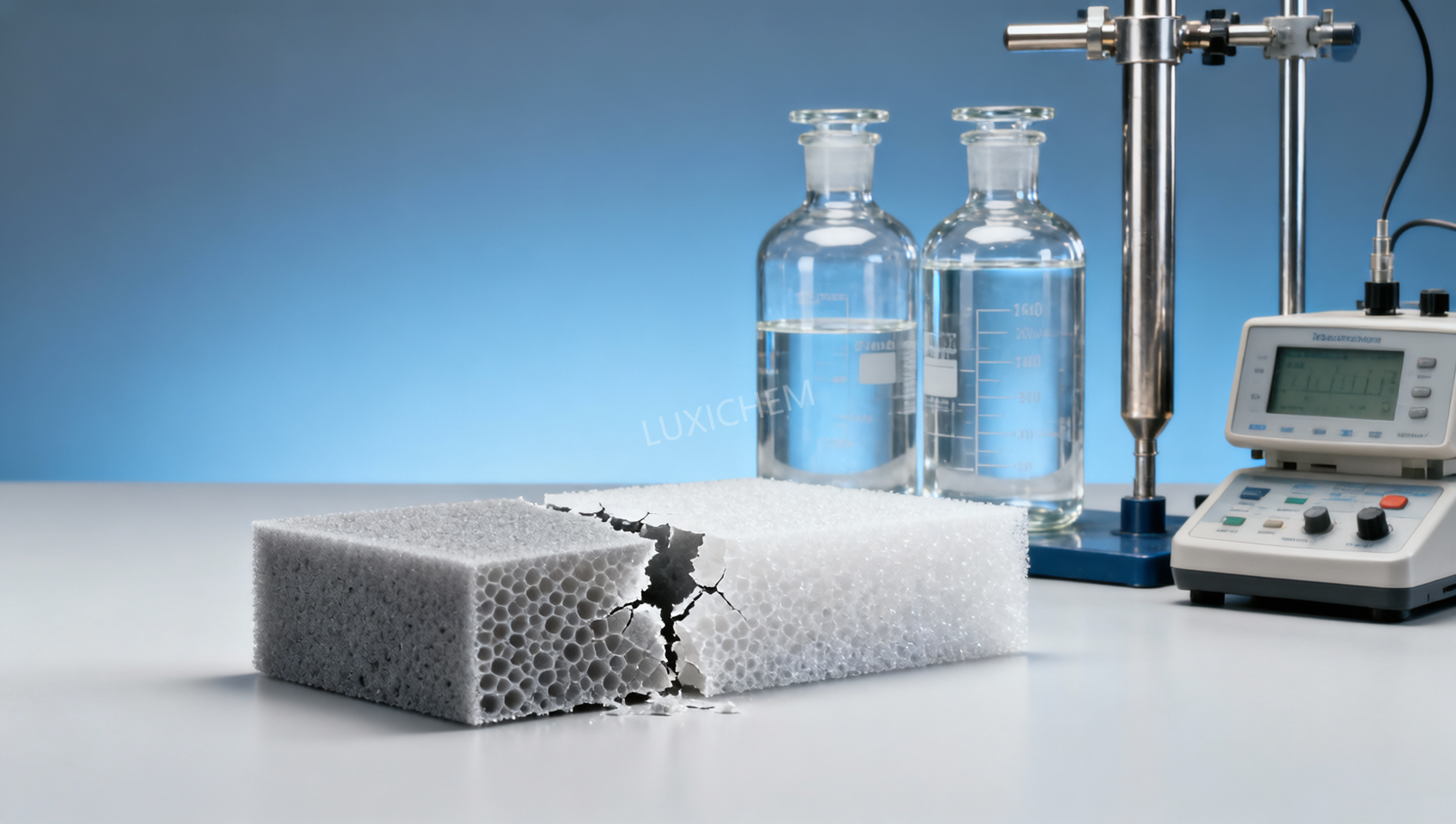
Brittle cells are one of the more frustrating defects in rigid polyurethane foam because the problem is often visible only after the foam has risen, cured, or been cut. The foam may look acceptable at first, then crack at the edges, crumble under finger pressure, show weak cell walls, or lose dimensional stability during handling. In insulation panels, pipe sections, appliance foam, and spray applications, these defects can affect both mechanical performance and thermal consistency.
When working with polyester polyol for rigid foam, brittle cell structure is rarely caused by one raw material alone. It usually comes from an imbalance between the resin system, isocyanate, catalyst package, blowing process, temperature, and mixing conditions. Operators get faster results when they treat brittleness as a reaction-and-processing problem rather than simply increasing or decreasing one component.
The most useful first distinction is this: a foam can be globally too hard, locally brittle, or physically weak because its cells have ruptured. Those conditions can look similar, but they do not always have the same cause. A hard foam with fine, intact cells may point to excessive crosslinking. A friable foam with torn cells may be more closely related to poor mixing, unstable blowing, moisture, or inadequate cure control.
What “brittle cells” usually look like in production
Rigid foam cells should form a reasonably uniform structure that can support the pressure generated during expansion and then remain stable through curing. When cell walls are too thin, too highly crosslinked, poorly developed, or damaged during rise, the foam becomes fragile. Operators may notice cracking near mold corners, powdery cut surfaces, collapse after demolding, uneven density through the thickness, or a sharp increase in breakage during trimming.
Cell brittleness should not be confused with an intentionally high-density, high-compressive-strength formulation. A properly designed rigid foam can be firm without being fragile. The concern begins when the foam fails unexpectedly under ordinary handling or when its structure becomes inconsistent from one batch to another.
A simple practical check is to compare the center and skin of a freshly cut sample. If the outer surface is hard but the interior tears or powders easily, the issue may involve heat transfer, cure rate, or expansion behavior. If both skin and core are glassy and crack-prone, formulation hardness and excessive network formation deserve closer attention.
The role of polyester polyol in cell strength
Polyester polyols are widely selected for rigid polyurethane systems where adhesion, chemical resistance, flame-retardant formulation flexibility, and mechanical properties matter. Their molecular structure, hydroxyl number, functionality, acid value, water content, and viscosity all influence how the polyurethane network forms. A change in any of these properties can alter the balance between flow, gas generation, gelation, and final cell-wall strength.
Higher functionality or a higher effective crosslink density can make the cured network stiffer. That can be useful up to a point, but it also reduces the foam’s ability to absorb stress during rise, cooling, cutting, or thermal cycling. If the polyester polyol for rigid foam is paired with a highly reactive isocyanate index or an aggressive catalyst package, the result may be a foam that gels too quickly and becomes brittle rather than resiliently rigid.
Viscosity matters as well. A high-viscosity polyol blend may be harder to mix evenly, especially where equipment shear is limited or component temperatures fluctuate. Poor dispersion can create local regions with different stoichiometry or catalyst concentration. Those local variations are often where fragile cells, voids, or cracking begin.
Acid value should also be reviewed when a new polyester polyol lot or supplier is introduced. Residual acidity can influence catalyst behavior and storage stability of the formulated polyol side. It does not automatically cause brittle foam, but a change in acid value can be relevant when reaction timing becomes less predictable.
Moisture: a common cause that is easy to underestimate
Water reacts with isocyanate to generate carbon dioxide, so even small and unintended moisture changes can disturb the blowing balance. In rigid foam production, moisture may enter through the polyol, additives, fillers, poorly sealed drums, humid air, contaminated transfer lines, or cleaning practices. The effect is not always obvious at the mixing stage.
Excess water can accelerate gas formation before the polymer matrix has developed enough strength to contain it. Cells may overexpand, coalesce, rupture, or become irregular. In some cases, the foam later feels brittle because thin or damaged cell walls cannot withstand handling. In other cases, excess urea formation from the water-isocyanate reaction makes the structure excessively hard and less forgiving.
The right response is not to make a blind correction to catalyst or isocyanate level. Confirm the water content of the polyol premix and investigate the material-handling path. Check drum closure, nitrogen blanketing where used, desiccant condition, line dead legs, and whether raw materials have been exposed during shift changes. A moisture trend is often more informative than one isolated test result.
Gelation and blowing must stay in step
A rigid foam needs two reactions to remain balanced: blowing creates the cellular structure, while gelation creates the polymer framework that holds it in place. If blowing is too fast relative to gelation, cells can expand beyond what the forming network can support. If gelation is too fast, the foam may lock up before it has expanded uniformly, creating internal stress and a brittle, uneven morphology.
Catalyst balance is central here. Amine catalysts commonly influence blowing and urethane formation, while organometallic catalysts can strongly affect gelation, depending on the system. Exact behavior depends on the formulation, so operators should avoid assuming that “more catalyst” will solve slow rise or poor strength. A faster reaction can make a defect worse if it narrows the processing window.
Useful observations include cream time, rise profile, tack-free behavior, core temperature, and demolding condition. If brittleness appears after a catalyst adjustment, compare these process observations with a known-good batch. A major shift in timing often reveals more than a final density measurement alone.
Isocyanate index and over-crosslinking
A high isocyanate index can increase hardness and may be used deliberately for certain performance targets. However, excessive index or inaccurate component ratio can produce an over-crosslinked structure. The foam may become dark, stiff, prone to cracking, or difficult to cut cleanly. The surface can be deceptively strong while the internal cells remain fragile.
Before changing the formulation, verify equipment calibration. Metering pump drift, pressure imbalance, worn seals, partial line blockage, or inaccurate density settings can shift the actual ratio even when the batch sheet is correct. This is particularly important on high-output lines, where small ratio errors can persist long enough to create a large quantity of off-spec foam.
It is also worth reviewing whether a polyol-side change has altered the effective hydroxyl content of the blend. A substitution that seems minor by weight can still change stoichiometry. Any reformulation should be assessed through the complete equivalent-weight calculation, not by volume or appearance alone.
Blowing agent compatibility and cell-opening effects
Physical blowing agents, water, surfactants, and the polyester polyol phase must remain compatible long enough for controlled nucleation and rise. Poor compatibility can create uneven gas distribution, large cells, voids, or localized collapse. These structural defects can later be interpreted as brittleness because the foam breaks along weak regions.
Silicone surfactants are especially important for stabilizing the cell structure. An unsuitable surfactant, an incorrect dosage, or a change in the polyol blend can reduce stabilization. Too little stabilization may allow cell coalescence; too much or an incompatible type may interfere with the intended morphology. The answer is formulation-specific, so screening should be done with controlled adjustments rather than multiple simultaneous changes.
Temperature affects compatibility too. Cold raw materials raise viscosity and may worsen mixing. Excessively warm components can shorten reaction time and increase volatility-related instability. Maintain component temperatures within the range established for the system, and record actual temperatures at the machine rather than relying only on storage-room readings.
Mixing problems often create local brittle zones
Even a sound formulation can produce poor foam if mixing energy, residence time, or component delivery is inconsistent. Inadequate mixing leaves local pockets that are rich in isocyanate, polyol, catalyst, or blowing agent. The resulting foam may have an acceptable average density while still containing brittle streaks or weak areas.
Check mixing-head cleanliness, nozzle condition, recirculation stability, pressure balance, and shot consistency. Deposits at the mixing head can change flow patterns gradually, which is why a defect may become worse across a shift rather than appearing suddenly. For batch blending, verify agitation effectiveness and the sequence in which catalysts, surfactants, blowing agents, and fillers are introduced.
Do not overlook filler dispersion where mineral fillers or flame-retardant packages are used. Agglomerates can act as stress concentrators and disrupt cell growth. Their presence does not prove that the polyester polyol is unsuitable; it may simply indicate that the premix needs better dispersion control.
A practical troubleshooting sequence
When brittle cells appear, changing several variables at once makes diagnosis difficult. A more disciplined sequence helps identify whether the issue is raw-material related, formulation related, or caused by equipment and environment.
- Keep a retained sample of the last acceptable polyol premix and compare it with the current batch where possible.
- Confirm raw-material temperatures, polyol viscosity, and water content before adjusting catalysts.
- Verify isocyanate-to-polyol ratio using actual machine output, not only the setpoint.
- Review rise time, gel time, foam core temperature, and demolding timing for any meaningful shift.
- Inspect the mixing head, filters, hoses, and recirculation loop before concluding that a raw material has failed.
- Make one controlled change, then assess cell appearance, density distribution, strength, and dimensional behavior after full cure.
The full cure period matters. Foam judged too early can seem brittle simply because it has not reached a stable state, while some internal stresses become clearer only after the part cools. The correct assessment timing should follow the product’s own process requirements.
Raw-material control beyond the foam line
Stable foam production depends on disciplined control of every formulation input, including materials that are not part of the polyurethane reaction itself. In broader chemical manufacturing, buffering agents are used to control pH-sensitive processes and reduce sudden formulation shifts. For example, Sodium metaphosphate CAS#10361-03-2 is used in chemical formulations and industrial processes where buffering capacity and process stability are relevant. It is not a direct substitute for a polyurethane catalyst, surfactant, or polyol component, but it illustrates why chemical compatibility and controlled handling must be assessed by application rather than by a generic “stabilizer” label.
For a foam operation, the same principle applies: each input should have a defined function, storage condition, quality check, and approved addition route. Introducing an unfamiliar chemical to correct brittleness without formulation validation can create more serious issues, including altered reactivity, contamination, or non-compliance with the finished product’s requirements.
Choosing the right next step
If a brittle-cell defect follows a raw-material change, start with the polyester polyol certificate of analysis, retained sample comparison, storage history, and blend calculations. If it appears intermittently on the same formulation, focus first on moisture exposure, machine ratio, mixing-head performance, and temperature variation. If it occurs consistently after a formulation adjustment, examine catalyst balance, isocyanate index, surfactant selection, and blowing-agent compatibility.
Luxi Chemical (Shandong) Co., Ltd. supplies chemical raw materials and related trading services to customers in more than 60 countries and regions. For users managing multi-material procurement, consistent documentation, suitable storage guidance, and clear communication on application requirements can be as valuable as the material itself. Where a rigid foam system is concerned, share the intended process, current defect pattern, component temperatures, and relevant polyol specifications before selecting a corrective path. That information usually narrows the investigation far more effectively than trial-and-error changes on the production line.
Related Picks
 Butylated Hydroxytoluene Price Drivers: Supply, Purity, and Purchasing Risk FactorsOct 21, 2026Butylated Hydroxytoluene price trends depend on supply stability, purity, logistics, and purchasing risk. Learn how to compare quotes wisely and reduce sourcing costs.
 Sodium Tripolyphosphate Price Trends: Raw Material and Energy ExposureOct 20, 2026Explore sodium tripolyphosphate price trends, from phosphate and soda ash costs to energy exposure. Learn how to compare quotes, manage sourcing risks, and make smarter purchasing decisions.
 Acetonitrile Shipment to Vietnam Successfully Dispatched; RCEP Benefits Boost Fine Chemical Trade with ASEANSep 16, 2026A shipment of industrial-grade acetonitrile from our company has recently been loaded and dispatched following the completion of standardized hazardous material packaging and container securing procedures.
 Nigerian Client’s Order of 4 Containers of Vinyl Acetate Successfully Loaded and Shipped to West AfricaSep 16, 2026We recently completed the loading of a vinyl acetate order for a Nigerian client; four containers of the product have been successfully packed and are ready for shipment to Nigeria.




Question Consultation
Send Us Your Inquiry Today

Luxi Chemical is a professional chemical product supplier with ample stock of all chemical categories and excellent quality, welcome your purchase inquiry.

