


How processing temperature affects polyvinyl chloride extrusion quality
How Processing Temperature Affects Polyvinyl Chloride Extrusion Quality
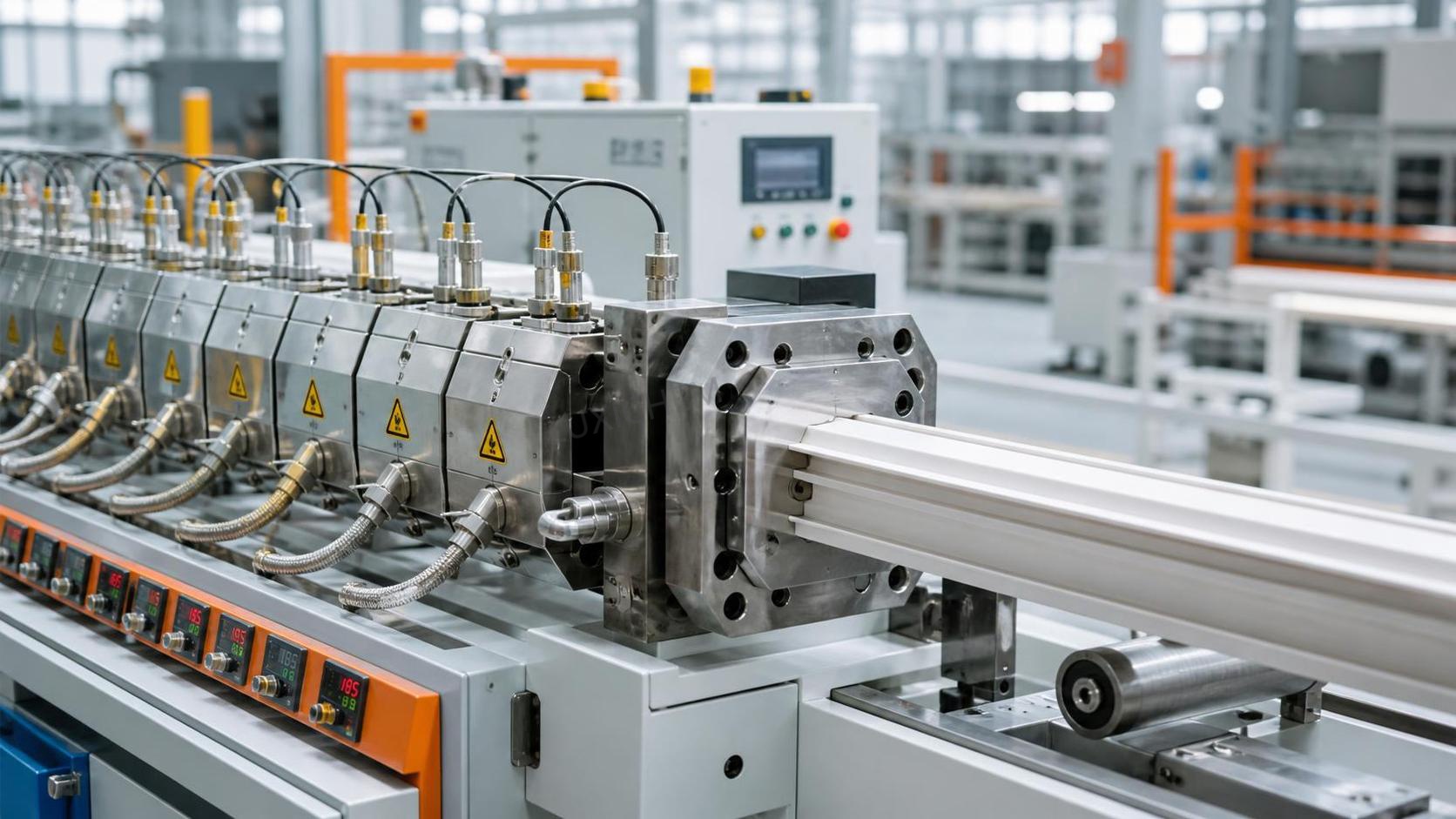
Processing temperature is one of the few extrusion settings that can change several quality outcomes at once. A small adjustment may improve surface gloss, then unexpectedly alter die swell, puller stability, impact performance, or color. That is why Polyvinyl chloride extrusion should not be managed by watching one barrel-zone number in isolation. The practical question is whether the compound reaches the die in a sufficiently fused, uniform, and thermally stable condition.
PVC is less forgiving than many common thermoplastics. It does not have a wide processing window between “not fused enough” and “starting to degrade.” The operator is therefore balancing heat, shear, residence time, screw speed, formulation, and cooling. A profile that works well for a rigid window profile may be unsuitable for a soft hose, conduit, sheet, or foam board, even if the base resin grade appears similar.
In day-to-day production, temperature control is not about chasing the highest throughput. It is about holding a stable melt condition long enough for the die and downstream equipment to do their jobs consistently. When that condition is lost, scrap often appears first as a visual issue, but the cause may be deeper inside the barrel.
Why PVC Has a Narrow Thermal Processing Margin
PVC compounds are formulated with stabilizers, lubricants, impact modifiers, fillers, processing aids, pigments, and other ingredients selected for a particular product. These additives broaden processability, but they do not eliminate sensitivity to excessive heat history. If the material receives too much heat from barrel heaters, screw shear, or prolonged residence time, degradation can begin. The usual early warning is a cream, yellow, or brown color shift. Depending on the compound and severity, the melt may also generate fumes, rough deposits, black specks, or an acrid odor.
At the other end of the range, low temperature can leave the PVC insufficiently fused. The extrudate may look dull or grainy, show weak knit lines, exhibit poor impact behavior, or fluctuate in dimension as the melt enters the die unevenly. Raising a barrel setpoint can help, but it is not always the correct answer. A cold-looking product can also come from poor dry blend quality, inadequate feed, insufficient screw work, a restrictive screen pack, or a die section that is losing heat.
This is the central operating principle: the controller display is a target, not the actual melt condition. The real process includes material temperature, shear heating, pressure, torque, residence time, and the temperature of the metal surfaces contacting the compound.
What Each Extrusion Zone Actually Influences
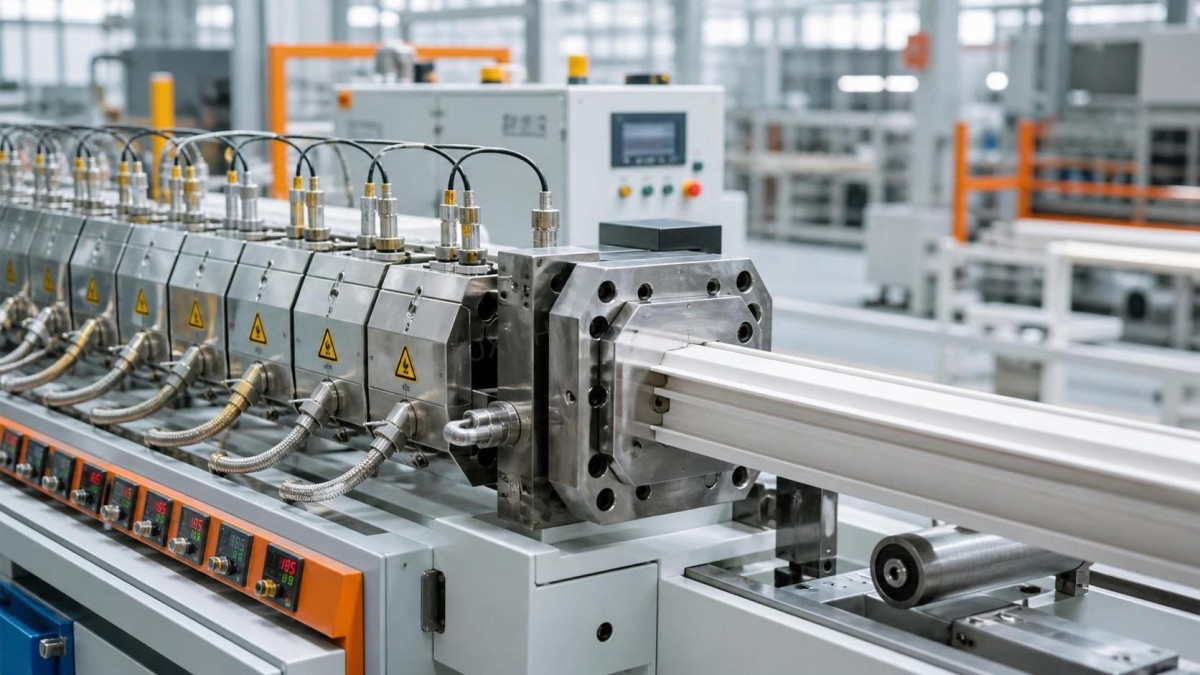
A typical PVC extruder uses several barrel zones, an adapter, and one or more die zones. Their roles overlap, so operators should avoid treating every zone as a separate “fix button.” A change in one area can move the balance elsewhere.
- Feed zone: This area needs enough control to prevent bridging and unstable feeding, but excessive heat can make dry blend sticky before it is properly conveyed. In rigid PVC processing, a feed zone that runs too warm can contribute to surging or irregular solids transport.
- Compression and transition zones: Here the compound begins to consolidate and fuse under both heat and mechanical work. If these zones are too cool, fusion may be incomplete. If they are too hot, the compound can receive damaging heat before it reaches the die.
- Metering zone: The objective is a uniform melt with predictable pressure and flow. Temperature instability here often shows up as variable output, uneven wall thickness, or inconsistent surface appearance.
- Adapter and die: These zones influence how smoothly the melt is distributed and how quickly it relaxes after leaving the die. A cold die can create drag marks or poor surface finish; an overheated die can worsen sag, dimensional drift, and thermal discoloration.
For twin-screw rigid PVC lines, shear generated by the screws is often a major part of the heat input. It is common to see a situation where a higher screw speed raises melt temperature even though barrel-zone setpoints have not changed. For that reason, a speed increase should be treated as a thermal change as well as a production-rate change.
Symptoms That Point to Temperature Problems
The most useful troubleshooting starts with the defect itself. Operators sometimes change several temperatures, the screw speed, and the haul-off setting together. That may get the line running again, but it also removes the evidence needed to identify the cause. When possible, make one controlled adjustment and observe pressure, motor load, output, product appearance, and downstream behavior.
A yellow streak does not automatically mean every zone should be lowered. If a line has just restarted after a pause, material held in an adapter or die may have experienced a much longer residence time than the material currently moving through the screw. In that situation, purging and checking for stagnant areas may matter more than changing the entire profile.
Low Temperature: The Hidden Cost of Incomplete Fusion
Running cold can appear safe because it reduces the immediate risk of discoloration. Yet under-fused PVC can create quality problems that are not obvious at the die. Rigid profiles may have weak corners or inconsistent impact resistance. Pipe may show poor surface finish, uneven wall distribution, or difficulty holding dimensions through vacuum calibration. In some cases, the output feels manageable until a downstream cutting, drilling, bending, or assembly step exposes the weakness.
The temptation is to raise all zones by the same amount. A more disciplined approach is to ask where fusion is being lost. If the pressure is low and the surface is dry, a moderate change in the zone responsible for consolidation may be more useful than heating the die. If the melt appears reasonably fused but exits with drag lines, the die zone or die condition may deserve attention instead. The adjustment should be followed by enough time for the barrel and die to stabilize; reacting to the first minute of output often leads to overcorrection.
When More Heat Creates More Defects
Overheating does not always look dramatic at first. A profile may become glossier and easier to pull, which can make the adjustment seem successful. Then output begins to drift, the product sags before calibration, color changes gradually, or die deposits increase over a longer run. PVC degradation is often a heat-history issue rather than a single temperature spike.
This is especially relevant during low-output production, planned pauses, and startup after maintenance. With less material moving through the equipment, residence time increases. A profile that is acceptable at normal output can become too severe when the line is slowed. If production must pause, the operating procedure should define whether the screw continues at a low rate, whether heaters are reduced, and how the equipment is purged before restart. The right procedure depends on the formulation and equipment design, so it should be verified against the compound supplier’s guidance and the plant’s established process limits.
Temperature Control Begins Before the Extruder
Stable extrusion starts with stable incoming material. Changes in resin characteristics, filler level, moisture exposure, particle distribution, packaging condition, or dry blend aging can alter how the compound accepts heat and shear. If a long-running temperature profile suddenly stops working after a material change, it is worth checking the material release information before assuming that the machine is at fault.
For chemical operations that handle multiple raw materials, basic analytical control is part of practical process discipline. Some laboratories use reagents such as Ammonium Molybdate CAS#13106-76-8 for phosphorus-related quantitative analysis and other chemical testing applications. It is not a PVC extrusion additive, and it should not be presented as one. Its relevance is the broader point: reliable production depends on knowing what is entering the process and using suitable methods to verify it.
Luxi Chemical (Shandong) Co., Ltd. works across chemical raw materials, chemical products, and international trade, serving customers in sectors including agriculture, food processing, and daily chemicals. In cross-border supply, consistency of product documentation, packaging condition, storage expectations, and communication about handling can be as important as the nominal product name. For a PVC processor, that same mindset helps prevent a formulation or handling variation from becoming an apparent “temperature problem” on the shop floor.
A More Reliable Adjustment Routine
When quality moves out of specification, begin with the process record rather than memory. Compare the current run with the last stable run: barrel and die temperatures, screw speed, motor load, melt pressure, output rate, ambient conditions where relevant, cooling settings, and material lot. A trend is more useful than a single reading. Rising pressure paired with increasing motor load suggests a different problem from falling pressure with repeated output surges.
Then inspect the basics that are easy to overlook: thermocouple placement, loose heater bands, cooling fan operation, controller tuning, feeder consistency, and buildup in the die. A displayed temperature can be stable while the actual metal temperature near the melt channel is not. Likewise, a clean-looking die may still contain a deposit in a low-flow section that holds material too long.
Make changes in small, traceable steps and allow the system to respond. If increasing output is the goal, do not raise screw speed and all temperature zones at once. Increase speed cautiously, watch melt pressure and product behavior, then determine whether a local temperature adjustment is genuinely needed. This takes longer than broad trial-and-error, but it reduces scrap and produces settings that can be repeated by the next shift.
The Best Profile Is the One That Stays Stable
There is no universal “correct” PVC extrusion temperature profile. The workable profile depends on resin type, compound formulation, screw configuration, die geometry, target output, and the finished product’s dimensional and mechanical requirements. A number copied from another line may be a useful starting point, but it is not proof that the process is under control.
Good operators read the whole line: color, gloss, pressure, torque, calibration behavior, cooling response, and the condition of the product after it has had time to settle. When those signals agree, temperature is doing its job. When they conflict, the answer is rarely just “turn it up” or “turn it down.”
Related Picks
 Butylated Hydroxytoluene Price Drivers: Supply, Purity, and Purchasing Risk FactorsOct 21, 2026Butylated Hydroxytoluene price trends depend on supply stability, purity, logistics, and purchasing risk. Learn how to compare quotes wisely and reduce sourcing costs.
 Sodium Tripolyphosphate Price Trends: Raw Material and Energy ExposureOct 20, 2026Explore sodium tripolyphosphate price trends, from phosphate and soda ash costs to energy exposure. Learn how to compare quotes, manage sourcing risks, and make smarter purchasing decisions.
 Acetonitrile Shipment to Vietnam Successfully Dispatched; RCEP Benefits Boost Fine Chemical Trade with ASEANSep 16, 2026A shipment of industrial-grade acetonitrile from our company has recently been loaded and dispatched following the completion of standardized hazardous material packaging and container securing procedures.
 Nigerian Client’s Order of 4 Containers of Vinyl Acetate Successfully Loaded and Shipped to West AfricaSep 16, 2026We recently completed the loading of a vinyl acetate order for a Nigerian client; four containers of the product have been successfully packed and are ready for shipment to Nigeria.




Question Consultation
Send Us Your Inquiry Today

Luxi Chemical is a professional chemical product supplier with ample stock of all chemical categories and excellent quality, welcome your purchase inquiry.

