


When does ferrovanadium grade affect steelmaking performance?
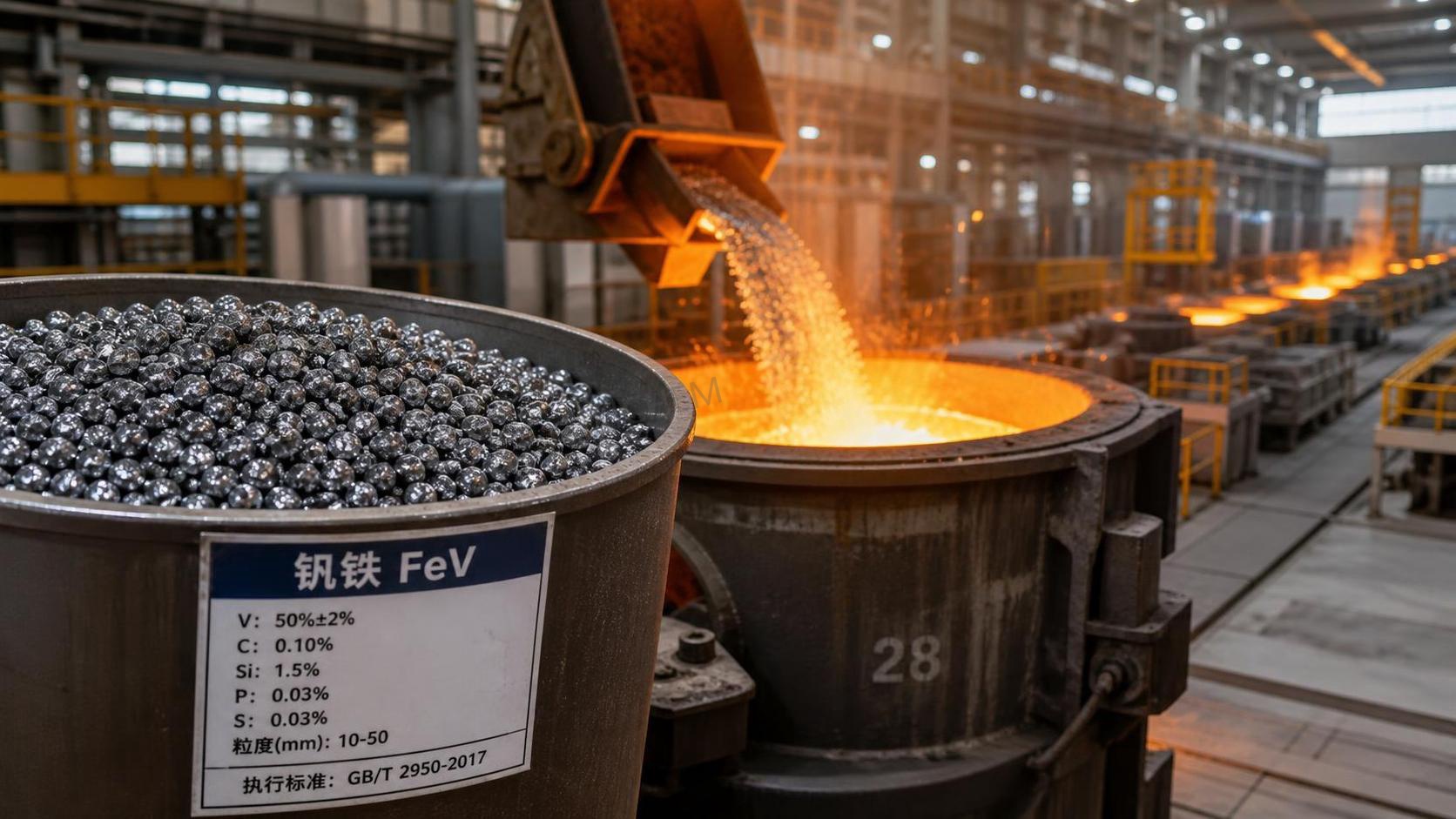
Ferrovanadium grade affects steelmaking performance when the steel specification is sensitive not only to final vanadium content, but also to the alloy’s recovery, impurity contribution, addition practice, and batch-to-batch consistency. In relatively forgiving applications, a grade change may have little visible effect if the required vanadium level is reached. In high-strength structural steel, microalloyed plate, line pipe, rail, tool steel, or weld-critical fabrications, the same change can alter process stability and increase the risk of failing mechanical-property or cleanliness requirements.
The key point is that ferrovanadium is not selected simply by comparing its quoted vanadium percentage. A higher-vanadium alloy is not automatically the better choice, and a lower-cost grade is not necessarily equivalent after melt losses, chemistry corrections, furnace time, and quality risk are considered. Grade matters most where the steelmaking route has limited tolerance for residual elements or where narrow property windows must be achieved repeatedly.
Why vanadium addition has a disproportionate effect in some steels
Vanadium is used primarily as a microalloying element. In appropriate steel compositions and thermal cycles, it can contribute to precipitation strengthening, grain refinement, and improved strength-to-weight performance. Its effect depends on interactions with carbon, nitrogen, titanium, niobium, manganese, aluminum, and the rolling or heat-treatment schedule. The alloy addition therefore sits inside a larger metallurgical system rather than functioning as an isolated strength enhancer.
Small variations in vanadium can matter because many specifications use relatively low target additions. When the intended dissolved or recoverable vanadium content is limited, inaccurate addition can shift the chemistry outside a narrow control range. Excess vanadium may create an avoidable cost burden or complicate the intended property balance; insufficient recovery can leave yield strength, hardness, temper resistance, or grain-control performance below target.
Grade selection becomes particularly consequential when a project requires repeatable properties across multiple heats, production sites, or steel suppliers. A single heat can sometimes be corrected through additional alloying or process adjustment. Repeated variation, however, consumes process margin and makes delivery performance dependent on corrective action rather than controlled input quality.
What “grade” should mean in a ferrovanadium purchase decision
Commercial Ferrovanadium grades are commonly distinguished by vanadium content and by limits on accompanying elements. The nominal vanadium percentage is important because it determines alloy addition mass and influences freight, handling, inventory, and dosing calculations. Yet it is only the beginning of the specification.
For steelmaking purposes, grade should be assessed through the complete certificate-of-analysis framework:
- Guaranteed vanadium range and the allowed variation between lots;
- Carbon, silicon, aluminum, phosphorus, sulfur, and other residual-element limits;
- Iron balance and any trace constituents relevant to the melt chemistry;
- Particle-size distribution, lump integrity, fines level, and packaging condition;
- Moisture and contamination controls where alloy handling or automated feeding is involved;
- Analytical method, sampling basis, certificate format, and traceability to the production lot.
Two products with a similar stated vanadium content can perform differently if their impurity profiles, size distribution, or analytical reliability are different. A procurement document that asks only for “ferrovanadium, minimum V content” leaves substantial room for material that meets the headline requirement but creates problems in the melt shop.
When vanadium content itself changes the operating decision
Higher-content grades reduce the physical mass required to add a given amount of vanadium. That can be valuable where charge-bucket space is constrained, alloy additions are made in small accurately weighed quantities, or transport and storage of alloying materials must be minimized. It can also simplify inventory because less material is handled per heat.
However, the higher-content option must be compatible with the plant’s addition system. If the alloy is added manually in small quantities, more concentrated material can improve dosing efficiency but may make a weighing error more significant. In automated systems, the feeder’s accuracy and the particle-size range must be validated for the selected product. A grade that bridges, segregates, or generates excessive fines can undermine the expected benefit of a more concentrated alloy.
Lower-content Ferrovanadium may be workable when large additions are needed, melt-shop practice can tolerate additional iron units, and the residual-element profile is acceptable. It may also offer more practical control in a process with less precise dosing equipment. The decision should not be based on the purchase price per tonne. The relevant comparison is the delivered cost per recoverable kilogram of vanadium, adjusted for alloy yield, added impurity load, handling losses, and any process changes needed to use the material.
Impurity limits matter when the steel has little chemistry margin
Carbon is one of the most important grade-related considerations. In some steel families, the carbon introduced through ferroalloys is negligible compared with the overall carbon target. In low-carbon, low-alloy, weldable, or tightly controlled steel grades, it may not be negligible. If the melt is close to its maximum carbon limit, a higher-carbon ferrovanadium grade can remove the flexibility needed for final trimming.
The practical consequence is not merely a laboratory nonconformance. Carbon control may affect weldability, heat-affected-zone behavior, toughness, or the ability to meet customer limits on carbon equivalent. Where welded structures operate under cyclic loads, low-temperature service, or pressure containment conditions, an apparently minor alloy-selection shortcut can create a material qualification issue downstream.
Silicon, aluminum, phosphorus, and sulfur deserve similar attention, although their importance varies by steel type and process route. Silicon and aluminum can interact with deoxidation practice and inclusion control. Phosphorus and sulfur are generally restricted in applications demanding toughness, formability, or fatigue performance. The allowable contribution from any individual ferroalloy must be evaluated against the complete alloy package, scrap chemistry, pig iron or DRI input, and expected process losses.
A useful question is not “Does this ferrovanadium meet its own published limits?” but “Can its maximum impurity contribution be accepted when all other charge materials are at their permitted upper limits?” This worst-case charge calculation is especially important for contracts requiring consistent supply over extended production campaigns.
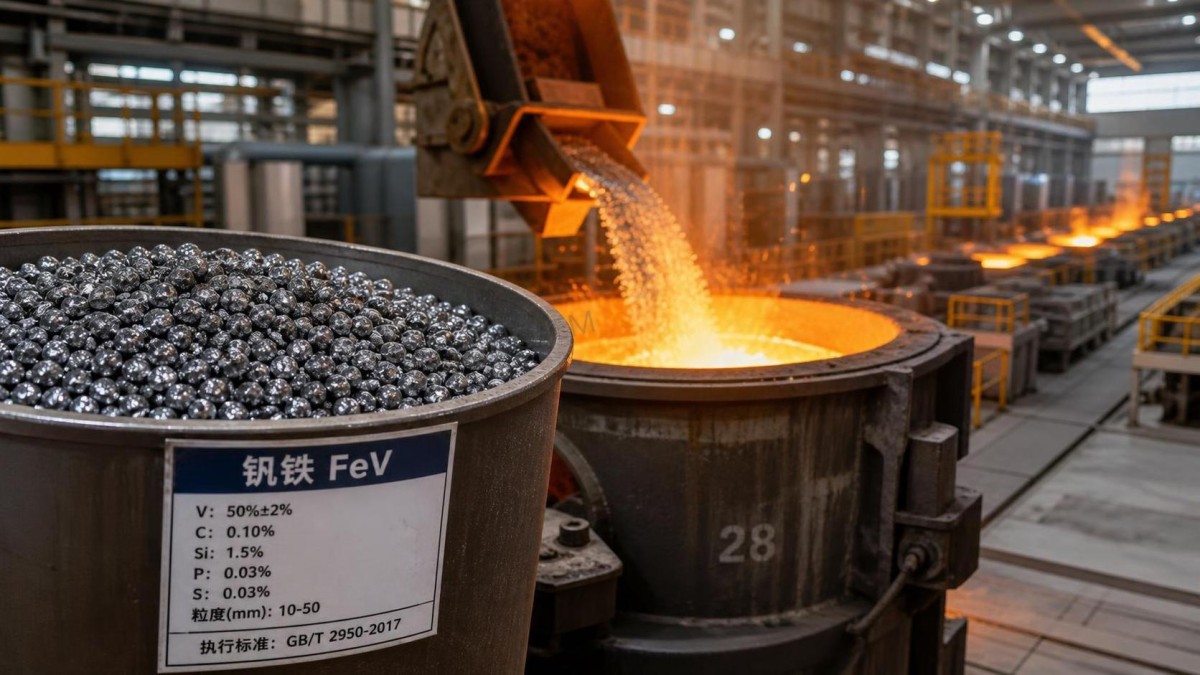
Recovery and dissolution are often more important than nominal chemistry
Ferrovanadium can be added at different stages depending on the furnace route, steel grade, and plant operating practice. The timing affects oxidation loss, dissolution, inclusion behavior, temperature requirements, and the ability to make final chemistry corrections. A grade that works adequately in one addition practice may be unsuitable in another.
If the alloy is added too early in an oxidizing stage, vanadium recovery may be reduced. If it is added too late or into conditions with inadequate mixing, undissolved particles or uneven distribution can become a concern. Ladle metallurgy is often used to improve control, but the actual outcome still depends on temperature, stirring energy, slag condition, and alloy form.
Particle size is therefore an operational parameter, not only a packaging detail. Oversized lumps may dissolve slowly in a short treatment window. Excessive fines can oxidize more readily, escape during handling, accumulate in feeders, or create inconsistent dosing. Segregation within bags or bulk containers can also cause the first and last portions of a lot to have different effective addition behavior.
Specifications should state the acceptable size range and, where relevant, establish limits on fines. For projects with remote or variable site handling, packaging durability matters as well. Water ingress, torn bags, and repeated transfer between warehouses can change the usable particle distribution before the alloy reaches the furnace floor.
Steel performance is shaped by the intended processing route
The same vanadium target does not have identical consequences in every steel product. In hot-rolled microalloyed structural sections or plate, vanadium’s contribution depends heavily on reheating, rolling reduction, finish-rolling temperature, cooling rate, and coiling conditions. If the rolling schedule does not support the intended precipitation behavior, increasing alloy quality alone will not deliver the expected strength.
In quenched-and-tempered or alloy engineering steels, vanadium may be selected for hardenability-related balance, temper resistance, grain control, or carbide effects. Here, interactions with chromium, molybdenum, manganese, and heat-treatment practice are central. A grade that introduces excessive carbon or undesirable residuals can be more problematic than its nominal vanadium content suggests.
For weldable high-strength steels, the target is frequently a balance rather than the maximum attainable strength. Higher strength can be useful only if toughness, ductility, formability, and welding performance remain within specification. Ferrovanadium selection should consequently be linked to the approved steelmaking and rolling route, not handled as an isolated purchasing substitution.
Where grade substitution creates hidden project risk
Substituting ferrovanadium during an active production schedule may appear straightforward when the replacement certificate shows equal or higher vanadium content. That conclusion is incomplete. A change in carbon limit, particle size, lot consistency, or recovery behavior can force new melt-shop settings, revised addition calculations, or additional laboratory verification.
The risk is greatest when production is tied to prequalified material grades, customer-specific approval regimes, or fabrication schedules that leave little room for repeat heats. A substitution can also create documentation issues if the material certificate does not provide the traceability or impurity reporting required by the steel producer’s quality system.
The technically sound approach is to treat a material change as a controlled metallurgical change. Compare the new grade against the approved alloy not only at typical values but also at contractual maximum and minimum values. Confirm the effect on charge calculations, process instructions, final chemistry windows, and any testing obligations. If the replacement requires a different alloy addition point or feeding practice, it should not be classified as a like-for-like procurement change.
Quality documentation should match the consequence of failure
For non-critical steelmaking, a standard mill certificate and incoming inspection may be sufficient. Higher-consequence applications need a stronger evidence chain: lot identification, representative sampling, verified analysis, retained certificates, and procedures for managing nonconforming material. The required rigor should be proportional to the cost of a chemistry excursion, a rejected coil, delayed fabrication, or a failed qualification test.
Incoming checks should focus on the parameters that could alter the approved melt practice. That may include vanadium assay, carbon, silicon, phosphorus, sulfur, size distribution, visible contamination, and bag condition. A certificate is valuable, but it does not replace verification when the material will be used in a narrow-margin steel grade or when a new supplier, route, or grade is being introduced.
Procurement systems also benefit from clear category separation. Chemical catalogs may contain unrelated materials used in food, pharmaceutical, or general processing supply chains, such as Magnesium Stearate CAS#557-04-0. Those products require entirely different quality, safety, and regulatory criteria from metallurgical alloys. Similar naming conventions or shared chemical-trade channels should never lead to combined specifications, interchangeable certificates, or diluted incoming-inspection controls.
A practical basis for selecting the grade
The right Ferrovanadium grade is the one that supports the approved steel chemistry and process route with the least total control burden. Begin with the steel specification: target vanadium, maximum residual limits, mechanical-property requirements, weldability expectations, and required product consistency. Then convert these requirements into alloy-specific limits rather than relying on a general commercial description.
Next, model the maximum impurity contribution from the alloy at the planned addition rate. This calculation should use the upper end of the supplier’s allowable impurity range, not only a representative analysis. Review whether the addition mass, particle-size distribution, and packaging suit the actual furnace or ladle operation. Finally, assess supplier capability in terms of lot consistency, certification, traceability, and continuity of the required grade.
Grade becomes less important when the steel chemistry has generous tolerance, the alloy addition is large enough to absorb ordinary variability, and the process can reliably correct final composition. It becomes decisive when vanadium additions are small and precise, residual limits are tight, welding or toughness performance is critical, or schedule pressure makes rework unacceptable. In those conditions, ferrovanadium should be specified as a controlled metallurgical input—not purchased as a commodity defined only by its vanadium percentage.
Related Picks
 Butylated Hydroxytoluene Price Drivers: Supply, Purity, and Purchasing Risk FactorsOct 21, 2026Butylated Hydroxytoluene price trends depend on supply stability, purity, logistics, and purchasing risk. Learn how to compare quotes wisely and reduce sourcing costs.
 Sodium Tripolyphosphate Price Trends: Raw Material and Energy ExposureOct 20, 2026Explore sodium tripolyphosphate price trends, from phosphate and soda ash costs to energy exposure. Learn how to compare quotes, manage sourcing risks, and make smarter purchasing decisions.
 Acetonitrile Shipment to Vietnam Successfully Dispatched; RCEP Benefits Boost Fine Chemical Trade with ASEANSep 16, 2026A shipment of industrial-grade acetonitrile from our company has recently been loaded and dispatched following the completion of standardized hazardous material packaging and container securing procedures.
 Nigerian Client’s Order of 4 Containers of Vinyl Acetate Successfully Loaded and Shipped to West AfricaSep 16, 2026We recently completed the loading of a vinyl acetate order for a Nigerian client; four containers of the product have been successfully packed and are ready for shipment to Nigeria.




Question Consultation
Send Us Your Inquiry Today

Luxi Chemical is a professional chemical product supplier with ample stock of all chemical categories and excellent quality, welcome your purchase inquiry.

