


How should glycidyl methacrylate be stored to limit degradation?
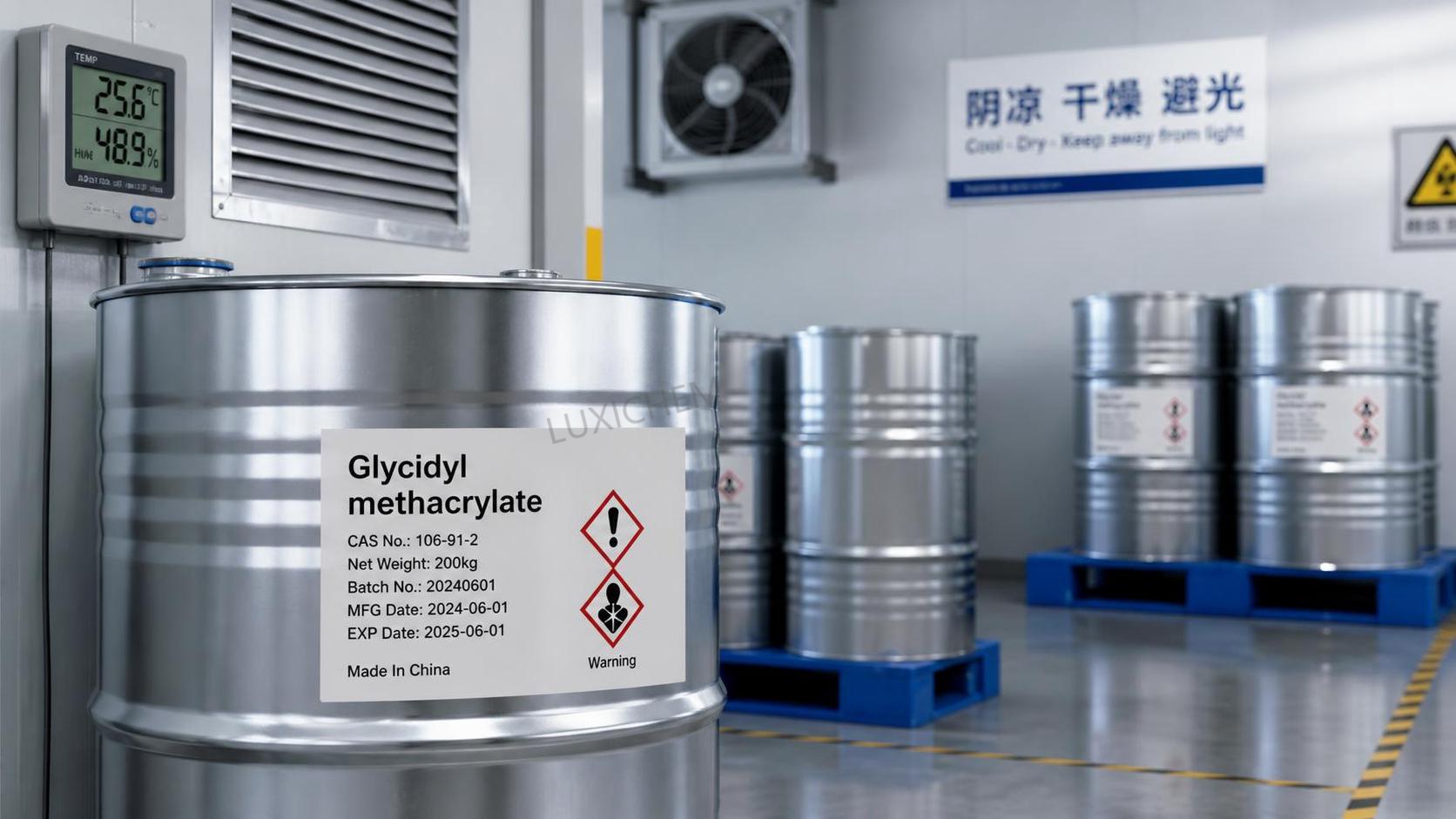
In a production room or laboratory, Glycidyl methacrylate may appear unchanged even after storage conditions have begun to reduce its useful life. A drum left near a warm wall, a partly used container opened repeatedly, or material transferred through poorly cleaned equipment can all increase the chance of premature polymerization, color change, viscosity rise, or loss of predictable reactivity.
To limit degradation, store Glycidyl methacrylate in its original, tightly closed container in a cool, dry, well-ventilated area away from direct sunlight, heat sources, moisture, oxidizing materials, strong acids, strong bases, and contamination. Follow the temperature range and inhibitor guidance on the supplier’s current safety data sheet and technical documentation. The practical goal is to keep the monomer cool, protected from light and air exposure, and free of substances that may initiate polymerization or react with the epoxide group.
Why storage control matters for this reactive monomer
Glycidyl methacrylate contains two reactive parts: a methacrylate double bond that can polymerize and an epoxide group that can react with nucleophiles, acids, bases, and moisture-related impurities. This combination makes it useful in coatings, adhesives, resin modification, polymer synthesis, and functional materials, but it also means storage conditions directly affect handling behavior.
Premature polymerization is often the most visible concern. As the material polymerizes, its viscosity may increase, stringy gel particles can appear, and the product may eventually become partially or fully solid. Even before obvious gelling occurs, small changes in composition can interfere with metering, mixing, curing consistency, or downstream molecular-weight control.
Heat, light, depleted inhibitor content, and contamination can accelerate this process. Water exposure may also affect product quality through epoxide-ring reactions. Because a container can look acceptable from the outside, routine storage discipline is more reliable than waiting for visible evidence of deterioration.
Set up the storage area before the material arrives
Storage begins with the room, not with the container. A suitable location should remain within the supplier-recommended temperature range and should not experience large daily swings. Repeated warming and cooling can cause condensation on containers, especially when cold material is moved into humid ambient air. Condensation may be drawn into an opened drum or introduced during transfer.
Choose a shaded area away from windows, roof heat, steam lines, furnaces, process vessels, and vehicle traffic that may expose containers to impact. Direct sunlight is undesirable even when the room itself seems cool, because local heating at the container surface may be much greater than the recorded room temperature.
- Keep containers away from ignition sources and follow site rules for flammable or combustible liquid storage where applicable.
- Maintain adequate ventilation so that vapors do not accumulate during receiving, sampling, or dispensing.
- Separate the material from oxidizers, peroxide-forming materials, strong acids, strong alkalis, amines, and other incompatible chemicals identified by the SDS.
- Use secondary containment appropriate to the package size and local operating requirements.
- Make sure temperature monitoring is meaningful: a sensor placed far from the storage zone may not reveal heat near a wall or loading door.
Do not assume that refrigeration is automatically safer. Some monomers have specific low-temperature storage limits, while excessive cooling can complicate dispensing, cause condensation during removal, or affect inhibitor performance. The approved temperature range for the exact grade and package should always take priority over a general rule such as “keep it as cold as possible.”
Protect the inhibitor system instead of treating it as an optional additive
Commercial grades of Glycidyl methacrylate are commonly stabilized with an inhibitor to slow unwanted polymerization during normal storage and transport. The inhibitor is part of the product’s stability design. It should not be removed, diluted unintentionally, or assumed to provide unlimited protection under poor conditions.
Problems can develop when operators transfer the monomer to a smaller vessel and leave behind part of the inhibitor distribution, blend it with another liquid without checking compatibility, or use a process step that strips stabilizing components. Long storage after repeated opening also creates uncertainty because air exchange, contamination, and temperature exposure are no longer controlled in the same way as an unopened package.
Before any operation intended to remove inhibitors, dry the material, distill it, or hold it at elevated temperature, review the process hazard assessment and the supplier’s technical guidance. Removing inhibitor may be necessary for certain specialized reactions, but it should be done only immediately before controlled use and with appropriate safeguards. A “cleaner” monomer is not necessarily a safer monomer to store.
Air exposure needs a balanced approach
Operators sometimes try to solve every stability concern by blanketing a container with inert gas. Whether this is appropriate depends on the specific grade, its inhibitor system, and supplier instructions. Some stabilized monomers rely on a controlled amount of oxygen for the inhibitor to function effectively. An oxygen-free headspace can therefore be unsuitable in certain cases. Do not introduce nitrogen or another inert gas as a routine practice unless the product documentation explicitly supports that approach.
The safer general practice is simpler: minimize unnecessary opening time, reseal the container promptly, use clean closed-transfer equipment where possible, and avoid changing the headspace atmosphere without a confirmed procedure.
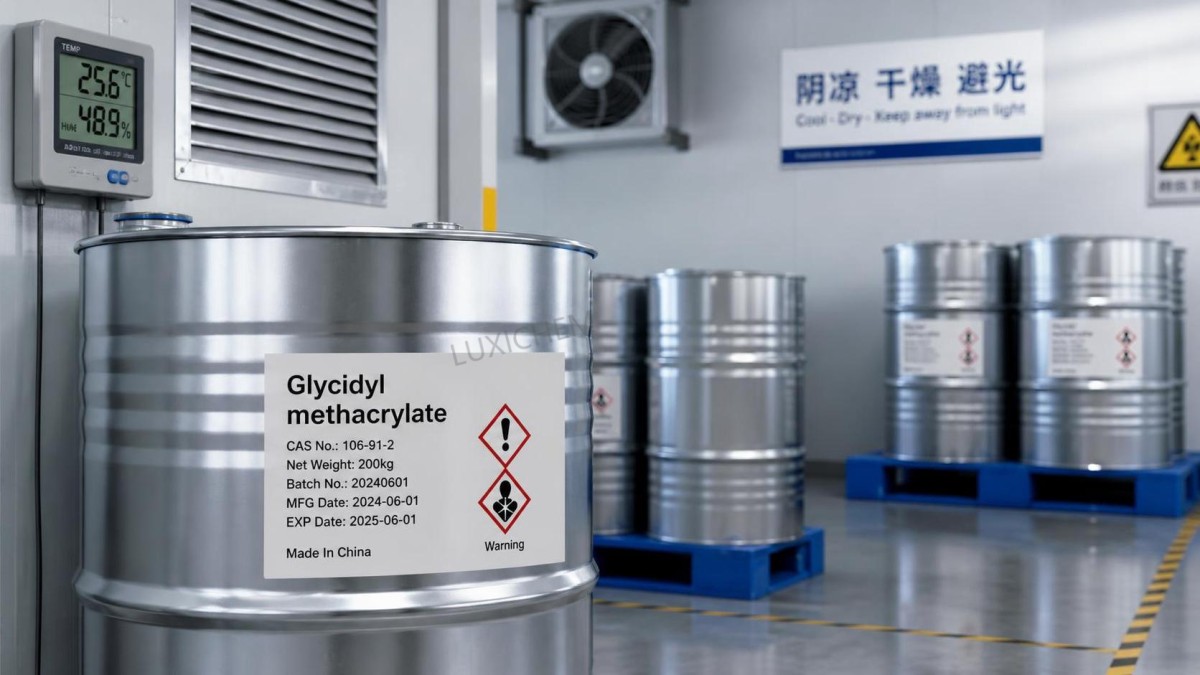
Handle partly used containers as a new storage risk
An unopened original package normally has the best chance of retaining its intended shelf life. Once opened, the material has encountered a different set of risks: humid air, airborne dust, residues from sampling tools, and repeated temperature changes. A partly used drum should not be managed as though it were still factory sealed.
When withdrawing material, use dedicated, dry, compatible equipment. Hoses, pumps, valves, funnels, and sample thieves should be inspected for residues from previous products. Even a small amount of reactive catalyst, amine-containing cleaner, acid residue, metal contamination, or partially cured resin can create quality problems. Avoid using improvised transfer tools that cannot be cleaned and dried consistently.
- Confirm the identity of the container before opening it, including batch information and the date it was first opened.
- Bring the material to a workable handling condition according to the approved temperature range; do not heat it aggressively to speed transfer.
- Use clean, dry, dedicated or verified-compatible transfer equipment.
- Take only the quantity needed for the operation rather than leaving a process vessel or open measure exposed.
- Close and secure the original container immediately after dispensing.
- Record the opening date, approximate remaining quantity, and any unusual appearance or handling observation.
For smaller working quantities, use only containers compatible with the chemical and suitable for the intended storage period. Relabel every secondary container clearly. The label should preserve the material identity, hazard information required by site practice, transfer date, and any shortened internal use-by date. Anonymous bottles are particularly hazardous with reactive monomers because operators cannot confirm stabilizer status, age, or prior exposure.
Watch for changes that deserve a hold decision
A routine visual check can detect obvious changes, but it cannot prove that the monomer remains within specification. Compare the product with the supplier’s stated appearance requirements and the condition recorded at receipt. Discoloration, haze, sediment, suspended particles, increased thickness, skin formation around a cap, or gel fragments are all reasons to stop routine use until the material is evaluated.
Do not try to “restore” questionable material by adding solvent, inhibitor, or fresh monomer unless a qualified technical procedure specifically permits it. Such actions can obscure the problem, change the formulation, and create a larger uncontrolled reaction risk. A hold-and-review decision is usually faster and safer than forcing suspect material into a batch.
Prevent contamination during sampling and processing
Sampling is a frequent weak point because it may be performed quickly and outside the normal closed-transfer path. Use dry, clean sample containers and tools made of materials confirmed as compatible. Return samples to the original package only when an approved procedure allows it; otherwise, do not pour unused sample material back into the drum. This prevents back-contamination from the sample bottle, laboratory atmosphere, or testing equipment.
Process residues deserve equal attention. Glycidyl methacrylate should not enter lines that contain unverified remnants of initiators, curing agents, acids, bases, or previous reactive formulations. Flush and dry equipment according to a documented procedure, then verify that the selected cleaning method does not leave reactive residues. Cleaning with a suitable solvent is not enough if the system is then left wet or exposed to humid air.
The same discipline applies when different chemical raw materials are stored nearby. Storage requirements are substance-specific. For example, Shikimic acid CAS#138-59-0 is supplied as a hygroscopic powder with a stated 2–8°C storage condition, whereas Glycidyl methacrylate is a reactive liquid monomer whose key risks include unwanted polymerization and contamination. A cold-storage rule suitable for one material should never be copied to another without checking its own documentation.
Use stock rotation, but do not rely on dates alone
First-expired, first-out rotation helps reduce the chance that old stock remains forgotten at the rear of a storage area. Record receipt date, supplier shelf-life information, lot number, opening date, and storage location. These records help an operator distinguish between a newly opened drum and an older container that has experienced multiple withdrawals.
Still, a date alone does not establish suitability. Material stored at an incorrect temperature or exposed to contamination may degrade before its indicated shelf life. Conversely, a package within date should not be used blindly when it shows abnormal appearance or has a questionable storage history. The right decision combines document review, container inspection, process knowledge, and, where required, quality testing against the relevant specification.
When a storage incident occurs
If a container has been exposed to excessive heat, direct sun, fire conditions, prolonged power loss, water intrusion, or an unknown contaminant, identify it and prevent normal issue to production. Do not open a container that is swollen, hot, or suspected of active polymerization merely to inspect it. Escalate through the site’s chemical safety process and use the current SDS, emergency instructions, and supplier support channel for the exact product grade.
For routine operations, the most effective protection is not a complicated storage program. It is consistent control of temperature, light, closure integrity, cleanliness, package age, and transfer practices. These controls preserve product quality while reducing the chance that a manageable reactive monomer becomes an unpredictable material-handling problem.
Related Picks
 Butylated Hydroxytoluene Price Drivers: Supply, Purity, and Purchasing Risk FactorsOct 21, 2026Butylated Hydroxytoluene price trends depend on supply stability, purity, logistics, and purchasing risk. Learn how to compare quotes wisely and reduce sourcing costs.
 Sodium Tripolyphosphate Price Trends: Raw Material and Energy ExposureOct 20, 2026Explore sodium tripolyphosphate price trends, from phosphate and soda ash costs to energy exposure. Learn how to compare quotes, manage sourcing risks, and make smarter purchasing decisions.
 Acetonitrile Shipment to Vietnam Successfully Dispatched; RCEP Benefits Boost Fine Chemical Trade with ASEANSep 16, 2026A shipment of industrial-grade acetonitrile from our company has recently been loaded and dispatched following the completion of standardized hazardous material packaging and container securing procedures.
 Nigerian Client’s Order of 4 Containers of Vinyl Acetate Successfully Loaded and Shipped to West AfricaSep 16, 2026We recently completed the loading of a vinyl acetate order for a Nigerian client; four containers of the product have been successfully packed and are ready for shipment to Nigeria.




Question Consultation
Send Us Your Inquiry Today

Luxi Chemical is a professional chemical product supplier with ample stock of all chemical categories and excellent quality, welcome your purchase inquiry.

