


What compatibility checks are needed before using glycidyl methacrylate?
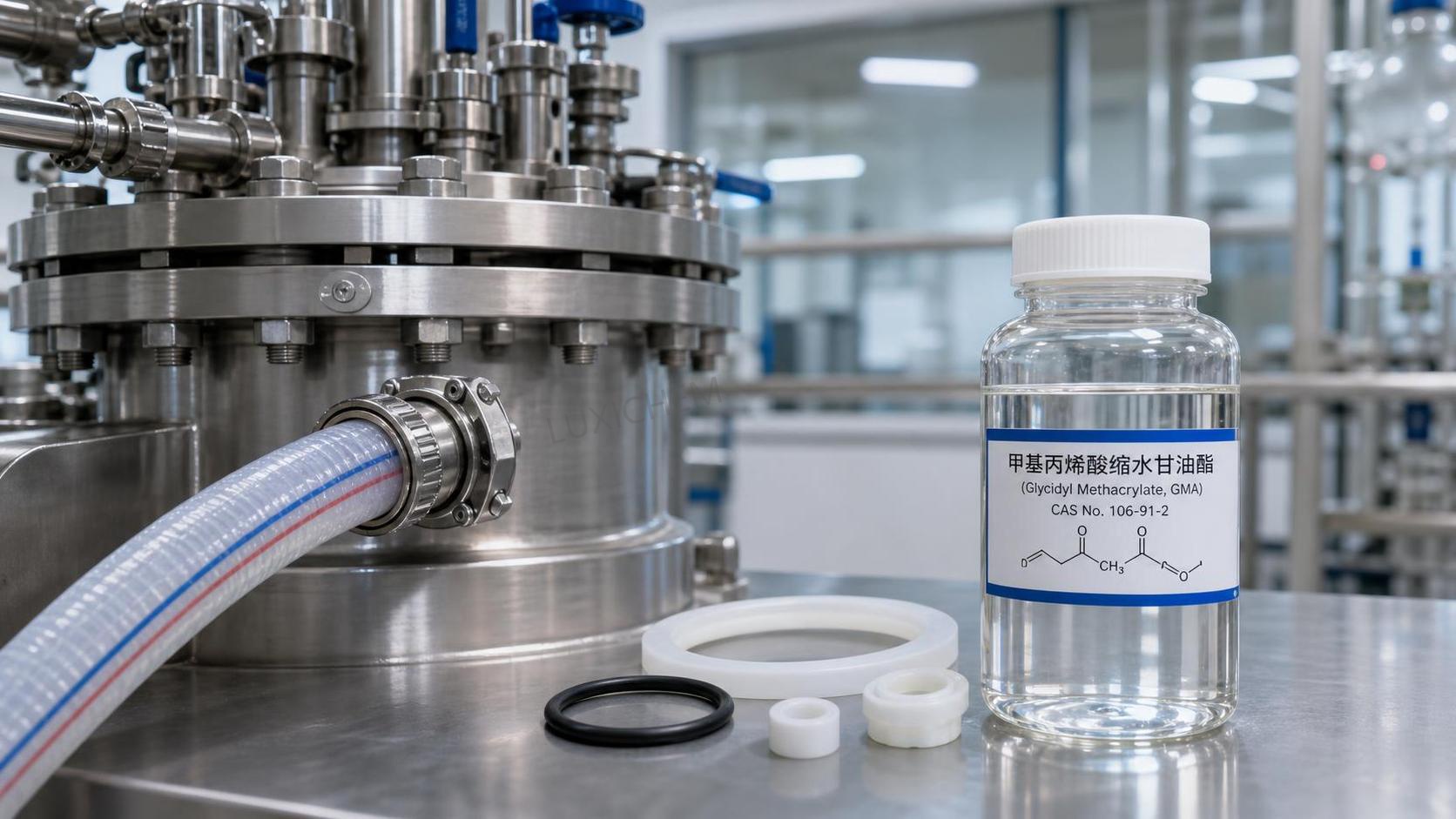
Before charging Glycidyl methacrylate into a pilot reactor, resin blend, coating line, or storage tank, confirm compatibility in four areas: the wetted equipment, the storage and transfer system, every formulation ingredient, and the intended cured or reacted product. This review cannot be reduced to a solvent-resistance table. Glycidyl methacrylate contains both a polymerizable methacrylate double bond and a reactive epoxide group, so a material may appear physically suitable while still causing inhibitor loss, premature polymerization, epoxy ring-opening, discoloration, or contamination.
The issue often appears during scale-up rather than at the first bench trial. A formulation may remain clear in a glass vessel, then show a viscosity rise after transfer through a hose, a gel particle problem after several hours in a feed tank, or inconsistent performance after contact with a curing agent. The practical decision is to identify which contacts are temporary and controlled, which are prolonged, and which can introduce heat, acids, bases, metal ions, moisture, or reactive nucleophiles. Each of those factors changes the compatibility decision for Glycidyl methacrylate.
Start by defining the exact contact scenario
A useful evaluation begins with a process map, not with a general statement that a material is “compatible.” List every point at which the monomer contacts a surface or another chemical: supplier packaging, receiving line, storage vessel, pump seals, filters, hoses, sampling devices, reactor internals, dilution solvents, initiators, pigments, additives, and waste containers. Include normal operating conditions as well as cleaning, shutdown, and upset conditions.
For each contact, record temperature, residence time, oxygen exposure, water exposure, agitation, light exposure, and whether the system is pressurized. A PTFE-lined valve used for a short transfer has a different risk profile from an elastomer seal exposed for weeks in a warm storage system. Likewise, compatibility with a dry acrylic resin solution does not establish compatibility with the same resin system after an amine, acid catalyst, or aqueous dispersion is added.
Separate physical resistance from chemical reactivity
The first equipment question is whether the construction material remains intact when exposed to the monomer. Stainless steel, glass-lined systems, and selected fluoropolymers are commonly considered in chemical handling, but the final choice depends on the entire process environment rather than the monomer alone. A vessel that tolerates Glycidyl methacrylate may not tolerate the cleaning solvent, initiator package, or elevated temperature used during the process.
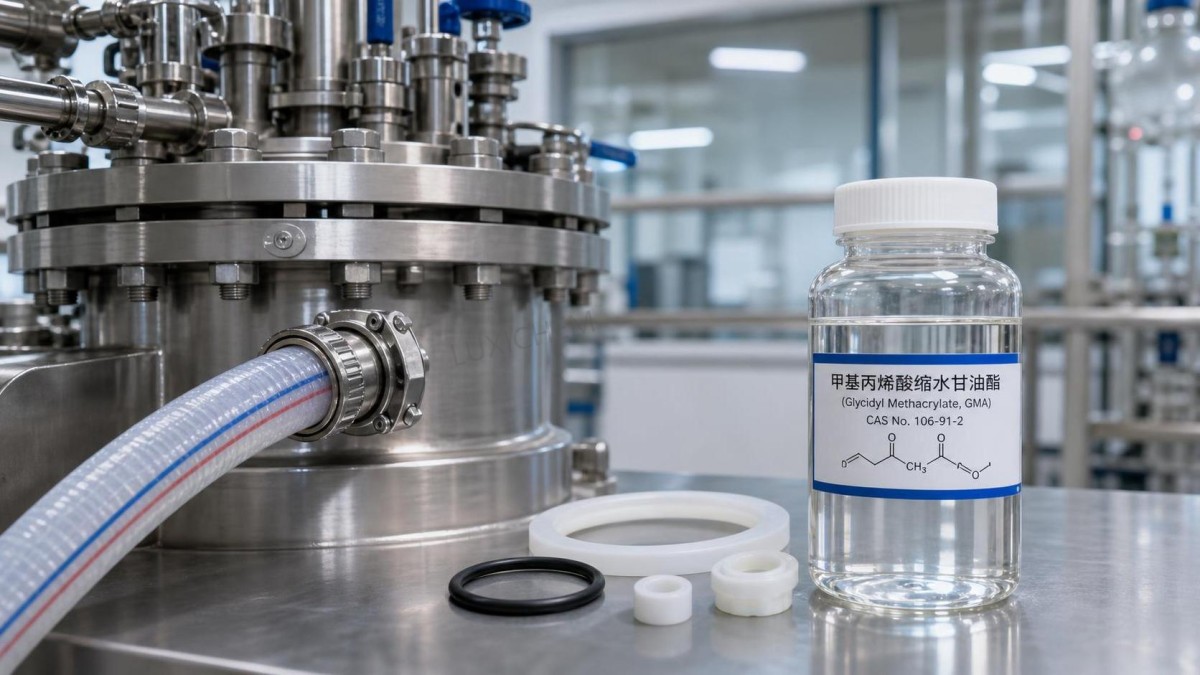
Elastomers deserve closer attention. Seals, O-rings, diaphragms, sight-glass gaskets, hose liners, and pump components can swell, soften, crack, or leach constituents into a reactive monomer. Such changes may not be obvious during a brief ambient-temperature test. Test the actual grade of elastomer at the highest expected process temperature and for a duration that reflects storage or circulation time. Measure mass change, hardness, dimensional change, appearance, and any resulting change in the monomer, such as haze, color, nonvolatile residue, or altered inhibitor concentration.
Do not treat a published compatibility rating as final qualification. Many charts are intended as initial screening tools and may not account for proprietary cure agents, mixed solvents, mechanical stress, pressure cycling, or long dwell times. A “recommended” rating can still be insufficient for a seal in continuous service where a small amount of permeation or extractable contamination is unacceptable.
Check for conditions that can trigger an unwanted reaction
The methacrylate group can undergo free-radical polymerization. Heat, radical initiators, peroxide residues, ultraviolet exposure, and certain contamination events can accelerate this pathway. The epoxy group can react with nucleophiles and can undergo ring-opening under acidic or basic conditions. Consequently, chemical compatibility must include reaction compatibility: ask not merely whether an ingredient dissolves, but whether it consumes, modifies, or destabilizes the monomer.
Priority review items include amines, thiols, alcohols, organic acids, strong mineral acids, bases, moisture-containing ingredients, metal salts, oxidizing materials, reducing agents, and residual catalysts. Their actual effect depends on concentration, temperature, order of addition, and exposure time. A low-level amine that is harmless in a rapidly cured formulation may be unsuitable in a premix intended to remain stable for days. Similarly, trace acid carried over from an upstream cleaning step can alter storage stability even where the bulk formulation is nominally neutral.
Inhibitor management must match the storage arrangement
Commercial methacrylate monomers are normally supplied with an inhibitor system to reduce the risk of unintended polymerization during transport and storage. This protection should not be assumed to remain constant after processing. Distillation, adsorption treatment, repeated transfers, filtration through unsuitable media, or blending with scavenging materials can lower inhibitor content. Inhibitor performance may also depend on the storage conditions and oxygen availability specified for the product grade.
A compatibility review should establish who controls inhibitor verification, what analytical method is used, which concentration range is acceptable, and what happens when material is returned from a line or partially emptied tank. Returning material to the original container without assessing contamination, temperature history, and inhibitor status can create a different risk than using fresh material. Avoid improvised inhibitor additions; the inhibitor type and treatment level should be confirmed against the product specification and the downstream process requirements.
Review tank, line, and utility cleanliness
Residues are often more significant than the nominal construction material. A reactor previously used for an amine-functional resin, an acid-catalyzed esterification, a peroxide-initiated polymerization, or an aqueous process may carry enough residue to affect a sensitive monomer. Dead legs, valve cavities, filter housings, flexible connectors, and sampling ports are typical locations where previous materials remain after a routine rinse.
Cleaning validation should therefore be linked to chemistry. Water alone may leave dissolved salts or promote hydrolytic concerns in a system intended to remain dry. A solvent rinse may remove organic residue yet leave acidic or basic deposits. Before first use, confirm the cleaning agent, rinse sequence, dryness requirement, and acceptance criterion. Visual cleanliness is not a reliable indicator where reactive residues are involved.
Utilities also require review. A jacket with poor temperature control can permit localized overheating during mixing or reaction. Air used for blanketing, transfer, or drying may introduce water or contaminants unless its quality is defined. Conversely, a fully inerted arrangement may affect the inhibitor protection strategy, so storage instructions should be evaluated as a complete system rather than copied from another acrylic monomer service.
Assess additives by functional group and by order of addition
Compatibility testing is more informative when ingredients are grouped by likely mechanism. Solvents should be assessed for solubility, water content, peroxide content where relevant, and their influence on viscosity and heat removal. Reactive diluents and comonomers require separate examination because they may alter polymerization rate, phase behavior, and final network structure. Pigments, fillers, and dispersants can introduce adsorbed moisture, metal-containing impurities, surface acidity, or amine functionality.
Order of addition can convert a compatible formula into an unstable one. Adding Glycidyl methacrylate into a diluted, temperature-controlled mixture may be manageable, while adding it directly to a concentrated amine-containing package may create a localized reaction zone before the system becomes homogeneous. The assessment should specify charge sequence, agitation rate, temperature limit, hold time between additions, and whether a premix is permitted.
- Amine-containing components: screen for epoxy reaction, viscosity drift, heat release, and loss of epoxide functionality during the planned hold period.
- Acidic additives or catalyst residues: assess ring-opening risk, color development, and potential acceleration of side reactions.
- Initiators and curing agents: verify dose, temperature window, segregation requirements, and whether direct contact before intended use is prohibited.
- Fillers and pigments: check moisture, pH-related behavior, metal content, and the effect of dispersion on temperature.
- Stabilizers and processing aids: confirm that they do not remove, neutralize, or interfere with the monomer’s inhibitor package.
When multiple vinyl-containing raw materials are stored or handled nearby, segregation should also prevent a simple but consequential mix-up. For example, n-Butyl vinyl ether CAS#111-34-2 is a clear, volatile liquid with limited water solubility and a low flash point. It may be relevant in certain organic synthesis or copolymer work, but it should not be treated as interchangeable with an epoxy-functional methacrylate. Separate identification, dedicated transfer procedures where appropriate, and formulation-specific compatibility records reduce the chance that a material selected for one monomer system is assumed suitable for another.
Use staged testing instead of a single pass/fail trial
A technically defensible qualification usually progresses from document review to targeted laboratory work and then controlled process confirmation. At the document stage, collect current safety and technical information for the monomer, additives, construction materials, seal materials, and cleaning agents. Identify contradictions: for example, a seal supplier may approve a chemical at room temperature, while the process requires higher temperatures or repeated thermal cycling.
Small-scale testing should reproduce the contacts that matter. A blend-stability test can track appearance, viscosity, temperature, acidity or other relevant indicators, and functional-group retention over the intended hold time. Coupon testing can examine metals, plastics, coatings, and elastomers after controlled exposure. For reactive combinations, calorimetric or other thermal screening may be justified before increasing batch size, especially where concentrated reagents, elevated temperature, or exothermic polymerization conditions are possible.
Scale-up confirmation should monitor the process, not only the final product. Record charging temperature, maximum temperature, mixing behavior, pressure where relevant, filter performance, transfer rate, and any evidence of deposits or gel formation. A stable initial batch does not automatically qualify an extended storage or recirculation condition. Where material will remain in a line between campaigns, test that condition explicitly.
Make the end-use compatibility decision separately
Equipment and blend compatibility do not prove that the final application is appropriate. In an adhesive, coating, composite, resin modification, or intermediate synthesis route, the dual functionality of Glycidyl methacrylate may be intentionally used to introduce polymerizable and epoxy-reactive sites. The same reactivity can affect cure timing, adhesion, crosslink density, flexibility, residual extractables, and compatibility with substrates or later-added components.
Define what functionality must remain at each stage. A process that aims to polymerize the methacrylate group while preserving epoxide functionality needs different controls from one that intentionally opens the epoxide during a subsequent reaction. Determine whether the selected initiator, catalyst, solvent, and thermal profile favor the desired route without promoting the competing route. This is especially important when a formulation includes both radical-curing chemistry and nucleophilic curing chemistry.
For regulated or sensitive end uses, the review should also cover residual monomer limits, migration or extractable concerns where applicable, impurity control, and the acceptability of all formulation components for the intended market. These are end-use decisions, not assumptions that can be inferred from a raw-material compatibility chart.
Warning signs that require the review to be reopened
Stop treating the original assessment as current when there is an unexplained rise in viscosity, haze, particles, unusual odor, color change, temperature increase during storage, filter plugging, seal deterioration, pump leakage, or an unexpected shift in cure behavior. Each symptom can have more than one cause, but all may indicate contamination, inhibitor loss, incompatibility, or an unintended reaction.
Changes in supplier grade, packaging, inhibitor specification, seal material, cleaning method, batch size, solvent source, or storage duration should also trigger a focused reassessment. The most reliable compatibility program is a controlled record of what was approved, under which conditions, and what evidence supports that approval. That record makes it possible to distinguish a genuine process change from a problem caused by an unexamined contact material or residual chemical.
Related Picks
 Butylated Hydroxytoluene Price Drivers: Supply, Purity, and Purchasing Risk FactorsOct 21, 2026Butylated Hydroxytoluene price trends depend on supply stability, purity, logistics, and purchasing risk. Learn how to compare quotes wisely and reduce sourcing costs.
 Sodium Tripolyphosphate Price Trends: Raw Material and Energy ExposureOct 20, 2026Explore sodium tripolyphosphate price trends, from phosphate and soda ash costs to energy exposure. Learn how to compare quotes, manage sourcing risks, and make smarter purchasing decisions.
 Acetonitrile Shipment to Vietnam Successfully Dispatched; RCEP Benefits Boost Fine Chemical Trade with ASEANSep 16, 2026A shipment of industrial-grade acetonitrile from our company has recently been loaded and dispatched following the completion of standardized hazardous material packaging and container securing procedures.
 Nigerian Client’s Order of 4 Containers of Vinyl Acetate Successfully Loaded and Shipped to West AfricaSep 16, 2026We recently completed the loading of a vinyl acetate order for a Nigerian client; four containers of the product have been successfully packed and are ready for shipment to Nigeria.




Question Consultation
Send Us Your Inquiry Today

Luxi Chemical is a professional chemical product supplier with ample stock of all chemical categories and excellent quality, welcome your purchase inquiry.

