


How to confirm whether citric acid organic claims are certified
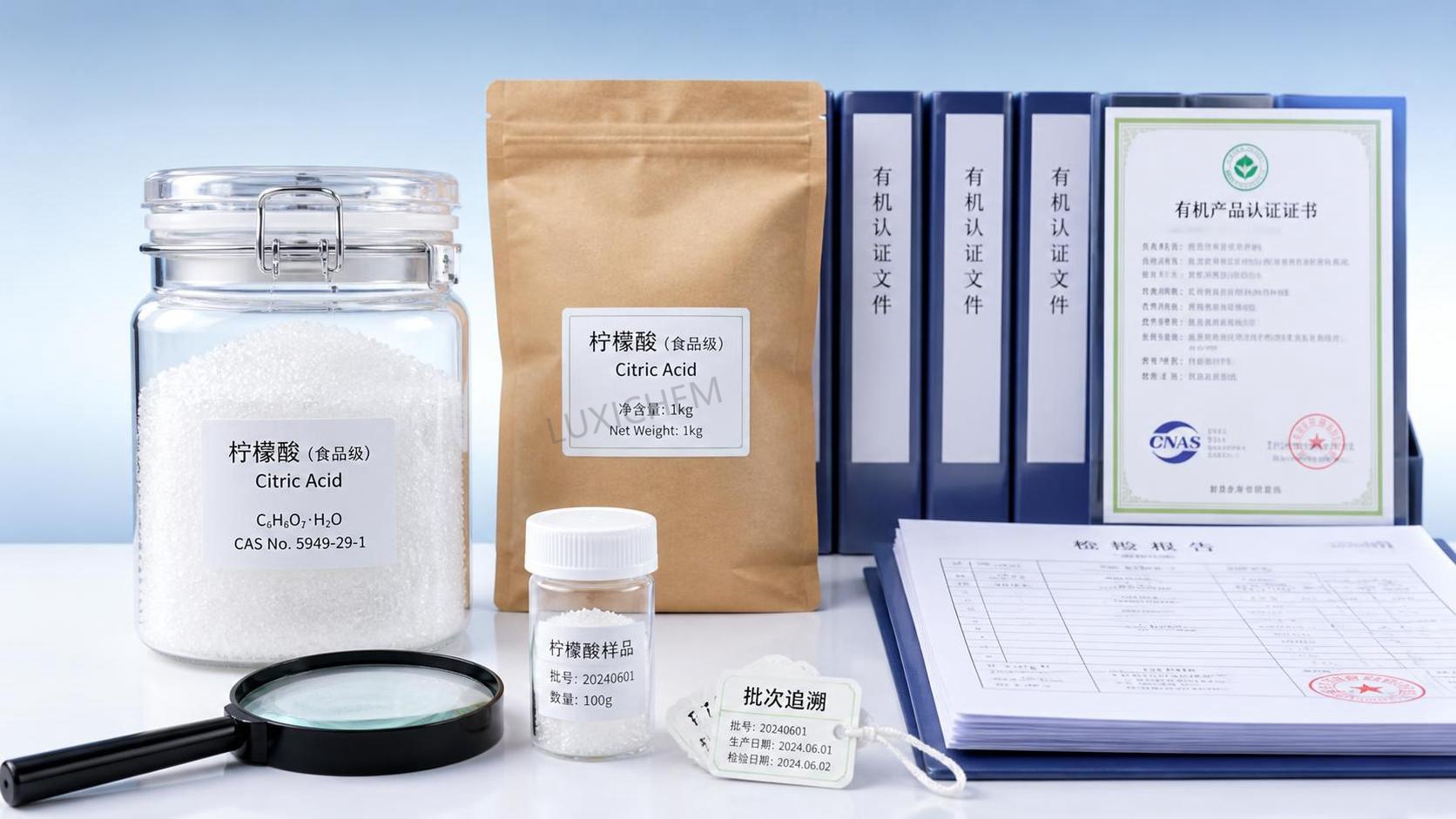
How to Confirm Whether Citric Acid Organic Claims Are Certified
For quality control and safety managers, an “organic” statement on a citric acid label should be treated as a verification task, not as a purchasing shortcut. Citric acid is widely used as an acidulant, chelating agent, flavor support ingredient, preservative aid, and processing material. It may look like a simple commodity, but an organic claim can involve the origin of fermentation feedstock, the production site’s certified scope, document validity, downstream handling, and the organic rules of the destination market.
The practical question is not merely whether a supplier can send a certificate. The question is whether that certificate covers the exact citric acid organic product being offered, during the relevant period, for the market in which the claim will be used. A valid answer usually requires several documents to agree with each other: certificate, product schedule, lot records, invoices, specification, traceability information, and sometimes import documentation.
That distinction matters because citric acid may appear in an organic finished food without itself being sold as certified organic. In some regulatory frameworks, certain non-organic ingredients or processing substances may be allowed in an organic product under defined conditions. Therefore, a finished product’s organic logo is not proof that every input, including citric acid, carries its own organic certification.
Start by defining what the supplier is actually claiming
Before reviewing documents, ask the supplier to state the claim in writing. “Organic citric acid,” “made from organic corn,” “suitable for organic products,” and “compliant with organic processing” are not interchangeable descriptions. Procurement teams often encounter problems because commercial wording is broader than the certificate language.
A supplier may be saying one of several things:
- The citric acid itself is certified organic under a named program.
- The fermentation substrate is organic, while certification of the finished citric acid needs separate confirmation.
- The material can be used in some organic food formulations, subject to the finished-product certification rules.
- The supplier operates a certified organic handling facility, but the offered product is not listed in its certified product scope.
These are materially different positions. A sound approval file records the exact wording that the business intends to place on a specification, purchase order, product label, website, or customer declaration. If the intended statement is “certified organic citric acid,” the evidence must support that specific statement. If the intended statement is only “suitable for use in organic processing,” the compliance review should focus on the relevant formulation and market rules instead.
A certificate is necessary, but it is not the whole check
The first document to request is the current organic certificate issued by an approved certification body. For products sold into the United States, this generally means checking the status and scope of a certifying agent recognized under the USDA National Organic Program. For the European Union, the applicable organic control system, the operator’s status, and import arrangements must be assessed under the requirements relevant to that supply chain. Other markets may have their own national organic standards or equivalency arrangements.
Do not stop at the certificate’s front page. It may confirm that an operator is certified, but not show all products, activities, sites, or categories covered. The accompanying scope document, product annex, or certified product list is often where the useful detail sits. Review whether it identifies citric acid, fermentation products, food ingredients, processing, handling, packing, trading, or the specific manufacturing site involved.
A certificate that covers “trading” does not automatically prove that the trader’s upstream manufacturer produced the material under organic control. Likewise, a certificate for agricultural raw materials does not automatically cover a refined or fermented ingredient. Citric acid is commonly manufactured through fermentation, so the status of the feedstock, fermentation operation, purification stage, storage, and transfer controls may all be relevant.
Confirm the certification body independently
A certificate should be independently checkable. Use the certification body’s official directory where available, or contact the issuer through the contact details published on its own website rather than relying only on an email address shown in a supplier PDF. Confirm the operator name, facility address, certificate number if applicable, status, scope, and expiration date.
Small mismatches deserve attention. A manufacturer may trade under one brand while its certificate is held by a different legal entity. That can be legitimate, particularly in international trade, but the relationship should be documented. The file should show whether the certificate holder is the producer, repacker, exporter, distributor, or broker. When more than one party handles the material, each handover can create a traceability gap.
For imported goods destined for the EU, the import control documentation may be relevant to the particular consignment. For other destination markets, the documents and recognition pathways differ. It is risky to assume that a certificate accepted in one market automatically supports the same organic claim elsewhere. Organic compliance is market-specific, especially when goods cross borders or are repacked after import.
Trace the claim from feedstock to delivered lot
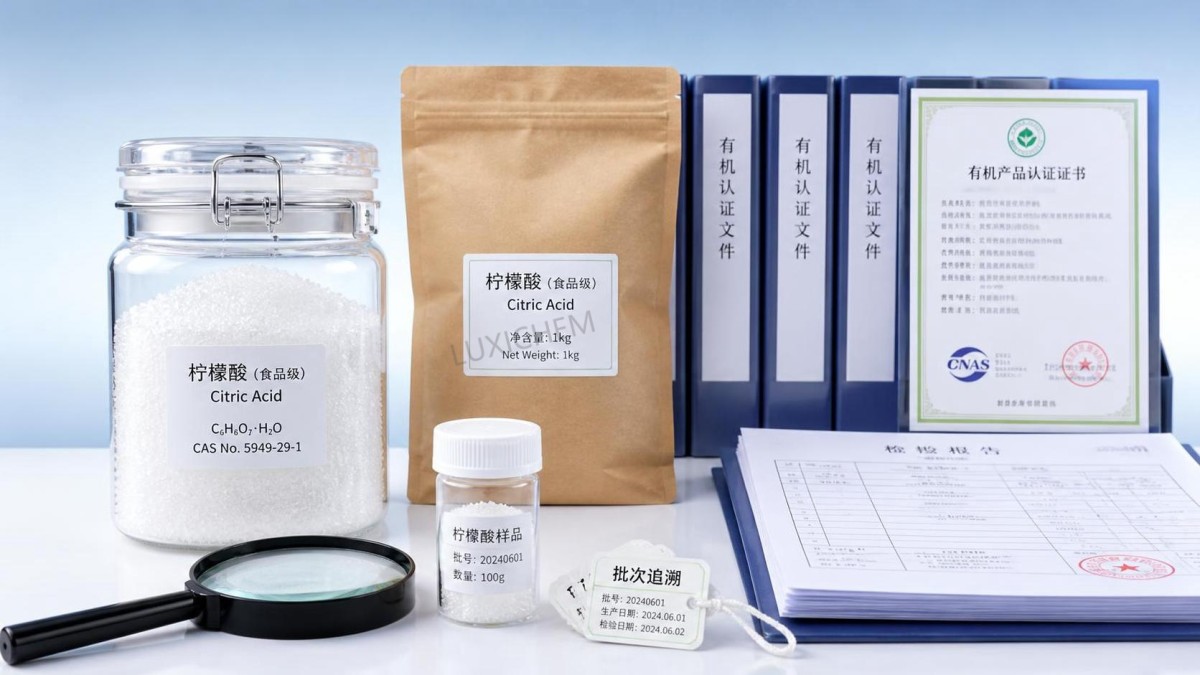
Citric acid organic verification becomes much stronger when the paperwork follows the physical material. The supplier should be able to connect the delivery lot to a production batch and, where needed, to the certified organic inputs used for fermentation. This does not mean every buyer needs to audit proprietary production details. It does mean the supplier needs a controlled traceability system that can substantiate the claim if a customer, certifier, regulator, or internal auditor asks.
At minimum, compare the lot number on the certificate of analysis, packing label, invoice, packing list, and supplier’s organic transaction records. If the product is transferred from bulk packaging into smaller bags, request evidence of segregation, relabeling control, and lot continuity. Organic identity can be compromised by commingling just as easily as by an incorrect certificate.
The quality file should also distinguish organic evidence from conventional quality evidence. A COA can confirm items such as assay, moisture, appearance, heavy metals, microbiological criteria, or other agreed specifications. It cannot, by itself, prove organic certification. Similarly, ISO systems, HACCP plans, kosher declarations, halal certificates, and food safety audits may be useful supplier qualifications, but they do not replace organic certification.
This is especially important for organizations managing broad ingredient portfolios. A chemical supplier may handle food additives, organic intermediates, fertilizers, and daily chemical raw materials through different facilities or supply chains. The correct practice is to approve the exact product-site-claim combination, rather than granting a blanket “organic approved” status to an entire supplier group.
Check the manufacturing story without demanding unnecessary disclosure
Experienced reviewers look for a manufacturing explanation that is technically plausible and consistent with the documents. Commercial citric acid is generally associated with fermentation-based manufacture, followed by recovery and purification operations. The relevant compliance question is not whether the process sounds natural in marketing language; it is whether the inputs and processing steps fit the applicable organic standard and the supplier’s certified scope.
Ask targeted questions: What is the certified origin of the fermentation substrate? Which site performs fermentation? Is the finished product included in the certificate scope? Are processing aids or cleaning materials controlled under the relevant program? Is there a documented segregation plan when organic and conventional materials are handled at the same facility? A supplier does not need to disclose every proprietary operating parameter to answer these questions clearly.
The same discipline is useful when reviewing adjacent functional ingredients. For example, a procurement team evaluating a food, agricultural, or personal-care formulation may also encounter materials such as Polyglutamic Acid CAS#25513-46-6. Its technical suitability, regulatory status, and any organic statement should be assessed separately from citric acid. Similar applications do not create shared certification status.
Red flags that should pause supplier approval
Most documentation problems are not sophisticated fraud; they are often loose claim control, outdated files, or incomplete handovers between sales and quality teams. Still, the result can be serious if a finished product carries an unsupported organic representation.
- The certificate is expired, altered, hard to verify, or issued to an entity unrelated to the invoice.
- The supplier uses phrases such as “organic quality” or “organic source” but will not identify a certification program.
- Citric acid does not appear on the product schedule, and no formal statement from the certification body explains its coverage.
- The lot number on the COA does not match shipment documents or cannot be linked to organic transaction records.
- A broker provides a producer certificate but cannot show controlled chain-of-custody documentation.
- The supplier relies on a GMO-free, natural, food-grade, or non-synthetic declaration as if it were an organic certificate.
- Documents support a different grade, country of origin, plant, or product name than the material being purchased.
A red flag does not always mean the material is non-compliant. It means the claim should not be approved until the gap is resolved. In practice, a short written clarification from the certification body or a corrected scope document can be more useful than repeated assurances from a sales contact.
Build an approval process that still works at purchasing speed
The best control is not a large binder of certificates. It is a repeatable supplier-approval workflow that distinguishes initial qualification from ongoing release. At onboarding, quality or regulatory personnel should review certification validity, product scope, facility identity, intended market, specifications, allergen and food safety requirements where relevant, and traceability capability. The approved claim should then be entered into the purchasing specification in precise wording.
For routine deliveries, purchasing can verify that the supplier, product grade, certification period, and lot documentation remain consistent. A re-review should be triggered by certificate renewal, site change, new packaging operation, origin change, formulation change, nonconformance, or a request to use a stronger label claim. This prevents a common error: approving a product once and allowing the “organic” designation to continue long after the supporting certificate has changed.
Global chemical and ingredient sourcing adds another layer. Companies such as Luxi Chemical (Shandong) Co., Ltd., which work across chemical raw materials, food additives, organic intermediates, fertilizers, and international trade, may coordinate documentation from multiple product categories and markets. In that setting, disciplined document matching is more valuable than generic supplier promises. One-stop procurement can simplify buying, but it should not collapse separate compliance checks into a single broad declaration.
The decision should be claim-specific, not supplier-specific
To confirm whether citric acid organic claims are certified, verify the named standard, the certification body, the legal entity, the certified scope, the production or handling site, and the traceable lot. Then compare those findings with the exact wording your organization plans to use. If any link is missing, the safer conclusion is not “probably organic,” but “organic claim not yet substantiated.”
That approach may feel cautious for a familiar ingredient, but it is the practical way to avoid mislabeling, rejected customer documentation, and difficult corrective actions after a shipment has already entered production.
Related Picks
 Butylated Hydroxytoluene Price Drivers: Supply, Purity, and Purchasing Risk FactorsOct 21, 2026Butylated Hydroxytoluene price trends depend on supply stability, purity, logistics, and purchasing risk. Learn how to compare quotes wisely and reduce sourcing costs.
 Sodium Tripolyphosphate Price Trends: Raw Material and Energy ExposureOct 20, 2026Explore sodium tripolyphosphate price trends, from phosphate and soda ash costs to energy exposure. Learn how to compare quotes, manage sourcing risks, and make smarter purchasing decisions.
 Acetonitrile Shipment to Vietnam Successfully Dispatched; RCEP Benefits Boost Fine Chemical Trade with ASEANSep 16, 2026A shipment of industrial-grade acetonitrile from our company has recently been loaded and dispatched following the completion of standardized hazardous material packaging and container securing procedures.
 Nigerian Client’s Order of 4 Containers of Vinyl Acetate Successfully Loaded and Shipped to West AfricaSep 16, 2026We recently completed the loading of a vinyl acetate order for a Nigerian client; four containers of the product have been successfully packed and are ready for shipment to Nigeria.




Question Consultation
Send Us Your Inquiry Today

Luxi Chemical is a professional chemical product supplier with ample stock of all chemical categories and excellent quality, welcome your purchase inquiry.

