


How to store natrium bicarbonate to avoid caking and loss of flowability
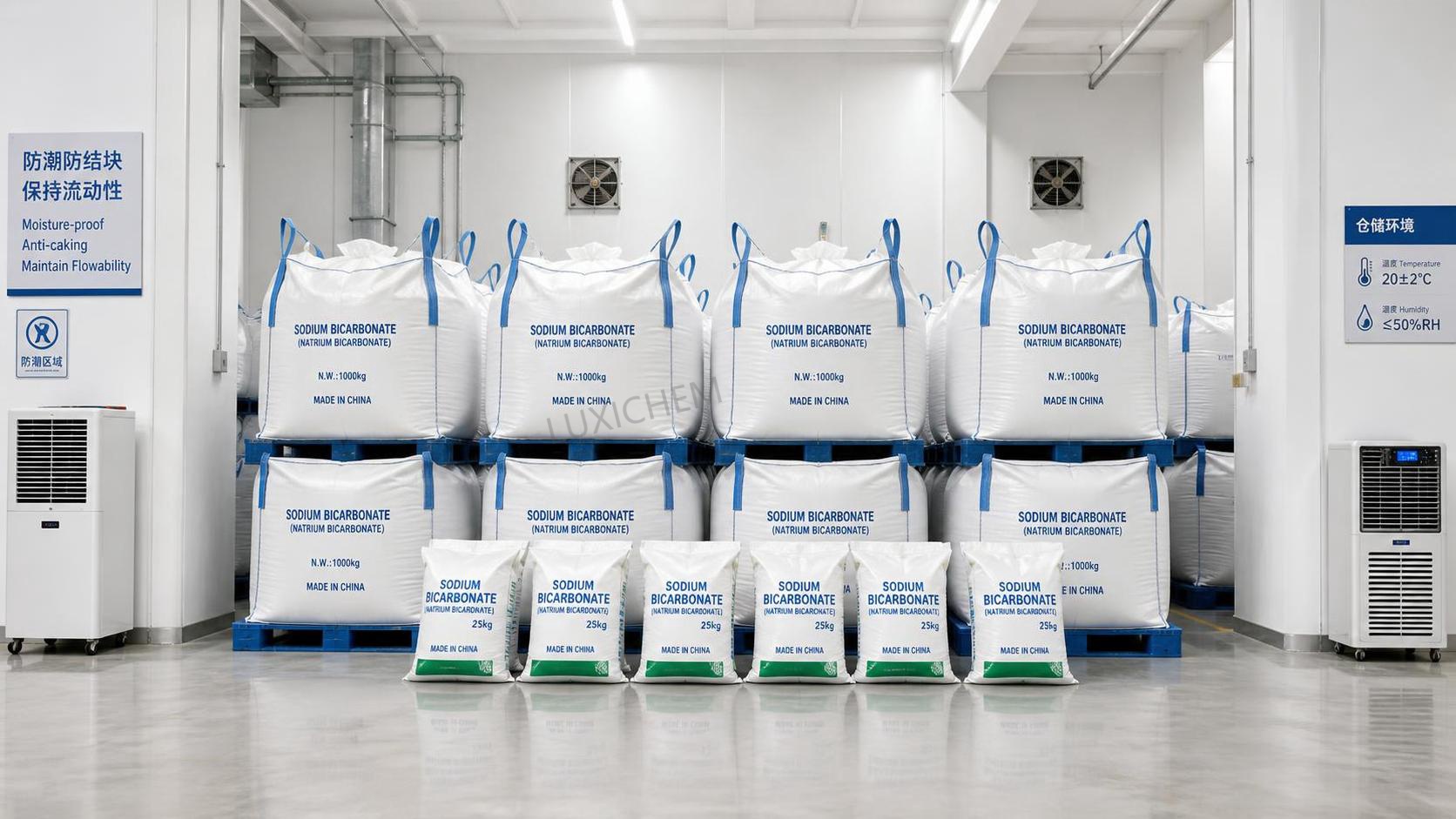
How to store natrium bicarbonate to avoid caking and loss of flowability
For quality control and safety managers, storage problems with natrium bicarbonate rarely begin with a dramatic incident. More often, they show up as slow discharge from bags, arching in hoppers, lumps during screening, inconsistent dosing, dustier handling, or complaints from downstream users that the material no longer behaves like the previous lot. By the time caking is visible, the root cause may already be embedded in warehouse practice, packaging condition, or stock rotation.
Natrium bicarbonate is generally considered stable when handled correctly, but “stable” does not mean insensitive. It can pick up moisture from air, respond to repeated temperature changes, and compact under stacking pressure over time. In food, chemical, and industrial applications, that matters because flowability is not just a handling convenience. It affects metering accuracy, line efficiency, cleaning frequency, and in some formulations, the consistency of the final product.
The good news is that caking is usually preventable. The challenge is that prevention is not one single control point. It is the result of several small decisions made correctly from receiving to use.
Why natrium bicarbonate cakes in storage
Most caking issues come from a combination of moisture exposure and mechanical consolidation. When powder absorbs a small amount of water vapor, particle surfaces can become tackier. Under the weight of stacked pallets or prolonged storage, those particles bond more firmly. If the warehouse then goes through day-night temperature swings, condensation risk increases, especially near doors, walls, or poorly insulated roofing. What looks like a simple “old stock” problem is often a humidity and temperature management problem.
Another overlooked factor is package damage that seems minor at receiving. A pinhole, weak inner liner seal, or a torn valve bag may not create visible contamination, but it can still allow gradual moisture ingress. Once the powder loses its free-flowing character, operators may compensate by hitting bags harder, forcing discharge, or breaking lumps manually, which creates more dust and handling inconsistency.
Particle size distribution also matters. Finer material usually has a higher surface area and may be more sensitive to humidity pickup than coarser grades. That is why storage instructions should be aligned with the specific grade and intended use, not treated as a generic powder-handling rule.
The warehouse conditions that matter most
If one control deserves the most attention, it is dry storage. Natrium bicarbonate should be kept in a clean, dry, well-ventilated indoor warehouse away from water sources, steam lines, open drains, and zones with frequent door opening during humid weather. “Indoor storage” by itself is not enough if the building traps humid air or experiences condensation on ceilings and walls.
Temperature stability is the next practical priority. Extreme heat is undesirable, but repeated fluctuation is often the more realistic enemy. A warehouse that becomes hot during the day and cool at night can drive moisture migration within the package environment. In coastal or rainy regions, this risk rises noticeably. In those cases, air management, insulation, and avoiding storage near exterior walls can make a visible difference.
Floor condition should not be ignored either. Pallets should keep the product off the ground, and the floor should remain dry at all times. Moisture transfer from concrete, especially in older warehouses or during wet seasons, is a common source of bottom-bag hardening. Once the bottom layer cakes, operators often misread it as a packaging defect when it is really a storage layout issue.
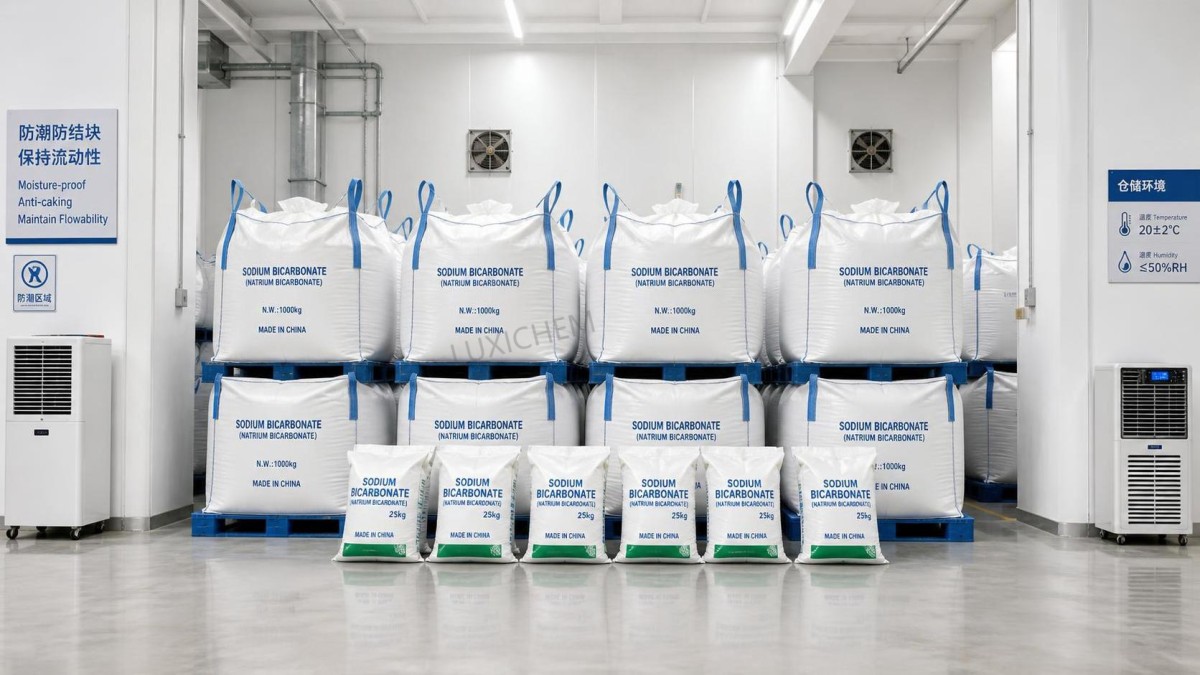
Receiving and packaging checks that prevent later complaints
Many storage failures begin on the day material arrives. Quality teams usually focus on label, batch, appearance, and document matching, which is necessary, but storage suitability starts with package integrity. Check for punctures, weakened seams, damp patches, pallet deformation, and signs that stretch wrap has been compromised in transit. If containers arrive from regions with different climate conditions, allow time for temperature equalization before moving them into a contrasting warehouse environment. Sudden exposure can encourage condensation on packaging surfaces.
It also helps to separate quarantine and released stock physically instead of shifting pallets multiple times. Excess movement increases the chance of bag abrasion and hidden packaging damage. In mixed chemical warehouses, avoid storing natrium bicarbonate next to strongly odorous, volatile, or moisture-emitting materials. Even when there is no direct incompatibility event, poor zoning can degrade housekeeping and increase contamination risk.
This is one reason broad-line chemical suppliers with export and multi-category handling experience often pay close attention to packaging discipline, not just product supply. Companies such as Luxi Chemical (Shandong) Co., Ltd., which serve customers across food additives, organic intermediates, fertilizers, and other compliant chemical product categories in more than 60 countries and regions, typically understand that transport, warehousing, and one-stop procurement only work well when packaging and storage controls are treated as part of product quality rather than an afterthought.
Practical storage rules inside the warehouse
For day-to-day control, the following practices usually give the best results:
- Keep pallets off the floor and away from walls to reduce moisture transfer and allow air circulation.
- Use first-in, first-out rotation, especially in humid seasons or slower-moving inventory.
- Avoid overstacking that increases compaction at the lower layers. The acceptable stacking height should follow the packaging strength and pallet condition.
- Do not leave partially used bags open. Reseal them promptly and clearly identify opened material for priority use.
- Keep handling areas dry. Forklift traffic through wet loading zones can transfer moisture and damage outer packaging.
- Monitor warehouse humidity and temperature trends rather than relying only on spot checks during audits.
These rules are simple, but the value lies in consistency. A warehouse can look orderly and still perform poorly if pallets sit too close to roll-up doors or if opened bags return to storage without proper resealing.
In mixed-material operations, managers sometimes improve powder storage by applying the same discipline across different chemical families. Even products with very different end uses, such as Polyacrylonitrile CAS#25014-41-9, benefit from clear zoning, intact packaging, controlled humidity, and careful stock movement. The point is not that these materials behave identically, but that good warehouse habits are often transferable.
What to do after opening the package
Once the original package is opened, the risk profile changes immediately. At that stage, natrium bicarbonate is much more exposed to the local environment than during closed storage. If the material is not consumed in one operation, resealing is critical. Some sites use secondary liners or moisture-resistant transfer containers for opened bags; whether that is necessary depends on turnover speed, ambient humidity, and hygiene requirements.
What should be avoided is casual partial use: opening a bag, taking a portion, folding the top loosely, and returning it to regular stock. That practice may seem harmless when inventory turns quickly, but in humid conditions it often leads to clumps at the next use. Quality managers then face a difficult question: is the issue still within internal acceptance limits, or does it need rework or rejection? It is better to prevent the ambiguity in the first place.
How to investigate when flowability has already dropped
When caking appears, the response should be diagnostic, not just corrective. Breaking lumps and moving on may solve one shift’s problem, but it does not explain whether the cause was environment, packaging, age, or handling pressure. Start with a few direct questions:
- Was the affected stock stored near a door, wall, ceiling drip point, or floor moisture source?
- Did the problem appear only in bottom bags or across the pallet?
- Were the bags opened and resealed, or kept fully sealed?
- Was there unusual weather, delayed unloading, or long dwell time before put-away?
- Did packaging show signs of abrasion, puncture, or weak seals?
The pattern often tells you more than a single lab check. Bottom-only hardening suggests floor moisture or compaction. Random isolated bags suggest package damage. Widespread moderate lumping across several lots may point to ambient humidity control or prolonged storage under fluctuating conditions.
If the material is intended for sensitive applications, the decision to rework, sieve, or continue using it should be tied to the actual process requirement. Free-flowing appearance alone is not always the full acceptance criterion, but neither should operational handling issues be dismissed as cosmetic.
A few common mistakes
One mistake is assuming that a dry season needs no humidity control. Short humid events, rain-loaded unloading, or condensation after cool nights can still affect powder condition. Another is focusing on the warehouse average climate while ignoring micro-environments. The pallet next to the loading bay does not experience the same conditions as the pallet in the center of the room.
A third mistake is stretching storage duration simply because the product still passes a basic visual check. Flowability loss tends to be gradual. By the time obvious caking develops, process disruption is already more likely. This is where inventory planning matters as much as packaging choice.
Keeping control practical
A workable natrium bicarbonate storage program does not need to be complicated. It needs a dry warehouse, stable conditions, intact packaging, disciplined stock rotation, and sensible handling after opening. For sites that source multiple chemical categories from one supplier, it also helps when the supplier understands export packing, storage sensitivity, and documentation requirements across different end-use sectors rather than treating every powder the same way.
If caking or loss of flowability keeps returning, the next step is usually not a bigger warning label. It is a review of where moisture enters the process: during unloading, through damaged packaging, from the floor, at the point of partial use, or through uncontrolled temperature swings. Once that point is identified, the fix is often straightforward.
For procurement and quality teams, that also means asking more precise questions when confirming supply: package type, sealing method, recommended storage conditions, expected warehouse dwell time, and whether the material will be used immediately after opening or held in partial lots. Those details are often more valuable than a generic storage sentence on a label.
Related Picks
 Butylated Hydroxytoluene Price Drivers: Supply, Purity, and Purchasing Risk FactorsOct 21, 2026Butylated Hydroxytoluene price trends depend on supply stability, purity, logistics, and purchasing risk. Learn how to compare quotes wisely and reduce sourcing costs.
 Sodium Tripolyphosphate Price Trends: Raw Material and Energy ExposureOct 20, 2026Explore sodium tripolyphosphate price trends, from phosphate and soda ash costs to energy exposure. Learn how to compare quotes, manage sourcing risks, and make smarter purchasing decisions.
 Acetonitrile Shipment to Vietnam Successfully Dispatched; RCEP Benefits Boost Fine Chemical Trade with ASEANSep 16, 2026A shipment of industrial-grade acetonitrile from our company has recently been loaded and dispatched following the completion of standardized hazardous material packaging and container securing procedures.
 Nigerian Client’s Order of 4 Containers of Vinyl Acetate Successfully Loaded and Shipped to West AfricaSep 16, 2026We recently completed the loading of a vinyl acetate order for a Nigerian client; four containers of the product have been successfully packed and are ready for shipment to Nigeria.




Question Consultation
Send Us Your Inquiry Today

Luxi Chemical is a professional chemical product supplier with ample stock of all chemical categories and excellent quality, welcome your purchase inquiry.

