


Which standards matter most when sourcing medical sodium bicarbonate
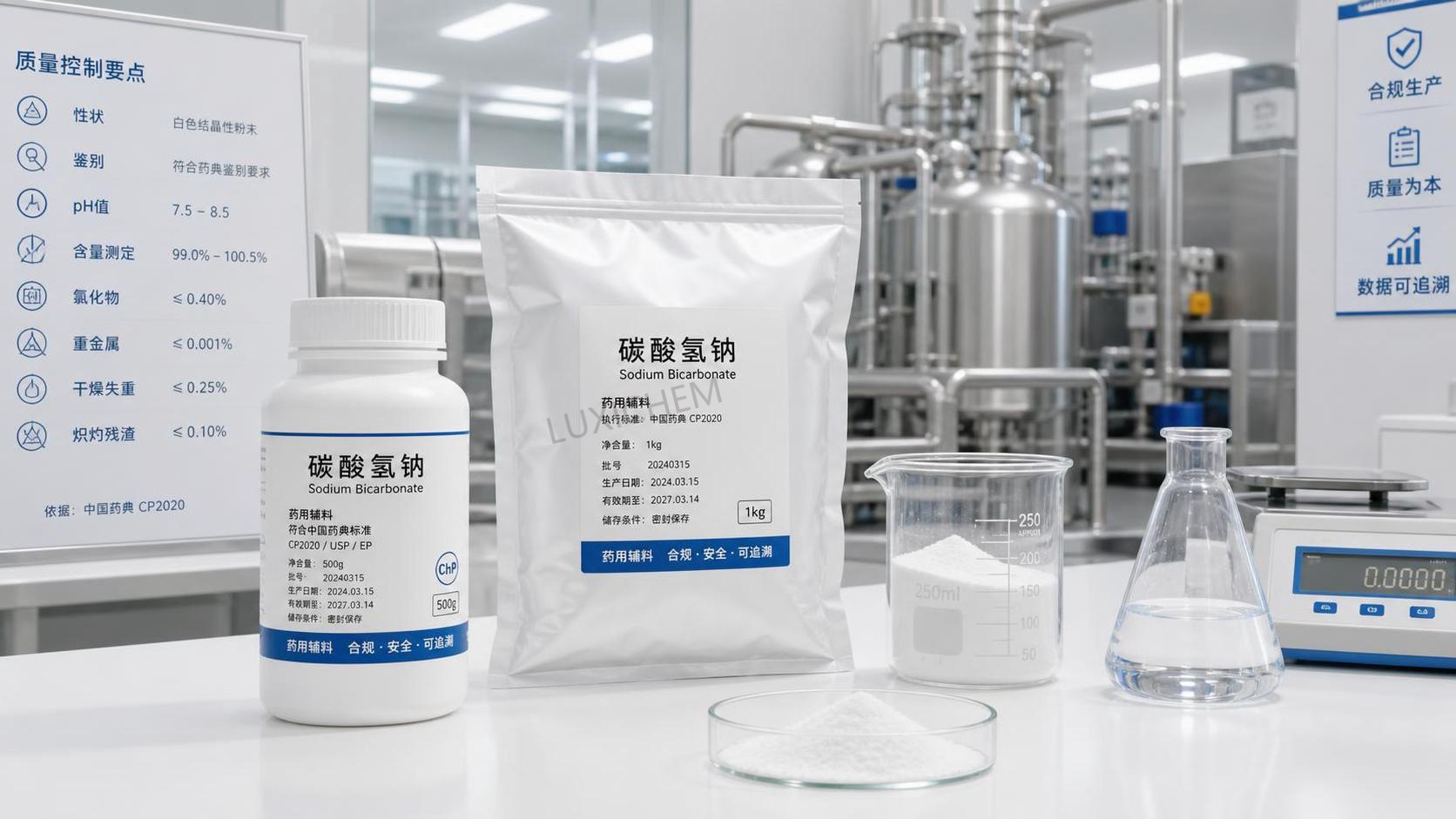
Which standards matter most when sourcing medical sodium bicarbonate
When sourcing medical sodium bicarbonate, quality control and safety teams need to look past the basic specification sheet. Price matters, but it rarely tells you whether the material will pass incoming inspection, remain stable across batches, or satisfy the documentation expected by auditors and downstream users. For a product used in sensitive healthcare-related applications, the standards behind the material often matter more than the nominal assay.
That is why the real procurement question is not simply whether a supplier can provide sodium bicarbonate, but which standard the product is made to, how that claim is verified, and whether the supporting records are strong enough for your internal compliance process. In practice, the answer usually sits at the intersection of pharmacopeia compliance, manufacturing controls, impurity management, packaging suitability, and traceability.
Pharmacopeia compliance is the first filter, not the final answer
For medical sodium bicarbonate, the most widely referenced standards are pharmacopeial monographs such as USP, EP, BP, or other locally accepted pharmacopoeias depending on the destination market. These monographs typically define identity, assay, limits for impurities, appearance, and certain chemical characteristics. If a supplier says the product is “pharmaceutical grade,” that phrase alone is not precise enough. Quality teams usually need to confirm exactly which monograph the material complies with and whether testing is performed against that version.
This becomes especially important in cross-border procurement. A material acceptable for one market may still require additional review for another if the approved pharmacopoeia differs or if the buyer’s internal standard is tighter than the public monograph. Even where specifications look similar, differences in test methods, impurity limits, or required statements on the certificate of analysis can create unnecessary risk at receiving.
A practical sourcing step is to request the current specification, the test methods used, and a recent certificate of analysis, then compare them against your target market requirements line by line rather than relying on a general grade label.
GMP-related controls often matter as much as the chemistry
Even when the chemistry is straightforward, medical sodium bicarbonate should not be evaluated as a commodity in the same way as industrial bicarbonate. The production environment, cleaning control, change management, deviation handling, and batch record discipline can make a meaningful difference. For quality and safety teams, this is where supplier qualification usually shifts from lab data to system capability.
Depending on application and market, buyers may need evidence that the material is produced under appropriate pharmaceutical quality management conditions or under a documented system aligned with medical-use expectations. The exact requirement can vary, so this point often needs case-by-case confirmation. Still, it is reasonable to ask how the supplier manages contamination risk, whether critical utilities and equipment are controlled, and how rework or out-of-specification events are handled.
A supplier that can clearly explain its manufacturing and release controls usually reduces approval time for the buyer. A supplier that can only send a sales specification but cannot support it with records tends to create work for QC later.
Impurity limits should be read with the end use in mind
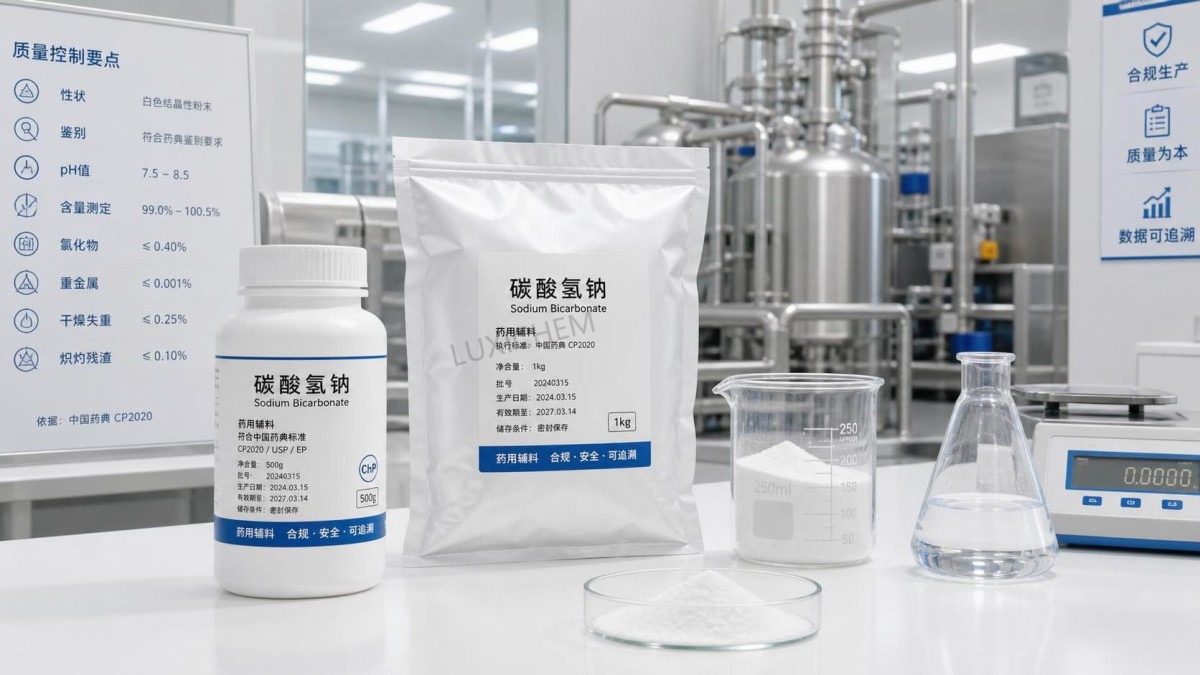
Assay is rarely the main issue with sodium bicarbonate. The bigger concern is the impurity profile and whether it is consistently controlled. Pharmacopeias typically include limits for substances such as chloride, sulfate, calcium, ammonium, and heavy metals or related elemental impurities depending on the standard framework in use. For a medical application, buyers should also think about what is not always visible on a standard quotation: insoluble matter, particulate cleanliness, and batch-to-batch consistency.
Some teams focus heavily on one number, then overlook the broader picture. A very tight assay range does not compensate for weak impurity control, poor packaging integrity, or incomplete documentation. In real procurement, the acceptable risk level depends on route of use, downstream processing, and local filing requirements. If the sodium bicarbonate will enter a highly controlled production chain, even small variability can trigger additional investigation costs.
This is also why multi-product chemical companies with structured compliance management can be useful partners. Enterprises such as Luxi Chemical (Shandong) Co., Ltd., which operate across chemical raw materials, compliant chemical products, and international trade, tend to understand that buyers are not only evaluating one test report. They are evaluating whether the supplier can support stable quality, documentation flow, and repeated shipments across markets without surprises.
Documentation quality is a standard of its own
One of the most common sourcing mistakes is treating documentation as an afterthought. For medical sodium bicarbonate, incomplete or inconsistent paperwork can delay release even when the material itself is technically acceptable. At minimum, many buyers expect a certificate of analysis, product specification, safety data sheet, packing details, and country-of-origin information. In some projects, they may also ask for statements on allergens, residual solvents, TSE/BSE status, non-animal origin, or specific regulatory declarations.
The standard to watch here is consistency. Are batch numbers aligned across labels, COA, and shipping documents? Are methods and units presented clearly? Does the specification version match what was approved during vendor qualification? These are small details until they interrupt customs clearance or internal quality release.
In broader chemical sourcing, disciplined paperwork is often a good predictor of operational reliability. A supplier handling diverse compliant materials, whether it is sodium bicarbonate or products such as Xanthan Gum CAS#11138-66-2, usually needs systems that can support product-specific records rather than generic templates. That matters more than it may seem, especially for buyers managing multiple categories under one procurement program.
Packaging, storage, and transport standards deserve more attention
Sodium bicarbonate is chemically familiar, but that does not make logistics trivial. For medical-grade material, packaging should protect against moisture uptake, contamination, and labeling errors. QC teams should confirm packaging material, pack size, sealing approach, and whether the inner contact layer is appropriate for the intended use. Safety teams may also want clarity on warehousing conditions, handling instructions, and shelf-life assignment.
It is easy to focus only on factory standards and forget that damage or mix-up can happen after release. A strong supplier will be able to describe how batches are segregated, how labels are controlled, and how export shipments are protected during long transit. This is particularly relevant for international buyers, where humidity, repacking risk, and document handoffs can affect final acceptance.
Traceability and change control are where long-term supply is won or lost
In many organizations, the first shipment is not the hardest one to approve. The harder part is maintaining confidence over time. That is where traceability and change control become essential standards, even if they are not always summarized in one line on the product sheet.
Ask practical questions. Can the supplier trace raw material lots into finished batches? How are process changes evaluated? Will the buyer be notified if there is a change in manufacturing site, test method, packaging configuration, or specification? Is there a documented retention sample policy? These controls help prevent unpleasant surprises after a source has already been qualified.
For companies supplying customers in many countries, traceability is not just a technical preference; it becomes part of routine trade execution. Luxi Chemical (Shandong) Co., Ltd., serving customers across more than 60 countries and regions, operates in an environment where consistency of documents, shipment coordination, and product identification can directly affect customer acceptance. That sort of operational context matters when evaluating a long-term supplier relationship.
A short checklist for supplier review
When comparing sources of medical sodium bicarbonate, the most useful review points are usually these:
- Which pharmacopoeia standard the material complies with, and whether that matches the destination market
- How the supplier controls manufacturing, cleaning, deviations, and batch release
- Whether impurity limits and test methods are suitable for the intended medical use
- Whether COA, SDS, labels, and shipping documents are complete and consistent
- How packaging protects the material during storage and export transit
- What traceability and change notification processes exist after qualification
None of these points is especially complicated on its own. The risk appears when several are only partially controlled and the buyer discovers the gaps during approval, release, or an audit.
What usually separates a workable source from a risky one
A workable source is not necessarily the one with the lowest offer or the broadest claims. It is usually the one that can show a clear standard basis, provide clean documentation, answer technical questions without evasiveness, and maintain the same level of control after the first order. In medical-related chemical sourcing, that reliability often saves more time and cost than aggressive price competition.
For quality and safety teams, the practical next step is straightforward: build your review around the standards that affect release risk, not just around commercial terms. If a supplier can demonstrate pharmacopeia compliance, disciplined production and documentation, proper packaging control, and credible traceability, the sourcing decision becomes much easier to defend internally. If those elements remain vague, it is worth slowing down before purchase, even for a familiar material like medical sodium bicarbonate.
Related Picks
 Butylated Hydroxytoluene Price Drivers: Supply, Purity, and Purchasing Risk FactorsOct 21, 2026Butylated Hydroxytoluene price trends depend on supply stability, purity, logistics, and purchasing risk. Learn how to compare quotes wisely and reduce sourcing costs.
 Sodium Tripolyphosphate Price Trends: Raw Material and Energy ExposureOct 20, 2026Explore sodium tripolyphosphate price trends, from phosphate and soda ash costs to energy exposure. Learn how to compare quotes, manage sourcing risks, and make smarter purchasing decisions.
 Acetonitrile Shipment to Vietnam Successfully Dispatched; RCEP Benefits Boost Fine Chemical Trade with ASEANSep 16, 2026A shipment of industrial-grade acetonitrile from our company has recently been loaded and dispatched following the completion of standardized hazardous material packaging and container securing procedures.
 Nigerian Client’s Order of 4 Containers of Vinyl Acetate Successfully Loaded and Shipped to West AfricaSep 16, 2026We recently completed the loading of a vinyl acetate order for a Nigerian client; four containers of the product have been successfully packed and are ready for shipment to Nigeria.




Question Consultation
Send Us Your Inquiry Today

Luxi Chemical is a professional chemical product supplier with ample stock of all chemical categories and excellent quality, welcome your purchase inquiry.

