


Hydrophilic vs. Hydrophobic Fumed Silica for Silicone Sealants
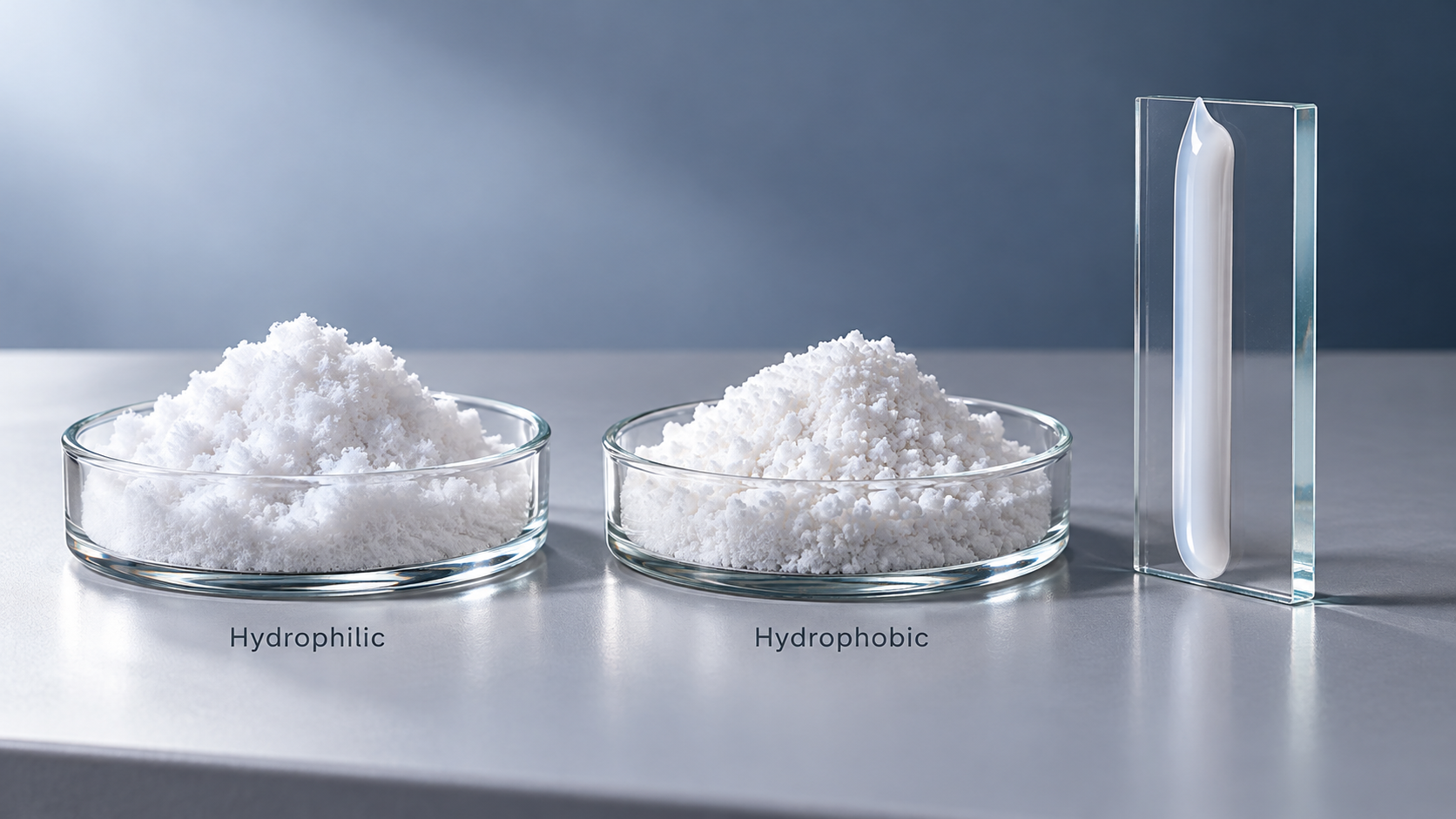
Hydrophobic fumed silica is often the stronger starting candidate for moisture-sensitive silicone sealants that must retain consistent extrusion and non-sag behavior during storage. Hydrophilic fumed silica remains a credible choice where its surface interactions deliver the required reinforcement and rheology without unacceptable moisture sensitivity or viscosity drift. Neither surface type is inherently superior: the useful comparison is performance in the complete formulation, both immediately after manufacture and after packaged aging.
The central trade-off is not simply water affinity. Surface treatment changes how silica interacts with silicone polymers, neighboring particles, crosslinkers, and other additives. A grade that produces high initial viscosity may still give poor vertical hold, excessive extrusion force, or unstable cure behavior. Selection therefore needs to connect surface chemistry with the sealant’s processing window, application behavior, and cured properties.
Surface chemistry changes the filler network
Hydrophilic fumed silica carries surface silanol groups, or Si–OH groups. These sites support hydrogen bonding between particles and interactions with suitable formulation components, including hydroxyl-terminated silicone polymers. The resulting network can increase low-shear resistance and contribute to reinforcement. Its strength depends on the polymer, filler concentration, available surface area, and competing ingredients—not simply on the presence of silanol groups.
Hydrophobic grades are produced by treating the silica surface with organosilicon compounds, reducing accessible silanol groups and introducing organic surface groups. Treatments based on silanes, silazanes, or siloxanes do not create identical surfaces. Residual silanol content, treatment chemistry, and surface coverage can differ substantially between grades sold under the same broad “hydrophobic” description.
Reducing surface polarity can improve compatibility with a silicone-rich matrix and lower moisture adsorption. It also changes particle-to-particle association and polymer adsorption. Consequently, hydrophobic treatment does not automatically increase thickening efficiency, nor does it necessarily weaken it. The outcome depends on which interactions control the network in that particular sealant.
Specific surface area adds another variable. Higher-area silica provides more interface per unit mass, but also increases wetting demand and can raise viscosity or complicate incorporation. Comparing a high-area hydrophilic grade with a lower-area treated grade cannot isolate the effect of surface treatment.
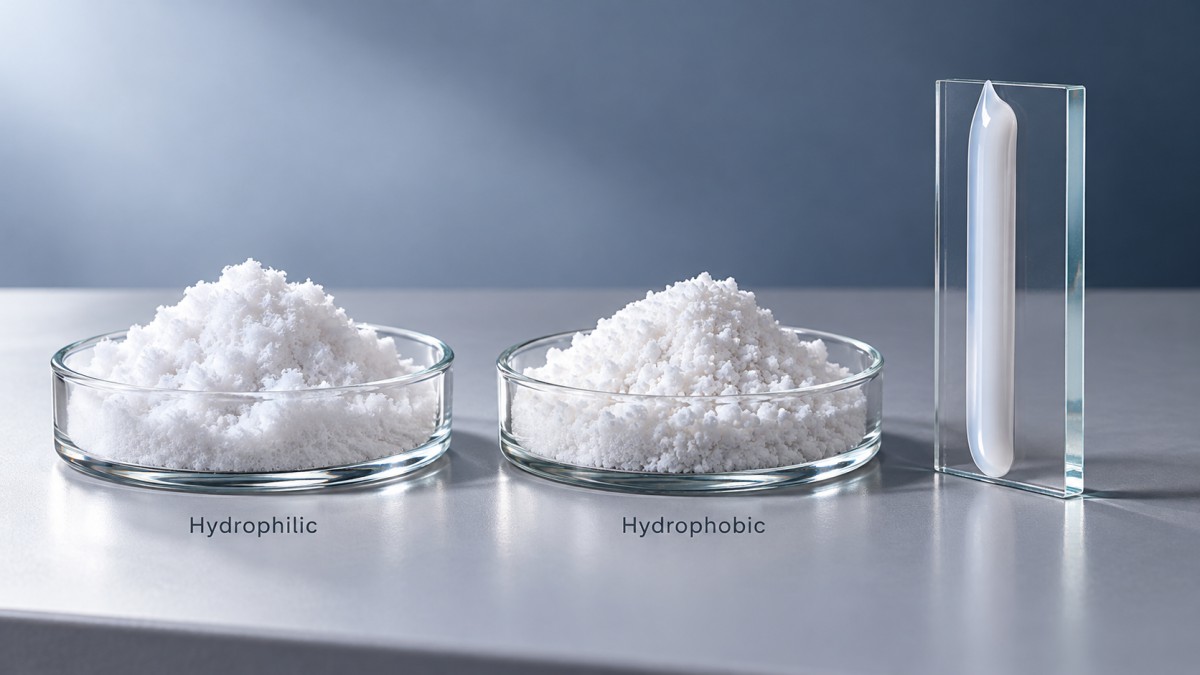
Compare sag resistance and extrusion together
A non-sag sealant must resist movement at rest, flow through a nozzle under pressure, and rebuild sufficient structure after application. These are different requirements. A single viscosity result, especially without a defined shear history, cannot establish whether a silica grade meets all three.
Hydrophilic silica can form a strong network through its accessible surface groups. However, crosslinkers, adhesion promoters, and other polar ingredients can modify those interactions. A base compound that appears well structured before the cure package is added may behave differently as a finished sealant.
A suitable hydrophobic grade can provide a more favorable balance between extrusion and shape retention in some silicone formulations. That advantage must be demonstrated rather than inferred from the surface label. A treated grade may require a different loading, mixing sequence, or polymer balance to reach the target performance.
For initial screening, compare grades at equal loading to expose their different responses. For a formulation decision, compare them again at equivalent application performance—for example, the same sag limit with acceptable extrusion. Equal dosage is a useful experimental control, but not necessarily a fair commercial endpoint.
Moisture matters most in the context of the cure system
In one-component moisture-curing silicone sealants, uncontrolled water entering during production or storage can promote premature reactions. Hydrophilic silica has greater affinity for adsorbed moisture, so its handling history deserves particular attention. Hydrophobic treatment reduces this affinity, but does not make the powder moisture-free or eliminate the need for controlled storage and processing.
The relevant question is how much water the filler introduces into the actual batch. A supplier’s loss-on-drying value may include volatile material other than water, depending on the method. Where moisture is critical, use an appropriate validated water determination method and distinguish measured water from broader volatile loss.
Acetoxy, alkoxy, and oxime condensation systems should not be treated as interchangeable test environments. Their crosslinkers, catalysts, and by-products differ, and silica surfaces can interact differently with each formulation. A grade qualified in one cure package should not automatically be approved for another.
For two-component condensation systems, external atmospheric moisture is not the same governing variable as in a one-component system, but filler moisture and surface interactions can still affect working life and cure development. Addition-cure silicones require separate attention to catalyst compatibility and trace contaminants. Hydrophobicity alone does not establish compatibility with a platinum-catalyzed formulation.
Storage instability can appear as thickening, thinning, altered extrusion, or changes in cure response. It is therefore unsafe to interpret every viscosity change as moisture-induced pre-cure. Filler-network rearrangement and interactions with other ingredients also need consideration. Track application properties and cure properties together before assigning a cause.
Dispersion quality can obscure the real comparison
Fumed silica consists of fused primary particles forming aggregates, which can associate into larger agglomerates. Sealant mixing should wet the powder and break down dispersible agglomerates sufficiently for consistent performance. It is not a process of separating all material into individual primary particles.
Poor incorporation can produce visible defects, inconsistent rheology, entrained air, and local weaknesses after cure. Increasing silica loading to compensate for weak structure may conceal a dispersion problem while worsening extrusion and cost.
Hydrophobic grades can wet more readily in some silicone-rich formulations, but “easier dispersion” is not a universal property. Bulk density, powder feeding, mixer geometry, polymer viscosity, and addition sequence all affect incorporation. A treatment that works well in one manufacturing arrangement may need process adjustment in another.
Record addition rate, mixer speed, torque or power demand, batch temperature, mixing time, and vacuum conditions during comparative trials. Identical mixing time does not guarantee equivalent dispersion. Conversely, allowing unrestricted extra mixing for one candidate can hide an impractical production requirement.
Temperature history also matters. Heating changes apparent viscosity during processing and may influence reactions once moisture-sensitive ingredients are present. Compare finished samples after a defined conditioning period at the same temperature, rather than directly from batches with different thermal histories.
Reinforcement must match the required movement behavior
Both hydrophilic and hydrophobic fumed silica can reinforce silicone elastomers. The result depends on dispersion, filler loading, polymer–filler interactions, and the cured network. Higher uncured viscosity is not proof of higher cured tensile strength, and higher tensile strength alone does not establish a better joint sealant.
A formulation can gain hardness and modulus while losing useful extensibility. For movement joints, the relevant balance includes stress at extension, elongation, elastic recovery, and adhesion under the intended conditions. For other applications, tear resistance or handling strength may carry greater weight.
Test specimens at matched cure conditions and sufficient cure time. Moisture-curing materials develop properties through their thickness, so differences in specimen geometry or conditioning can be mistaken for filler effects. Where practical, compare both early property development and properties after adequate cure.
Adhesion needs its own evaluation. Silica can change flow, substrate wetting, and the distribution or availability of formulation components, but bulk reinforcement does not demonstrate interfacial durability. Test the intended substrates and relevant exposure conditions rather than relying solely on free-film mechanical data.
For transparent sealants, dispersion and optical compatibility impose an additional constraint. Both surface types can be considered, but neither guarantees clarity. Assess haze, visible particles, and appearance after aging at the thickness relevant to the finished application.
Build the qualification around the finished formulation
A practical screening program should include a controlled reference formulation and a limited number of candidates selected by surface treatment and specific surface area. Keep polymer grade, plasticizer, mineral fillers, and cure package fixed during the initial comparison. Otherwise, several simultaneous changes can make an apparent improvement impossible to attribute.
After establishing the response at equal loading, adjust each promising candidate toward the same application targets. This separates an unsuitable grade from a suitable grade used at an unsuitable dosage. Blends of hydrophilic and hydrophobic silica can also be evaluated where they address a defined performance gap, but they introduce another composition variable and should not replace a clear baseline.
The qualification record should connect the following observations:
- Manufacturing behavior: incorporation time, mixing demand, temperature rise, deaeration, and visible dispersion quality.
- Fresh application behavior: sag, extrusion, recovery after shear, tooling, and stringing where relevant.
- Cure response: skin formation, tack-free behavior, through-cure, or working life as appropriate to the system.
- Cured performance: modulus, tensile behavior, elongation, tear resistance where required, and substrate adhesion.
- Packaged stability: changes in application and cure properties after storage in the intended packaging.
Elevated-temperature aging is useful for screening, but it does not automatically establish a room-temperature shelf life. Heat can accelerate different processes by different amounts. Support shelf-life decisions with real-time storage data and packaging representative of commercial supply.
Choose the grade that meets the full operating window
Hydrophilic silica is worth retaining when it provides the required reinforcement and rheology at acceptable loading, and the finished formulation remains stable under realistic moisture control and storage conditions. Its lower purchase price, where applicable, is meaningful only if it does not create additional drying, processing, or stability burdens.
Hydrophobic silica deserves priority screening when moisture pickup, interaction with polar formulation ingredients, or retention of application properties limits the current formulation. However, approval should identify the specific treatment and grade—not merely “hydrophobic fumed silica.” Different treated products are not automatically interchangeable.
Supplier specifications should support that distinction. Relevant information includes surface treatment identity, specific surface area, moisture or volatile test methods, bulk density, and agreed quality limits. Powder pH values also require their test conditions to be meaningful; they should not be read directly as the acidity or basicity of a nonaqueous sealant.
The final comparison is cost at equivalent, retained performance: silica dosage, mixing effort, usable throughput, and finished-product consistency. A candidate that passes fresh sag testing but loses extrusion stability in the cartridge has not met the requirement. The preferred grade is the one that preserves the required balance from compounding through storage, dispensing, and cure.
Related Picks
 Butylated Hydroxytoluene Price Drivers: Supply, Purity, and Purchasing Risk FactorsOct 21, 2026Butylated Hydroxytoluene price trends depend on supply stability, purity, logistics, and purchasing risk. Learn how to compare quotes wisely and reduce sourcing costs.
 Sodium Tripolyphosphate Price Trends: Raw Material and Energy ExposureOct 20, 2026Explore sodium tripolyphosphate price trends, from phosphate and soda ash costs to energy exposure. Learn how to compare quotes, manage sourcing risks, and make smarter purchasing decisions.
 Acetonitrile Shipment to Vietnam Successfully Dispatched; RCEP Benefits Boost Fine Chemical Trade with ASEANSep 16, 2026A shipment of industrial-grade acetonitrile from our company has recently been loaded and dispatched following the completion of standardized hazardous material packaging and container securing procedures.
 Nigerian Client’s Order of 4 Containers of Vinyl Acetate Successfully Loaded and Shipped to West AfricaSep 16, 2026We recently completed the loading of a vinyl acetate order for a Nigerian client; four containers of the product have been successfully packed and are ready for shipment to Nigeria.




Question Consultation
Send Us Your Inquiry Today

Luxi Chemical is a professional chemical product supplier with ample stock of all chemical categories and excellent quality, welcome your purchase inquiry.

