


Water Treatment Chemicals for RO: Checking Membrane Compatibility
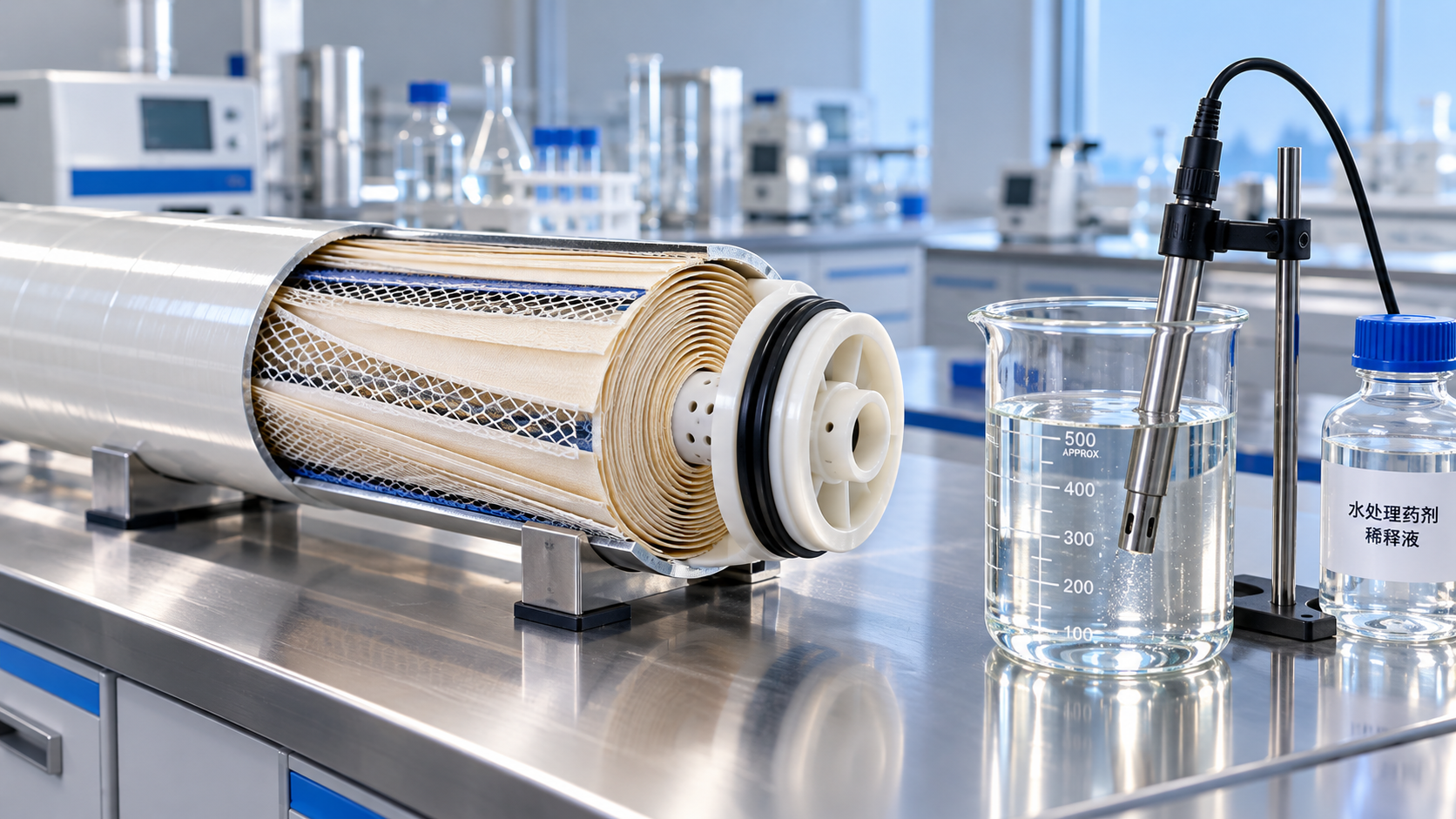
Water treatment chemicals are compatible with an RO membrane only when the exact formulation, concentration, temperature, pH, and exposure time fall within the limits established for that membrane element. A statement such as “suitable for polyamide” is insufficient for approval. The supporting evidence must address the installed element model and distinguish continuous dosing, intermittent treatment, cleaning, and preservation.
Compatibility also extends beyond the membrane surface. Feed spacers, permeate carriers, adhesives, seals, and pressure-vessel components contact treatment solutions. A chemical that leaves the selective layer intact can still damage a seal or weaken a bonded component. Approval therefore needs to cover the assembled element and the wetted equipment exposed during treatment.
Start with the installed membrane and its exposure limits
Most modern brackish-water and seawater RO elements use a thin-film composite polyamide selective layer. These membranes are sensitive to oxidants, and their allowable cleaning conditions vary by model. Cellulose acetate membranes have different chemical tolerances and operating restrictions. Neither material name provides enough information to transfer a chemical program from one installation to another.
The controlling documents are the current element datasheet, operating manual, cleaning guidance, and any written chemical approval applicable to the proposed product. Record the document revision and element designation. A compatibility statement issued for a different membrane family, an earlier formulation, or a different cleaning temperature leaves an unresolved gap.
Separate the limits into continuous operation, cleaning, and storage. A membrane’s permitted cleaning pH range can be wider than its operating range because cleaning occurs under restricted temperature and duration. That wider range does not authorize continuous chemical dosing at the same pH.
The chemical environment changes between the dosing point and the membrane
A dosing calculation describes the average concentration after mixing. It does not describe the concentrated chemical plume immediately downstream of an injection quill. Poor mixing, an unsuitable injection location, or chemical addition during low flow can expose the first elements to substantially different conditions from those measured in the bulk feed.
Acid and caustic injection deserve particular attention. Confirm dilution requirements, mixing distance, injection hardware, and pump interlocks against the actual hydraulic arrangement. Chemical dosing should stop when the associated water flow stops. Restart procedures must also prevent an accumulated slug from entering the pressure vessels.
Inside an operating RO element, retained solutes concentrate toward the concentrate end, while concentration polarization increases dissolved-solute levels near the membrane surface. Consequently, antiscalant selection requires a projection using the actual feed analysis, recovery, temperature, and relevant operating extremes. Feed concentration alone does not establish protection against precipitation within the array.
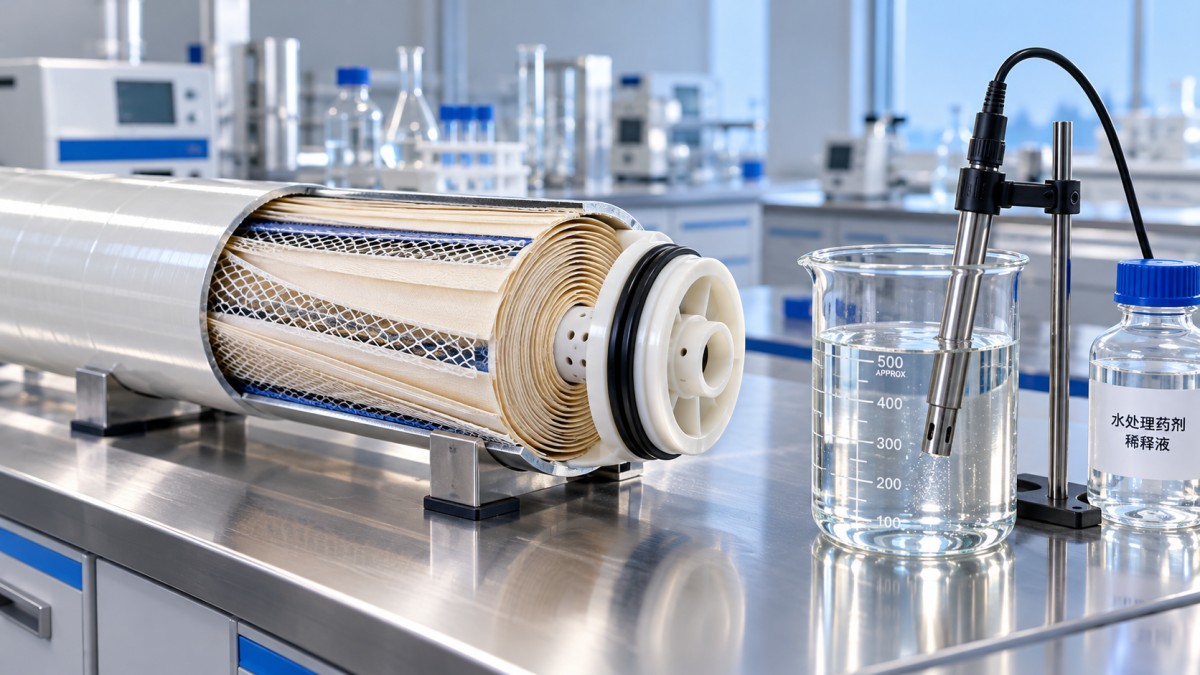
The same reasoning applies to chemical interactions. Residual cationic coagulants can interact with anionic antiscalants and form deposits. An antiscalant can have acceptable compatibility with membrane materials yet perform poorly in water containing carryover from upstream clarification. Compatibility evaluation must therefore include pretreatment chemicals and realistic carryover conditions.
Oxidants require a separate assessment
For polyamide RO, free chlorine is a primary concern because oxidation can damage the selective layer and increase salt passage. Damage depends on exposure conditions, including pH, temperature, and the presence of catalytic metals. A cumulative exposure allowance, where published, should not be treated as a routine operating target or a guarantee against damage.
Chloramine chemistry also requires model-specific guidance. A restriction stated for free chlorine cannot automatically be interpreted as approval for combined chlorine. Other oxidants, including peroxide-containing treatments and peracetic acid formulations, need explicit assessment at the proposed concentration, temperature, and contact time.
Where a reducing agent removes an upstream oxidant, verify the residual at the membrane inlet under changing feed conditions. Oxidation-reduction potential is useful as a process indicator, but it does not directly measure a specific oxidant concentration. The analytical method must suit the oxidant and detect residuals at the level relevant to the membrane restriction.
Dechlorination itself needs controlled dosing. Excess reducing agent does not provide unlimited additional protection and can alter downstream biological conditions. The injection system, mixing arrangement, monitoring location, and response to loss of chemical feed all affect whether the membrane receives adequately treated water.
Antiscalants, cleaners, and biocides need different evidence
Antiscalants: material compatibility and scale control are separate findings
An antiscalant approval should establish that the formulation is acceptable for the membrane at its intended dose. A separate scale projection should establish that the proposed program controls the relevant precipitation risks. Passing either assessment does not replace the other.
The projection needs a sufficiently complete water analysis. Calcium carbonate, sulfate salts, silica, and metal-related deposits respond differently to water chemistry and operating conditions. An incomplete analysis can produce an apparently acceptable dose while overlooking a limiting constituent. Acid addition also changes carbonate chemistry and must be reflected in the projection.
Request evidence for the commercial formulation, including relevant impurities and formulation aids, rather than only its principal active ingredient. A generic phosphonate or polymer description cannot establish compatibility for every product containing that chemistry. Any formulation substitution requires review, even when the stated active content remains unchanged.
Cleaners: combine pH, temperature, and duration
Cleaning limits form a combined operating envelope. The highest permitted temperature at a mild pH may exceed the permitted temperature at an extreme pH. Selecting the maximum pH and maximum temperature from separate lines of a datasheet can therefore create an unapproved cleaning condition.
Evaluate the working solution after dilution and again during circulation. Deposits consume cleaning chemicals, and dissolved foulants change solution composition. Measurements taken only in the preparation tank do not establish the conditions returning from the membrane array. Record pH and temperature at locations that reveal the actual exposure.
Cleaner selection should follow foulant identification. Acid cleaning is appropriate for certain mineral deposits, while alkaline formulations address many organic deposits and biological residues. The sequence matters: an unsuitable first step can make remaining material harder to remove. Mixed fouling requires a justified sequence, compatible rinsing, and control of chemical carryover between stages.
Surfactants, chelants, solvents, and other additives also need review. A solution within the permitted pH range can still contain an incompatible ingredient. Household detergents and unspecified industrial cleaners lack the formulation control needed to infer suitability from pH alone.
Biocides: antibacterial activity does not establish RO suitability
Biocide acceptance requires both membrane compatibility and evidence of effectiveness under the intended treatment conditions. A nonoxidizing product still needs assessment of concentration, contact time, water chemistry, and rinse requirements. Compatibility with the selective layer does not establish compatibility with elastomers or bonded components.
Pharmaceutical antibacterial activity provides no basis for selecting an RO biocide. For example, Streptomycin sulfate CAS#3810-74-0 is an antibiotic associated with tuberculosis treatment; that application does not establish membrane compatibility, suitability for controlling RO biofilms, or acceptability in a water-treatment program. Its appearance in a chemical catalog is insufficient evidence for such use.
Biological deposits also require a removal strategy. Killing microorganisms does not remove the accumulated extracellular material responsible for flow restriction and pressure loss. Treatment effectiveness should therefore be assessed alongside cleaning performance and the conditions allowing regrowth.
Turn supplier documentation into an approval decision
A safety data sheet supports hazard communication and handling, but it rarely contains enough information to establish membrane compatibility. A certificate of analysis describes specified batch properties; it does not demonstrate acceptable long-term membrane performance. Technical approval requires a connection between the supplied product and the intended exposure.
The evidence package should identify the product and formulation revision, applicable membrane models, approved concentration range, exposure duration, temperature, pH conditions, and any exclusions. Where a proprietary formulation prevents full disclosure, a written compatibility statement must still define the tested or approved conditions clearly.
Distinguish a membrane manufacturer’s approval from a chemical supplier’s declaration. Both are useful, but they have different evidential weight. If their limits conflict, resolve the discrepancy before treatment. A general claim covering “all RO membranes” cannot override a model-specific restriction.
For an uncertain application, testing should address the unresolved question. Material screening can reveal obvious incompatibility, but a flat membrane coupon does not represent a complete spiral-wound element. It omits adhesives, seals, spacers, and the hydraulic conditions that influence deposition.
A controlled element trial should define baseline performance, water composition, chemical exposure, and acceptance criteria in advance. Track normalized permeate flow, normalized salt passage, and differential pressure. Compare results at equivalent conditions; raw flow and conductivity change with temperature, feed salinity, pressure, and recovery even without membrane damage.
Interpret performance changes before assigning a cause
An increase in permeate conductivity does not by itself prove chemical attack. Feed salinity changes, damaged interconnectors, seal leakage, and operating changes can produce similar observations. Conversely, acceptable conductivity immediately after treatment does not establish that every exposed component remains sound.
Oxidative damage often appears as increased normalized salt passage and can accompany increased permeability. Fouling commonly reduces normalized flow or raises differential pressure, but these patterns overlap. Evaluate the timing, chemical records, stage-specific measurements, and mechanical condition before attributing a change to one mechanism.
After cleaning or biocide treatment, flush according to the applicable membrane and chemical instructions. Confirm removal using measurements relevant to the formulation; pH alone will not demonstrate removal of every surfactant, preservative, or biocide. Product-water release criteria must reflect the intended water use.
The final approval record should state the exact product, membrane model, dosing or cleaning conditions, monitoring requirements, and triggers for reassessment. A change in formulation, membrane type, feed composition, recovery, or cleaning temperature can invalidate the original conclusion and requires the affected compatibility evidence to be reviewed.
Related Picks
 Butylated Hydroxytoluene Price Drivers: Supply, Purity, and Purchasing Risk FactorsOct 21, 2026Butylated Hydroxytoluene price trends depend on supply stability, purity, logistics, and purchasing risk. Learn how to compare quotes wisely and reduce sourcing costs.
 Sodium Tripolyphosphate Price Trends: Raw Material and Energy ExposureOct 20, 2026Explore sodium tripolyphosphate price trends, from phosphate and soda ash costs to energy exposure. Learn how to compare quotes, manage sourcing risks, and make smarter purchasing decisions.
 Acetonitrile Shipment to Vietnam Successfully Dispatched; RCEP Benefits Boost Fine Chemical Trade with ASEANSep 16, 2026A shipment of industrial-grade acetonitrile from our company has recently been loaded and dispatched following the completion of standardized hazardous material packaging and container securing procedures.
 Nigerian Client’s Order of 4 Containers of Vinyl Acetate Successfully Loaded and Shipped to West AfricaSep 16, 2026We recently completed the loading of a vinyl acetate order for a Nigerian client; four containers of the product have been successfully packed and are ready for shipment to Nigeria.




Question Consultation
Send Us Your Inquiry Today

Luxi Chemical is a professional chemical product supplier with ample stock of all chemical categories and excellent quality, welcome your purchase inquiry.

