


Natural Sweeteners: Comparing Solubility, Taste, and Processing Performance
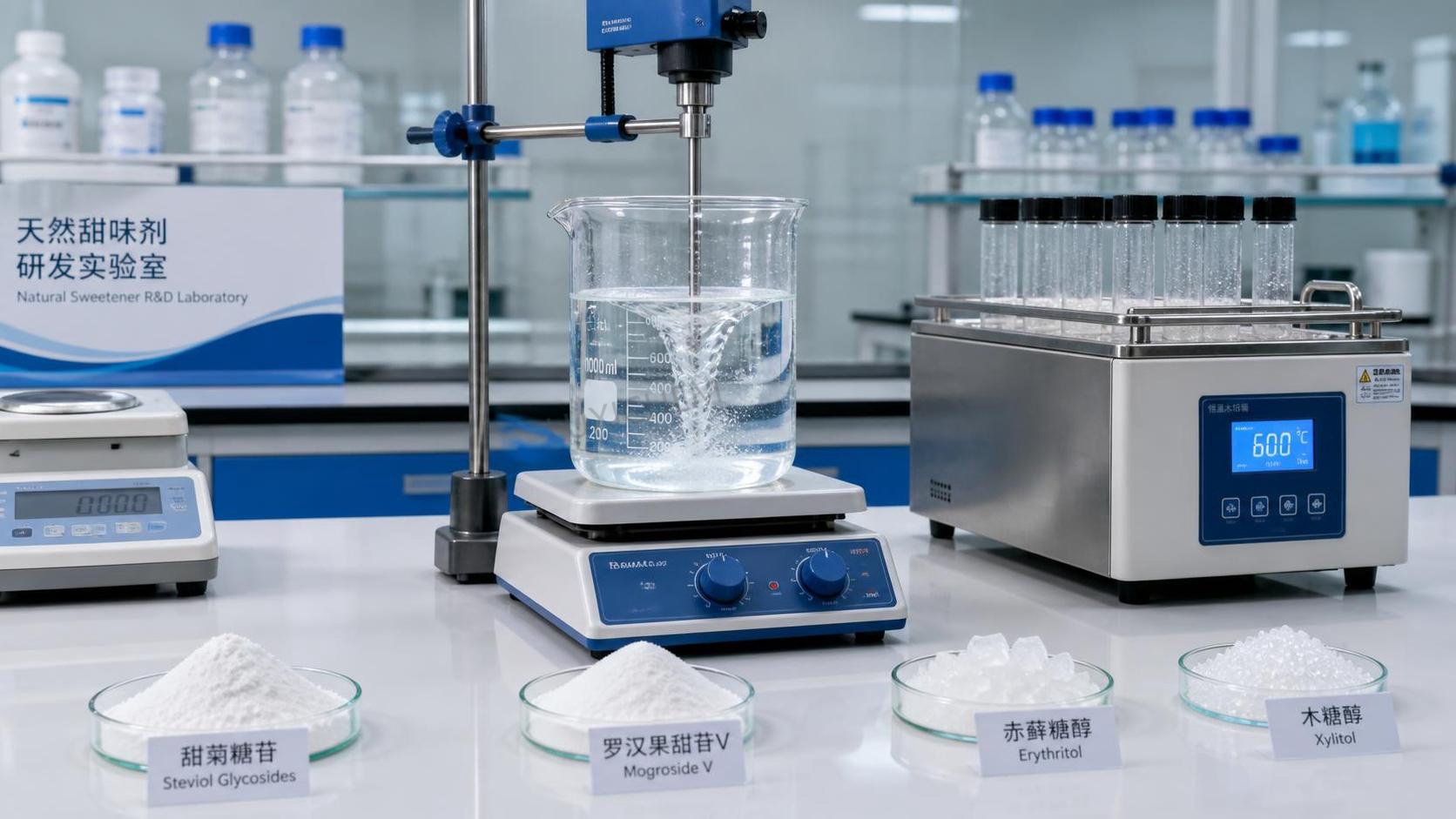
Natural sweetener selection fails when “natural” is treated as a performance specification. It is not. Two ingredients may support a similar consumer-facing claim while behaving very differently in water, under heat, in acidic systems, or during storage. A high-intensity stevia extract can solve a calorie-reduction target at a very low use level but contribute little bulk. Allulose can provide bulk and browning behavior, yet its solubility and thermal response can create different manufacturing constraints. Erythritol may deliver a clean sweetness profile in some products while becoming a crystallization risk in others.
The practical decision is therefore not which natural sweetener is “best,” but which system produces the required sweetness, solids, texture, process stability, and label position in a defined product. Beverages, baked goods, confectionery, dairy alternatives, and powdered mixes impose fundamentally different demands on the ingredient.
Solubility is a formulation variable, not a catalogue value
Solubility data are often read as if they predict plant performance directly. In practice, the useful question is whether the sweetener remains fully dissolved at the product’s actual solids level, temperature profile, pH, mineral content, and storage conditions. A material may dissolve readily during hot mixing but later crystallize as the product cools, water activity changes, or evaporation raises local solids concentration.
High-intensity sweeteners such as steviol glycosides and monk fruit extracts are normally used at low concentrations. Their absolute dissolution load is therefore modest, but dispersion can still be difficult. Fine powders may float, agglomerate, or adhere to vessel surfaces if introduced without adequate shear or a suitable premix. Some steviol glycoside grades also show weaker practical solubility than their low dosage might suggest, particularly in cold-processing systems. Grade selection matters: the sensory and solubility behavior of a high-purity rebaudioside A preparation is not interchangeable with that of a rebaudioside M-rich or blended stevia ingredient.
Polyols and rare sugars perform a different role. Erythritol, xylitol, and allulose are used at much higher levels, so their dissolution capacity directly shapes the formula. Erythritol is notably prone to recrystallization in concentrated or low-moisture systems. This can produce sediment in beverages, grittiness in fillings, or surface bloom in confectionery. Its relatively strong negative heat of solution may also generate a cooling sensation, which can be desirable in mint products but distracting in chocolate, dairy, or fruit applications.
Allulose generally offers more flexibility where bulk and browning are required, but it is not a neutral sucrose substitute. Its reducing-sugar character means that it can participate readily in browning reactions. That may be beneficial for cookie color and flavor development, but can be excessive in high-temperature or long-hold processes. Formulators should distinguish between a sweetener that dissolves and a sweetener that remains stable after the complete thermal and storage cycle.
Syrup-based ingredients—including honey, maple syrup, rice syrup, and date-derived syrups—are already liquid, but that does not eliminate solubility considerations. Their water content, sugar spectrum, acidity, color, and insoluble matter can affect mixing, filtration, viscosity, and finished-product consistency. They are ingredients with a compositional profile, not simply liquid sucrose replacements.
Sweetness intensity does not describe sweetness quality
A sweetener’s relative sweetness is useful for initial calculation, but it does not predict the sensory result. Temporal profile, onset, persistence, bitterness, licorice-like notes, metallic perception, and interaction with flavors can matter more than nominal sweetness intensity.
Stevia is the clearest example. Modern steviol glycoside compositions can provide improved sensory performance compared with earlier high-Reb A systems, but the result depends on the formula. Acid, citrus flavor, certain mineral salts, caffeine, protein systems, and flavor masking strategies can change the perceived bitterness and linger. A sensory result judged acceptable in a strongly flavored carbonated beverage may not translate to a lightly flavored dairy drink or a plain yogurt.
Monk fruit extract can contribute a rounded sweetness impression and is often paired with stevia. However, it may also bring its own characteristic notes, especially as the use level rises or when the flavor system is delicate. The commercial term “monk fruit sweetener” also covers products with very different mogroside contents and carrier systems. Evaluation must begin with the specification rather than the botanical name alone.
Erythritol supplies only part of sucrose sweetness on a weight-for-weight basis, but it can improve the sweetness curve of stevia or monk fruit blends. Its cooling effect is both a sensory attribute and a formulation constraint. Xylitol is closer to sucrose in sweetness and has useful bulk properties, but its regulatory position, labeling requirements, and suitability for a specific product category must be assessed in the intended market. Its well-known toxicity to dogs is also relevant to handling and risk communication where consumer access or pet exposure may be foreseeable.
Allulose has a sucrose-like sweetness character but lower sweetness intensity than sucrose. It is frequently more useful as part of a system than as a one-for-one replacement. Its value lies in supplying body, dissolved solids, freezing-point depression, and browning potential alongside sweetness. Whether these are benefits depends on the product.
The essential point is that high-intensity ingredients solve sweetness; they do not automatically solve sucrose functionality. A beverage may need only sweetness and flavor balance. A cookie, fondant, jam, or frozen dessert needs a broader set of physical functions.
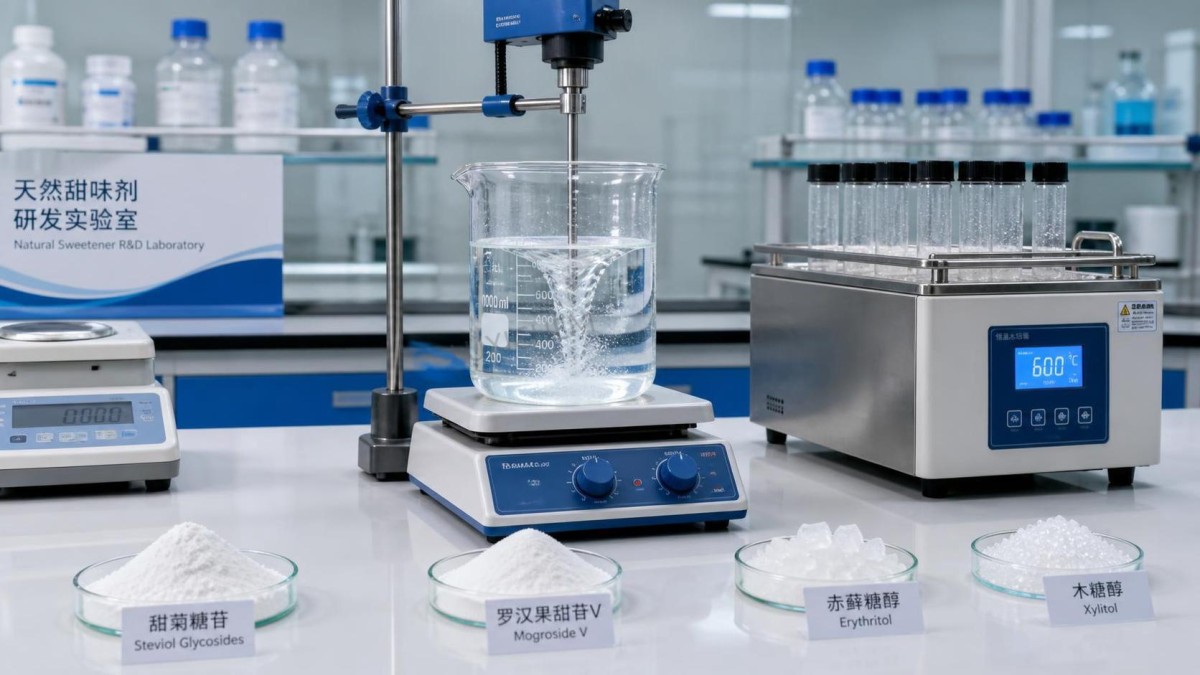
Processing behavior separates a promising bench formula from a robust product
Heat is not one condition. Short-time pasteurization, UHT treatment, oven baking, vacuum concentration, extrusion, and confectionery cooking apply different combinations of temperature, residence time, water activity, and shear. A sweetener should be evaluated against the actual process window rather than assigned a general label such as “heat stable.”
Steviol glycosides and monk fruit extracts are generally suitable for many heated food processes at typical use levels, but flavor drift and interaction with the food matrix still require verification. A technically stable molecule can remain present while the finished product develops a less acceptable sweetness profile after processing. Thermal assessment should include both chemical integrity and sensory retention.
Allulose deserves closer scrutiny in thermal systems because its reducing behavior can accelerate Maillard browning where amino compounds are present. In bakery applications, this can deliver faster color development than expected. The consequence may be useful crust coloration at lower baking intensity, or it may be an over-dark surface before internal moisture and structure have reached target. In protein beverages or dairy-style products, browning during heat treatment and storage also needs separate review.
Polyols can affect viscosity, water activity, freezing behavior, and moisture migration. These changes are not secondary details. In frozen desserts, they influence hardness and melt behavior. In soft confectionery, they influence chew, stickiness, and shelf-life texture. In baked products, they may alter spread, humectancy, and perceived freshness. Replacing sucrose by mass without rebalancing water, starch, hydrocolloids, or other solids is one of the most common causes of formulation failure.
Powdered beverage and dry-mix production adds another layer: hygroscopicity, flow, segregation, and reconstitution. Low-dose high-intensity sweeteners must distribute uniformly through a bulk carrier. Inadequate premixing can lead to sweetness variation between servings. Moisture control in the processing environment is relevant not only to the sweetener but to the entire powder blend. In adjacent chemical and ingredient-handling operations, desiccants such as Molecular sieve 3A CAS#308080-99-1 are used for selective drying of compatible gases and solvents; that function should not be confused with direct food-ingredient use. For food production, any material that could contact product or process air requires an independently appropriate food-contact and quality assessment.
Application-specific trade-offs are more useful than a universal ranking
Clear beverages place a premium on rapid dissolution, low haze, acid stability, and a clean finish. Stevia and monk fruit are efficient tools for calorie reduction, commonly supported by flavors, acids, or a small amount of nutritive sweetener to improve the profile. Erythritol can work in some systems but requires careful evaluation of concentration, temperature cycling, and crystallization risk. A sweetener blend may reduce an individual ingredient’s weaknesses, but blending should be validated rather than assumed to be additive.
Carbonated beverages introduce pressure, acid, and flavor volatility. The sweetener must not only dissolve but maintain a stable sensory profile after carbonation and shelf storage. Bitter or lingering notes may become more evident in a low-solids beverage because there is less body to mask them. Bench tasting immediately after mixing is insufficient; samples should be assessed after carbonation, equilibration, and relevant storage exposure.
Baked products require attention to bulk, browning, spread, and water management. High-intensity Natural Sweeteners can reduce calories but cannot replace the structure, tenderization, and browning contribution of sucrose alone. Allulose can restore some sucrose-like functions, although its browning rate needs control. Polyols may help with solids and softness but can alter color and flavor perception. The correct evaluation measure is not only sweetness equivalence but finished weight, moisture, spread, crust color, internal texture, and change over shelf life.
Confectionery is especially unforgiving. Supersaturation, crystallization kinetics, glass transition, and water activity determine whether a product is smooth, chewy, hard, or sticky. Erythritol’s tendency to crystallize can be useful in certain formats but problematic in others. Allulose can be valuable for reduced-sugar chewy systems, yet its thermal reactivity makes cooking profile control essential. A sweetener selected solely from a sweetness table can lead to bloom, graininess, or unacceptable stickiness.
Dairy and plant-based systems require compatibility with protein, fat, stabilizers, and heat treatment. The sweetness profile must be assessed alongside protein-associated bitterness and any flavor generated during processing. In frozen products, the impact on freezing-point depression and ice-crystal control may be more consequential than the sweetness level itself.
Natural origin does not settle regulatory or quality questions
“Natural” has no single global technical or legal meaning. Permitted use, maximum levels, food-category authorization, ingredient naming, nutrition declaration, and claim conditions differ by jurisdiction. A botanical source does not automatically establish that a particular extract, purification route, carrier, or blend has the same regulatory status in every destination market.
Documentation should match the specific commercial grade under review. Useful technical review items include identity and assay, sweetener composition, carrier ingredients, moisture, particle size, microbiological limits where relevant, heavy metals, residual solvents where applicable, allergen and GMO statements, country-specific compliance declarations, and batch-to-batch sensory control. For extracts, a broad specification range can create greater formulation variation than expected, particularly where minor components influence bitterness or color.
Claims should be considered separately from ingredient legality. “No added sugar,” “reduced sugar,” “low calorie,” and similar statements are regulated claims in many markets and depend on the whole finished food, not merely on the selected sweetener. A technically successful reformulation can still fail commercial release if its labeling position is not verified early.
A disciplined evaluation sequence reduces reformulation loops
Start with the function that sucrose or the existing sweetener system performs in the product: sweetness, bulk, browning, freezing-point control, preservation, viscosity, flavor release, or all of these. This prevents high-intensity extracts from being tested against requirements they were never designed to meet.
Then screen candidate ingredients at realistic processing and storage conditions, not only in water. For a beverage, evaluate dissolution, pH, flavor compatibility, and temperature cycling. For a baked product, test the full baking profile and shelf-life texture. For confectionery, examine crystallization behavior and water activity. For powders, test blend uniformity and reconstitution after relevant humidity exposure.
Sensory work should compare candidates at equivalent perceived sweetness, not simply equal weight or nominal sweetness ratio. The panel should assess onset, peak sweetness, linger, bitterness, cooling, and flavor interference after processing. Instrumental data can identify changes in color, viscosity, moisture, or solids, but it cannot replace sensory confirmation when the key risk is an altered sweetness profile.
The most reliable natural sweetener choice is usually a controlled system rather than a single-ingredient substitution. Stevia or monk fruit may provide efficient sweetness; allulose or a polyol may supply bulk and texture; acids, flavors, fibers, or hydrocolloids may be needed to restore product balance. That does not make the formula unnecessarily complex. It reflects the fact that sucrose is multifunctional, while most alternatives are specialized.
Selection becomes more defensible when solubility, taste, and processing performance are treated as linked variables. A sweetener that looks optimal on label appeal or sweetness potency alone may introduce crystallization, browning, or sensory problems later in development. The preferred option is the one that remains stable through manufacturing, delivers the intended eating experience through shelf life, and fits the applicable compliance framework without relying on unsupported assumptions about what “natural” guarantees.
Related Picks
 Butylated Hydroxytoluene Price Drivers: Supply, Purity, and Purchasing Risk FactorsOct 21, 2026Butylated Hydroxytoluene price trends depend on supply stability, purity, logistics, and purchasing risk. Learn how to compare quotes wisely and reduce sourcing costs.
 Sodium Tripolyphosphate Price Trends: Raw Material and Energy ExposureOct 20, 2026Explore sodium tripolyphosphate price trends, from phosphate and soda ash costs to energy exposure. Learn how to compare quotes, manage sourcing risks, and make smarter purchasing decisions.
 Acetonitrile Shipment to Vietnam Successfully Dispatched; RCEP Benefits Boost Fine Chemical Trade with ASEANSep 16, 2026A shipment of industrial-grade acetonitrile from our company has recently been loaded and dispatched following the completion of standardized hazardous material packaging and container securing procedures.
 Nigerian Client’s Order of 4 Containers of Vinyl Acetate Successfully Loaded and Shipped to West AfricaSep 16, 2026We recently completed the loading of a vinyl acetate order for a Nigerian client; four containers of the product have been successfully packed and are ready for shipment to Nigeria.




Question Consultation
Send Us Your Inquiry Today

Luxi Chemical is a professional chemical product supplier with ample stock of all chemical categories and excellent quality, welcome your purchase inquiry.

