


Plant Extract Manufacturing: Which Processing Steps Affect Consistency?
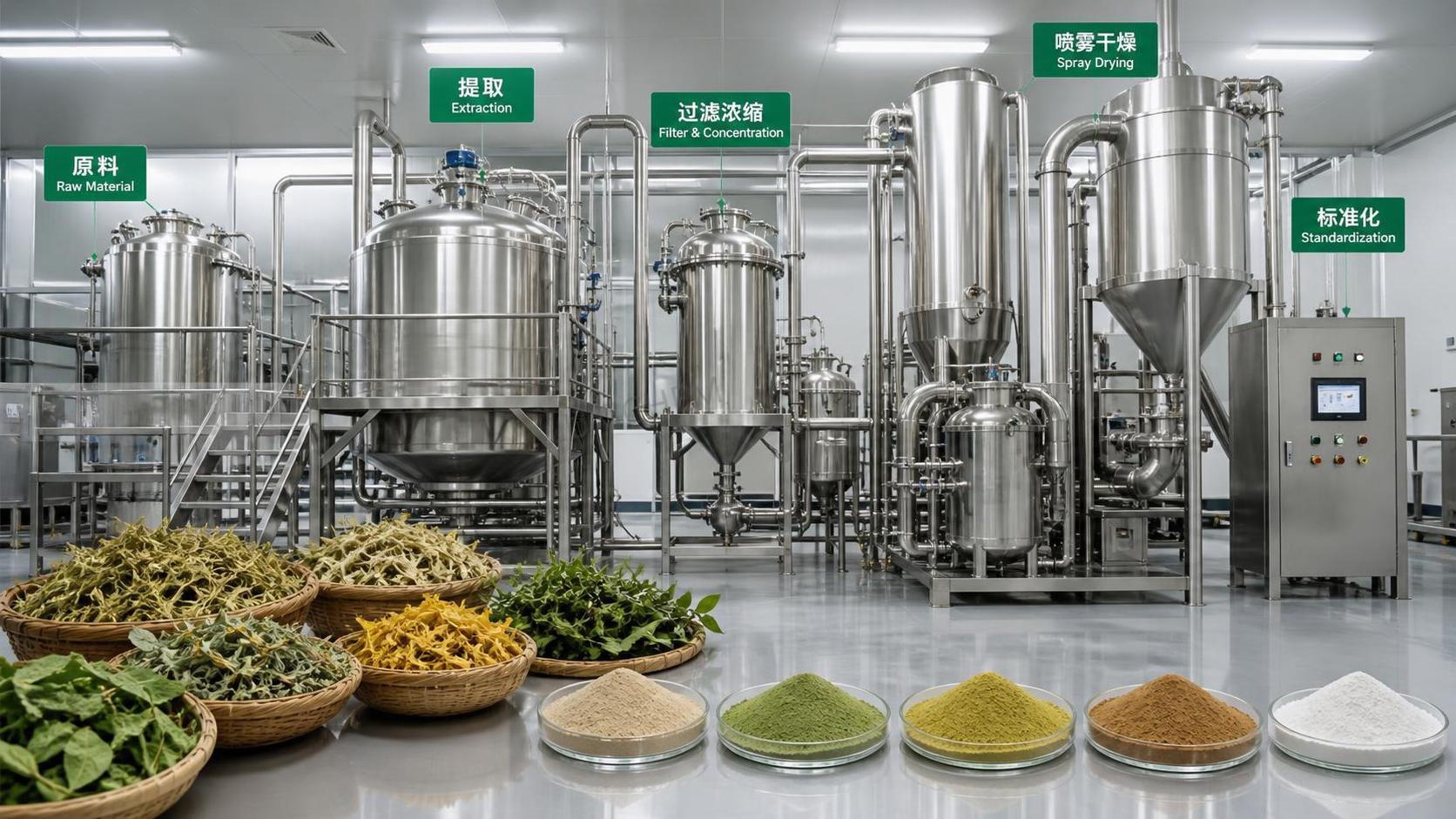
Consistency in plant extract manufacturing is determined by the combined effect of botanical variability and process control. A supplier can use the correct plant species and still produce batches that differ in marker content, color, odor, solubility, microbial status, or performance in a finished formulation. For technical evaluators, the practical question is therefore not simply whether an extract meets a single assay result. It is whether the manufacturing process controls the variables that cause the extract to move outside an acceptable operating range over repeated production lots.
The highest-impact steps are usually raw-material qualification, drying and milling, extraction, liquid-solid separation, concentration, drying, and final standardization. These stages should be reviewed as a connected process. A tight final assay specification cannot fully compensate for poor traceability, variable starting material, excessive thermal exposure, or an unstable powder-making process.
Start with the botanical material, not the finished powder
Plant Extracts inherit much of their variability from the agricultural material. Species identification is only the first check. The plant part, harvest period, growing conditions, maturity, post-harvest handling, and storage duration can all shift the profile of target and non-target compounds. Leaves, roots, fruits, seeds, and bark from the same botanical source may have very different chemical distributions. A specification that identifies only the botanical name leaves substantial room for inconsistency.
A capable raw-material control system should establish more than a name on a purchase record. It should define the approved plant part, acceptance criteria for moisture and foreign matter, handling limits after harvest, and methods used to prevent substitution or mixing. For materials susceptible to adulteration, identity testing should be proportionate to the risk and should distinguish the intended botanical from plausible substitutes.
Technical reviewers should also ask how incoming material is sampled. Botanical lots are inherently heterogeneous. A small sample taken from a large bale or mixed delivery can miss high-moisture areas, foreign material, or uneven distribution of active constituents. The sampling plan should reflect the physical form of the material and the lot size, rather than treating every consignment as a uniform powder.
Drying can preserve or distort the chemical profile
Drying is often described as a basic preservation step, but it is also an early compositional control point. If residual moisture remains too high, microbial growth and enzymatic activity may continue during storage. If drying temperature or exposure time is too severe, heat-sensitive constituents may degrade, volatile fractions may be lost, and color may darken. The appropriate window differs by botanical material and by the compounds being protected.
Uniformity matters as much as the nominal drying temperature. Dense roots and bark can retain internal moisture after their surfaces appear dry, while thin leaves may become over-dried quickly. Evaluators should look for process records that demonstrate control of endpoint moisture and, where relevant, evidence that the drying method is compatible with the extract’s intended marker profile. A supplier that reports only a finished-product moisture result provides less assurance than one that controls both the raw material and the final powder.
Milling follows closely behind. Particle size affects extraction kinetics because it changes exposed surface area and solvent penetration. Finer material may improve recovery, but excessive milling can raise local temperature, create more fines that complicate filtration, and expose sensitive compounds to oxygen. A defined milling range, rather than an uncontrolled “fine powder” description, supports more reproducible extraction behavior.
Extraction conditions determine more than yield
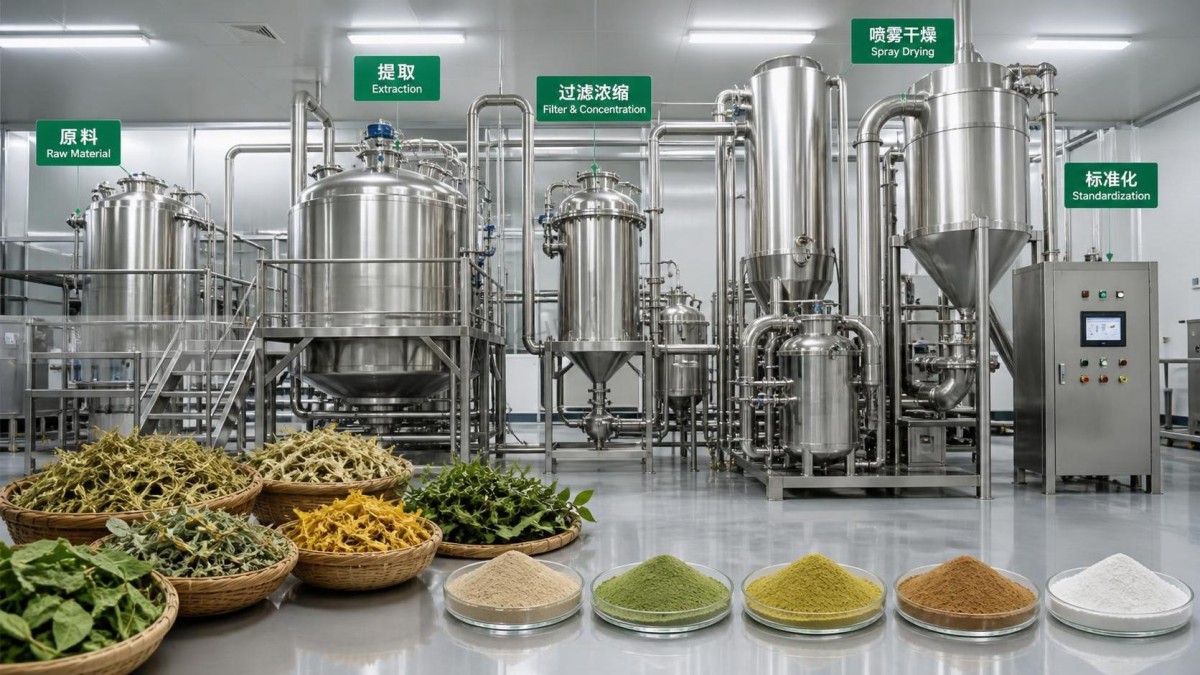
Extraction is the stage most often associated with potency, yet its effect is broader. Solvent type, solvent-to-solid ratio, extraction temperature, contact time, agitation, pH, number of extraction cycles, and whether the system is open or closed all influence the chemical profile. Adjusting one parameter to improve yield can increase co-extraction of sugars, tannins, chlorophyll, waxes, proteins, resins, or other compounds that later affect color, odor, viscosity, filterability, and formulation compatibility.
For example, an extract with a satisfactory marker assay may still be difficult to dissolve because process conditions concentrated a larger share of hydrophobic co-components. In food or daily chemical applications, this can appear later as sediment, haze, odor variation, or color drift. In agricultural formulations, variation in the non-marker fraction may influence dispersibility, tank-mix behavior, or stability under different water conditions.
A robust manufacturing specification therefore links the target constituent to a controlled extraction window. It does not rely only on the broad instruction to use water, ethanol, or another solvent. Reviewers should seek clear limits for key conditions, defined controls for reused solvent where applicable, and a rationale for the chosen extraction sequence. If a material is standardized after extraction, it remains important to know whether the base extract profile is stable before the standardization adjustment is made.
Solvent management deserves particular attention. Residual solvent requirements depend on the intended market and application, but residual testing alone is not the full question. Water quality, solvent purity, solvent recovery practices, and the possibility of cross-contact with other extracts can affect both compliance and product behavior. A shared extraction line is not inherently unsuitable, provided cleaning, segregation, and changeover controls are sufficient for the materials processed.
Clarification and concentration are common sources of hidden variation
Once the extraction liquor has been produced, filtration and concentration can introduce variation that is less visible in a product specification. Filtration removes insoluble material, but it can also retain or pass colloidal fractions depending on filter media, pore size, pressure, temperature, and loading. A high-solids batch may require more aggressive filtration than usual, causing a shift in appearance or in the relative amount of compounds carried into the concentrate.
Concentration increases this sensitivity. Vacuum level, temperature, residence time, and endpoint solids all affect the concentrate. Heat-sensitive compounds may decline during extended concentration; viscous concentrates can be difficult to mix uniformly; and local overheating can create darker material or insoluble matter. Changes in solids content also alter the way a concentrate behaves in downstream drying equipment.
For this reason, a technical assessment should not treat color variation automatically as cosmetic. Color can change for harmless botanical reasons, but it can also signal oxidation, thermal exposure, altered clarification, or a higher proportion of non-target components. The right response is to compare color alongside assay, chromatographic profile where relevant, moisture, solubility, and manufacturing history. A single visual attribute is rarely enough to identify the cause.
Process-document review becomes especially valuable when a buyer handles both botanical ingredients and conventional chemical raw materials. The assessment discipline is similar, but the critical variables differ. A material such as Potassium hexafluorotitanate CAS#16919-27-0 can be assessed largely through defined chemical identity, physical properties, and impurity controls. Plant extracts require those controls plus a stronger examination of source-material variation and process history, because a consistent assay does not necessarily represent a consistent multi-component profile.
Drying and carrier selection shape the final material
The transition from liquid concentrate to a saleable powder is frequently where a process that looks controlled on paper becomes difficult to reproduce. Spray drying, vacuum drying, freeze drying, and other methods impose different stresses on the extract. The chosen approach affects moisture, bulk density, particle morphology, hygroscopicity, reconstitution behavior, and retention of volatile or heat-sensitive components.
Spray drying can support efficient powder production, but it requires control of feed solids, feed viscosity, inlet and outlet conditions, atomization, and powder collection. A small change in feed composition may alter droplet formation and create more fine particles, lower bulk density, or poor flow. If the extract contains sugars, gums, or other sticky fractions, wall deposition and variable recovery can become meaningful production issues.
Carriers and processing aids should be evaluated as functional components, not as minor footnotes. They can improve drying yield, flowability, and storage stability, but they also change the concentration of the native extract and may influence solubility or sensory properties. The final specification should make the carrier system clear, including whether its level is fixed, permitted within a range, or adjusted batch by batch to meet a target assay.
Batch standardization deserves careful interpretation. Standardization can be a valid way to provide predictable marker content, particularly when natural raw materials vary. Its value depends on how it is performed. Adding a defined amount of a permitted carrier or blending compatible lots may provide consistent functional strength. However, a batch that reaches the target assay through substantial adjustment can still differ materially in its broader profile from another batch at the same assay level. Where formulation performance depends on more than one identified marker, comparative fingerprinting or application-relevant performance testing may be more informative than a single numerical result.
Release testing should match the use case
A certificate of analysis is necessary, but its usefulness depends on whether the test panel addresses the risks of the intended application. Identity, marker assay, moisture, microbial limits, heavy metals, pesticide residues, residual solvents, and foreign matter are common considerations, though the appropriate controls depend on the botanical, extraction solvent, use level, and regulatory route of the final product.
For a technical evaluator, the more useful question is: which characteristics could make this extract fail in our formulation or market? A water-soluble beverage ingredient may require strong attention to clarity, odor, flavor contribution, and dissolved stability. A topical formulation may require focus on color stability, compatibility with surfactants and preservatives, microbial robustness, and absence of insoluble particles. An agricultural product may need practical checks on dispersion, storage behavior, and compatibility with the rest of the formulation.
- Identity: Confirm that the method can distinguish the intended botanical and plant part from plausible substitutes.
- Potency: Define the marker or marker range, but avoid treating it as the entire compositional profile.
- Physical behavior: Check particle size, bulk density, moisture, solubility or dispersibility, and appearance when these affect processing.
- Contaminant control: Align microbiological, residue, and elemental impurity testing with the source material and intended use.
- Stability: Review retention samples, trend data, and packaging suitability where color, odor, or potency can drift during storage.
Testing methods should be sufficiently specific for their decision purpose. A broad spectrophotometric result may be useful for routine monitoring, while chromatographic profiling may be more appropriate when closely related compounds, adulteration risk, or profile drift must be distinguished. Method validation should also be considered in practical terms: can the method reliably measure the material within the ranges the specification allows, and can results be compared across sites or laboratories when needed?
What to request before approving a supplier
The most productive supplier review combines documents with a focused process discussion. Ask for the manufacturing flow, but also ask where the supplier considers the process sensitive and how deviations are handled. A generic flowchart that lists “extract, filter, concentrate, dry” is less useful than a description of controlled ranges, in-process checks, rework policy, and batch blending practices.
Batch history is particularly valuable. Multiple recent certificates can show whether assay, moisture, color, and other relevant attributes remain within a narrow practical range rather than merely inside wide specification limits. Where a buyer has a demanding formulation, representative samples from more than one batch can reveal whether variation is operationally significant before commercial qualification.
Consistency is therefore built upstream and protected at every handoff. Raw botanical control limits the variability entering the plant. Extraction and separation determine the chemical profile carried forward. Concentration and drying establish the final powder’s physical behavior. Release testing verifies that the material remains fit for its intended use, but it should confirm a controlled process rather than serve as the only safeguard against process variation.
Related Picks
 Butylated Hydroxytoluene Price Drivers: Supply, Purity, and Purchasing Risk FactorsOct 21, 2026Butylated Hydroxytoluene price trends depend on supply stability, purity, logistics, and purchasing risk. Learn how to compare quotes wisely and reduce sourcing costs.
 Sodium Tripolyphosphate Price Trends: Raw Material and Energy ExposureOct 20, 2026Explore sodium tripolyphosphate price trends, from phosphate and soda ash costs to energy exposure. Learn how to compare quotes, manage sourcing risks, and make smarter purchasing decisions.
 Acetonitrile Shipment to Vietnam Successfully Dispatched; RCEP Benefits Boost Fine Chemical Trade with ASEANSep 16, 2026A shipment of industrial-grade acetonitrile from our company has recently been loaded and dispatched following the completion of standardized hazardous material packaging and container securing procedures.
 Nigerian Client’s Order of 4 Containers of Vinyl Acetate Successfully Loaded and Shipped to West AfricaSep 16, 2026We recently completed the loading of a vinyl acetate order for a Nigerian client; four containers of the product have been successfully packed and are ready for shipment to Nigeria.




Question Consultation
Send Us Your Inquiry Today

Luxi Chemical is a professional chemical product supplier with ample stock of all chemical categories and excellent quality, welcome your purchase inquiry.

