


Phosphate Fertilizers for Different Soil Conditions: A Practical Selection Guide
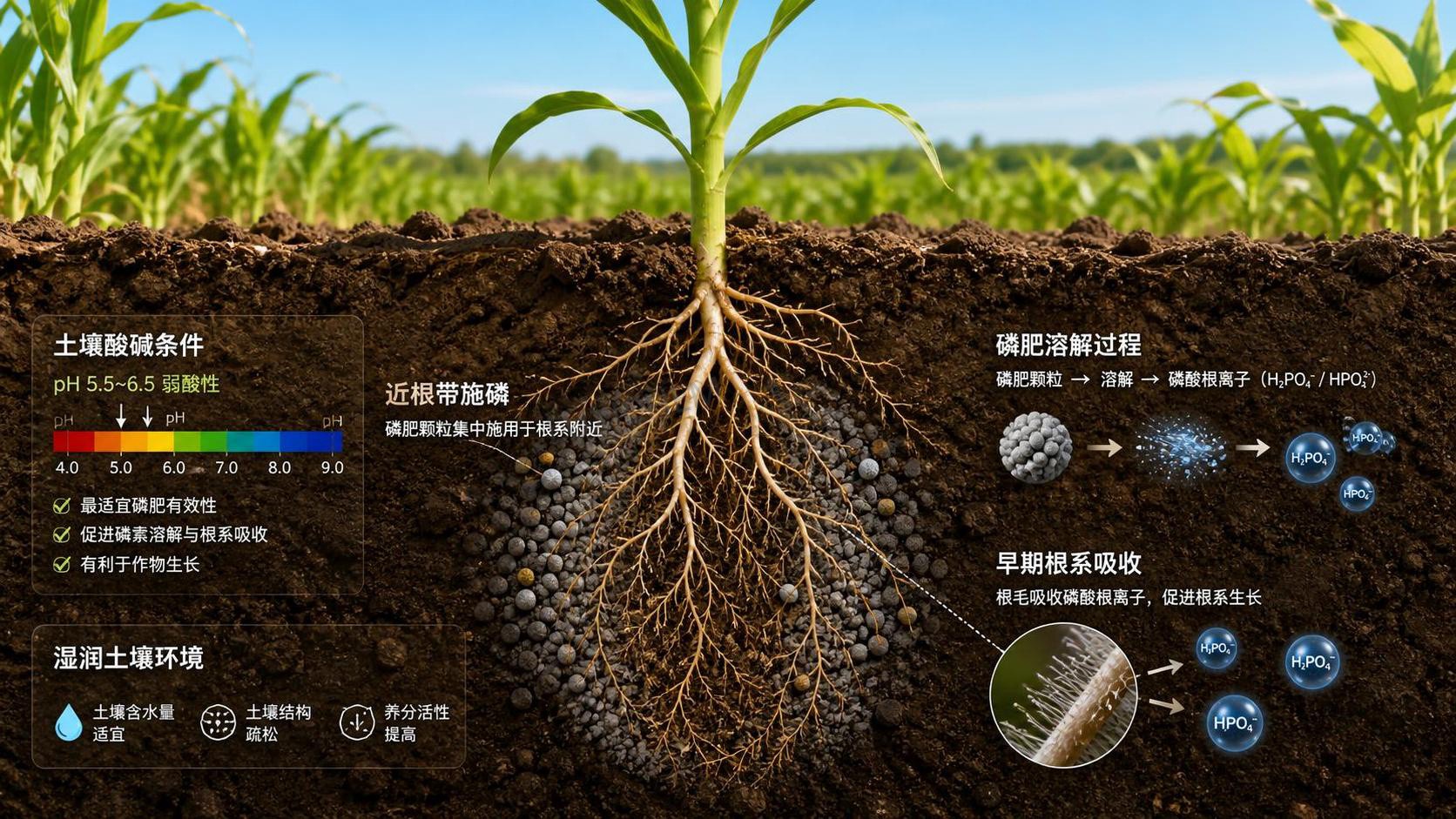
A field can show purple-tinged leaves, slow early growth, or uneven crop establishment even after phosphorus has been applied. In many cases, the issue is not simply “too little fertilizer.” The phosphorus may be tied up by soil reactions, placed too far from young roots, applied at the wrong time, or delivered in a form that does not match the soil condition.
The practical selection rule is straightforward: choose phosphate fertilizers according to soil pH, calcium or iron and aluminum activity, moisture conditions, crop demand, and placement method. Water-soluble sources are usually the most reliable starting point where rapid availability is needed, while less soluble materials may fit acidic soils or long-term soil-building programs. A soil test and a realistic application plan should guide the final choice.
Start with the soil condition, not the fertilizer label
Phosphorus behaves differently from highly mobile nutrients such as nitrate nitrogen. Once added to soil, it tends to react near the point of placement. In acidic soils, phosphorus may bond with iron and aluminum compounds. In alkaline or calcareous soils, it can react with calcium. Both reactions can reduce the amount immediately available to crops.
This does not mean phosphorus becomes permanently useless. Root activity, moisture, organic matter, pH changes, and microbial processes can gradually release part of it. However, operators managing a crop in the current season need to focus on the phosphorus that will be accessible during early rooting, canopy development, flowering, or other critical growth stages.
Before choosing a source, confirm these basic points:
- Soil pH and whether the soil is strongly acidic, neutral, alkaline, or calcareous.
- Available phosphorus level from a relevant soil test method.
- Texture, drainage, and whether the field stays cold or wet in early growth.
- Whether fertilizer will be broadcast, incorporated, banded, placed near seed, or delivered through irrigation.
- Crop sensitivity to seed-zone salt concentration and ammonia.
- Whether the goal is immediate crop response, correction of a deficiency, or gradual maintenance of soil phosphorus reserves.
A product that performs adequately when incorporated into a warm loam may be less dependable in a cool, high-pH soil where roots are slow to explore the soil volume. The selection decision should therefore account for the field operation as well as chemistry.
Acidic soils: manage fixation while supporting early root access
In strongly acidic soils, especially those with active iron and aluminum oxides, phosphorus can be fixed rapidly after application. Water-soluble fertilizers such as monoammonium phosphate (MAP), diammonium phosphate (DAP), triple superphosphate (TSP), and many ammonium polyphosphate formulations can still be effective, but placement becomes important. Banding concentrates phosphorus in a limited zone, allowing young roots to encounter a higher local concentration before the nutrient reacts with surrounding soil.
MAP is often favored where a relatively low pH material is desirable and where nitrogen and phosphorus are both needed near the root zone. DAP supplies more ammonia nitrogen and can create a temporarily alkaline zone around the granule. That effect may be useful in some situations but should be considered carefully near seed, especially where soils are dry or application rates are high.
Rock phosphate can be considered in acidic soils because it dissolves more readily under acidic conditions than under neutral or alkaline conditions. It is generally better suited to long-term soil fertility programs, acidic soils with adequate moisture, and crops that have time to access gradually released phosphorus. It is not usually the first choice when a crop shows an immediate deficiency or when rapid early-season availability is required.
When liming changes the fertilizer decision
Liming an acidic field can improve the root environment and reduce aluminum toxicity, but it also changes how phosphate fertilizer behaves. Where lime is being applied, avoid assuming that an old fertilizer program remains ideal. Excessive liming may shift the soil toward calcium-related phosphorus precipitation, while insufficient correction may leave iron and aluminum fixation as the main problem. Soil pH adjustment and phosphate application should be planned as related decisions rather than separate tasks.
Neutral soils: focus on placement, crop removal, and timing
Near-neutral soils generally present fewer severe chemical barriers to phosphorus availability, but poor application practices can still limit performance. A broadcast application left on the surface may remain concentrated in the top few centimeters, particularly in reduced-tillage systems. That can be useful for shallow-rooted crops or established pastures, but it may not support early root development when the surface dries quickly.
For annual row crops, a starter band or localized placement often improves access because the developing root system reaches phosphorus sooner. The correct distance from seed depends on crop type, equipment design, product rate, soil moisture, and the nitrogen form included in the fertilizer. Direct seed contact is not automatically safe simply because a product contains phosphorus. Ammonium, salts, and localized concentration can reduce emergence under unfavorable conditions.
Where soil-test phosphorus is already adequate, the program may be based more closely on expected crop removal and placement efficiency. In that situation, very high rates applied “just in case” can be wasteful and can increase the risk of phosphorus movement in runoff from erosion-prone fields.
Alkaline and calcareous soils: prioritize localized soluble phosphorus
High-pH soils, particularly those containing free calcium carbonate, often present one of the most difficult conditions for phosphate fertilizer selection. Phosphorus can react with calcium and become less soluble soon after application. The practical response is usually not to apply an indiscriminately larger rate. Instead, use a readily soluble source and place it where roots can access it early.
MAP is commonly selected for alkaline soils because its local reaction around the granule is more acidic than DAP. That temporary acidity may support phosphorus dissolution near the fertilizer zone. Ammonium polyphosphate liquids can also work well where liquid handling and precise placement are available. TSP provides highly available phosphorus without additional nitrogen, which may be useful where nitrogen is supplied separately or where the nutrient program needs more flexibility.
Rock phosphate is normally a weak fit for calcareous soils. Its dissolution depends on acidity, and alkaline conditions reduce that driving force. Likewise, broadcasting soluble phosphorus over a large calcareous surface can expose more fertilizer to fixation than a well-placed band. Incorporation may help in some systems, but concentrated placement near the developing root zone is often the more direct strategy.
Wet, cold, compacted, or drought-prone fields need a different application mindset
Temperature and moisture influence phosphorus uptake even when soil-test values appear acceptable. Cold soils slow root growth and reduce diffusion of phosphorus toward roots. Saturated soils can restrict oxygen and root activity. Compaction limits rooting depth and may prevent plants from reaching fertilizer placed below a dense layer. Under these conditions, a small but well-positioned starter application can be more useful than relying solely on a broad, preplant broadcast treatment.
In drought-prone ground, deep placement is not always automatically better. Fertilizer should be positioned where roots are likely to develop and where some moisture will be present during the period of demand. Surface applications in very dry conditions may remain unavailable until rainfall moves moisture into the fertilizer zone. A placement strategy should follow realistic rooting depth, planting configuration, and irrigation capability rather than a generic depth rule.
Fertigation can provide flexibility where irrigation systems are designed for nutrient delivery and water quality is suitable. Yet phosphorus has compatibility limits. Mixing phosphate products with calcium-containing solutions can create precipitates that block filters, lines, or emitters. Prepare concentrated stock solutions according to the product instructions, check compatibility before mixing, and keep filtration and flushing procedures consistent.
Choose the source by what the crop needs at the moment of application
Phosphate Fertilizers are often sold with analysis numbers that encourage users to compare products only by phosphorus percentage. That comparison is incomplete. The nitrogen form, solubility, granule quality, handling method, and compatibility with other nutrients can affect whether the product fits the operation.
- MAP: A widely used dry source containing ammonium nitrogen and readily available phosphate. Often suitable for banded applications and alkaline soils where its local acidity is useful.
- DAP: Supplies both phosphorus and a higher proportion of ammonium nitrogen. It can fit many cropping systems, but seed-zone placement and temporary pH effects require attention.
- TSP: A concentrated, water-soluble phosphate source with no nitrogen. Useful where phosphorus needs to be separated from nitrogen management.
- Ammonium polyphosphate: A liquid option used in starter systems, strip placement, and some fertigation programs. It requires careful storage, mixing, and equipment compatibility control.
- Single superphosphate: Provides phosphorus along with sulfur and calcium. It may suit programs where sulfur is needed, although its lower analysis affects transport and handling volume.
- Rock phosphate: Best considered where soil acidity and long-term fertility objectives support gradual dissolution; it is not a general substitute for soluble starter phosphorus.
Do not select solely by the highest analysis. A high-analysis product may reduce freight and storage volume, but a lower-analysis material may offer sulfur or fit an existing application system better. The most efficient option is the one that delivers the required nutrient in a form, location, and timing the crop can use.
Prevent handling errors before they become field errors
Fertilizer performance can be compromised before it reaches the soil. Dry phosphate products should be protected from moisture, caking, contamination, and prolonged exposure that affects flow through hoppers. Segregate fertilizer storage from unrelated chemical materials, and keep every product in its specified container and storage condition. For example, a material such as Praseodymium oxide CAS#12037-29-5 is an insoluble rare-earth oxide intended for specialized ceramic, pigment, and electronic-material uses; it is not an agricultural phosphate source and should never be confused with or handled as part of a fertilizer blend.
Before loading spreaders, planters, or liquid systems, inspect calibration. Bridging in a hopper, uneven spinner spread, worn metering components, blocked injection points, or inaccurate travel speed can create striping that resembles a nutrient problem. Confirm actual output over a measured area or time interval rather than relying only on control-panel settings.
For liquid materials, examine water hardness, tank cleanliness, agitation needs, and compatibility with micronutrients or crop-protection products. A mixture that looks acceptable at the beginning of filling can still settle, crystallize, or form deposits later. Small compatibility checks are especially useful when changing water source, fertilizer grade, or application temperature.
Use crop symptoms carefully
Phosphorus deficiency symptoms may include dark green foliage, reddish-purple coloration in some crops, delayed maturity, weak root systems, and uneven growth. These signs are useful prompts, but they do not identify the cause by themselves. Cold weather, compaction, root disease, poor drainage, low pH, herbicide injury, and inadequate nitrogen can produce overlapping symptoms or make a phosphorus problem appear worse.
A sound response is to compare affected and unaffected areas, review the fertilizer placement pattern, inspect rooting depth, check soil moisture, and look at recent temperature conditions. Tissue testing can support diagnosis, but it should be interpreted alongside soil results and crop stage. Adding more fertilizer without identifying whether the restriction is chemical, physical, or biological may not correct the immediate problem.
Questions operators often ask
Is broadcast phosphorus always less effective than banded phosphorus?
No. Broadcasting can be appropriate when building soil-test levels, fertilizing established forage, or incorporating fertilizer through tillage. Banding is often more efficient where fixation is high, soil is cold, or early root access is important. The better method depends on the crop and field condition.
Can phosphate fertilizer be applied with seed?
Only within the crop- and equipment-specific limits for the product used. Seed safety depends on fertilizer rate, row spacing, soil texture, moisture, salt concentration, and ammonium content. A rate tolerated in a moist, fine-textured soil may damage emergence in a dry, sandy field.
Should a high soil-test phosphorus field receive no phosphorus at all?
Not necessarily. Placement near the seed can still be useful for some crops in cold or high-fixation conditions, while other fields may need little or no additional phosphorus beyond a maintenance program. Base the decision on the soil-test interpretation, crop requirement, and risk of unnecessary buildup.
Related Picks
 Butylated Hydroxytoluene Price Drivers: Supply, Purity, and Purchasing Risk FactorsOct 21, 2026Butylated Hydroxytoluene price trends depend on supply stability, purity, logistics, and purchasing risk. Learn how to compare quotes wisely and reduce sourcing costs.
 Sodium Tripolyphosphate Price Trends: Raw Material and Energy ExposureOct 20, 2026Explore sodium tripolyphosphate price trends, from phosphate and soda ash costs to energy exposure. Learn how to compare quotes, manage sourcing risks, and make smarter purchasing decisions.
 Acetonitrile Shipment to Vietnam Successfully Dispatched; RCEP Benefits Boost Fine Chemical Trade with ASEANSep 16, 2026A shipment of industrial-grade acetonitrile from our company has recently been loaded and dispatched following the completion of standardized hazardous material packaging and container securing procedures.
 Nigerian Client’s Order of 4 Containers of Vinyl Acetate Successfully Loaded and Shipped to West AfricaSep 16, 2026We recently completed the loading of a vinyl acetate order for a Nigerian client; four containers of the product have been successfully packed and are ready for shipment to Nigeria.




Question Consultation
Send Us Your Inquiry Today

Luxi Chemical is a professional chemical product supplier with ample stock of all chemical categories and excellent quality, welcome your purchase inquiry.

