


PP Resin Selection Guide: Key Melt Flow and Impact Factors for Product Design
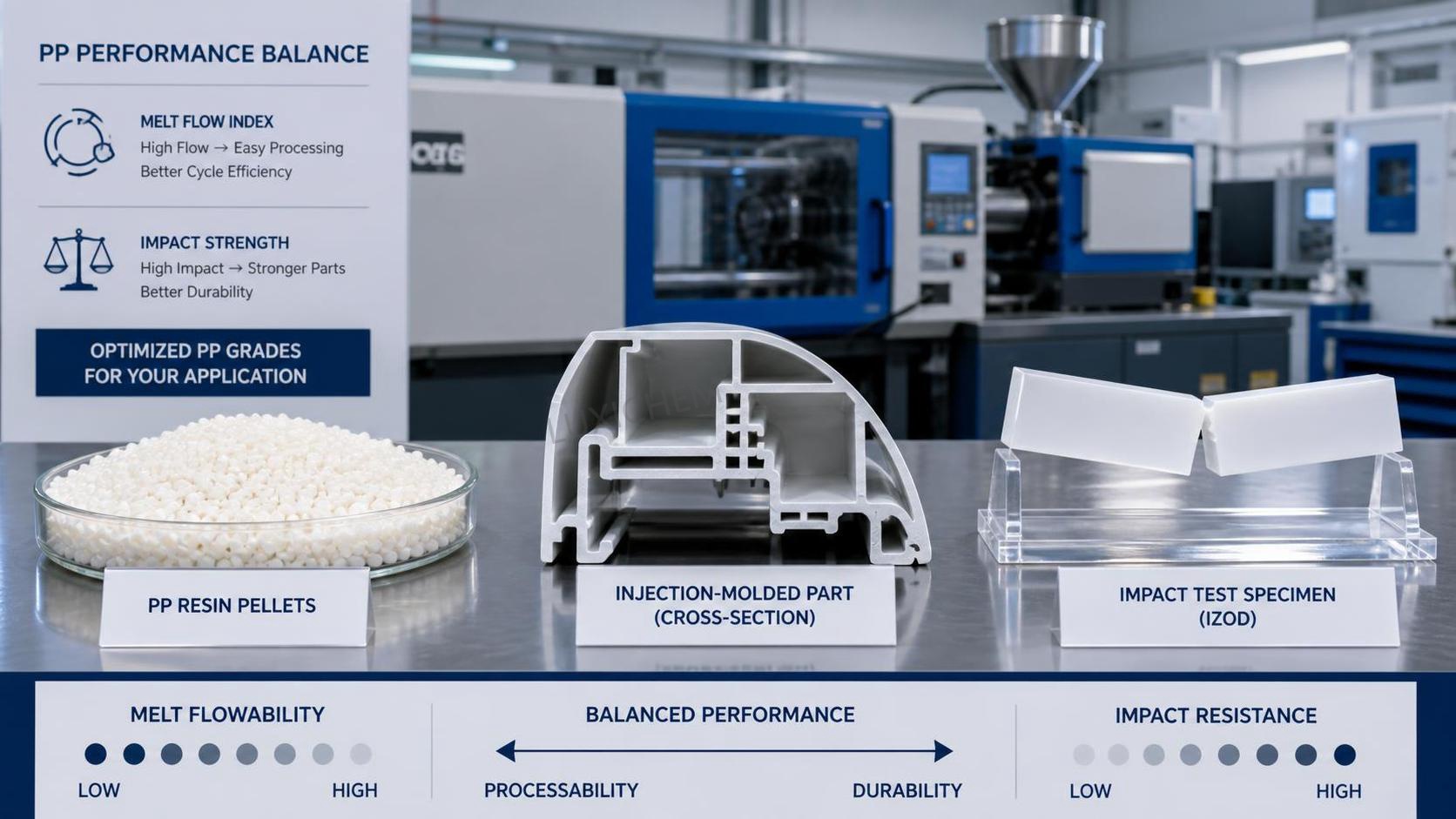
It often starts with a small but expensive argument inside a project review: the molded part looks fine in CAD, the wall thickness seems reasonable, and the tooling route is already under discussion, yet nobody is fully confident about the pp resin grade. One person prefers easier flow to reduce molding pressure, another worries that a high-flow material may leave the part too brittle when dropped, flexed, or used in cold conditions. This is a familiar point of friction in product design because polypropylene rarely fails on paper alone. It fails when processing behavior and end-use demands are judged separately.
The trouble is that two numbers are often treated as shortcuts: melt flow rate and impact value. They matter, but not in isolation. If you are evaluating material options for housings, caps, containers, interior components, or general injection-molded parts, the real question is not “Which number is higher?” It is “Which balance gives the least risk for this geometry, this process window, and this service condition?” Once that question becomes the center of selection, decisions become more stable and less dependent on guesswork.
In many teams, the first sign of a poor resin match is not a lab result. It is a production discussion about short shots, warpage, sink marks, gate hesitation, hinge cracking, or parts passing dimensional checks but failing practical handling. When that happens, people often blame the mold, then the machine, then the operator. Sometimes they are right. But sometimes the grade itself was never screened properly against both processing and impact demands.
Where selection usually goes off track
A common mistake is treating high melt flow as automatically “better for molding.” Higher flow can certainly help fill thin walls, long flow paths, and detailed features. It may reduce injection pressure demands and support cycle stability in parts with complex geometry. But a very high-flow grade may also reflect lower molecular weight, and that can shift toughness downward depending on the formulation, part design, and temperature of use. If the application sees rough handling, assembly stress, snap-fit movement, or occasional drops, an easy-filling grade can become a hidden liability.
The opposite mistake happens just as often. A team sees an impact requirement and moves toward a tougher, lower-flow option without fully considering the moldability cost. That can mean higher pressure, more difficult filling in thin sections, visible weld-line sensitivity, and a narrower process window. In a simple thick-wall part, this may be manageable. In a thin, cosmetic, or multi-gated part, it can create daily production headaches.
That is why pp resin selection should start from actual use conditions and part geometry together, not from a datasheet number chosen in isolation.
Start with the part, not the catalog
Before comparing grades, it helps to define the stresses the molded part will really experience. Not every impact concern is a “drop test” problem. Some are assembly impacts, some are repetitive flexing, and some are localized shocks around corners, bosses, or snap-fits. Likewise, not every flow concern is about filling a mold cavity. Sometimes the issue is maintaining dimensional consistency across cavities or controlling orientation effects in a long, flat part.
In practice, four questions make the selection process much clearer:
- Is the part thin-wall, long-flow, or highly detailed?
- Will it face cold handling, repeated stress, or accidental drops?
- Are there weld lines, hinges, clips, or stress concentrators in the design?
- Is stable processing more important than maximizing one mechanical property?
If most answers point toward difficult filling, melt flow deserves early attention. If they point toward handling abuse or structural reliability, impact performance moves closer to the front. Usually, both matter, and the decision becomes a trade-off rather than a direct ranking.
Reading melt flow rate without oversimplifying it
Melt flow rate is useful because it gives a quick sense of how easily the resin may move during processing under specified test conditions. For evaluation work, it is best treated as a relative indicator, not a complete predictor. A higher MFR often supports easier cavity filling, finer feature replication, and potentially smoother molding in parts that are sensitive to pressure limits. That makes it attractive for packaging components, thin-wall containers, and parts with narrow gates or long runners.
Still, MFR alone does not tell you how the resin will behave in your exact tool or how much toughness the finished part will retain after molding. Two grades with similar nominal flow may process differently because of additive packages, copolymer structure, nucleation, or intended application design. So the right habit is to use MFR as a screening tool first, then validate with part-specific concerns.
When reviewing a candidate grade, ask:
- Does its flow range match the part thickness and expected fill length?
- Will the machine and mold setup need to run near their limits to use it?
- Could easier flow reduce shear-related defects, or might it create new concerns about toughness?
These questions are more practical than simply preferring the highest-flow option available.
Impact resistance matters differently depending on the design
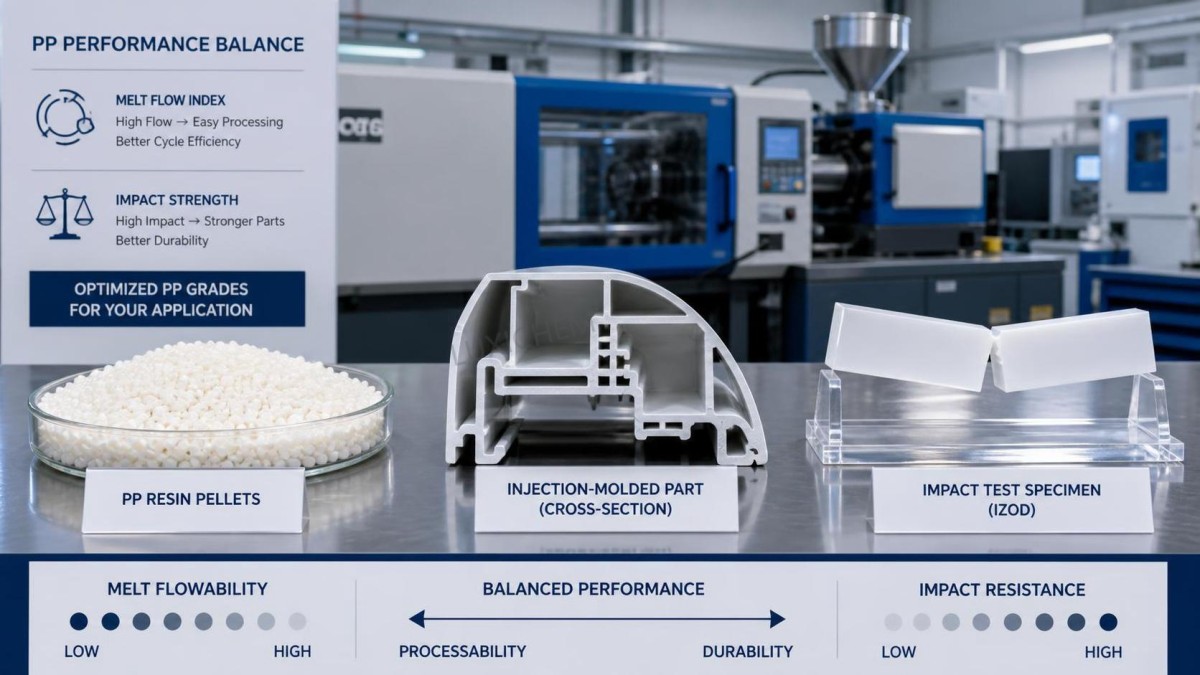
Impact performance is often treated as a single yes-or-no property, but molded parts rarely fail that way. A part may survive a blunt drop and still crack at a living hinge, near a screw boss, or along a weld line. Another may seem tough in room-temperature handling but become vulnerable in cooler environments. This is why impact data should be read alongside the part’s geometry and expected service conditions.
For many applications, the question is less about chasing the toughest possible grade and more about finding enough toughness where the part is weakest. A thick utility bin and a thin snap-fit cover do not need the same interpretation of impact resistance, even if both are made from polypropylene. In thin sections, local stress concentration often dominates performance more than a simple bulk material comparison.
It also helps to be careful with assumptions around copolymer and homopolymer choices. Impact copolymers are often selected for improved toughness, especially when abuse resistance matters. But they may come with trade-offs in stiffness, clarity, or processing response. Homopolymers may suit applications where rigidity and flow are more important than high-impact durability. The key is not to memorize one rule, but to connect the resin family to the actual design requirement.
Balancing both factors during evaluation
A reliable way to narrow options is to sort candidate grades into three working groups rather than debating dozens of small differences.
When flow is the main constraint
If the part has thin walls, long flow paths, fine details, or cosmetic surfaces that become unstable when filling is difficult, start with grades that can process comfortably in that window. Then check whether the remaining impact level is enough for handling and assembly. This approach avoids the common mistake of choosing a tough grade that looks good on paper but creates molding inconsistency.
When durability is the main constraint
If the part includes snap-fits, hinges, corners exposed to knocks, or service conditions involving repeated handling, begin with impact-capable grades. Then verify whether mold filling remains realistic without forcing high pressure or elevated scrap risk. In many projects, this leads to a mid-range flow option rather than a maximum-toughness or maximum-flow extreme.
When neither side can dominate
Many commercial and industrial parts sit in the middle: they need good moldability and enough toughness to avoid nuisance failures. In those cases, selection often succeeds when teams stop looking for the “best” single property and instead rank risk. Which failure would cost more: unstable molding, or occasional brittle performance? That answer usually points toward the safer compromise.
During material research, teams sometimes review related raw materials used elsewhere in the supply chain or formulation work. For example, some buyers handling broader chemical sourcing may also come across intermediates such as m-Cresol CAS#108-39-4. It is not part of polypropylene grade selection itself, but it is a reminder that technical purchasing often works best when material evaluation is organized by application role rather than by name alone.
Signs that the chosen grade may be wrong even before formal testing
You do not always need a full failure history to suspect a mismatch. If a trial requires unusually aggressive processing just to fill the mold, the resin may not be a comfortable fit for the design. If parts release fine but feel overly stiff and show whitening or cracking around clips during assembly, impact margin may be too low. If dimensions swing as processing changes are made to protect appearance or fill, the material-window match may be weak.
These observations do not replace formal validation, but they are valuable because they connect datasheet interpretation to shop-floor reality. A grade can be technically acceptable and still be a poor operational choice if it forces unstable processing or leaves too little tolerance for normal variation.
A practical way to compare candidate grades
When evaluating polypropylene options, it helps to compare them in the same order every time so discussion stays tied to function rather than preference.
Start with geometry. Note wall thickness, gate layout, flow length, and any fragile features. Then review the likely service stresses: impact, flexing, temperature exposure, stacking load, or assembly strain. Only after that should you line up the candidate pp resin grades by flow range, toughness profile, and expected stiffness trade-off.
From there, narrow the list by elimination:
- Remove grades that clearly sit outside the needed processing window.
- Remove grades that cannot support the weakest feature of the part.
- Keep the options that leave reasonable room for both molding and use.
This sounds simple, but it prevents a lot of circular debate. It also reduces the tendency to overreact to a single property value. A datasheet is a starting point, not a verdict.
Small adjustments that reduce selection risk
Sometimes the best answer is not changing to a dramatically different grade, but adjusting the evaluation logic. If impact is borderline, look at whether a corner radius, boss design, or clip geometry is creating avoidable stress concentration. If flow is borderline, check whether gate position or wall balance is making the resin work harder than necessary. Resin selection should happen alongside part design review, because the same grade can behave very differently in two similar-looking parts.
It is also worth separating “must-have” requirements from “nice-to-have” preferences. A part may need to survive routine handling, but not severe impact. Or it may need excellent fill in a narrow process window, while ultra-high stiffness is not essential. Once those priorities are stated clearly, grade selection becomes less subjective.
In broader procurement reviews, this discipline helps beyond polypropylene as well. Teams that classify materials by function, process demands, and end-use risk usually make cleaner sourcing decisions, whether they are comparing polymer grades or unrelated chemical inputs such as m-Cresol CAS#108-39-4 for another workflow.
Making the final call
The best material decision is usually the one that leaves the fewest unresolved risks. For product design, melt flow tells you how comfortably the resin may process; impact resistance tells you how much abuse the part may tolerate. Neither should be read alone, and neither should automatically override the other.
If the part is thin, detailed, or difficult to fill, flow deserves more weight. If the part includes vulnerable features or rough service conditions, impact deserves more weight. If both matter, choose the grade that preserves the widest safe operating window rather than the most impressive single property. That is often the difference between a material that looks suitable in a meeting and one that remains dependable through tooling, molding, and actual use.
For anyone comparing pp resin options under design pressure, the most useful habit is simple: evaluate the part’s weakest point and the process’s narrowest margin at the same time. Once those two realities are visible, selection becomes much less confusing.
Related Picks
 Butylated Hydroxytoluene Price Drivers: Supply, Purity, and Purchasing Risk FactorsOct 21, 2026Butylated Hydroxytoluene price trends depend on supply stability, purity, logistics, and purchasing risk. Learn how to compare quotes wisely and reduce sourcing costs.
 Sodium Tripolyphosphate Price Trends: Raw Material and Energy ExposureOct 20, 2026Explore sodium tripolyphosphate price trends, from phosphate and soda ash costs to energy exposure. Learn how to compare quotes, manage sourcing risks, and make smarter purchasing decisions.
 Acetonitrile Shipment to Vietnam Successfully Dispatched; RCEP Benefits Boost Fine Chemical Trade with ASEANSep 16, 2026A shipment of industrial-grade acetonitrile from our company has recently been loaded and dispatched following the completion of standardized hazardous material packaging and container securing procedures.
 Nigerian Client’s Order of 4 Containers of Vinyl Acetate Successfully Loaded and Shipped to West AfricaSep 16, 2026We recently completed the loading of a vinyl acetate order for a Nigerian client; four containers of the product have been successfully packed and are ready for shipment to Nigeria.




Question Consultation
Send Us Your Inquiry Today

Luxi Chemical is a professional chemical product supplier with ample stock of all chemical categories and excellent quality, welcome your purchase inquiry.

