


PVC Granules Defects in Molding: Common Causes and Practical Fixes
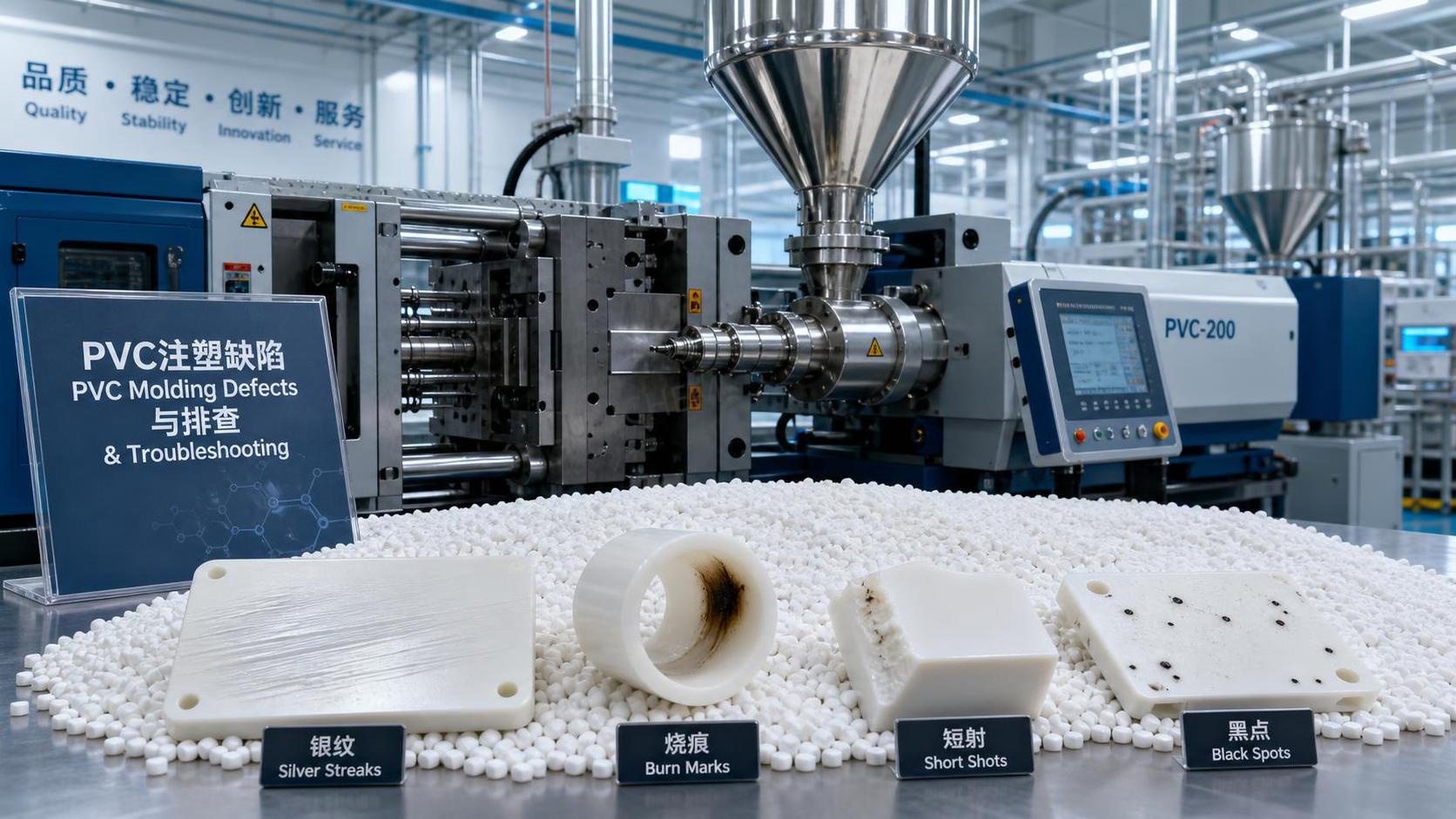
Start with the defect pattern on the molded part, then work backward through material condition, temperature history, pressure behavior, cooling balance, and screw residence time. With pvc granules, visible defects often come from a small mismatch between formulation behavior and machine settings rather than from one single failure point. If the surface, dimensions, and mechanical feel all changed at the same time, the problem may be upstream in drying, blending consistency, contamination, or lot variation. If only one feature changed, such as gloss, gate blush, sink, or burn marks, the cause is usually more localized.
PVC is less forgiving than many commodity thermoplastics because thermal stability, lubrication balance, and shear sensitivity directly affect melt condition. In practical troubleshooting, assuming that any defect is caused only by mold damage or only by raw material quality usually leads to delay. A stable result depends on the interaction of resin, additives, machine condition, die or mold design, and the handling of pvc granules before they enter the barrel.
Surface streaks, discoloration, and burn-like marks
When dark streaks, yellowing, brown lines, or localized scorching appear, the first suspicion should be thermal degradation. PVC can degrade if melt temperature becomes too high, if residence time is too long, or if stagnant zones hold material in the barrel, nozzle, hot runner, or dead corners of the flow path. A machine that was running another polymer earlier may also leave degraded residue that breaks loose during production.
Look at the full temperature profile rather than one barrel setting. A moderate barrel temperature can still produce excessive melt heat if screw speed is high, back pressure is excessive, or the screw and barrel are worn enough to increase shear in an uneven way. In some cases, a blocked vent, sticky non-return valve, or partial nozzle restriction raises local heat and creates a repeating burn pattern. If the defect appears at regular shot intervals, trapped degraded material may be purging out from a stagnant pocket.
Corrective action should begin with controlled purging and inspection of likely hang-up zones. If the process allows it, reduce rear and middle barrel temperatures slightly, lower screw speed, and shorten residence time by matching shot size more closely to barrel capacity. Avoid leaving heated pvc granules in the barrel during long stops. If the line must pause, a shutdown procedure with temperature reduction is often safer than holding material at processing temperature. Burn marks near the end of fill can also point to trapped air in the mold cavity, so vent depth, vent cleanliness, and fill speed at the final section should be reviewed before blaming the material alone.
Silver streaks and splay
Splay on PVC parts often looks like fine silver lines spreading from the gate or following the flow direction. Moisture is one possible cause, but with pvc granules it should not be treated as the only explanation. Surface volatiles from additives, contamination by incompatible polymers, residual cleaning fluids in the hopper path, and decomposition gases from overheated PVC can produce a similar appearance.
If the streaks began after a new lot was introduced, compare bulk density, granule size distribution, and feed behavior in the throat. Irregular feeding can create unstable plasticizing and intermittent gas release. Material stored in humid conditions may also carry surface moisture, especially if bags were opened and partially used for extended periods. Conveying air that is not well controlled can reintroduce moisture or dust. Fine powder buildup around the feed throat sometimes signals handling abrasion, which can affect melting consistency.
Practical fixes include cleaning the hopper, throat, and loader lines, isolating any regrind temporarily, and confirming that no foreign resin entered the feed stream. If moisture is suspected, use only the drying conditions suitable for the actual PVC compound; overheating during drying can be as harmful as inadequate drying. Lowering melt temperature slightly and reducing aggressive shear often improves gas-related streaking. If the defect is concentrated near the gate, a gate that is too small or too restrictive may be causing local overheating during injection.
Short shots and incomplete filling
When the cavity does not fully fill, the obvious reaction is often to increase injection pressure. That may work for a few cycles, but it can hide the real problem. Incomplete filling with pvc granules may come from low melt temperature, premature freezing at a thin section, poor venting, low actual shot volume, excessive viscosity from formulation shift, or a flow path that has become narrower because of deposit buildup.
A useful distinction is whether the short shot always stops at the same location. If it does, examine mold temperature uniformity, local wall thickness, venting, and blockage in that flow path. If the stop point changes from cycle to cycle, the issue is more likely unstable feeding, cushion inconsistency, slipping in the injection unit, or variation in melt homogeneity. A worn screw tip or non-return valve can cause part-to-part shot inconsistency that resembles a material defect.
- Raise melt temperature in small steps only if there is room before degradation risk becomes significant.
- Review injection speed stages. A very slow initial fill may allow early skinning, while an overly fast profile can trap air and leave the end of fill weak.
- Measure actual cushion stability over several cycles instead of trusting one displayed value.
- Inspect filters, nozzles, and gates for partial obstruction, especially after color change or restart.
If the machine has been idle with heated material inside, degraded fragments can also migrate and restrict flow. In that situation, cleaning the flow path may solve more than another pressure increase.
Flash that appears without an obvious mold change
Flash is not always a sign that clamp force is simply too low. With PVC, flash can develop when melt viscosity drops because temperature drifted upward, lubrication balance shifted, or the material remained in the barrel long enough to change rheology. A mold parting line that was previously acceptable may start flashing only after thermal expansion changes alignment or after vent areas become damaged and begin acting like leakage paths.
Look at where the flash forms. Parting-line flash around the whole perimeter suggests clamping or parallelism issues. Flash near inserts, ejector pins, or local shutoffs points to wear, trapped debris, or localized pressure spikes. If flash became worse after raising barrel temperatures to solve a short shot, the adjustment may have overshot and created a lower-viscosity melt that now escapes more easily.
Corrective work should include checking clamp condition, tie bar balance if applicable, mold seating, and contamination on shutoff surfaces. Then compare peak cavity demand against fill speed and packing profile. Sometimes a small reduction in transfer point or holding pressure stabilizes the edge without causing underfill. If the machine is processing a hygroscopic auxiliary ingredient elsewhere in the line, keep that material fully segregated; cross-contamination can alter melt behavior in ways that look like tooling wear.
Sink marks, voids, and soft sections
Sink marks are usually associated with thick sections that cool slowly and shrink after the outer skin has set. In rigid PVC molding, sinks may appear more readily where rib-to-wall ratios are too heavy, packing pressure is cut off too early, or mold cooling is uneven. Internal voids can form when the surface freezes before the core is adequately packed. On some parts, the first sign is not a visible depression but an unexpectedly soft feel around bosses or reinforced areas.
Before adjusting pressure, check whether the gate remains open long enough for effective packing. If the gate seals too early, extra hold time will not help. Mold temperature that is too low may freeze the gate quickly, while melt temperature that is too low may limit flow into thicker sections. Conversely, excessive melt temperature can increase overall shrink behavior and distort the packing window.
Where redesign is not possible, stabilizing the process usually means balancing melt temperature, mold temperature, hold pressure, and hold time around the actual gate freeze point. Water channel blockage, scale inside cooling lines, or poor thermal contact at one mold insert can create localized sinks that are wrongly attributed to a new batch of pvc granules. Maintenance on cooling circuits is often more effective than repeatedly changing the material setting sheet.
Warping, twist, and dimensional drift
Warping often develops from uneven cooling, orientation stress, or differential shrinkage between sections of different thickness. PVC parts with long flat spans, asymmetrical ribs, or mixed wall transitions are especially sensitive. If one side of the mold runs hotter because of blocked cooling or poor contact, the part may leave the tool looking acceptable and distort later during post-cooling.
Dimensional drift across a shift can also come from unstable ambient conditions around the mold, inconsistent mold temperature control, or machine cycles that are changing by a few seconds at a time. In service work, one common misjudgment is to focus on final dimensions without checking ejection temperature. Parts measured too soon after ejection may appear inconsistent when the real issue is insufficient thermal stabilization before inspection.
Adjustments that may help include reducing orientation by moderating fill speed in thin sections, improving cooling symmetry, and reviewing whether packing is creating one-sided stress. If the mold uses inserts with very different thermal conductivity, local geometry may require independent temperature control rather than a single circuit setting. A compound change with different lubricant response can also alter release behavior and post-mold shrink pattern.
In some plants, desiccants or drying chemicals stored nearby, including materials such as Phosphorus pentoxide CAS#1314-56-3, are handled in the same warehouse area as polymer additives. Even without direct use in PVC molding, poor segregation of strongly moisture-reactive or dust-form materials can complicate housekeeping and contamination control around raw material staging.
Brittleness, cracking, and poor impact feel
If molded parts break too easily or show edge cracking during trimming, the cause may lie in degradation, excessive internal stress, insufficient fusion, contamination, or an incorrect processing window for the compound. Brittle PVC parts do not always show obvious burn marks. A part can look clean and still have lost toughness because the melt experienced damaging heat history.
Cold mold surfaces can increase frozen-in stress, especially in sharp corners or around gates. Overpacking may worsen cracking around inserts and knit lines. Regrind ratio, if used, should be verified against the compound's tolerance because repeated heat history can change performance. Inconsistent additive dispersion can create local weak zones that resemble mechanical damage from handling.
A practical approach is to compare fracture location and appearance. Cracks at knit lines suggest poor fusion or trapped air. Cracks near gates suggest orientation or overpacking. Random brittle failure across the part may indicate broader thermal damage or contamination. If a small process shift restores impact feel, the issue may be processing-related; if not, retention samples from earlier lots can help separate machine effects from raw material changes.
Black specks, gels, and unmelted particles
Black specks usually point to degraded residue, but gels and hard particles may come from insufficient melting, poor mixing, contamination, or additive agglomeration. With pvc granules, unmelted particles can appear when barrel temperatures are uneven, screw design is not suited to the formulation, or throughput is too high for stable plasticization. A sudden increase after maintenance may mean the barrel heaters were reinstalled incorrectly or thermocouple readings are inaccurate.
Material transfer equipment should also be examined. Dust, metal fines from worn loaders, fragments from packaging, and residues from previous compounds can all show up as visual defects. If black specks appear mainly after startup, cleanout and purge practice is a stronger suspect than the current batch itself. If they continue throughout the run, inspect the screw, non-return valve, nozzle seat, and any hot runner manifolds for dead spots.
Some processors keep strong dehydrating chemicals such as Phosphorus pentoxide CAS#1314-56-3 in broader chemical inventory. The main relevance here is indirect: storage discipline matters. Fine reactive powders should remain fully separated from polymer raw materials, open containers, and maintenance benches to reduce the chance of foreign-particle introduction.
When the defect is probably not in the raw material
Several recurring problems are often blamed on resin quality even though machine condition is the main driver. Barrel bands that cycle poorly, a drifting thermocouple, inconsistent hydraulic response, blocked cooling channels, worn screw flights, and leaking non-return valves can all produce symptoms that mimic unstable pvc granules. A defect that disappears after mold transfer to another machine is a strong sign that the original equipment should be inspected more closely.
Transport and storage still matter. Torn bags, prolonged exposure to heat, mixed lot handling, and hopper contamination can change behavior before processing starts. But changing material too quickly can destroy traceability. It is usually better to isolate one variable at a time: same machine with retained material, same material on another machine, then controlled changes in temperature or speed. That sequence narrows the cause without creating new uncertainty.
When a molded PVC part begins to fail visually or dimensionally, the fastest route is usually a disciplined comparison between current settings, actual machine behavior, and the material’s recent handling history. Most defects can be reduced once the problem is tied to either heat history, gas generation, flow restriction, packing imbalance, or contamination instead of treating every symptom as a separate issue.
Related Picks
 Butylated Hydroxytoluene Price Drivers: Supply, Purity, and Purchasing Risk FactorsOct 21, 2026Butylated Hydroxytoluene price trends depend on supply stability, purity, logistics, and purchasing risk. Learn how to compare quotes wisely and reduce sourcing costs.
 Sodium Tripolyphosphate Price Trends: Raw Material and Energy ExposureOct 20, 2026Explore sodium tripolyphosphate price trends, from phosphate and soda ash costs to energy exposure. Learn how to compare quotes, manage sourcing risks, and make smarter purchasing decisions.
 Acetonitrile Shipment to Vietnam Successfully Dispatched; RCEP Benefits Boost Fine Chemical Trade with ASEANSep 16, 2026A shipment of industrial-grade acetonitrile from our company has recently been loaded and dispatched following the completion of standardized hazardous material packaging and container securing procedures.
 Nigerian Client’s Order of 4 Containers of Vinyl Acetate Successfully Loaded and Shipped to West AfricaSep 16, 2026We recently completed the loading of a vinyl acetate order for a Nigerian client; four containers of the product have been successfully packed and are ready for shipment to Nigeria.




Question Consultation
Send Us Your Inquiry Today

Luxi Chemical is a professional chemical product supplier with ample stock of all chemical categories and excellent quality, welcome your purchase inquiry.

