


PVC Pellets vs PVC Powder: Which Form Fits Your Extrusion Process Better?
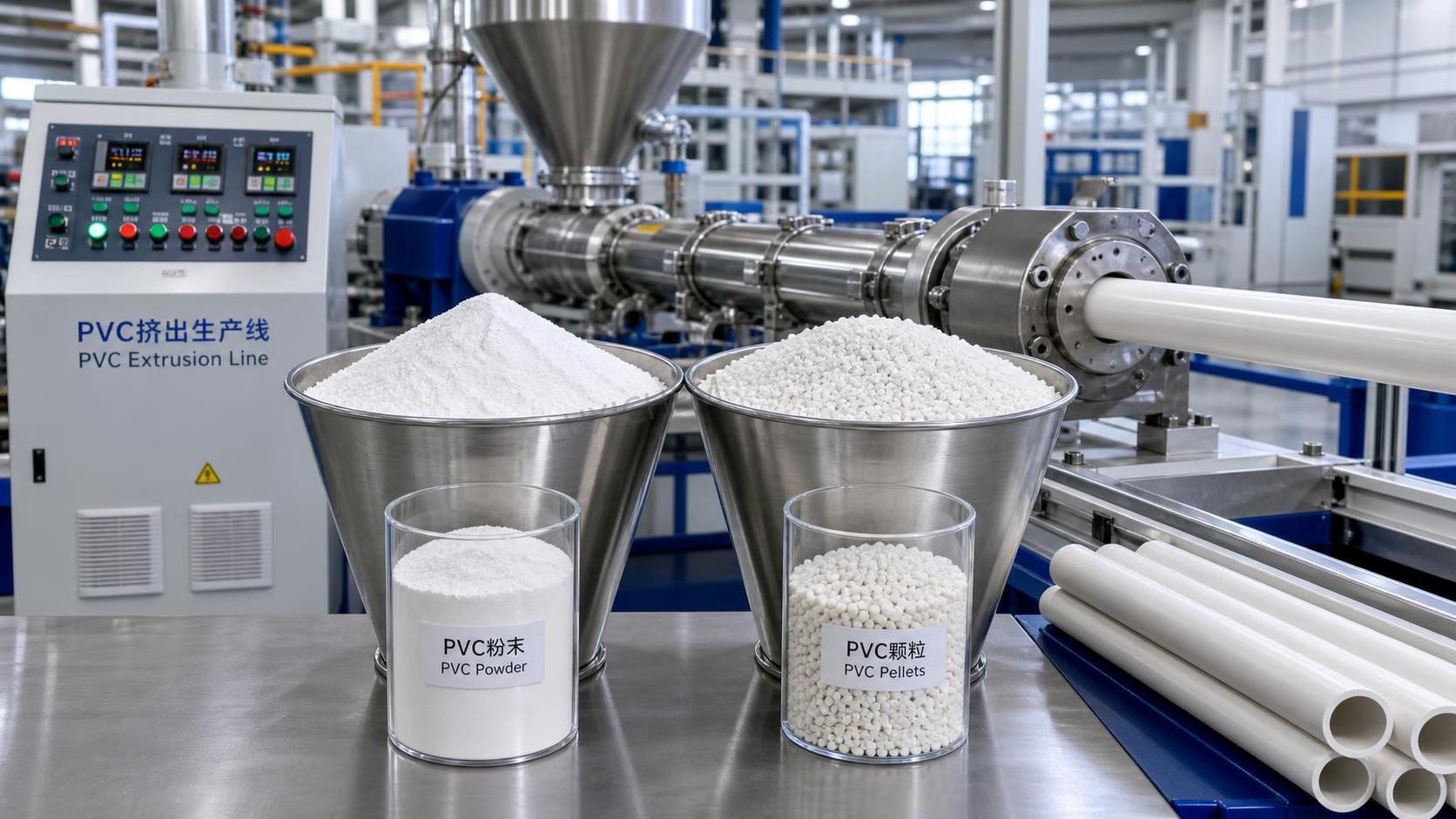
It often starts with a line that should be running smoothly but is not. The extruder is set, the die is not obviously blocked, the formulation looks familiar, yet feeding fluctuates, melt pressure drifts, and the finished profile or pipe does not feel as consistent as expected. In many plants, this kind of issue leads to a practical question rather than a theoretical one: should the material be supplied as powder, or would pellets make the process easier to control?
That question matters because extrusion problems rarely stay small. Unstable feed can turn into variable output, more startup waste, longer cleaning time, or tighter operator attention than the job should require. When comparing pvc pellets with PVC powder, the useful approach is not to ask which form is universally better. The more useful question is which form fits the actual extrusion setup, the product geometry, the mixing route, and the day-to-day operating habits on the floor.
Where the decision usually becomes difficult
Many material evaluations become confusing because pellets and powder are often discussed as if they were only different shapes of the same thing. In practice, they behave differently from the moment they enter storage to the moment they leave the die. If you are reviewing material options for a line that already has occasional surging, dust concerns, slow color change, or sensitivity to ambient conditions, the form of PVC can either reduce those problems or make them more noticeable.
PVC powder is often chosen when processors want flexibility in dry blending, formulation adjustment, or direct control over additives before fusion. It fits operations that are already designed around powder handling and where upstream compounding is part of the normal process. Pellets, by contrast, are more often preferred where feeding consistency, cleaner handling, and simpler transfer matter more than in-house blend customization.
The difficulty is that both options can seem reasonable on paper. The answer becomes clearer when you compare them at the points where extrusion lines usually struggle: feeding, melting, throughput stability, storage, housekeeping, and changeover.
Feed behavior is usually the first deciding factor
If the line has a history of erratic feed, the material form deserves close attention. Powder can bridge in hoppers, compact unevenly, or respond more sharply to vibration, humidity, and hopper geometry. In a system built for it, that may be manageable. In a system that was never optimized for powder flow, it can create small interruptions that show up later as dimensional variation or pressure fluctuation.
Pellets generally move more predictably through bins, loaders, and feed throats. That does not mean every pelletized PVC grade will run perfectly, but it usually means fewer variables in bulk flow. For evaluators who are trying to reduce operator intervention, this is often the first strong argument in favor of pvc pellets.
Still, the line configuration matters. A twin-screw setup designed around dry blend processing may extract good performance from powder because the equipment, screw design, and thermal profile were selected with that feed form in mind. In that case, switching to pellets may not automatically improve output. The machine has to be considered along with the material.
Melting is not just about temperature
One common mistake in evaluation is to reduce the comparison to melt temperature alone. The more important issue is how the material reaches fusion and whether it does so consistently. Powder usually enters the process with a larger effective surface area and can respond differently to shear and heat input than pellets. That can be helpful in some formulations, especially where the processor wants direct influence over fusion behavior through dry blend design.
Pellets have already gone through a compounding and pelletizing stage before arriving at the extrusion line. Because of that, they often provide a more uniform starting point. In practical terms, this can make the line less sensitive to small feeding variations and may help produce a steadier melt stream. For lines that run long production campaigns and value repeatability over formulation flexibility, pellets often make daily operation simpler.
But there is a tradeoff. If your process depends on adjusting stabilizers, lubricants, fillers, or pigments in-house, powder offers more room to fine-tune before extrusion. Pellets reduce that freedom unless you are sourcing a specifically compounded grade.
When housekeeping and plant conditions shape the decision
Sometimes the choice is not driven by the extruder at all. It is driven by the building.
PVC powder can create dust during unloading, conveying, or charging, especially in facilities with frequent material transfers. That affects housekeeping, filter maintenance, and sometimes even the accuracy of material usage if fine material is lost during handling. Pellets are usually cleaner to store and move. For operations trying to simplify internal logistics or reduce cleanup around feeding stations, this can be a meaningful advantage.
Humidity and storage conditions also matter. Powder can be more sensitive to the way it packs, sits, and flows over time. If the facility has inconsistent climate control, or if materials are often opened and reused, powder handling procedures need to be tighter. Pellets are not immune to storage issues, but they are often less troublesome in daily movement and staging.
This is one reason some teams move toward pvc pellets even when the processing window itself is acceptable with powder: the line may be only one part of the bigger operational burden.
Product type changes the answer
Not every extrusion application values the same things. A rigid profile line, a pipe line, a sheet line, and a cable-related process may all weigh the comparison differently.
For applications where output steadiness and simple feeding are critical, pellets can be easier to justify. Where the operation relies on a custom dry blend and has experienced staff managing formulation and fusion, powder may remain the better fit. This is especially true when the process window has already been built around powder and changing the material form would introduce new trial work in screw speed, barrel temperatures, and die balance.
It helps to ask a narrower question: is the plant mainly trying to improve processing stability, or is it trying to preserve formulation control? That single distinction often clears up most of the indecision.
A practical way to compare without overcomplicating the trial
When reviewing material form options, the best comparisons are usually small and disciplined rather than broad and ambitious. Instead of trying to judge every variable at once, focus on the few that actually influence production decisions.
Start with the existing problem. If the complaint is feeder inconsistency, measure the trial against feed behavior and output smoothness. If the problem is frequent cleanup and dust, compare handling effort from receiving to hopper loading. If the issue is product consistency, watch for stability in pressure, appearance, and downstream control rather than relying on first impressions during startup.
It is also worth checking whether the material form changes the sensitivity of the line. Some lines appear to run both forms adequately during short tests, but one form may react more sharply to ordinary variation in ambient conditions, operator timing, or residence time. The easier material to live with is often the better choice, even if both can be made to work under ideal supervision.
In certain compounding or stabilization discussions, procurement and technical teams may also review related additives or intermediates that affect formulation strategy upstream. In those cases, materials such as Triphenylphosphine CAS#603-35-0 may appear in sourcing conversations, not as a substitute for PVC form selection, but as part of broader raw-material planning around processing consistency and formulation design.
Common evaluation mistakes that lead to the wrong choice
One frequent mistake is assuming pellets are always the premium option. They are often easier to handle, but that does not automatically mean they are the best fit for a line engineered around powder fusion. If the extrusion system, operator routines, and additive strategy are already optimized for powder, forcing a switch to pellets can create unnecessary adaptation work.
Another mistake is judging powder only by the problems of a poorly designed powder handling system. If bridging, dust, and feed interruption are happening because of hopper design, conveying setup, or inconsistent premixing, the material form may be blamed for what is really a system issue.
A third mistake is forgetting downstream requirements. Some operations focus heavily on feed convenience but overlook whether the melt behavior supports surface finish, dimensional control, and changeover speed. Material form should be evaluated across the full process, not just at the loading point.
So which form fits better?
If your priority is simpler material movement, cleaner handling, and more predictable feeding across ordinary plant conditions, pellets often make the stronger case. They tend to suit operations that want steady routine production with fewer handling complications and less dependence on carefully managed powder flow behavior.
If your priority is formulation flexibility, direct dry blending, and maintaining a process already built around powder fusion, powder may remain the more practical choice. In that setting, the value is not convenience alone but the ability to tailor the compound closer to the line’s needs.
For many evaluators, the real answer is not “pellets versus powder” in the abstract. It is “which form removes the biggest constraint in this specific extrusion process.” If the main constraint sits in storage, conveying, and feeding, pellets deserve serious attention. If the main constraint sits in compounding freedom and fusion control, powder may continue to be the right path.
The most reliable decision usually comes from matching material form to the line’s weak point instead of its ideal state. Extrusion rarely happens under perfect conditions. The better material form is often the one that keeps the process stable when the shift is busy, the ambient conditions are less than ideal, and the equipment is being asked to run like normal rather than like a laboratory trial.
That is why pvc pellets are often selected for operational simplicity, while powder remains valuable where process customization is central. Neither form is universally superior. The better fit is the one that aligns with how the line is actually run, how the material is actually handled, and how much adjustment the process can realistically support over time.
Related Picks
 Butylated Hydroxytoluene Price Drivers: Supply, Purity, and Purchasing Risk FactorsOct 21, 2026Butylated Hydroxytoluene price trends depend on supply stability, purity, logistics, and purchasing risk. Learn how to compare quotes wisely and reduce sourcing costs.
 Sodium Tripolyphosphate Price Trends: Raw Material and Energy ExposureOct 20, 2026Explore sodium tripolyphosphate price trends, from phosphate and soda ash costs to energy exposure. Learn how to compare quotes, manage sourcing risks, and make smarter purchasing decisions.
 Acetonitrile Shipment to Vietnam Successfully Dispatched; RCEP Benefits Boost Fine Chemical Trade with ASEANSep 16, 2026A shipment of industrial-grade acetonitrile from our company has recently been loaded and dispatched following the completion of standardized hazardous material packaging and container securing procedures.
 Nigerian Client’s Order of 4 Containers of Vinyl Acetate Successfully Loaded and Shipped to West AfricaSep 16, 2026We recently completed the loading of a vinyl acetate order for a Nigerian client; four containers of the product have been successfully packed and are ready for shipment to Nigeria.




Question Consultation
Send Us Your Inquiry Today

Luxi Chemical is a professional chemical product supplier with ample stock of all chemical categories and excellent quality, welcome your purchase inquiry.

