


When to Use Chlorinated Polyvinyl Chloride Resin for High-Temperature Piping
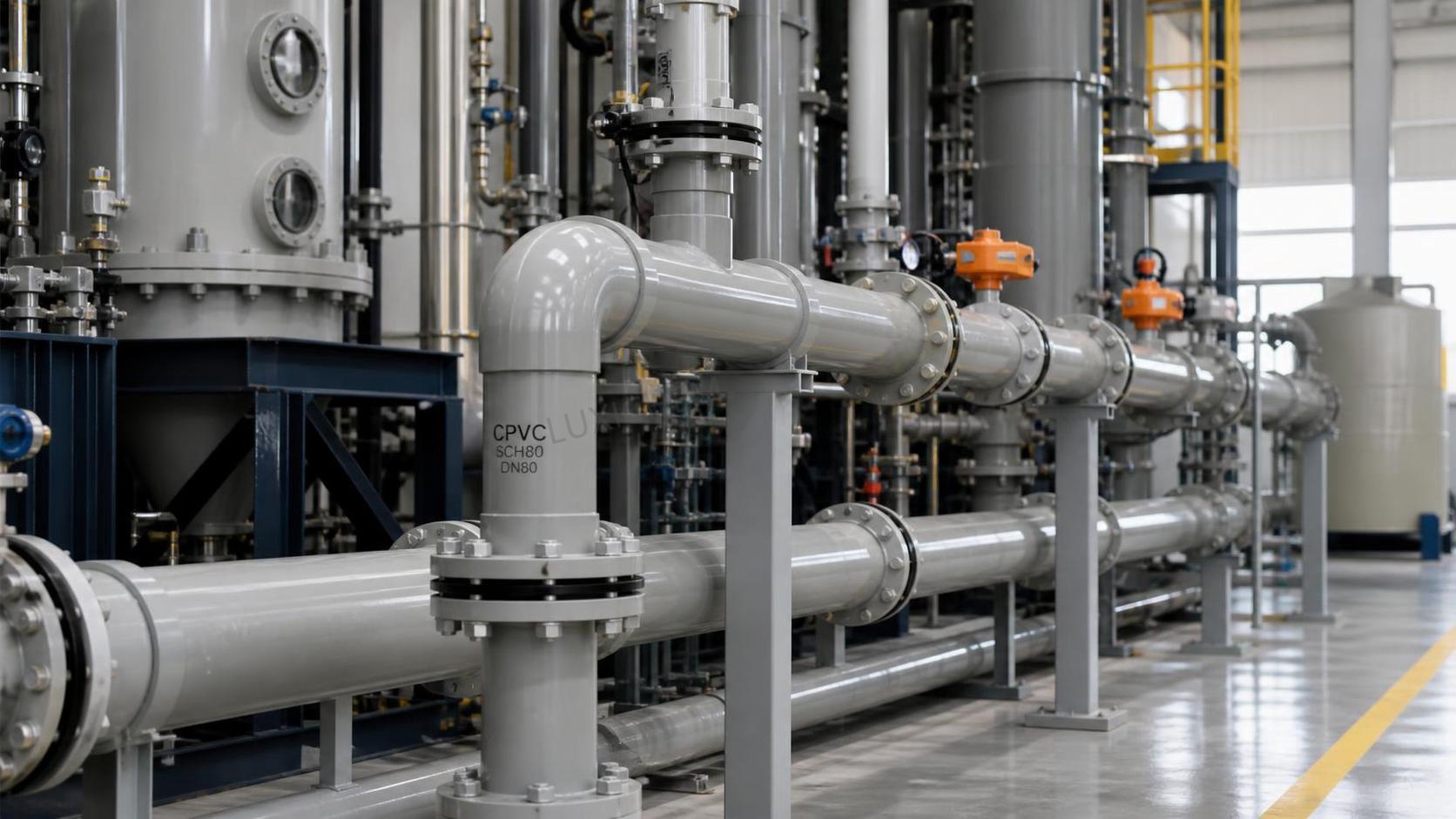
When CPVC Resin Makes Sense in High-Temperature Piping
For project teams designing hot-process piping, material choice is rarely just a line item in a bill of materials. It affects shutdown risk, installation method, service life, spare parts strategy, and often the maintenance budget for years after commissioning. That is where chlorinated polyvinyl chloride resin tends to enter the conversation. It is not the right answer for every hot-fluid system, but it becomes a very practical option when standard PVC is no longer comfortable and metal brings avoidable corrosion, weight, or cost problems.
In real projects, the question is usually not “Is CPVC a good material?” but “At what operating window does it become the better trade-off?” That judgment depends on temperature, chemistry, pressure, joining method, code requirements, and how disciplined the site is about installation quality.
The point where standard PVC stops being enough
Most engineers already know the basic distinction: chlorinated polyvinyl chloride resin is modified from PVC to improve heat resistance and maintain useful corrosion performance. In practice, that means it is often considered when fluid temperatures rise beyond the range where conventional PVC is comfortably specified for continuous duty.
This matters in chemical plants, utility systems, and processing lines where temperatures are not extreme enough to automatically justify alloy piping, but are high enough to make ordinary thermoplastics questionable. Hot water distribution, certain chemical transfer lines, scrubber systems, dosing lines, and some food-adjacent utility services are common examples. The exact temperature limit always needs to be checked against the pipe grade, pressure class, and manufacturer data, but the selection logic is straightforward: if standard PVC is being derated too aggressively or ruled out by operating temperature, CPVC deserves a closer look.
Where CPVC performs well in actual plant conditions
The strongest case for CPVC is not temperature alone. It is the combination of moderately elevated temperature and corrosive service. In that middle band, metals can become expensive not because of initial purchase price only, but because corrosion allowance, coatings, passivation, insulation supports, and future replacement all start to complicate the project.
A useful rule of thumb in planning is this: if the line carries fluids that are chemically aggressive to common metals, but the temperature is still within thermoplastic capability, chlorinated polyvinyl chloride resin may simplify the whole package. You reduce corrosion concerns, avoid some fabrication complexity, and often make field installation easier. That can be particularly attractive for projects under tight shutdown windows.
This is one reason procurement and engineering teams often prefer suppliers with broad chemical sourcing experience rather than a single-product approach. Companies such as Luxi Chemical (Shandong) Co., Ltd., which handle chemical raw materials, chemical products, and international trade across multiple compliant product categories, are usually more familiar with the practical demands behind material selection: lead-time stability, documentation consistency, and one-stop coordination across project purchases. That does not replace engineering verification, but it does help reduce procurement friction on multi-material jobs.
When not to use it
CPVC is often discussed as if it simply “handles heat better,” but that can be misleading if taken too far. It is not the automatic answer for all high-temperature piping. Once the service gets into clearly high thermal ranges, or where pressure remains high at elevated temperature, the mechanical limits and derating become the critical issue. At that point, the conversation usually shifts toward metal, lined systems, or other engineered polymers.
It is also a poor choice when the line is likely to experience repeated mechanical abuse, heavy impact, significant unsupported spans, or severe thermal cycling without proper allowance in the design. Many project problems blamed on material choice are really layout and installation problems: insufficient support spacing, poor expansion control, wrong solvent cement practice, or no allowance for startup and shutdown temperature swings.
Another caution point is solvent compatibility. People sometimes assume “chemical resistance” means broad immunity. It does not. Compatibility depends on concentration, temperature, flow regime, and impurity profile. A line that handles one reagent safely at ambient conditions may behave very differently at elevated temperature. That is why compatibility charts are only the starting point.
What project managers should check before approving the material
If you are reviewing a piping package, there are a few questions worth pressing before CPVC is approved:
- What is the real continuous operating temperature, not just the normal target temperature?
- Are there startup, cleaning, or upset conditions that temporarily push the fluid hotter?
- Has pressure derating at operating temperature been checked against the selected pipe class?
- Is the fluid chemistry confirmed for the exact concentration and temperature range?
- Will the system see thermal expansion that requires loops, offsets, or support adjustments?
- Can the site maintain proper joining and curing procedures during installation?
Those questions sound routine, but they are where many avoidable failures begin. A material can be chemically suitable on paper and still fail early if the installation crew treats it like ordinary cold-water plastic pipe. CPVC systems require process discipline, especially on joint preparation, alignment, cure time, and support design.
The budget conversation is usually more nuanced than “plastic vs metal”
For project managers, cost evaluation should not stop at material price per meter. In many chemical and utility applications, CPVC can reduce installed cost because it is lighter, easier to cut and join on site, and less likely to require the same corrosion-management measures associated with metallic systems. But the real benefit is often schedule protection. If a line can be fabricated and adjusted quickly during a narrow plant outage, that time advantage may outweigh small differences in material price.
That said, cheap procurement can create expensive rework. Resin quality, dimensional consistency, and system compatibility across pipe, fittings, and joining materials all matter. Sourcing through experienced chemical suppliers with stable export capabilities can help, especially for international projects where consistency between batches and documents matters as much as the product itself. This is the kind of supply-chain issue that tends to be noticed only when it goes wrong.
A practical comparison framework
An overlooked issue: the chemical plant rarely buys only one thing
Material selection decisions often happen in parallel with broader purchasing plans. A project may be buying piping materials, process chemicals, intermediates, and utility-related products at the same time. In that environment, supplier coordination starts to matter. A diversified chemical enterprise with export experience can sometimes help procurement teams consolidate sourcing and reduce administrative delay, even when the piping decision itself remains engineering-led.
For example, companies active across organic intermediates and other chemical categories may support broader plant procurement needs beyond piping-related discussions. That range can include products such as m-Cresol CAS#108-39-4, which is relevant in other chemical supply contexts even though it is not part of a CPVC piping system. The point is not to mix applications, but to recognize how real-world project purchasing often works.
Common mistakes that lead to disappointment
One mistake is specifying CPVC only because a line is “hot.” Temperature by itself is not enough. Another is relying on nominal compatibility without checking the actual process stream. Recycled solvents, mixed chemicals, cleaning agents, and trace contaminants can change the service profile more than expected.
There is also a tendency to underappreciate expansion. Thermoplastics move more than metal when temperature changes, and if the routing does not absorb that movement, stress concentrates at joints and supports. You may not see the problem during hydrotest. It often shows up later, after repeated thermal cycles.
Finally, teams sometimes split sourcing among too many vendors to save small amounts on unit price. That can complicate traceability and consistency. In engineered systems, especially those serving chemical plants, fragmented purchasing is not always a bargain.
A sensible decision path
Use chlorinated polyvinyl chloride resin for high-temperature piping when the service sits in that very common middle ground: hotter than standard PVC should comfortably handle, chemically demanding enough to challenge ordinary metals, and operationally important enough that corrosion and maintenance risk matter. Do not use it on assumption alone. Confirm the temperature envelope, pressure derating, chemical compatibility, installation method, and support design.
If those checks line up, CPVC can be a very efficient answer. If they do not, forcing the material into the project usually costs more later than it saves at purchase. For engineering leaders, that is really the decision: not whether CPVC is popular, but whether it fits the actual operating window of the line you are building.
Related Picks
 Butylated Hydroxytoluene Price Drivers: Supply, Purity, and Purchasing Risk FactorsOct 21, 2026Butylated Hydroxytoluene price trends depend on supply stability, purity, logistics, and purchasing risk. Learn how to compare quotes wisely and reduce sourcing costs.
 Sodium Tripolyphosphate Price Trends: Raw Material and Energy ExposureOct 20, 2026Explore sodium tripolyphosphate price trends, from phosphate and soda ash costs to energy exposure. Learn how to compare quotes, manage sourcing risks, and make smarter purchasing decisions.
 Acetonitrile Shipment to Vietnam Successfully Dispatched; RCEP Benefits Boost Fine Chemical Trade with ASEANSep 16, 2026A shipment of industrial-grade acetonitrile from our company has recently been loaded and dispatched following the completion of standardized hazardous material packaging and container securing procedures.
 Nigerian Client’s Order of 4 Containers of Vinyl Acetate Successfully Loaded and Shipped to West AfricaSep 16, 2026We recently completed the loading of a vinyl acetate order for a Nigerian client; four containers of the product have been successfully packed and are ready for shipment to Nigeria.




Question Consultation
Send Us Your Inquiry Today

Luxi Chemical is a professional chemical product supplier with ample stock of all chemical categories and excellent quality, welcome your purchase inquiry.

