


PVC Suspension Resin Selection Guide for Rigid Profiles and Injection Molding
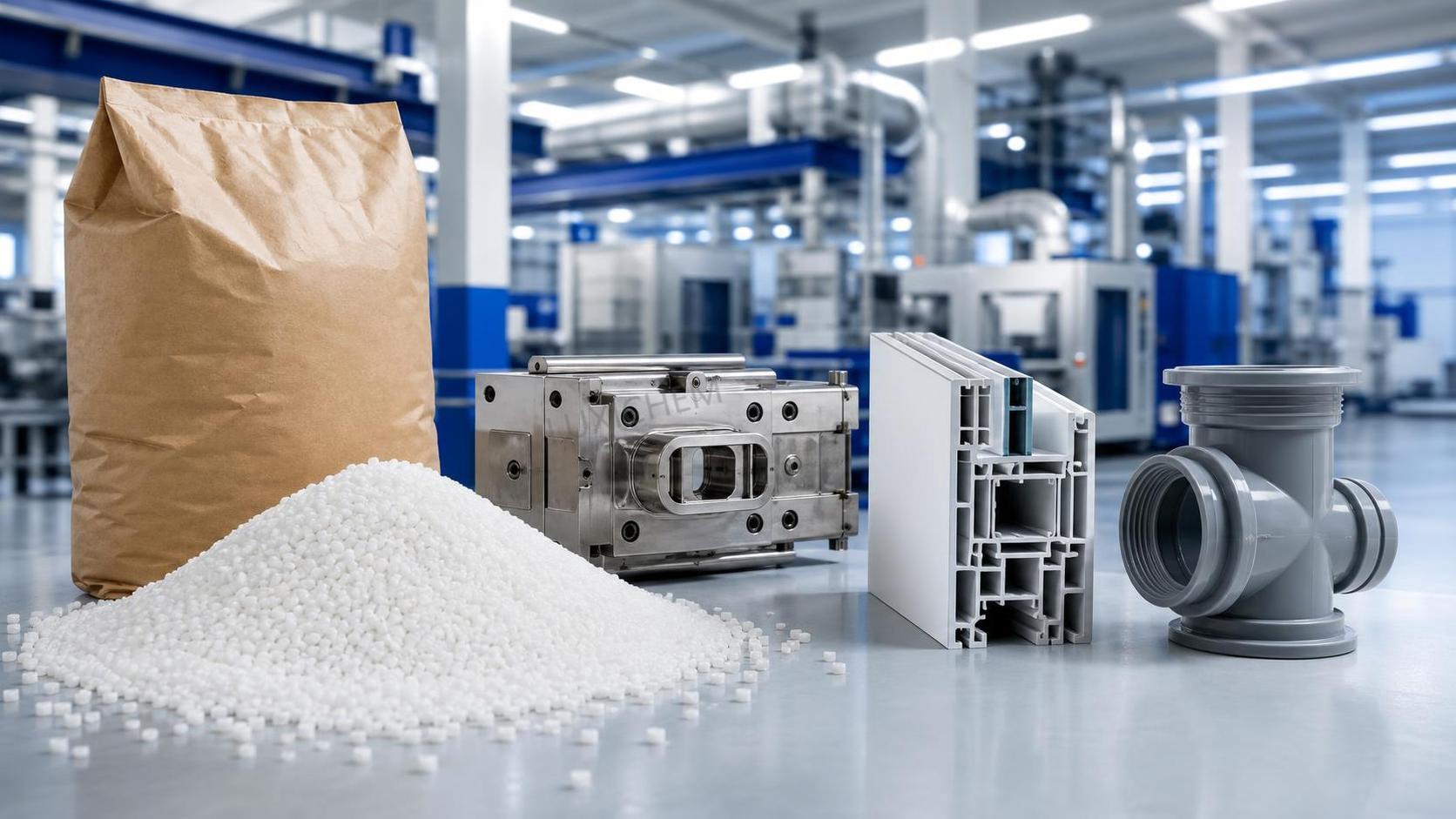
For processors working with rigid PVC profiles or injection-molded parts, resin selection is rarely a theoretical exercise. It directly affects output stability, die pressure, fusion behavior, gloss, impact performance, and scrap rate. That is why choosing the right pvc suspension resin is less about finding a “best grade” and more about matching resin behavior to the realities of your equipment, formulation, and product requirements.
In practice, buyers and operators often start with a familiar grade and only reconsider when problems appear: uneven plasticization, fish eyes, poor demolding, inconsistent whiteness, or a cycle time that will not come down. By that point, the issue is no longer just material cost. It becomes a production efficiency problem. A slightly cheaper resin can end up costing more if it narrows the processing window or increases rejection rates.
For rigid profiles and injection molding, the selection logic overlaps in some areas, but the priorities are not the same. Profiles usually demand a stable fusion window, consistent bulk density, good dry blend flow, and predictable melt strength through the die. Injection molding puts more emphasis on flow behavior, thermal stability under short but intense processing conditions, mold filling, part surface quality, and dimensional consistency after cooling. Treating both applications as if they can run equally well on the same resin grade is one of the more common mistakes in procurement and production planning.
What users are really trying to decide
When someone searches for a guide on pvc suspension resin for these applications, the real question is usually not “what is suspension resin?” It is closer to this: which grade will run reliably on my line, produce parts that pass inspection, and avoid avoidable process trouble?
That decision usually sits on four practical questions:
- How easily will the resin process on current equipment?
- Will it support the required mechanical and surface properties?
- How much formulation adjustment will be needed?
- Can supply quality remain consistent across batches and over time?
These are operator-level and purchasing-level questions, and they matter more than generic grade descriptions. Two suppliers may both offer a resin within a similar nominal classification, yet actual performance can differ because of particle size distribution, porosity, residual volatiles, impurity control, and batch consistency.
Start with the application, not the catalog
Rigid profiles and injection-molded PVC parts may both use suspension resin, but they do not “consume” resin properties in the same way.
For rigid profiles
Window profiles, pipes with profile-like sections, trim boards, and other extruded rigid shapes usually need a resin that gives stable plastification and enough melt strength to hold shape after exiting the die. If the resin fuses too slowly, the profile may show poor surface finish, low strength, or internal defects. If it fuses too quickly, processing torque can rise, thermal stability margin can shrink, and the line may become harder to control in warm weather or at higher throughput.
For this segment, processors usually pay close attention to K-value or degree of polymerization, apparent density, porosity, and dry blend compatibility. A medium to higher K-value is often preferred for rigid extrusion because it can support strength and stiffness, but the ideal range depends on line design, screw configuration, lubricant system, and whether high filler loading is used.
For injection molding
PVC injection molding for fittings, electrical parts, industrial components, or specialty rigid items usually needs easier mold filling and cleaner melt flow under controlled thermal exposure. Here, the resin must process quickly enough to avoid poor replication or weld line issues, but without becoming so heat-sensitive that degradation starts during residence time. A grade that works well in extrusion may feel too “stiff” in injection if the machine or mold is not optimized for it.
In other words, the same resin characteristic that helps shape retention in profile extrusion can sometimes work against fast, uniform mold filling.
The resin properties that deserve the closest attention
Many procurement conversations still focus too narrowly on one parameter, usually K-value. That is useful, but incomplete. For real production decisions, a broader set of indicators matters.
Among these, K-value is still the most visible reference point, but it should be treated as an entry filter, not the final answer. Two resins with similar K-values can behave very differently in extrusion torque, fusion time, and final part appearance.
How rigid profile processors should evaluate a grade
For profile lines, the right resin usually shows its value in how forgiving it is. Operators generally want a grade that allows stable output through normal variation in ambient temperature, blending condition, and line speed. A resin that only performs well under narrow settings may look acceptable in a supplier trial but create trouble in everyday production.
Several signs suggest a grade is well matched for rigid profile use:
- Dry blend feeds smoothly without obvious bridging or segregation
- Fusion develops consistently without sudden torque spikes
- Profile surface remains even at practical throughput rates
- Vacuum calibration and downstream cooling stay stable
- Finished sections maintain dimensional accuracy and impact performance
What deserves caution is the assumption that “higher molecular weight always means better strength.” In actual profile production, if the resin makes fusion too difficult, the line may compensate with more aggressive processing or formulation changes, and that can erase the expected performance gain. Mechanical properties are not delivered by resin specification alone; they emerge from the interaction between resin, stabilizer package, lubricants, fillers, processing conditions, and cooling control.
That is also why line trials should be judged on more than one shift of smooth operation. A good trial checks output consistency, cut-edge appearance, screw cleaning frequency, color stability, and whether the process remains stable after raw material batches change.
How injection molders should think about selection
For injection molding, a practical evaluation starts with the mold and machine, not just the resin data sheet. Gate design, runner balance, barrel condition, screw geometry, and residence time all influence what kind of resin behavior is workable. A grade that appears easy-flowing on paper may still cause yellowing or sticking if the machine has dead spots or if the cycle is too long.
For molders, the preferred pvc suspension resin often supports:
- Predictable plastification and short, stable cycle times
- Clean cavity filling without excessive injection pressure
- Acceptable part release and surface finish
- Low tendency toward burn marks or degradation streaks
- Dimensional repeatability after cooling and conditioning
If the application involves fittings or parts under pressure, impact, or electrical load, resin selection should also be checked against the required finished-part standard. Some properties depend heavily on formulation and part design, so “general-purpose” grades can become risky if the end-use requirement is more demanding than the supplier conversation suggests.
Where buyers and operators often get misled
One common misconception is that a resin with broader market use is automatically the safest option. In reality, widely traded grades are often chosen because they are versatile, not because they are optimized for every line. Versatility is helpful, but not identical to fit.
Another weak assumption is that changing stabilizers or lubricants can always compensate for a poor resin match. Formulation adjustment can help, sometimes significantly, but it has limits. If the resin’s core behavior does not align with the process, operators often end up chasing symptoms instead of solving the root issue.
There is also a procurement habit worth questioning: evaluating resin mainly by delivered price per ton. For profile and injection applications, the more useful metric is usually total production cost. That includes output rate, scrap, energy use, cleaning frequency, downtime, and customer complaints linked to part variability. A resin that costs slightly more but runs steadily may be the lower-cost option over a month or quarter.
Supplier evaluation matters as much as grade selection
In B2B chemical purchasing, the grade name alone is not enough. Operators should ask how stable the supplier’s manufacturing process is, whether batch-to-batch variability is tightly controlled, and how technical support is handled when line behavior changes. This is especially important for users managing multiple plants or supplying customers with strict consistency requirements.
Useful supplier-side questions include:
- How consistent are key resin parameters across recent production batches?
- What testing methods are used for quality release?
- Can representative samples be supplied from standard production, not trial material only?
- What is the response process if resin behavior shifts after commercial delivery?
- Are compliance documents or application-specific declarations available where needed?
For export-oriented manufacturers, documentation and logistics reliability can matter almost as much as resin performance. Delayed shipment, packaging inconsistency, or incomplete compliance paperwork can disrupt production just as seriously as a processing problem.
In broader chemical sourcing, companies that handle diverse raw materials often help buyers simplify vendor management across categories. In that context, some procurement teams also review unrelated specialty inputs alongside core polymers. For example, when assessing supplier coordination capacity, a buyer may look at how consistently the same partner handles niche products such as Indole-3-Butyric Acid CAS#133-32-4 together with larger-volume industrial materials. The point is not product overlap, but whether the supplier can maintain documentation discipline, delivery control, and communication quality across different product lines.
A practical trial method before switching grades
Before approving a new resin for full production, processors should avoid relying on a single lab test or one short machine run. A more useful trial structure includes both process and finished-part observations.
A sensible evaluation sequence is usually:
- Check certificate consistency and basic physical indicators across sample lots
- Run the resin in the existing formulation first, before optimizing additives
- Record torque, fusion behavior, melt temperature, output, and appearance
- Measure key final properties relevant to the application
- Compare cleaning frequency, scrap rate, and operator intervention needs
- Repeat under at least slightly different throughput or ambient conditions
This matters because some grades look acceptable during carefully supervised sampling but become unstable once production returns to normal pace and oversight. The objective is to see whether the resin can tolerate ordinary plant variation.
What to watch in current decision-making
For many buyers, the market question is no longer just “which resin grade works?” It is also “which grade can remain available, compliant, and stable enough to support customer commitments?” That makes dual attention necessary: one eye on process performance, the other on supply continuity.
Depending on region and end use, users may also need to verify restrictions or declarations related to residual monomer, heavy metals in stabilizer systems, food-contact suitability, or construction-related compliance requirements【待核实】. These are not universal in the same form for every market, but they can affect whether a technically workable resin is commercially acceptable.
For operators and purchasing teams, the best decision framework is usually straightforward: define the real process window, identify the finished-part properties that cannot be compromised, and then choose the pvc suspension resin that performs reliably within those boundaries. That approach is slower than buying on habit or price alone, but it is usually the one that holds up once production pressure starts.
Related Picks
 Butylated Hydroxytoluene Price Drivers: Supply, Purity, and Purchasing Risk FactorsOct 21, 2026Butylated Hydroxytoluene price trends depend on supply stability, purity, logistics, and purchasing risk. Learn how to compare quotes wisely and reduce sourcing costs.
 Sodium Tripolyphosphate Price Trends: Raw Material and Energy ExposureOct 20, 2026Explore sodium tripolyphosphate price trends, from phosphate and soda ash costs to energy exposure. Learn how to compare quotes, manage sourcing risks, and make smarter purchasing decisions.
 Acetonitrile Shipment to Vietnam Successfully Dispatched; RCEP Benefits Boost Fine Chemical Trade with ASEANSep 16, 2026A shipment of industrial-grade acetonitrile from our company has recently been loaded and dispatched following the completion of standardized hazardous material packaging and container securing procedures.
 Nigerian Client’s Order of 4 Containers of Vinyl Acetate Successfully Loaded and Shipped to West AfricaSep 16, 2026We recently completed the loading of a vinyl acetate order for a Nigerian client; four containers of the product have been successfully packed and are ready for shipment to Nigeria.




Question Consultation
Send Us Your Inquiry Today

Luxi Chemical is a professional chemical product supplier with ample stock of all chemical categories and excellent quality, welcome your purchase inquiry.

