


Selecting Water Treatment Chemicals from a Raw Water Analysis
Selecting water treatment chemicals starts with matching the raw water analysis to the required treated-water quality and the treatment equipment—not comparing chemical prices. The same source water can require different chemistry for drinking-water production, reverse osmosis feed, cooling-tower makeup, or boiler makeup. A laboratory report identifies constraints; it does not, by itself, establish the correct product or dose.
The central decision is whether a contaminant should be removed, chemically converted, or kept under controlled conditions. Coagulation can help remove suspended particles but will not solve excessive dissolved salinity. Antiscalants can suppress certain deposits within a validated operating range but do not remove hardness. Reliable selection therefore begins with a defined treatment objective, representative water data, and confirmation that the proposed chemistry works within the complete process.
Define the water-quality target before interpreting the report
A chemical recommendation is incomplete without a clear endpoint. That endpoint may be a regulatory limit, an equipment supplier’s feedwater requirement, a process-quality specification, or a discharge condition. These requirements are not interchangeable: water acceptable for cooling makeup may still cause unacceptable scaling or contamination in another application.
Record the design flow, normal and peak demand, operating temperature, treatment sequence, and expected recovery or concentration factor. Include the materials exposed to the chemicals and any restrictions on residual aluminum, iron, oxidants, phosphorus, sodium, or other added constituents. A treatment chemical can solve one problem while introducing another downstream.
Distinguish source-water quality from the quality at each dosing point. An antiscalant injected before reverse osmosis must be evaluated against the membrane feed after upstream treatment, not simply against the original source analysis. Likewise, disinfectant demand can change substantially after clarification and filtration.
Check whether the analysis represents the design conditions
A single sample is a snapshot. Surface-water turbidity and organic loading can change after rainfall; groundwater chemistry can differ between wells; blended supplies can shift when source proportions change. Selection should account for an identified operating range rather than an annual average alone.
Request sampling dates, locations, analytical methods where relevant, and historical variation. Field measurements matter for parameters such as pH, temperature, and disinfectant residual, which can change during transport or storage. For metals, clarify whether results represent dissolved or total concentrations: dissolved iron and particulate iron do not necessarily require the same treatment sequence.
Check units before comparing results. Hardness and alkalinity are often reported as calcium carbonate equivalents, while individual ions may be reported as their own mass concentrations. Missing units, incomplete ion data, or an unexplained charge imbalance can undermine scale calculations and chemical recommendations.
Use coagulation tests to resolve particle-removal decisions
Aluminum-based coagulants, ferric salts, and selected polymers can be candidates when the objective is to destabilize colloids and support solids removal. Selection depends on particle characteristics, organic matter, pH, alkalinity, temperature, and the capabilities of the downstream separation equipment.
Conventional metal-salt coagulants consume alkalinity and can depress pH. In poorly buffered water, increasing the dose may push conditions outside the useful coagulation range. Prehydrolyzed products can differ in alkalinity demand, but their performance still requires testing. A product described only as “polyaluminum chloride,” for example, is not sufficiently specified for a meaningful comparison; aluminum content, basicity, impurities, and delivered concentration matter.
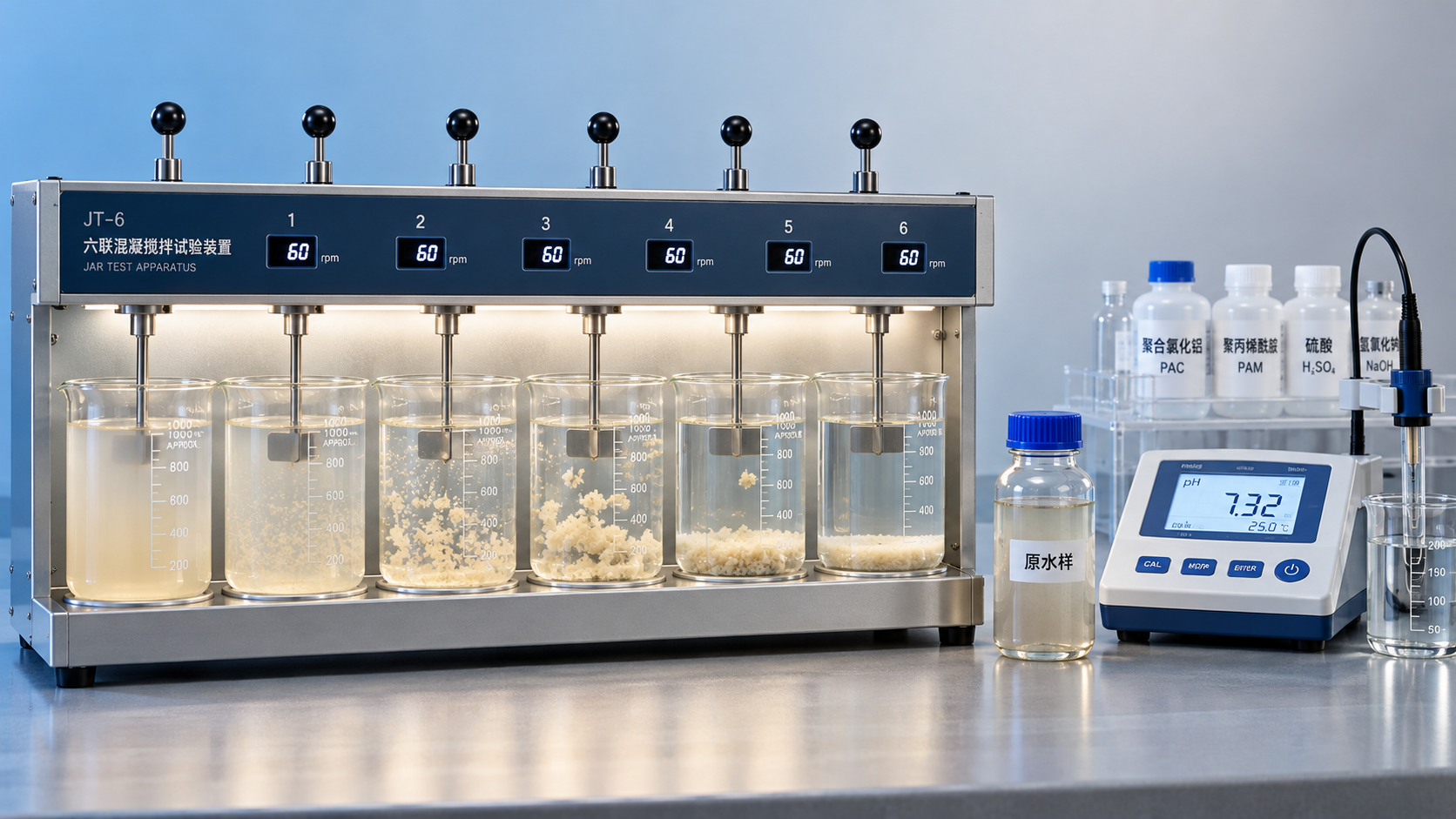
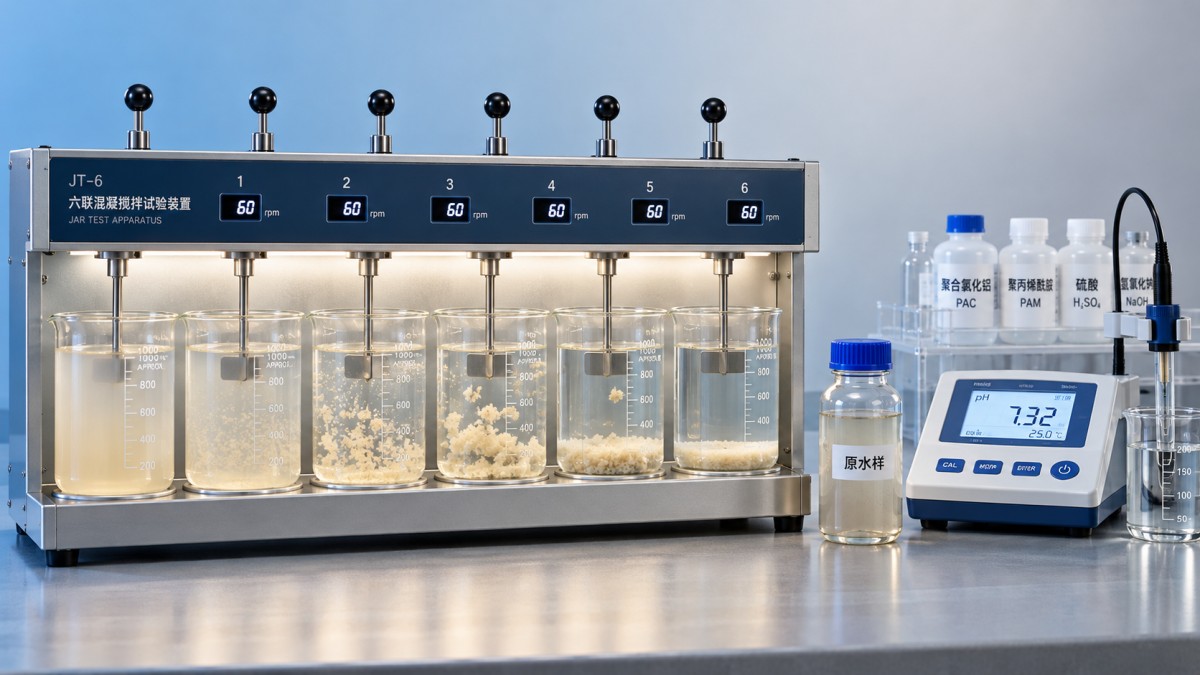
Jar testing should compare realistic dose ranges and pH conditions using representative water. Assess settled turbidity, floc formation, settling behavior, residual metal, and, where relevant, organic-carbon removal and filterability. The clearest beaker is not necessarily the best operating choice if the resulting floc breaks under transfer conditions or creates excessive filter loading.
Polymer selection also requires attention to charge type, molecular characteristics, dilution, and preparation. Overdosing can impair separation, and a polymer suitable for clarification may be unsuitable upstream of a membrane. Compatibility must be checked across the process rather than inferred from one successful settling test.
Separate pH adjustment, softening, and scale inhibition
Acid, alkali, softening reagents, and antiscalants address different mechanisms. Treating them as interchangeable options can leave the underlying constraint unresolved.
pH adjustment changes chemical conditions. Acid addition can reduce carbonate scaling tendency, but the choice of acid also changes the ionic composition. Sulfuric acid adds sulfate, which matters where calcium, barium, or strontium sulfate precipitation is a concern. Hydrochloric acid adds chloride, which must be considered against corrosion and process limitations. Acid demand should be established from alkalinity and an appropriate titration or process model, not from starting pH alone.
Softening removes hardness. Lime-based precipitation or ion exchange may be appropriate when actual hardness removal is required. Their implications extend beyond reagent price: precipitation creates sludge and requires solids separation, while ion exchange requires regeneration and produces a waste stream. The selection depends on flow, water chemistry, residual-quality requirements, and waste-handling capacity.
Antiscalants inhibit specified precipitation mechanisms within defined limits. Their suitability depends on a complete ionic analysis and the proposed operating conditions. For reverse osmosis, the evaluation must include recovery, temperature, pH, membrane arrangement, and concentrate chemistry. A dose recommendation without a stated recovery and limiting scale species is not a defensible design basis.
Antiscalant cannot compensate indefinitely for excessive concentration or inadequate pretreatment. If projections indicate unacceptable risk, reducing recovery or removing the limiting constituent may be more reliable than increasing chemical dose. Interactions with residual coagulants and polymers also need review because incompatible carryover can contribute to membrane fouling.
Select oxidation and disinfection around demand and downstream limits
Oxidation for iron or manganese removal and disinfection for microbial control can use some of the same chemicals, but their design objectives differ. Oxidation must convert the target constituent into a form the process can remove. Disinfection must deliver the required microbial control under the applicable water-quality and operating conditions.
For iron and manganese, confirm pH, oxidant demand, reaction time, and the filtration step needed to retain the precipitated solids. Adding oxidant without adequate downstream separation can simply move the contamination problem to filters, membranes, or distribution equipment.
For disinfection, applied dose is not the same as effective residual. Organic matter, ammonia, reduced metals, and other constituents consume oxidant. Chlorine effectiveness also depends on pH, temperature, contact conditions, and the target organisms. A measured residual at one point does not establish adequate treatment throughout a poorly mixed tank.
Evaluate relevant by-product risks and equipment restrictions before selecting the oxidant. Organic matter is important for chlorination assessments, while bromide is a relevant input when evaluating ozone. Many polyamide reverse osmosis membranes have strict oxidant exposure limits; membrane-specific requirements should govern any upstream chlorination and dechlorination arrangement. Excess reducing chemical can also create undesirable downstream conditions, so both dosing and verification require control.
Keep chemical compatibility tied to the actual application
The chemical register should distinguish treatment reagents from utilities and heat-transfer fluids. For example, Propylene glycol CAS#57-55-6 may be relevant to a separate closed-loop freeze-protection system, but it is not a substitute for a coagulant, antiscalant, or disinfectant. Water miscibility and a high purity specification do not establish suitability for direct dosing into a treatment stream. Such fluids require a separate assessment of formulation, inhibitors, material compatibility, and potential cross-contamination.
Within the treatment system, review both storage compatibility and diluted-stream interactions. Acids and hypochlorite must be segregated to prevent chlorine release. Oxidizers and reducing agents require appropriate separation, while coagulants and antiscalants should not be assumed compatible merely because their injection points are apart.
Specify dosing location, injection hardware, mixing provision, dilution-water quality, and wetted materials alongside the chemical. A product that performs in a laboratory can fail to deliver the expected result if the installed pump cannot control its required dose or the process provides insufficient mixing and reaction time.
Compare delivered treatment cost, not container price
Supplier offers should be normalized to the same performance basis. Different liquid concentrations can make price per tonne misleading, while products with similar active content may still require different effective doses.
For a liquid product dosed on an as-supplied mass basis:
Daily consumption (kg/day) = flow (m³/day) × dose (mg/L) ÷ 1,000.
At an illustrative flow of 1,000 m³/day and an as-supplied dose of 20 mg/L, consumption is 20 kg/day. If the stated dose instead refers to active ingredient, the supplied-product requirement must be adjusted for active concentration. Pump sizing additionally requires product density and the minimum and maximum dosing conditions.
Compare chemical cost with associated alkali or acid demand, sludge production, dewatering, filter backwashing, membrane cleaning, waste disposal, and storage requirements. A lower-priced coagulant may lose its advantage if it materially increases neutralization demand or sludge-handling costs.
Procurement specifications should define the relevant active content, acceptable impurities, batch documentation, shelf life, and storage conditions. For regulated uses, confirm the approvals or certifications required by the destination jurisdiction and application; an industrial-grade specification or safety data sheet alone does not establish drinking-water suitability.
Make procurement conditional on an operating envelope
The final selection should state where the chemical is expected to work: raw-water range, flow, temperature, pH, dose range, treatment objective, and downstream constraints. Where uncertainty remains, use jar tests, bench testing, or a suitably designed pilot before committing to long-term supply.
Acceptance criteria should cover treated-water performance and operational consequences, including residuals, sludge behavior, filter loading, and membrane compatibility where applicable. Agree how dosing will change when source-water conditions move outside the tested range, and which measurements trigger investigation rather than automatic dose escalation.
Supply reliability belongs in this decision as well. Review batch consistency, replenishment lead time, local stock, packaging compatibility, and the consequences of substitution. An alternative product with the same generic chemical name may differ enough in concentration or formulation to require recalibration and repeat testing. A defensible selection is therefore a documented combination of chemistry, equipment, controls, and supply conditions—not simply an approved product name.
Related Picks
 Butylated Hydroxytoluene Price Drivers: Supply, Purity, and Purchasing Risk FactorsOct 21, 2026Butylated Hydroxytoluene price trends depend on supply stability, purity, logistics, and purchasing risk. Learn how to compare quotes wisely and reduce sourcing costs.
 Sodium Tripolyphosphate Price Trends: Raw Material and Energy ExposureOct 20, 2026Explore sodium tripolyphosphate price trends, from phosphate and soda ash costs to energy exposure. Learn how to compare quotes, manage sourcing risks, and make smarter purchasing decisions.
 Acetonitrile Shipment to Vietnam Successfully Dispatched; RCEP Benefits Boost Fine Chemical Trade with ASEANSep 16, 2026A shipment of industrial-grade acetonitrile from our company has recently been loaded and dispatched following the completion of standardized hazardous material packaging and container securing procedures.
 Nigerian Client’s Order of 4 Containers of Vinyl Acetate Successfully Loaded and Shipped to West AfricaSep 16, 2026We recently completed the loading of a vinyl acetate order for a Nigerian client; four containers of the product have been successfully packed and are ready for shipment to Nigeria.




Question Consultation
Send Us Your Inquiry Today

Luxi Chemical is a professional chemical product supplier with ample stock of all chemical categories and excellent quality, welcome your purchase inquiry.

