


What Is Dextrin Used for in Paper Adhesives and Textile Finishing?
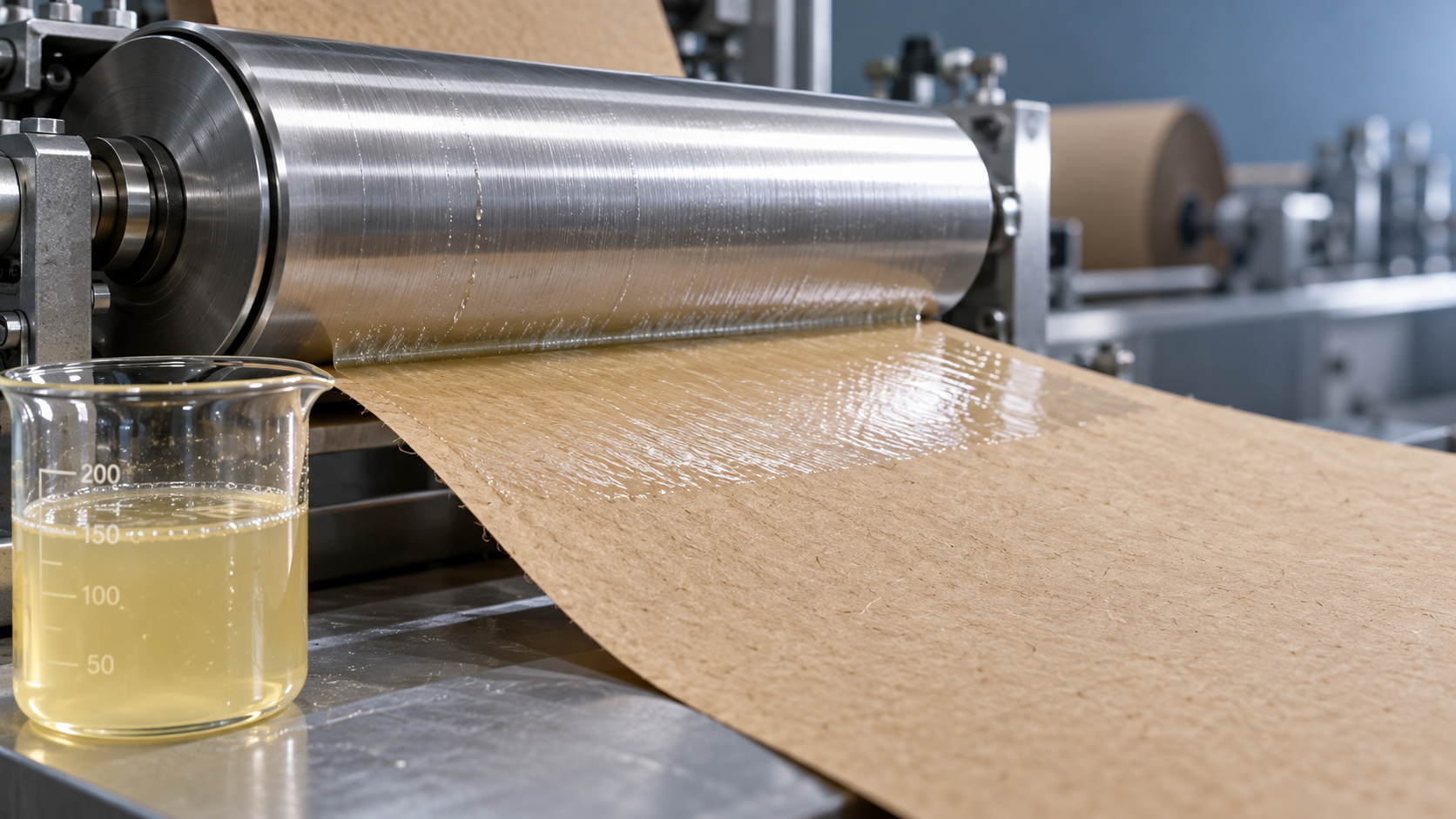
Dextrin is used in paper adhesives to bond porous surfaces and in textile finishing to give fabrics temporary body, stiffness, and a more controlled surface feel. Both uses depend on the same basic behavior: dextrin disperses or dissolves in water, depending on its grade and preparation conditions, then forms a binding film as the water leaves.
The important distinction is what that film must accomplish. In a paper adhesive, it must hold surfaces together through converting and subsequent handling. On a textile, it must produce the required handle and appearance without excessive harshness, dusting, or interference with later processing. Dextrin is therefore not one interchangeable raw material; its suitability depends on grade, formulation, substrate, and drying conditions.
Why a starch-derived material works in both applications
Dextrin is a family of starch-conversion products, commonly produced by heating starch under controlled conditions, often with an acid catalyst. This treatment changes the starch’s molecular structure and reduces chain length to varying degrees. The resulting materials differ in water solubility, solution viscosity, color, and film properties.
Compared with unmodified starch, suitable dextrin grades can provide more manageable viscosity at useful solids concentrations. This matters because an adhesive or finishing bath must carry enough material to perform its function while still flowing through pumps, coating equipment, or application rollers.
Its affinity for paper and many textile fibers comes partly from the hydroxyl groups in its carbohydrate structure. These support interactions with cellulosic surfaces such as paper and cotton. As water evaporates or enters an absorbent substrate, dextrin becomes concentrated and forms a film that binds surfaces or holds fibers in a more fixed arrangement.
That film remains moisture-sensitive unless the formulation is specifically modified. Water sensitivity is a limitation for humid-service packaging but can be useful when a textile treatment must wash out. The same property can therefore be either an advantage or a drawback, depending on the intended use.
What dextrin does in paper adhesives
In paper converting, dextrin functions primarily as the adhesive binder. It is used in suitable formulations for paper bags, envelopes, paper labels, laminated paper constructions, and wound paper products such as tubes and cores. The exact application depends on the strength, application method, appearance, and moisture resistance required.
Bonding paper layers and seams
Paper is porous, so a water-based adhesive does more than sit between two surfaces. Some liquid enters the sheet while the adhesive remains at and near the interface. A successful formulation balances wetting, penetration, and film formation: enough penetration helps establish contact with the fiber structure, but excessive penetration can leave too little binder at the bond line.
In a bag seam, for example, the adhesive must spread consistently and develop enough early strength to stop the seam opening during handling. In a wound paper tube, the adhesive must support layer-to-layer bonding while allowing the winding operation to proceed without excessive slip or distortion. These jobs do not necessarily call for the same viscosity or solids content.
Controlling application and setting behavior
Dextrin adhesives can be formulated for roller, wheel, or other compatible application systems. Viscosity influences coat weight, transfer, stringing, and penetration. An adhesive that is too thin may soak into absorbent paper; one that is too thick may transfer unevenly or fail to wet the surface adequately.
Setting occurs as water leaves the bond line through absorption and evaporation. Higher solids can reduce the amount of water that must be removed for a given dry adhesive deposit, but only if the adhesive remains workable. Simply increasing solids is not a universal way to increase production speed: poor spreading or insufficient wetting can undermine the bond before drying becomes the limiting factor.
Formulation ingredients may adjust tack, flexibility, viscosity, or storage behavior. In some systems, borate chemistry is used to modify rheology and tack. Such additions require formulation-specific control because dosage and pH can change flow behavior substantially.
Where paper performance reaches its limits
A dry dextrin bond can perform well in an appropriate paper construction without being water-resistant. High humidity can soften the adhesive film, and direct water exposure can weaken it. Packaging intended for condensation, wet handling, or sustained humid storage needs evaluation under those conditions rather than reliance on dry bond strength alone.
Coated, heavily sized, or film-laminated papers also need separate attention. A formulation that bonds readily to absorbent kraft paper may wet a coated surface poorly. Dextrin should not be treated as a general-purpose adhesive for nonporous substrates.
It is also important not to equate every starch-based paper adhesive with dextrin. Corrugating adhesives, for example, commonly use starch systems whose preparation and gelatinization behavior differ from those of a prepared dextrin adhesive. Substitution is not a simple name-for-name exchange.
What dextrin does in textile finishing
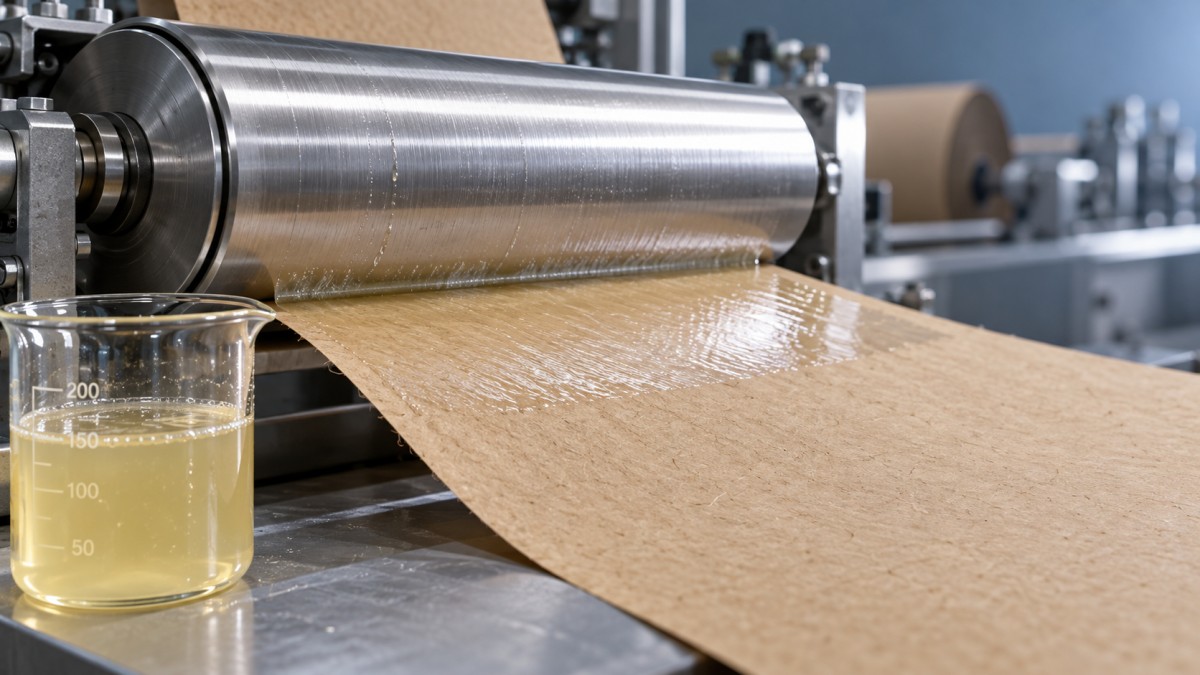
In textile finishing, dextrin is used mainly to modify physical handle and appearance. Its deposited film can increase body, add stiffness, help restrain loose surface fibers, and produce a smoother-looking surface. These effects are especially relevant when a temporary finish is acceptable or desirable.
The result is not the same as permanently changing the fiber. Dextrin acts as an added material on and between fibers, so the finish depends on how much is deposited, where it is distributed, and how it dries.
Adding body without confusing it with durable performance
A lightweight fabric may require more substance or a crisper feel for presentation or a particular end use. A dextrin finish can help the fabric hold its shape by restricting some movement between fibers and yarns. Increasing the dry add-on generally strengthens this effect, but excessive deposition can make the fabric boardy or unpleasant to handle.
The desired endpoint is therefore not maximum stiffness. It is a specified balance between body, flexibility, drape, and appearance. A finish that looks satisfactory on an undisturbed sample may crack or shed material after folding and rubbing if the deposited film is too brittle.
Dextrin alone should not be credited with durable-press behavior, permanent crease resistance, or wash-fast stiffening. Those outcomes require different chemistry or a more complex finishing system. Ordinary dextrin finishing is better understood as a controllable, moisture-sensitive surface treatment.
Improving surface appearance
By binding some protruding fibers and forming a film, dextrin can contribute to surface smoothness and a more uniform appearance. Mechanical finishing, such as calendering, may further influence the result. Any improvement depends on the original fabric structure and the full finishing process, not just the presence of dextrin in the bath.
Application uniformity matters because uneven pickup becomes uneven stiffness or visible variation after drying. Bath viscosity, fabric absorbency, wet pickup, and drying conditions all affect where the finish ends up. Rapid or uneven drying can also encourage migration toward the surface, changing handle and distribution.
Finishing is not the same as warp sizing
Dextrin may also be used in textile sizing formulations, where the objective is to help yarn withstand weaving stresses. That is a different function from finishing a completed fabric. A sizing formulation is judged by yarn protection, abrasion behavior, flexibility, and subsequent removal; a fabric finish is judged mainly by the required handle, appearance, and end-use behavior.
The distinction matters when interpreting a supplier’s claim that a grade is suitable “for textiles.” Evidence of suitability for a sizing blend does not establish that the same grade will deliver the desired finish on a woven or knitted fabric.
Why grade selection changes the result
Commercial descriptions such as white dextrin and yellow dextrin indicate broad product families, not complete performance specifications. Conversion conditions and starch source affect behavior within those families. Color alone cannot establish solubility, adhesive strength, or suitability for a pale fabric.
White dextrins are generally less extensively converted than many yellow dextrins and may require more demanding preparation conditions. Many yellow dextrins offer greater cold-water solubility and lower viscosity at comparable solids. These are useful tendencies, but the supplier’s measured specifications and preparation instructions remain more informative than the grade name.
A viscosity value is meaningful only with its measurement conditions. Two products cannot be compared reliably if one value was measured at a different solids concentration, temperature, or test method. Likewise, solubility does not by itself establish bonding performance: a highly soluble grade may still lack the film characteristics needed for a particular application.
What to check before treating two grades as equivalents
The most useful comparison starts with the prepared formulation, not the powder alone. Preparation temperature, mixing sequence, water quality, solids content, and holding time can all affect the material delivered to the application point. A laboratory solution prepared under ideal conditions may not represent a production batch held for an extended period.
For paper adhesives, comparisons should include application consistency, early bond development, dry bond strength, and performance after relevant humidity exposure. Fiber tear can be useful evidence of a strong paper bond, but it is influenced by the paper’s own strength and is not a universal numerical measure of adhesive quality.
For textile finishes, comparisons should include dry add-on, handle, shade change, flexing behavior, and removal under the intended washing or downstream processing conditions. Water solubility makes removal feasible, but actual wash-out depends on fabric construction, deposited quantity, formulation additives, temperature, and mechanical action.
Prepared aqueous dextrin mixtures also need appropriate hygiene and storage control because carbohydrate-containing liquids can support microbial growth. Any preservative system must suit the application and applicable requirements. Similarly, a food-grade designation does not automatically establish that a complete adhesive is suitable for a particular food-contact packaging use.
The practical value of dextrin is its ability to provide a water-applied, film-forming binder whose behavior can be adjusted. In paper, the decisive question is whether it creates a reliable bond under the intended converting and service conditions. In textiles, it is whether the deposited film delivers the required temporary finish without unacceptable harshness, appearance changes, or removal difficulties. Those application-specific results—not the dextrin name alone—determine whether a grade is suitable.
Related Picks
 Butylated Hydroxytoluene Price Drivers: Supply, Purity, and Purchasing Risk FactorsOct 21, 2026Butylated Hydroxytoluene price trends depend on supply stability, purity, logistics, and purchasing risk. Learn how to compare quotes wisely and reduce sourcing costs.
 Sodium Tripolyphosphate Price Trends: Raw Material and Energy ExposureOct 20, 2026Explore sodium tripolyphosphate price trends, from phosphate and soda ash costs to energy exposure. Learn how to compare quotes, manage sourcing risks, and make smarter purchasing decisions.
 Acetonitrile Shipment to Vietnam Successfully Dispatched; RCEP Benefits Boost Fine Chemical Trade with ASEANSep 16, 2026A shipment of industrial-grade acetonitrile from our company has recently been loaded and dispatched following the completion of standardized hazardous material packaging and container securing procedures.
 Nigerian Client’s Order of 4 Containers of Vinyl Acetate Successfully Loaded and Shipped to West AfricaSep 16, 2026We recently completed the loading of a vinyl acetate order for a Nigerian client; four containers of the product have been successfully packed and are ready for shipment to Nigeria.




Question Consultation
Send Us Your Inquiry Today

Luxi Chemical is a professional chemical product supplier with ample stock of all chemical categories and excellent quality, welcome your purchase inquiry.

